
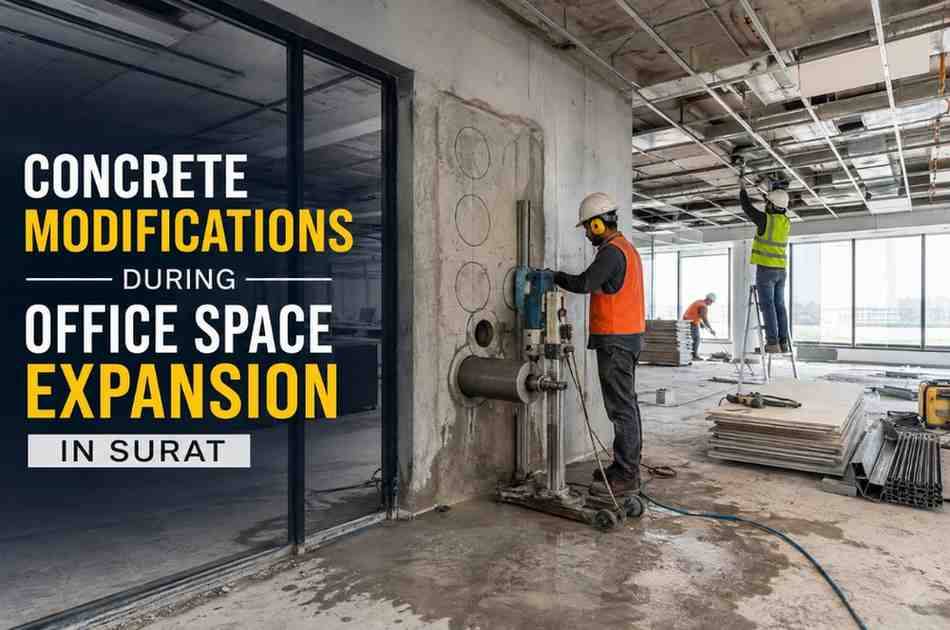
Surat's skyline is changing fast. Textile houses, diamond trading firms, IT parks, and corporate offices across the city are outgrowing their original footprints, and business owners are increasingly knocking down walls—literally—to make room for growth. Whether it's converting a warehouse into a modern workspace, merging two adjacent units, or adding a mezzanine floor to accommodate a growing team, office space expansion almost always comes down to one unavoidable task: modifying concrete.
Concrete modification isn't just about breaking down a wall with a hammer. It's a precise, technical process that determines whether your expansion project stays on schedule, on budget, and structurally sound. At Core Cutting India ([email protected]), we've worked with businesses across Surat—from Ring Road to Pal, Adajan to Vesu—helping them reshape commercial spaces without compromising the safety of the building. This guide walks you through everything you need to know about concrete modifications during an office expansion project in Surat.
Why Concrete Modification Matters in Office Expansion
When a business expands within an existing building, the biggest obstacle is almost always the concrete structure itself—load-bearing walls, RCC slabs, columns, and beams that were never designed with future flexibility in mind. Unlike drywall partitions, which can be removed with basic tools, reinforced concrete requires specialized equipment, technical calculations, and skilled operators.
Getting this wrong can lead to cracked structures, water seepage, misaligned floors, or in the worst cases, compromised structural integrity. Getting it right means a seamless transition from your old layout to your new, expanded workspace—with minimal disruption to ongoing business operations.
Common Scenarios That Require Concrete Modification
Office expansions in Surat typically fall into a few recurring categories, each with its own concrete-cutting requirements.
1. Merging Adjacent Office Units
Many commercial buildings in Surat, especially in business hubs like City Light, Ring Road, and Piplod, are built with individual units separated by shared concrete or brick walls. When a growing company wants to combine two or three units into one large office, the dividing walls need to be removed cleanly, often while the building above and around remains fully occupied.
2. Creating New Doorways or Access Points
Expansion frequently means redesigning traffic flow. A new connecting doorway between departments, a fire exit, or an additional entrance for client access often requires cutting precise openings into existing RCC or brick walls without disturbing surrounding structural elements.
3. Floor Slab Openings for Staircases, Lifts, and Ducts
When offices expand vertically—adding a mezzanine or connecting two floors—a slab opening becomes necessary for an internal staircase, elevator shaft, or additional service ducting for HVAC, electrical, and plumbing lines.
4. Core Drilling for New Utility Lines
As office headcount grows, so does the need for more power outlets, network cabling, plumbing, and ventilation. Core drilling creates clean, circular holes through concrete walls and slabs for pipes, conduits, and cable runs without cracking the surrounding structure.
5. Column and Beam Modifications
In rare but critical cases, expansion plans require modifying areas near structural columns or beams. This demands the most caution, careful load assessment, and often collaboration with a structural engineer before any cutting begins.
Techniques Used in Professional Concrete Modification
Diamond Core Drilling
Diamond core drilling is the go-to method for creating clean, circular holes in concrete for pipes, cables, HVAC ducts, and utility lines. The diamond-tipped bit cuts through reinforced concrete with minimal vibration, dust, and noise—an essential feature when working in an occupied office building in busy commercial areas of Surat.
Wall Sawing
Wall sawing uses a track-mounted circular saw with a diamond blade to make precise, straight cuts through concrete walls. This technique is ideal for creating new doorways, windows, or openings for merging spaces, and it produces smooth edges that require minimal finishing work.
Floor Sawing and Slab Cutting
For modifications to concrete floors and slabs—such as staircase openings or utility trenches—floor saws cut straight lines to a controlled depth. This method ensures the opening is exactly the size needed, reducing waste material and follow-up repair work.
Wire Sawing
For thicker structural elements or unusually shaped cuts, wire sawing uses a diamond-embedded wire loop that can cut through concrete, reinforced steel, and even irregular shapes. It's particularly useful for large-scale demolition where control and precision matter.
Controlled Demolition
Where larger sections of concrete need to be removed entirely, controlled demolition combines cutting and mechanical breaking techniques to bring down structures safely, section by section, rather than through uncontrolled hammering that can damage adjoining areas.
The Concrete Modification Process for Office Expansion
Step 1: Site Assessment and Structural Evaluation
Before any cutting begins, a thorough site visit identifies load-bearing elements, existing utility lines, and structural drawings (if available). This step is critical to avoid accidentally cutting into a column, main beam, or a live electrical or plumbing line hidden within the concrete.
Step 2: Utility Scanning
Professional teams use ground-penetrating radar (GPR) or rebar detectors to scan the concrete for embedded electrical conduits, plumbing, and reinforcement steel before marking the cutting area. This prevents costly and dangerous mistakes.
Step 3: Planning and Permissions
Depending on the building's ownership structure and municipal regulations in Surat, certain structural modifications may require approval from the housing society, building management, or local authorities—particularly for changes affecting shared walls or the building envelope.
Step 4: Cutting and Coring
With the plan finalized, the actual cutting work begins using the appropriate technique—wall sawing, core drilling, floor sawing, or wire sawing—based on the specific requirement. Dust suppression systems and vibration control measures are used throughout to minimize disruption.
Step 5: Debris Removal and Site Cleanup
Once cutting is complete, all concrete debris is cleared from the site. A well-managed cleanup process is especially important in office environments, where dust and clutter can affect ongoing business operations in adjacent areas.
Step 6: Structural Finishing
Cut edges are finished, and any necessary reinforcement or support structures are installed to ensure the modified area meets safety standards before interior work like flooring, electrical fitting, and painting begins.
Benefits of Hiring Professional Concrete Cutting Services
Precision: Diamond-tipped tools create exact cuts with minimal margin for error, which reduces material waste and finishing work.
Minimal Disruption: Low-vibration, low-dust techniques mean nearby offices can often continue operating during the modification process.
Structural Safety: Professionals assess load-bearing elements and avoid compromising the building's structural integrity, something that generic labor or unqualified contractors often overlook.
Faster Turnaround: Specialized equipment completes work far more quickly than manual breaking methods, helping keep your expansion project on schedule.
Compliance: Experienced concrete cutting companies are familiar with local building codes and safety standards relevant to commercial properties in Surat.
Why Choose Core Cutting India for Your Office Expansion Project
At Core Cutting India, we specialize in diamond core drilling, wall sawing, floor sawing, and controlled demolition services tailored for commercial and industrial spaces across Surat. Our team understands the unique challenges of working within occupied office buildings—tight timelines, noise restrictions, dust control requirements, and the need to protect surrounding structures.
We bring modern equipment, trained operators, and a safety-first approach to every project, whether it's a small core-drilled opening for new cabling or a complete wall removal to merge multiple office units into one expansive workspace. Our goal is simple: help your business grow into the space it needs, without unnecessary delays or structural risk.
If your business is planning an office expansion in Surat and you need reliable concrete cutting or coring services, reach out to Core Cutting India at [email protected]. Our team can assess your site, recommend the right approach, and execute the work with the precision your project deserves.
Frequently Asked Questions (People Also Ask)
1. How much does concrete cutting cost for office renovation in Surat? Costs vary based on the type of cutting (core drilling, wall sawing, or slab cutting), the thickness and reinforcement of the concrete, and the size of the area being modified. It's best to request a site visit and quote from a professional concrete cutting company for an accurate estimate.
2. Is concrete cutting safe for load-bearing walls? Modifying load-bearing walls requires a structural assessment beforehand. A professional team will evaluate the wall's role in the building's structure and, if necessary, involve a structural engineer to design temporary or permanent support before cutting.
3. How long does a typical concrete modification project take for an office expansion? Timelines depend on the scope of work. A single core-drilled opening might take a few hours, while merging multiple office units or creating a slab opening for a staircase can take several days, including planning, cutting, and finishing.
4. Does concrete cutting create a lot of noise and dust in an occupied building? Modern techniques like diamond core drilling and wall sawing use water-cooled blades and dust suppression systems, significantly reducing noise and airborne dust compared to traditional demolition methods, making them suitable for occupied commercial spaces.
5. Do I need permission from the building authority before modifying concrete walls in Surat? In most cases, especially for changes to shared walls, external structures, or load-bearing elements, approval from the building society, landlord, or local municipal authority may be required. It's advisable to check applicable regulations before starting any structural work.
6. What's the difference between core drilling and wall sawing? Core drilling creates circular holes, typically used for pipes, cables, and ducts. Wall sawing creates straight-line cuts, typically used for doorways, windows, or larger openings in walls.
7. Can concrete cutting be done without disturbing the surrounding office space? Yes. Professional concrete cutting companies use vibration-controlled equipment and dust containment methods, allowing work to be carried out with minimal disruption to adjacent areas, even during business hours in some cases.
Related Searches
- Concrete cutting services near me Surat
- Diamond core drilling contractors Surat
- Office renovation contractors Surat
- Commercial concrete demolition Gujarat
- RCC wall cutting cost Surat
- Structural modification for office expansion
- Concrete coring for electrical and plumbing lines
- Best concrete cutting company in Gujarat