
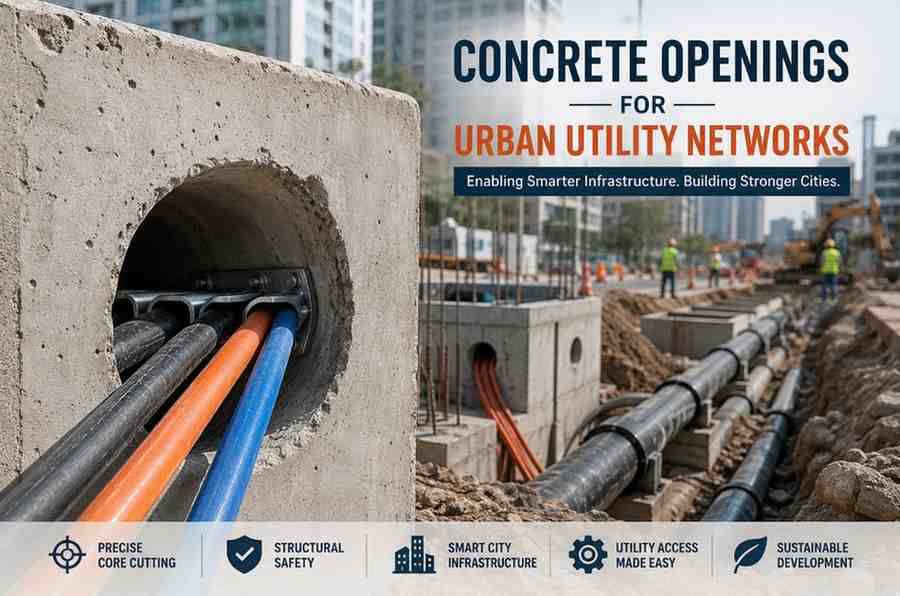
Cities run on networks that most people never see. Water lines, sewer mains, stormwater drains, electrical conduits, gas pipelines, and fiber-optic cables all thread beneath streets, sidewalks, basements, and building foundations. Every one of these systems, at some point, has to pass through concrete — a wall, a slab, a foundation footing, or a road surface. That passage point is called a concrete opening, and how it's created can make the difference between a smooth utility rollout and a costly, disruptive mess.
At Core Cutting India ([email protected]), we specialize in precision concrete openings for exactly this purpose: creating clean, accurate, structurally sound passages so utility networks can be installed, repaired, or expanded without unnecessary damage to existing infrastructure. In this article, we'll walk through what concrete openings are, why they matter so much in urban environments, the methods used to create them, and what to look for when choosing a contractor for this kind of work.
What Are Concrete Openings, Exactly?
A concrete opening is any deliberately created hole, gap, or cavity in a concrete structure that allows something to pass through — typically a pipe, cable, duct, or conduit. These openings can range from a small two-inch hole for a single electrical cable to a large multi-foot opening designed to accommodate a bundle of utility lines or an entire duct bank.
Concrete openings are needed in almost every type of urban structure:
- Building foundations and basement walls, where water, sewer, gas, and electrical lines enter from the street
- Road and pavement slabs, where utility trenches cross or utilities need to be accessed from below
- Bridge and flyover structures, where drainage or service lines must pass through structural elements
- Manholes and utility vaults, where multiple ducts converge
- Retaining walls and culverts, where stormwater or drainage pipes need a path through
Because concrete is dense, reinforced, and structurally load-bearing in most of these applications, creating an opening isn't as simple as drilling into drywall. It requires the right equipment, the right technique, and a clear understanding of the structure's design — otherwise you risk weakening the very structure the opening is being cut into.
Why Urban Utility Networks Depend on Precision Openings
In a rural or greenfield setting, utility installation is relatively straightforward: dig a trench, lay the pipe, backfill. Urban environments are a different story entirely. Cities are dense with existing infrastructure — old and new — and every utility opening has to be planned around structures, traffic, underground congestion, and public safety.
1. Minimizing Disruption to Traffic and Businesses
Urban roads and footpaths are almost always in active use. Breaking open large sections of concrete pavement to run a new cable or repair a pipe can mean days of road closures, detours, and lost business for shops along the route. Precision concrete opening techniques — particularly core drilling — allow utility contractors to create a small, exact access point instead of an entire excavation zone, dramatically cutting down disruption time.
2. Protecting Structural Integrity
Concrete structures, especially in multi-story buildings, bridges, and load-bearing walls, are engineered with specific tolerances. An improperly placed or oversized opening can compromise the structural capacity of a slab or wall, leading to cracking, water ingress, or in severe cases, structural failure. Precision openings, planned with knowledge of rebar placement and load paths, avoid this risk.
3. Coordinating Multiple Utility Providers
In most cities, water boards, electricity boards, telecom companies, and municipal drainage departments all operate independently, but their networks frequently intersect at the same physical points — a single duct bank, a shared utility corridor, or a common manhole. Precision concrete openings make it possible for multiple utilities to share access points efficiently, reducing the number of times a road or wall needs to be cut open.
4. Supporting Retrofit and Upgrade Projects
Older buildings and older parts of cities were not designed with today's utility demands in mind — fiber-optic internet, smart meters, EV charging infrastructure, and expanded electrical capacity are all being retrofitted into existing concrete structures. This retrofit work depends heavily on the ability to cut clean, accurate openings into existing concrete without demolishing entire sections of a building.
Common Methods Used to Create Concrete Openings
Not all concrete opening work is done the same way. The method chosen depends on the size of the opening, the thickness and reinforcement of the concrete, the location, and how sensitive the surrounding area is to noise, dust, and vibration.
Diamond Core Drilling
This is the most widely used method for creating round openings for pipes, cables, and conduits. A diamond-tipped core bit rotates at high speed, cutting a smooth, precise cylindrical hole through the concrete. Core drilling is prized for being low-vibration, low-dust (especially with wet drilling techniques), and highly accurate — making it ideal for occupied buildings, live roads, and sensitive structural elements.
Core drilling is typically used for:
- Utility pipe and cable penetrations through walls and slabs
- HVAC duct openings
- Plumbing and drainage line installations
- Small to medium-sized utility access points
Concrete Wall and Slab Sawing
For larger openings — such as those needed for duct banks carrying multiple utility lines, or for creating maintenance access points — wall sawing or slab sawing is used. This method uses a large circular diamond blade to cut straight lines, which can then be combined to remove a rectangular or square section of concrete.
Wire Sawing
For very thick or heavily reinforced concrete, such as bridge decks or large structural elements, wire sawing offers a flexible, high-precision cutting method. A diamond-embedded wire loop is used to cut through the concrete in sections too large or oddly shaped for conventional saws.
Hand-Held and Ring Sawing
For smaller, more accessible jobs — particularly in confined utility vaults or tight basement spaces — hand-held saws and ring saws allow for precise cuts in areas where larger equipment can't maneuver.
The Process: How a Professional Concrete Opening Is Executed
A well-executed concrete opening project generally follows these steps:
- Site Assessment and Utility Mapping: Before any cutting begins, the site is surveyed to identify existing utilities, rebar locations, and structural elements using tools like ground-penetrating radar (GPR) or rebar scanners. This step prevents accidental damage to live electrical lines, water pipes, or structural steel.
- Planning the Opening Size and Location: Based on the utility being installed — whether it's a single cable duct or a multi-line bundle — the exact size, shape, and location of the opening is calculated, factoring in code requirements and structural load considerations.
- Selecting the Cutting Method: Depending on concrete thickness, reinforcement density, and site constraints, the appropriate method (core drilling, sawing, or wire cutting) is selected.
- Execution with Dust and Vibration Control: Especially in occupied buildings or busy urban streets, wet-cutting techniques and vacuum dust extraction are used to control debris, protect air quality, and reduce noise.
- Edge Finishing and Sealing: Once the opening is made, edges are smoothed, and after the utility line is installed, the surrounding gap is sealed with appropriate fire-rated, water-resistant, or structural grout materials depending on the application.
- Inspection and Sign-Off: A final inspection confirms the opening meets structural and utility code requirements before the site is handed back over.
Choosing the Right Contractor for Concrete Openings
Given how much precision and structural knowledge this work demands, choosing an experienced concrete cutting contractor is critical. Here's what to look for:
- Experience with urban and occupied-site work: A contractor should be comfortable working around live traffic, occupied buildings, and tight urban spaces without causing unnecessary disruption.
- Modern equipment: Diamond core drilling rigs, wall saws, and wire saws with dust and water management systems reduce mess and improve accuracy.
- Structural awareness: The ability to read structural drawings, locate rebar, and avoid load-bearing elements is essential to prevent damage.
- Multi-utility coordination experience: Contractors who have worked across water, power, telecom, and drainage projects understand the coordination challenges unique to shared utility corridors.
- Safety compliance: Proper containment of dust, noise control, and adherence to local safety codes protect both workers and the public.
At Core Cutting India, our teams bring years of hands-on experience creating concrete openings for utility networks across residential, commercial, and municipal projects. From single conduit penetrations to large-scale duct bank access points, we combine precision equipment with careful planning to minimize disruption and protect structural integrity.
The Bigger Picture: Why This Work Matters for Cities
As cities grow denser and utility demands increase — more data cables for connectivity, more electrical capacity for EVs and smart infrastructure, upgraded water and drainage systems for climate resilience — the pressure on existing concrete infrastructure only increases. Every new utility line has to find its way through walls, slabs, and foundations that were often built decades ago.
Precision concrete opening work is, in many ways, invisible infrastructure work. It doesn't get the same attention as a new bridge or a shiny new building, but it's the quiet, careful process that lets all the systems a modern city depends on actually connect to each other. Done well, it's fast, clean, and barely noticeable. Done poorly, it can mean cracked foundations, water damage, or utility failures years down the line.
Conclusion
Concrete openings might seem like a small, technical detail in the much larger picture of urban utility networks, but they are foundational — quite literally — to how water, power, communication, and drainage systems reach the people who depend on them. Precision matters at every step, from initial site assessment to final sealing, and the right cutting method can mean the difference between a quick, minimally disruptive installation and a costly structural problem.
If your project involves installing, repairing, or upgrading utility lines through concrete structures, working with an experienced concrete cutting specialist is one of the smartest decisions you can make. Core Cutting India brings the equipment, expertise, and structural understanding needed to get these openings right — safely, precisely, and with minimal disruption to the surrounding environment.
For more information or to discuss a project, reach out to Core Cutting India at [email protected].
Frequently Asked Questions
What is concrete core drilling used for in utility work? Concrete core drilling is used to create clean, round openings in walls, slabs, and foundations so that pipes, electrical conduits, HVAC ducts, and telecom cables can pass through concrete structures. It's the go-to method for utility work because it's precise, low-vibration, and causes minimal disturbance to the surrounding structure compared to breaking or jackhammering.
How do you make an opening in concrete for pipes or cables? The process starts with scanning the area for rebar and existing utilities, then marking the exact size and location of the opening based on the pipe or cable diameter. A diamond core drill (for round openings) or a wall/slab saw (for larger rectangular openings) is then used to cut through the concrete. Wet cutting techniques are often used to control dust, and the edges are finished smooth before the utility line is installed and the gap is sealed.
What tools are used to cut openings in concrete slabs? Common tools include diamond core drills for round penetrations, wall saws and slab saws for larger rectangular cuts, wire saws for thick or heavily reinforced sections, and hand-held or ring saws for tight, hard-to-access spaces. The choice of tool depends on the slab thickness, reinforcement, and the size of the opening required.
Is core drilling better than breaking concrete for utility access? In most urban utility scenarios, yes. Core drilling produces a precise, clean opening exactly the size needed, whereas breaking concrete with hammers or breakers tends to create larger, irregular openings that weaken the surrounding structure, generate more debris and noise, and take longer to repair. Core drilling also reduces the risk of accidentally damaging nearby rebar or existing utility lines.
How much does concrete core cutting cost for utility installation? Costs vary depending on the diameter of the opening, the thickness and reinforcement of the concrete, site accessibility, and the number of openings required. Small single-cable penetrations are generally inexpensive, while large multi-utility duct bank openings or work on thick structural elements cost more due to the equipment and labor involved. It's best to get a site-specific quote from a contractor like Core Cutting India for an accurate estimate.
Can concrete openings be made without disrupting traffic or nearby structures? Yes. Precision methods like diamond core drilling and wall sawing are specifically chosen for urban utility projects because they allow contractors to create exact openings with minimal noise, dust, and vibration — often without the need for full road closures or extended shutdowns of nearby buildings. Proper planning and dust/vibration control equipment make it possible to carry out this work even in busy, occupied areas.