
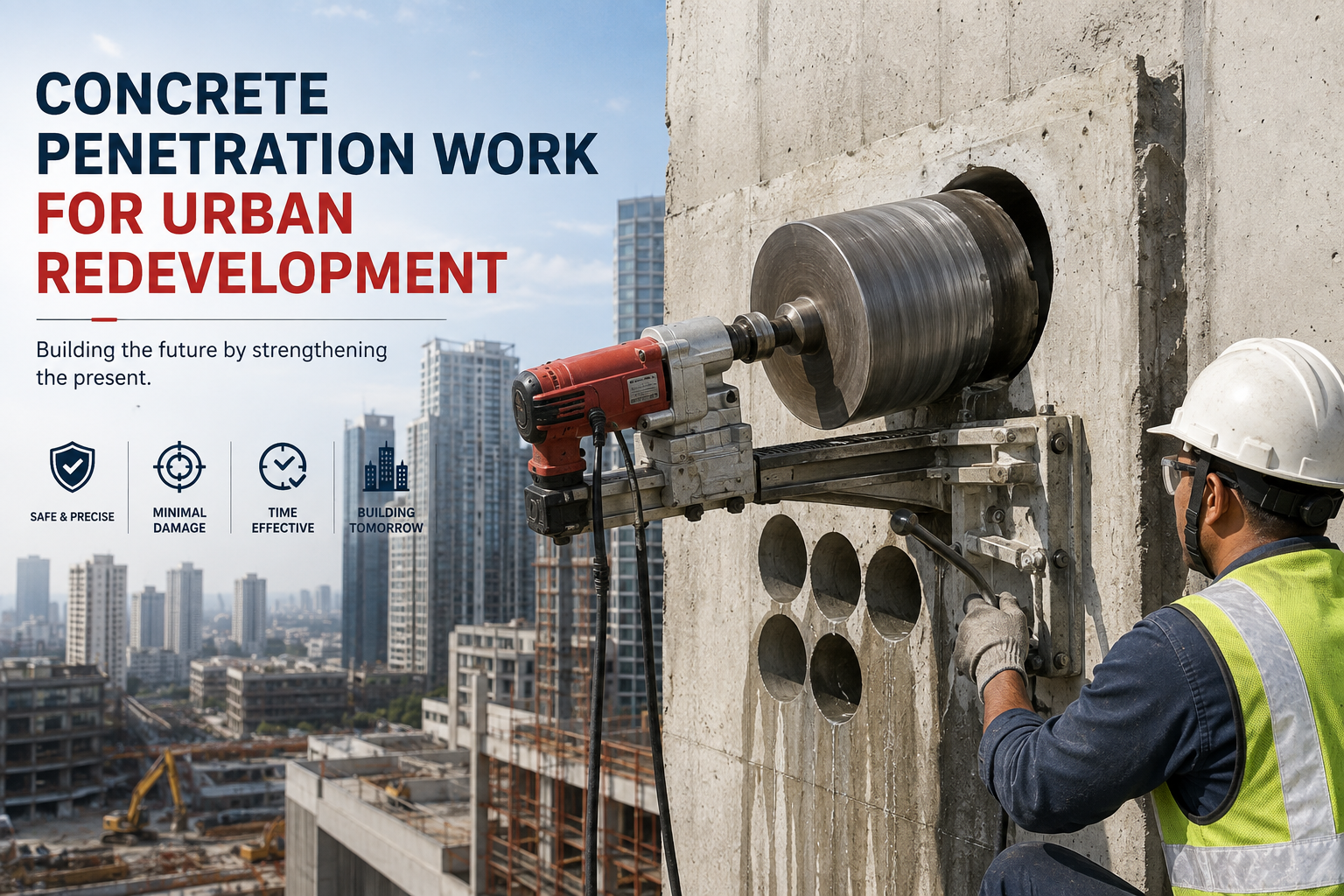
Introduction
Cities across India are changing faster than ever. Old buildings are being retrofitted, aging infrastructure is being upgraded, and new utilities are being threaded through structures that were never designed to accommodate them. At the heart of this transformation lies a specialized but often overlooked discipline: concrete penetration work. Whether it's cutting a precise opening for a new HVAC duct, drilling a core for a plumbing riser, or creating a doorway in a load-bearing wall, concrete penetration work is what makes modern urban redevelopment possible without tearing a building down and starting over.
At Core Cutting India ([email protected]), we specialize in delivering safe, accurate, and non-disruptive concrete cutting and drilling solutions for redevelopment projects of every scale — from residential retrofits to large commercial and infrastructure overhauls. In this guide, we explore what concrete penetration work involves, why it matters for urban redevelopment, the techniques and tools used, and how to choose the right contractor for your next project.
What Is Concrete Penetration Work?
Concrete penetration work refers to the controlled cutting, drilling, or coring of concrete structures to create openings, channels, or access points without compromising the structural integrity of the building. Unlike demolition, which is destructive and often irreversible, penetration work is precise and calculated. It allows contractors to:
- Create openings for pipes, cables, ducts, and conduits
- Install new doors, windows, or staircases in existing walls
- Access structural elements for inspection or reinforcement
- Modify floor slabs for elevators, utility shafts, or drainage systems
This work typically falls into a few core categories: diamond core drilling, wall sawing, floor sawing, wire sawing, and chain sawing. Each technique is suited to different materials, thicknesses, and project requirements, and choosing the right method is critical to achieving clean, accurate results.
Why Concrete Penetration Work Matters in Urban Redevelopment
Urban redevelopment is rarely about building from scratch. It's about breathing new life into existing structures — repurposing old factories into loft apartments, upgrading decades-old office towers with modern utilities, or retrofitting public infrastructure to meet current safety codes. This kind of work demands precision, and that's exactly where concrete penetration work becomes indispensable.
1. Preserving Structural Integrity
One of the biggest risks in any redevelopment project is unintentionally weakening a structure. Traditional demolition methods like jackhammering can cause micro-fractures, vibrations, and unpredictable damage to surrounding concrete. Controlled penetration techniques, particularly diamond core drilling, minimize vibration and stress on the structure, preserving its long-term stability while still achieving the required access points.
2. Enabling Utility Upgrades
Older buildings were often constructed with minimal or outdated utility infrastructure. As cities modernize, buildings need new plumbing lines, electrical conduits, fiber-optic cabling, and HVAC systems. Concrete penetration work allows these upgrades to be integrated into existing floors and walls with minimal disruption to the building's use.
3. Supporting Adaptive Reuse
Adaptive reuse — converting old industrial or commercial buildings into new residential, retail, or mixed-use spaces — is one of the defining trends in urban redevelopment. This process almost always requires new openings for windows, staircases, elevators, and mechanical systems, all of which depend on accurate, safe concrete cutting and coring.
4. Reducing Construction Timelines
Precision cutting tools allow contractors to complete penetration work faster than traditional methods, which is critical in dense urban environments where construction delays can have major cost and logistical implications. Faster completion also means less disruption to nearby residents, businesses, and traffic.
5. Minimizing Noise and Dust in Occupied Buildings
Many redevelopment projects take place in buildings that remain partially occupied during construction. Modern concrete cutting techniques, especially wet diamond cutting, significantly reduce dust and noise compared to conventional demolition, making it possible to work in sensitive environments like hospitals, schools, and residential complexes.
Common Techniques Used in Concrete Penetration Work
Diamond Core Drilling
Diamond core drilling uses a hollow, diamond-tipped bit to bore precise circular holes through concrete, brick, or masonry. It's the go-to method for creating openings for pipes, cables, HVAC ducts, and anchor bolts. Core drilling produces clean, accurate holes with minimal vibration, making it ideal for occupied or structurally sensitive buildings.
Wall Sawing
Wall sawing uses a track-mounted circular saw with a diamond blade to make straight, precise cuts in vertical concrete surfaces. It's commonly used for creating door openings, window enlargements, and wall removals in load-bearing and non-load-bearing walls alike.
Floor Sawing
Similar to wall sawing but used on horizontal surfaces, floor sawing is essential for cutting expansion joints, removing damaged slab sections, or preparing floors for new utility trenches.
Wire Sawing
Wire sawing uses a diamond-embedded cable to cut through extremely thick or heavily reinforced concrete sections, such as bridge supports, thick foundations, or large structural columns. It's particularly useful when other methods can't reach the required depth.
Chain Sawing
Chain sawing employs a diamond-chain cutting mechanism for precise corner cuts and openings, often used alongside wall sawing to create clean, flush corners in door and window openings.
Applications of Concrete Penetration Work in Redevelopment Projects
- Plumbing and Drainage Upgrades: Core drilling creates precise openings for new water supply lines, drainage pipes, and sewage systems in older buildings.
- Electrical and Data Infrastructure: Modern buildings require extensive cabling for power, internet, and communication systems, all of which need clean penetration points through floors and walls.
- HVAC Installation: Ductwork for heating, ventilation, and air conditioning often needs to pass through multiple floors and walls, requiring accurately sized core holes.
- Elevator and Staircase Installation: Adaptive reuse projects frequently involve cutting large floor openings for new elevator shafts or staircases.
- Structural Reinforcement Access: Engineers sometimes need access points to inspect or reinforce existing structural elements, particularly in seismic retrofitting projects.
- Window and Door Modifications: Wall sawing allows redevelopment teams to resize or reposition openings to meet new architectural or code requirements.
Safety Considerations in Concrete Penetration Work
Because this work involves cutting into structural elements, safety planning is non-negotiable. Reputable contractors follow a structured process that includes:
- Structural Assessment: Before any cutting begins, engineers assess the location of rebar, post-tension cables, and load-bearing elements using tools like ground-penetrating radar (GPR) and rebar scanners.
- Method Selection: The right cutting technique is chosen based on material thickness, reinforcement, and the sensitivity of the surrounding environment.
- Dust and Vibration Control: Wet-cutting methods and vacuum extraction systems are used to minimize airborne dust and control vibration levels.
- Compliance with Building Codes: All work must adhere to local construction and safety regulations, especially in occupied or heritage buildings.
- Post-Cut Inspection: After penetration work is complete, structural engineers often verify that the surrounding areas remain sound before finishing work proceeds.
Environmental Considerations
Sustainable urban redevelopment increasingly demands construction methods that minimize environmental impact. Concrete penetration work supports this goal in several ways. Precision cutting generates far less waste material than full demolition, and wet-cutting techniques capture slurry and dust rather than releasing them into the surrounding air and water systems. Additionally, by enabling the reuse of existing structures instead of full teardown-and-rebuild approaches, penetration work contributes to reduced embodied carbon in redevelopment projects — a growing priority for cities pursuing greener growth.
Choosing the Right Concrete Penetration Contractor
Not all concrete cutting providers offer the same level of precision, safety compliance, or equipment capability. When evaluating a contractor for an urban redevelopment project, consider the following:
- Experience with Similar Projects: Look for a track record in redevelopment, retrofit, or adaptive reuse work specifically, not just new construction.
- Equipment and Technology: Confirm that the contractor uses modern diamond cutting tools, GPR scanning, and dust/vibration control systems.
- Safety Certifications: Verify compliance with relevant safety standards and insurance coverage.
- Ability to Work in Occupied Spaces: For redevelopment projects in active buildings, the contractor should have proven methods for minimizing disruption.
- Clear Communication and Planning: A good contractor will provide a detailed scope of work, including scanning reports, cutting plans, and timelines before work begins.
At Core Cutting India, our teams combine technical expertise with a deep understanding of the unique challenges that urban redevelopment projects present. We work closely with architects, structural engineers, and project managers to ensure every penetration is planned, executed, and inspected with precision.
The Future of Concrete Penetration Work in Indian Cities
As Indian cities continue to densify and infrastructure ages, the demand for skilled concrete penetration services is only expected to grow. Government initiatives around smart cities, metro rail expansion, and building retrofitting for energy efficiency will require increasingly sophisticated cutting and coring solutions. Emerging technologies like robotic-assisted core drilling and advanced 3D scanning for pre-cut structural mapping are already beginning to shape the next generation of this trade, promising even greater precision and safety for redevelopment projects across the country.
Conclusion
Concrete penetration work may not always be the most visible part of urban redevelopment, but it is one of the most essential. From preserving structural integrity to enabling modern utility upgrades, precise cutting and coring techniques allow cities to modernize their built environment without unnecessary demolition, disruption, or waste.
If you're planning a redevelopment, retrofit, or renovation project and need reliable concrete cutting and core drilling services, Core Cutting India is here to help. Reach out to us at [email protected] to discuss your project requirements and get a customized plan from our experienced team.
People Also Ask
1. What is concrete penetration work? Concrete penetration work refers to the controlled cutting, drilling, or coring of concrete surfaces to create precise openings for utilities, structural access, or architectural modifications, without resorting to full demolition.
2. Why is concrete cutting important in urban redevelopment? It allows existing buildings to be upgraded with modern utilities, structural reinforcements, and new layouts while preserving the original structure, reducing waste, cost, and construction time compared to full rebuilds.
3. What equipment is used for concrete penetration? Common equipment includes diamond core drills, track-mounted wall saws, floor saws, wire saws, and chain saws, each suited to different cutting depths and structural conditions.
4. Is core drilling safe for old buildings? Yes, when performed by experienced professionals who conduct structural scanning beforehand and use vibration-controlled, precision equipment, core drilling is a safe method even for older or heritage structures.
5. How much does concrete core cutting cost in India? Costs vary based on the diameter and depth of the cut, the material's reinforcement, site accessibility, and location. It's best to request a site-specific quote from a professional contractor like Core Cutting India.
6. What is the difference between core drilling and wall sawing? Core drilling creates circular holes using a hollow diamond bit, typically for pipes or cables, while wall sawing uses a straight diamond blade to make linear cuts, typically for door or window openings.
Core Cutting India | Contact: [email protected]