
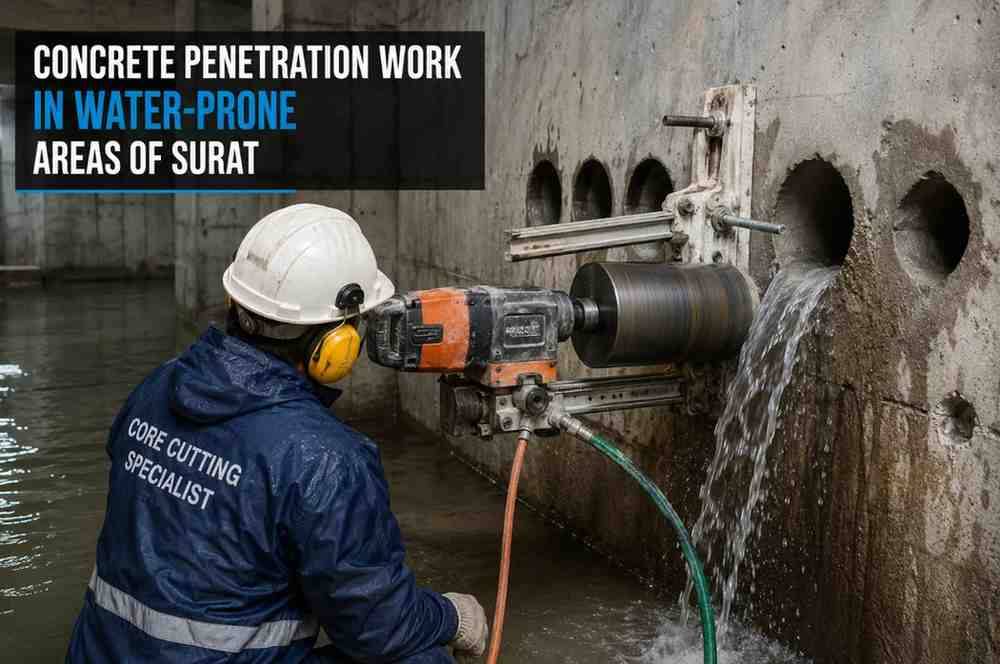
Surat, one of Gujarat's fastest-growing industrial and textile hubs, sits along the banks of the Tapi River. While this location has fuelled the city's commercial success, it has also made large parts of Surat — from Adajan and Athwalines to Katargam and Udhna — prone to seasonal flooding, high water tables, and persistent dampness in the soil. For builders, contractors, and property owners, this reality adds a layer of complexity to even routine construction tasks, especially concrete penetration work such as core drilling, wall cutting, and pipe or cable routing through concrete structures.
At Core Cutting India ([email protected]), we specialize in precision concrete cutting and drilling services tailored to the unique demands of water-prone regions. In this guide, we break down what concrete penetration work involves, why it becomes more technical in areas like Surat, and how professional expertise makes the difference between a durable structure and a costly repair down the line.
What Is Concrete Penetration Work?
Concrete penetration work refers to the process of creating precise openings, holes, or channels through concrete elements — walls, slabs, beams, or foundations — to accommodate plumbing lines, electrical conduits, HVAC ducts, drainage systems, or structural modifications. This is typically achieved using specialized equipment such as:
- Diamond core drilling machines for clean, circular holes
- Wall saws for straight, controlled cuts in vertical surfaces
- Wire saws for thick or heavily reinforced concrete sections
- Handheld cutters for smaller, localized openings
Unlike traditional hammer-and-chisel demolition, modern concrete penetration techniques rely on diamond-tipped tools that cut through concrete with minimal vibration, dust, and structural disturbance. This precision is essential in occupied buildings, load-bearing structures, and — most importantly for Surat — areas where the surrounding soil and water table are already under stress.
Why Surat's Water-Prone Geography Changes the Equation
Surat's proximity to the Tapi River, combined with its low-lying topography in several zones, means that construction and renovation projects frequently encounter:
1. High Groundwater Tables
In many parts of the city, groundwater sits close to the surface for a significant part of the year. This affects the moisture content of concrete structures, particularly basements, retaining walls, and foundation slabs, making them more susceptible to cracking, seepage, and weakened load-bearing capacity.
2. Seasonal Flooding and Waterlogging
Surat has experienced significant flood events historically, most notably the 2006 floods, which left a lasting impact on how the city approaches infrastructure resilience. Even in a typical monsoon season, waterlogging in low-lying pockets is common, which means concrete structures are regularly exposed to standing water and saturated soil.
3. Corrosion and Reinforcement Risk
Persistent moisture accelerates the corrosion of steel reinforcement bars (rebar) inside concrete. When penetration work is carried out carelessly, exposed rebar in water-prone zones corrodes faster, compromising structural integrity over time.
4. Soil Instability During Excavation
Water-saturated soil is less stable, which means any penetration or drilling work that extends below grade — such as sump pits, drainage channels, or utility trenches — carries a higher risk of soil collapse or shifting if not managed with the right technique and sequencing.
These factors mean that concrete penetration work in Surat cannot follow a generic, one-size-fits-all approach. It requires local expertise, an understanding of seasonal risk windows, and equipment suited to damp or saturated conditions.
Common Applications of Concrete Penetration Work in Surat
Plumbing and Drainage Installations
Given Surat's flood history, effective stormwater drainage and sump systems are critical. Concrete penetration is used to create channels for drainage pipes that direct excess water away from foundations and basements, reducing the risk of water pooling around structural elements.
Electrical and Utility Conduits
Textile mills, commercial complexes, and residential towers across Surat require precise openings for electrical wiring and utility conduits. In water-prone basements or ground floors, these penetrations must be carefully sealed afterward to prevent moisture ingress along cable routes.
HVAC Duct Installation
Commercial buildings, especially in areas like Vesu and Piplod, often require concrete cutting for ventilation and air conditioning ducts. Poor sealing after penetration in humid, water-adjacent zones can lead to condensation issues and mold growth.
Structural Retrofitting and Renovation
Older structures in flood-affected neighborhoods sometimes require retrofitting — adding new door or window openings, structural reinforcements, or expansion joints. This work demands careful assessment of the existing concrete's condition, since prolonged water exposure can weaken it in ways that aren't visible from the surface.
Basement and Foundation Waterproofing Access
Ironically, one of the most common reasons for concrete penetration in Surat is to fix water problems — creating access points for injecting waterproofing compounds, installing sump pumps, or inserting weep holes to relieve hydrostatic pressure on foundation walls.
Techniques Best Suited for Water-Prone Concrete Cutting
Diamond Core Drilling
This is the most reliable technique for creating clean, round holes for pipes and cables. Diamond core bits generate less heat and vibration than conventional drilling, which matters significantly in structures already weakened by moisture. Wet diamond drilling, which uses a continuous water flow to cool the bit, is often used — though in already-damp environments, contractors must manage water runoff carefully to avoid further saturating the surrounding area.
Wall Sawing
For larger openings, such as new doorways or window bays in flood-resistant retrofits, wall saws mounted on tracks provide straight, controlled cuts. This method minimizes stress on adjacent concrete, which is particularly important when the structure has already been softened by years of moisture exposure.
Dry-Cutting Alternatives
In some cases — particularly indoors or in areas where adding more water isn't advisable — dry-cutting diamond blades with dust extraction systems are used instead of wet methods. This choice depends on the specific moisture profile of the site and is typically determined after an on-site assessment.
Non-Destructive Scanning Before Drilling
Before any penetration begins, professional teams use ground-penetrating radar (GPR) or rebar scanners to map the internal structure of the concrete. This step is non-negotiable in water-prone areas, where corroded or repositioned rebar (a common consequence of long-term moisture exposure) can otherwise be accidentally cut, weakening the structure further.
Key Challenges Contractors Face in Surat
Managing Water Table Interference: When penetration work extends below or near the water table, contractors must plan for continuous water ingress during the process, often requiring temporary pumping or dewatering systems.
Timing Around Monsoon Season: Major structural penetration work is best scheduled outside the monsoon months (typically June to September in Surat) to reduce complications from waterlogging and unstable soil.
Ensuring Post-Penetration Sealing: Any opening made in a water-prone structure must be properly sealed with waterproof grouting, expansion foam, or specialized sealants immediately after work is completed. An unsealed penetration is often worse than no penetration at all, since it becomes a direct pathway for water infiltration.
Working Around Aging Infrastructure: Many buildings in Surat's older commercial districts were constructed before modern waterproofing standards were common. This means contractors must often assess and account for pre-existing deterioration before beginning new penetration work.
Why Professional Expertise Matters
Attempting concrete penetration work in water-prone areas without specialized knowledge carries real risks: structural cracking, accidental rebar damage, water infiltration, and even foundation instability. A professional concrete cutting service brings several advantages:
- Site-specific assessment using scanning technology to identify rebar, utility lines, and moisture-affected zones before cutting begins
- Equipment calibrated for local conditions, including wet and dry cutting tools suited to Surat's humidity and groundwater levels
- Experience with sealing and waterproofing to ensure every penetration is protected against future water ingress
- Compliance with structural safety standards, minimizing risk to load-bearing elements
- Efficient project timelines, reducing the exposure window during which an open penetration could be affected by rain or flooding
At Core Cutting India, our teams combine technical precision with a deep understanding of Surat's local terrain and seasonal water patterns. Every project — whether it's a residential basement drainage upgrade in Adajan or a commercial HVAC installation in Vesu — is approached with the specific water-related risks of that location in mind.
Best Practices for Property Owners and Developers
If you're planning any construction or renovation project involving concrete penetration in Surat's water-prone zones, keep these best practices in mind:
- Schedule major work outside monsoon season whenever possible.
- Insist on a pre-drilling scan to avoid damaging rebar or existing utility lines.
- Ask about sealing methods the contractor will use post-penetration.
- Choose contractors experienced in local geography, not just general construction.
- Request a moisture assessment of the concrete structure before major cutting work begins.
- Plan drainage solutions proactively, rather than only after water damage appears.
Conclusion
Concrete penetration work is a routine but technically demanding part of construction and renovation — and in a city like Surat, where water-prone geography adds an extra layer of complexity, precision and local expertise are non-negotiable. From diamond core drilling for plumbing lines to wall sawing for structural retrofits, every method must be adapted to account for high water tables, seasonal flooding, and the long-term durability of the structure.
Whether you're a homeowner addressing a drainage issue, a developer working on a new commercial project, or a facility manager overseeing renovations, partnering with an experienced concrete cutting service ensures the job is done safely, cleanly, and with long-term water resistance in mind.
Core Cutting India brings years of specialized experience in concrete cutting, coring, and penetration work across Surat's diverse construction landscape. To discuss your project or request a site assessment, reach out to us at [email protected].
Frequently Asked Questions
What is concrete penetration work and why is it needed? Concrete penetration work involves cutting or drilling precise openings through concrete structures to accommodate plumbing, electrical, drainage, or HVAC systems. It's needed whenever a building requires new utility access points without compromising structural integrity.
Is concrete core drilling safe in water-prone or flood-affected areas? Yes, when performed by experienced professionals using proper scanning, drilling, and sealing techniques. Safety depends heavily on assessing moisture levels and rebar condition before cutting, and sealing the opening correctly afterward.
How much does concrete cutting and coring cost in Surat? Costs vary based on concrete thickness, penetration size, accessibility, and whether wet or dry cutting methods are required. Contact Core Cutting India at [email protected] for a project-specific quote.
What precautions are taken before drilling concrete near water pipelines? Professionals use ground-penetrating radar or utility scanners to map existing pipelines and rebar before drilling, reducing the risk of accidental damage or leaks.
Which drilling method is best for wet or damp concrete structures? Diamond core drilling is generally preferred for its precision and reduced vibration, though the choice between wet and dry cutting depends on the specific site conditions and moisture levels.
How long does concrete penetration work take to complete? Timelines depend on the scope of the project, concrete thickness, and site conditions, but most standard penetration jobs can be completed within a single day, with sealing and finishing work following shortly after.