
Introduction
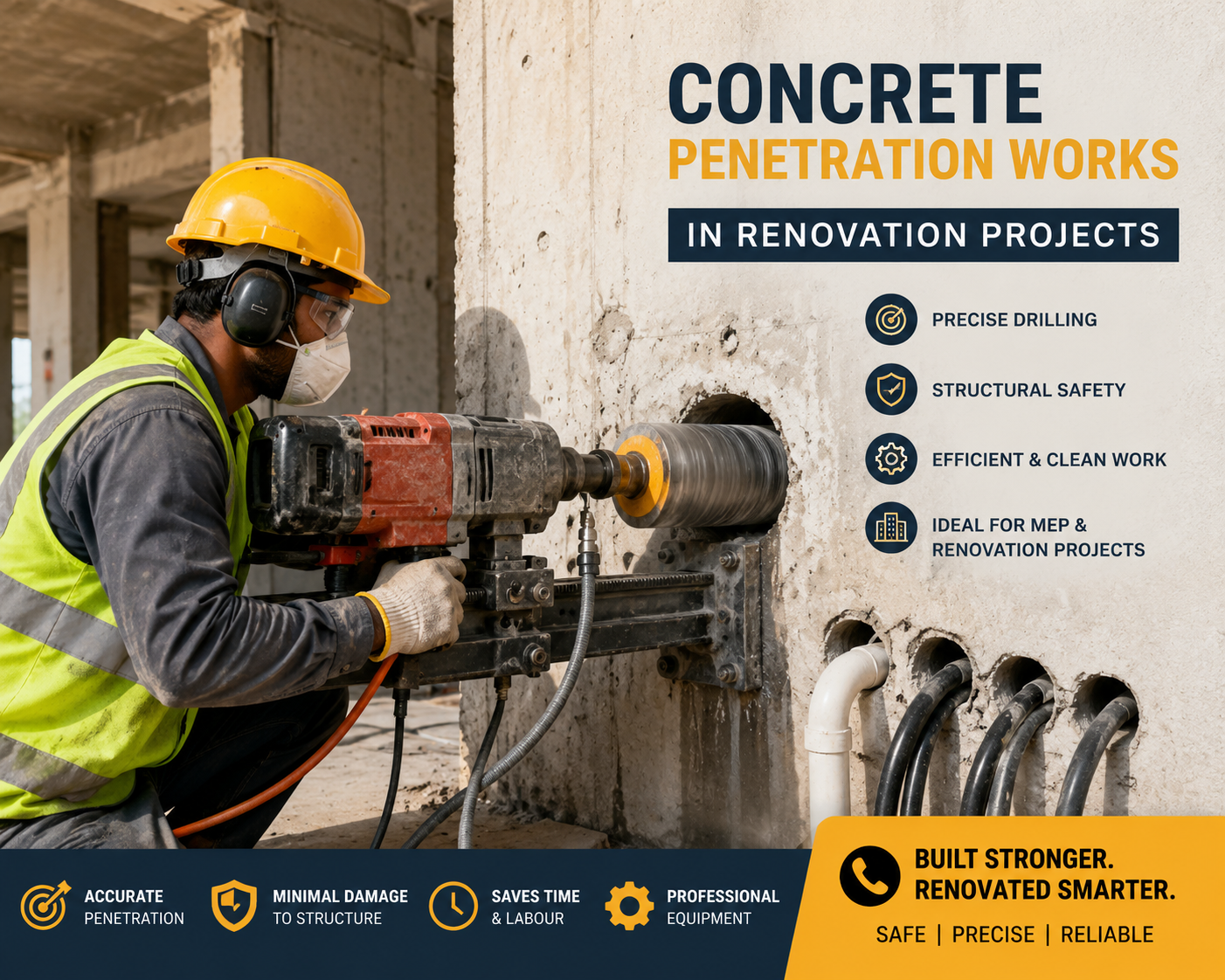
Every renovation project, whether it is a 40-year-old bungalow in Pune, a high-rise apartment in Mumbai, or a commercial complex in Gurugram, eventually runs into the same hard truth: concrete does not want to be changed. Walls, slabs, and columns that were poured decades ago now stand between a homeowner's dream kitchen and a new plumbing line, or between a corporate office and a modern HVAC duct. This is where concrete penetration works come in — a specialised set of techniques used to cut, drill, and core through reinforced concrete without compromising the structural integrity of the building.
In India, where a large share of urban housing stock and commercial real estate is being renovated, retrofitted, or repurposed rather than demolished and rebuilt, concrete penetration work has quietly become one of the most important trades in the construction ecosystem. Companies like Core Cutting India ([email protected]) specialise in exactly this — precise, dust-controlled, structurally safe cutting and drilling for renovation and retrofit projects across the country.
This blog explains what concrete penetration works actually involve, why they matter so much in renovation, the techniques and machines used, real Indian project scenarios, and how to choose the right contractor for the job.
What Is Concrete Penetration Work?
Concrete penetration work refers to any process that creates an opening, channel, or void in an existing concrete structure — walls, floors, slabs, beams, or columns — to allow for new installations such as pipes, cables, ducts, doors, windows, elevators, or staircases. Unlike breaking concrete with a hammer or chisel, penetration work uses controlled, engineered methods so that the surrounding structure remains stable and undamaged.
The main categories include:
- Core Drilling (Core Cutting): Using a diamond-tipped hollow drill bit to bore precise circular holes through concrete, brick, or stone. Common for pipe passages, cable routing, and HVAC ducting.
- Wall Sawing: Using a track-mounted circular diamond blade to cut straight, clean openings in vertical walls — typically for new doors, windows, or ventilation openings.
- Floor Sawing (Slab Sawing): Cutting straight lines in horizontal concrete slabs, often used for staircases, lift shafts, or utility trenches.
- Wire Sawing: Using a diamond-embedded wire loop for cutting very thick or heavily reinforced concrete, or in tight spaces where a saw blade cannot reach — common in bridge and heritage structure work.
- Chasing and Grooving: Cutting narrow channels into concrete or masonry to embed electrical conduits or plumbing lines flush with the surface.
Each method is chosen based on the thickness of the concrete, the presence of reinforcement steel, the location within the building, and the precision required.
Why Concrete Penetration Works Matter in Renovation
Renovation is fundamentally different from new construction. In a new building, architects and MEP (mechanical, electrical, plumbing) engineers plan every opening before the concrete is poured. In renovation, the concrete already exists — often built decades ago with no modern documentation — and new systems must be threaded through it without disturbing the load-bearing framework.
This makes concrete penetration work essential for several reasons:
1. Retrofitting Modern Utilities Old Indian buildings, especially those built before the 1990s, were not designed for split ACs, structured cabling, modern plumbing stacks, or fibre internet. Renovation projects routinely require new penetrations for these services.
2. Structural Safety Cutting concrete incorrectly — say, with a hammer drill or by manually breaking through a slab — can crack surrounding areas, damage embedded reinforcement, or destabilise load paths. Engineered core cutting keeps openings precise and structurally predictable, which is critical when working with rebar-dense RCC members.
3. Space Optimisation In dense Indian cities, renovation often means converting a single large flat into two units, merging two shops into one commercial space, or adding a mezzanine floor. All of these require accurately placed slab and wall penetrations.
4. Compliance With Modern Codes Fire safety, accessibility, and ventilation norms have evolved. Older commercial buildings undergoing renovation frequently need new fire-exit openings, elevator shafts, or ventilation ducts cut into existing concrete to meet current building codes.
Common Applications in Indian Renovation Projects
Residential Renovations
In cities like Delhi, Bengaluru, and Chennai, older housing societies and independent houses are being modernised extensively. Typical concrete penetration needs include:
- Core drilling for new bathroom and kitchen plumbing risers
- Cutting openings for split-AC pipe and drain routing
- Wall sawing for enlarging or relocating doors and windows
- Floor sawing for internal staircases when converting a single-storey home into a duplex
Heritage and Old City Buildings
Cities such as Ahmedabad's old town, Kolkata's colonial-era buildings, and Mumbai's South Bombay heritage structures present unique challenges. These buildings often have lime concrete, brick-and-lime masonry, or early RCC with unpredictable reinforcement patterns. Concrete penetration specialists here rely heavily on wire sawing and low-vibration core drilling to avoid stressing fragile, aged materials while installing modern electrical and fire-safety systems.
Commercial and IT Office Retrofits
India's IT corridors — Gurugram's Cyber City, Bengaluru's Whitefield and Electronic City, Hyderabad's HITEC City, and Pune's Hinjawadi — see constant office renovations as companies redesign floor plates for new tenants. This involves:
- Core cutting through RCC slabs for raised flooring cable routes and server room cooling ducts
- Wall sawing for glass-partition doorways
- Slab openings for internal staircases connecting duplex office floors
Hospitals and Healthcare Facilities
Hospital renovations in cities like Chennai and Mumbai require some of the most precise penetration work, since medical gas lines, MRI machine foundations, and specialised ductwork must be installed without disrupting ongoing hospital operations. Dust-free, low-noise core drilling methods are essential here to maintain hygiene standards and avoid disturbing patients.
Malls and Retail Spaces
When retail brands renovate store layouts inside malls such as those in Noida, Mumbai, or Bengaluru, wall sawing and core cutting are used to reconfigure shopfronts, add escalators, or route new fire-sprinkler piping through existing slabs — often during tight overnight work windows to avoid disrupting business hours.
Elevator and Staircase Additions
A growing renovation trend in Indian residential societies is retrofitting elevators into buildings that were originally built without them, driven by an ageing population and accessibility requirements. This requires large-diameter, multi-storey core cutting through several RCC slabs in precise vertical alignment — one of the more technically demanding penetration jobs in the industry.
Techniques and Equipment Used
Modern concrete penetration work in India relies on diamond tooling, which is far more precise and controlled than traditional demolition methods.
- Diamond Core Drilling Machines: Handheld or rig-mounted machines that bore circular holes ranging from a few millimetres to over a metre in diameter, depending on the application.
- Wall Saws: Track-guided diamond blade saws capable of cutting straight lines up to 600–700 mm deep, commonly used for openings in load-bearing and non-load-bearing walls.
- Floor Saws: Walk-behind machines used for horizontal slab cutting, often paired with core drills for corner releases.
- Wire Saw Systems: Diamond wire loops driven by a hydraulic or electric power unit, used for extremely thick sections or irregular cuts.
- Dust Extraction and Water-Fed Systems: Since most Indian renovation work happens in occupied buildings, wet-cutting or vacuum dust extraction is used to control airborne concrete dust — an important consideration for indoor air quality and compliance with pollution control norms in cities like Delhi-NCR.
Benefits of Professional Concrete Penetration Work Over Traditional Methods
Traditional concrete breaking with hammers or chisels is still common in unorganised renovation work in India, but it comes with serious drawbacks: uneven openings, micro-cracking in surrounding concrete, accidental damage to embedded rebar or cables, excessive noise, and large amounts of debris.
Professional concrete penetration work, by contrast, offers:
- Precision: Openings are cut to exact dimensions, reducing rework and material waste.
- Structural Safety: Controlled cutting avoids stressing adjacent concrete or cutting through critical reinforcement.
- Reduced Vibration and Noise: Important in occupied buildings, hospitals, and heritage structures where vibration can affect neighbouring areas.
- Faster Turnaround: Diamond tools cut through reinforced concrete significantly faster than manual breaking.
- Cleaner Work Sites: Water-fed or vacuum dust control keeps renovation sites cleaner, which matters in residential societies and commercial spaces still in use.
Challenges Specific to Indian Renovation Projects
Concrete penetration work in India comes with its own set of challenges that specialised contractors must navigate:
- Undocumented Structures: Many buildings, especially those over 20–30 years old, lack structural drawings, making it difficult to know rebar placement or slab thickness in advance. Contractors often use rebar scanners and ground-penetrating tools before cutting.
- Hidden Utility Lines: Old buildings frequently have undocumented electrical conduits or plumbing lines embedded in walls, increasing the risk of accidental damage without proper scanning.
- Working in Occupied Spaces: Unlike new construction, most renovation-related cutting happens while residents or employees are still using the building, requiring careful scheduling, noise control, and debris management.
- Monsoon and Humidity: In coastal cities like Mumbai and Chennai, high humidity and monsoon schedules can affect wet-cutting operations and require additional site protection.
- Load-Bearing Verification: In older masonry or load-bearing structures common in smaller Indian towns, a structural engineer must confirm which walls can be safely penetrated before any cutting begins.
Safety, Compliance, and Best Practices
Before any concrete penetration work begins on a renovation project, reputable contractors follow a structured process:
- Structural Assessment: A structural engineer evaluates whether the wall, slab, or column can be safely penetrated, and to what extent.
- Rebar and Utility Scanning: Ground-penetrating radar or rebar locators are used to map reinforcement and hidden services before cutting.
- Method Selection: The right combination of core drilling, wall sawing, or wire sawing is chosen based on thickness, location, and access constraints.
- Dust and Debris Control: Wet-cutting or vacuum extraction systems are deployed, particularly important given India's building pollution control norms in metro cities.
- Post-Cutting Reinforcement: Where required, openings are reinforced with steel plates, epoxy coating, or additional structural support to restore load paths.
Adherence to relevant Indian structural and safety codes, along with proper personal protective equipment for workers, is non-negotiable on any professional renovation site.
Choosing the Right Concrete Penetration Contractor in India
Given the technical and structural risks involved, choosing an experienced contractor is one of the most important decisions in any renovation project. Key factors to evaluate include:
- Experience with similar building types (residential, heritage, commercial, healthcare)
- Availability of modern diamond-cutting equipment and dust-control systems
- A track record of working alongside structural engineers rather than cutting blind
- Transparent quotations based on concrete thickness, diameter/length, and site access
- Compliance with safety and environmental norms for occupied buildings
Core Cutting India works across residential, commercial, industrial, and heritage renovation projects nationwide, offering core drilling, wall sawing, floor sawing, and wire sawing services tailored to each site's structural needs. For project consultations, site assessments, or quotations, reach out at [email protected].
Conclusion
As India's cities mature, renovation and retrofit work is only going to grow — driven by ageing building stock, changing utility needs, evolving safety codes, and the sheer cost advantage of upgrading existing structures over demolishing and rebuilding them. Concrete penetration works sit at the heart of this transformation, quietly enabling everything from a new bathroom line in a Delhi apartment to a retrofitted elevator shaft in a decades-old housing society in Mumbai.
Done well, concrete penetration work is invisible — a clean, precise opening that lets new systems function without anyone noticing the disruption it took to get there. Done poorly, it can compromise the very structure a renovation is meant to improve. That difference is exactly why experienced, specialised contractors matter.
For renovation projects that demand precision, safety, and minimal disruption, Core Cutting India offers end-to-end concrete penetration solutions. Get in touch at [email protected] to discuss your next renovation project.