
Surat's commercial skyline has grown fast over the last decade — malls, textile markets, IT parks, hospitals, and high-rise office towers now dominate areas like Adajan, Vesu, Ring Road, and the Diamond Bourse district. With that growth has come tighter scrutiny from fire departments and municipal authorities, especially after several high-profile fire incidents across Gujarat pushed building owners to take compliance seriously. One of the most overlooked — yet absolutely critical — parts of any fire safety upgrade is the concrete penetration work: the precise cutting and drilling required to route sprinkler pipes, fire-rated ductwork, electrical conduits, and smoke barrier systems through existing concrete slabs and walls.
At Core Cutting India, we work with architects, MEP contractors, and facility managers across Surat to execute these penetrations safely, accurately, and in full compliance with fire codes. This blog explains why concrete penetrations matter for fire safety, what the process involves, and what commercial property owners in Surat need to know before starting an upgrade.
Why Fire Safety Upgrades Matter for Surat's Commercial Buildings
Surat is one of Gujarat's fastest-growing commercial hubs, home to thousands of textile units, diamond processing centers, retail complexes, and multi-storey office buildings. Many of these structures were built years ago, before current fire safety norms were finalized under the National Building Code (NBC) 2016 and the Gujarat Fire Prevention and Life Safety Measures Act. As enforcement has tightened, property owners are being asked to retrofit older buildings with modern fire suppression, detection, and compartmentalization systems.
A fire safety upgrade typically includes:
- Installation of automatic sprinkler systems
- Addition of fire-rated dampers in HVAC ductwork
- Smoke and fire barrier walls between floors or wings
- Fire hydrant risers and wet riser piping
- Emergency exit signage wiring and fire alarm cabling
None of these systems can be installed without creating precise openings — called penetrations — through existing concrete floors, walls, and beams. This is where professional concrete cutting and core drilling services become essential.
What Are Concrete Penetrations?
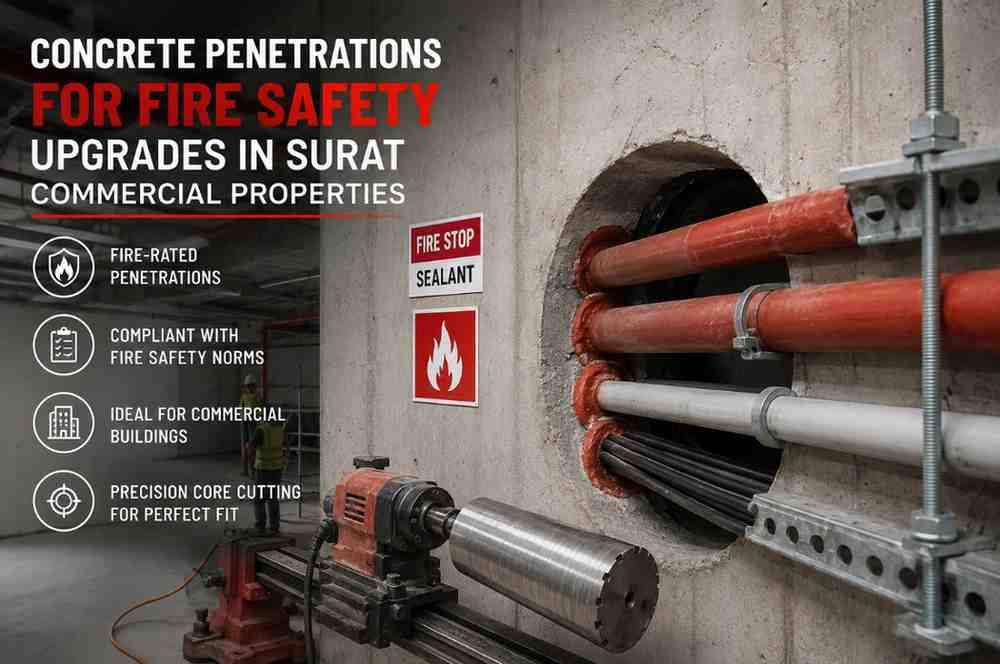
A concrete penetration is any opening cut or drilled through a concrete structural element to allow a pipe, duct, cable, or conduit to pass through. In fire safety retrofits, these penetrations serve very specific purposes:
Sprinkler and riser pipe penetrations — Circular openings drilled through slabs and walls to route water supply pipes for sprinkler heads and fire hydrant systems between floors.
Fire damper and ductwork openings — Rectangular or circular cuts made for HVAC ducts fitted with fire dampers that automatically close during a fire to stop smoke and flame spread.
Cable and conduit penetrations — Smaller diameter holes for fire alarm wiring, emergency lighting circuits, and public address system cables.
Smoke barrier and compartmentation openings — Precision cuts required when creating fire-rated compartments that slow the spread of fire and smoke between different sections of a building.
Each of these penetrations must be cut to exact specifications, in the correct location, without compromising the structural integrity of the building — and afterward, each opening must be properly fire-stopped to maintain the fire-resistance rating of the wall or floor it passes through.
The Core Drilling and Concrete Cutting Process
Professional concrete penetration work for fire safety upgrades generally follows these stages:
1. Site Survey and Structural Assessment
Before any cutting begins, our team surveys the site to identify the location of rebar, post-tensioned cables, and existing utilities using GPR (ground-penetrating radar) or rebar scanning equipment. This step is critical in commercial buildings, where cutting through a structural tendon or a hidden electrical line can cause serious damage or safety hazards.
2. Marking and Coordination with MEP Drawings
Every penetration point is marked according to approved mechanical, electrical, and plumbing (MEP) drawings. In fire safety retrofits, this coordination is especially important because sprinkler and damper locations are dictated by fire engineering calculations, not just convenience.
3. Diamond Core Drilling
For circular penetrations — such as sprinkler risers or cable conduits — diamond core drilling is used. This method uses a diamond-tipped hollow bit to cut clean, precise, dust-controlled holes through concrete, brick, or reinforced structural elements with minimal vibration and no damage to surrounding material.
4. Wall and Floor Sawing
For larger rectangular openings, such as those needed for fire dampers or duct risers, wall sawing or track sawing is used to create straight, accurate cuts. This method is preferred over manual demolition because it produces clean edges and avoids unnecessary stress on the surrounding structure.
5. Fire Stopping and Sealing
This is the step many contractors underestimate — but it is arguably the most important part of the entire process. Once a penetration is made, it must be sealed with fire-rated sealants, fire collars, intumescent wraps, or mortar systems that restore the fire-resistance rating of the wall or slab. An unsealed or improperly sealed penetration effectively creates a pathway for fire and smoke to travel between floors, defeating the purpose of the upgrade entirely.
Common Challenges in Surat Commercial Buildings
Surat presents a few recurring challenges when it comes to concrete penetration work for fire safety retrofits:
Older RCC structures — Many buildings in areas like Ring Road, Nanpura, and the old city have dense reinforcement or non-standard slab thicknesses, requiring careful scanning before drilling.
Occupied premises — Textile markets, diamond units, and office towers often need to remain operational during retrofit work, which means low-noise, low-dust cutting methods are essential.
Space constraints — High-density commercial zones like Ring Road and Varachha often have tight service shafts and limited working space, requiring compact, precise equipment.
Coordination with multiple contractors — Fire safety upgrades typically involve HVAC teams, plumbers, electricians, and fire consultants working together, so penetration timing has to be carefully sequenced.
Working with an experienced concrete cutting contractor who understands both the technical and logistical side of these projects helps avoid delays, rework, and compliance issues down the line.
Why Professional Core Cutting Matters for Compliance
Fire safety inspectors and third-party auditors in Gujarat increasingly check not just whether sprinkler systems and dampers exist, but whether penetrations were executed and sealed correctly. Poorly cut openings, over-sized holes, or missing fire-stop materials are common reasons buildings fail fire safety audits.
Professional concrete penetration work offers several compliance advantages:
- Accurate hole sizing that matches pipe or duct specifications exactly, avoiding oversized gaps
- Minimal disturbance to rebar and structural elements, preserving load-bearing capacity
- Documentation and photographic records that can be submitted for fire NOC (No Objection Certificate) applications
- Proper fire-stop sealing that satisfies fire-resistance rating requirements during inspection
For commercial property owners applying for or renewing a Fire NOC from the Surat Municipal Corporation, having professionally executed and documented penetration work can make the difference between a smooth approval and a rejected application.
Choosing the Right Concrete Cutting Partner in Surat
When selecting a contractor for fire safety-related concrete penetration work, commercial property owners and facility managers should look for:
- Experience specifically with fire safety and MEP-related cutting, not just general demolition
- Access to diamond core drilling and wall sawing equipment suited for RCC structures
- Knowledge of rebar scanning and structural safety practices
- Familiarity with fire-stopping materials and methods
- Ability to work around occupied commercial spaces with dust and noise control
At Core Cutting India, our teams have handled concrete penetration work across Surat's commercial, industrial, and institutional properties — from textile market complexes to corporate office towers. We coordinate directly with fire consultants and MEP contractors to ensure every opening is cut to specification and every penetration is properly sealed, so your building meets current fire safety standards without unnecessary structural risk.
Final Thoughts
Fire safety upgrades are no longer optional for commercial properties in Surat — they're a regulatory necessity and, more importantly, a matter of protecting lives and assets. But the effectiveness of any fire safety system, whether it's a sprinkler network or a smoke barrier wall, depends heavily on how well the underlying concrete penetration work is executed. Rushed, imprecise, or poorly sealed openings can undermine even the best-designed fire protection systems.
If you're planning a fire safety retrofit for your commercial property in Surat, it's worth bringing in a specialized concrete cutting and core drilling team early in the planning process — not as an afterthought once the MEP contractor is ready to install pipes and ducts.
Get in touch with Core Cutting India for a site assessment and consultation on concrete penetration work for your fire safety upgrade project. Email us at [email protected] to discuss your requirements.
Frequently Asked Questions
What are concrete penetrations used for in fire safety systems? Concrete penetrations create the openings needed to route sprinkler pipes, fire-rated ductwork, electrical conduits, and fire alarm cabling through existing floors and walls as part of a fire protection system.
Is core drilling safe for load-bearing walls and slabs? Yes, when performed by trained professionals who first scan the structure for rebar and tendons and calculate safe hole placement and size, core drilling does not compromise structural integrity.
What fire safety upgrades are mandatory for commercial buildings in Gujarat? Requirements vary by building height and occupancy but commonly include sprinkler systems, fire alarm and detection systems, fire dampers in ductwork, emergency lighting, and compartmentation, as outlined under the Gujarat Fire Prevention and Life Safety Measures Act and NBC 2016 guidelines.
How much does concrete core cutting cost in Surat? Costs depend on the number, size, and depth of penetrations, the type of concrete or reinforcement involved, and site accessibility. Core Cutting India provides site-specific quotes after an initial assessment.
What is fire stopping and why is it required after drilling? Fire stopping involves sealing a penetration with fire-rated materials to restore the fire-resistance rating of the wall or slab, preventing fire and smoke from spreading through the opening.
How long does a commercial fire safety retrofit take? Timelines vary based on building size and scope of work, but concrete penetration work itself is typically scheduled in phases to minimize disruption to occupied commercial spaces.
Core Cutting India | [email protected]