
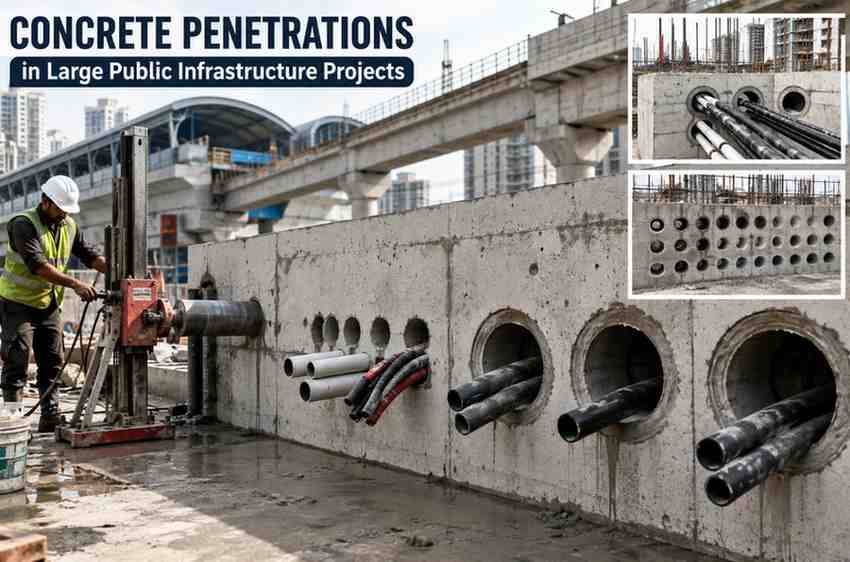
Public infrastructure forms the structural backbone of modern civilization. From the sprawling transit networks beneath our megacities to towering dams, bridges, hospitals, and airports, these assets are designed to endure for decades or even centuries. Behind the colossal exterior of steel and concrete lies an intricate nervous system: mechanical, electrical, plumbing (MEP) systems, drainage networks, fiber-optic data trunks, and ventilation shafts.
Integrating these systems into massive structural frameworks requires precise, engineered interventions known as concrete penetrations.
Executing penetrations in large-scale public infrastructure is vastly different from residential or commercial retrofitting. The scale, strict safety regulations, high load-bearing demands, and the sheer volume of reinforced concrete require state-of-the-art methodology. This guide explores the critical nature of concrete penetrations in public projects, the advanced techniques utilized, and how specialized contractors ensure structural resilience.
1. What Are Concrete Penetrations in Infrastructure?
In civil engineering, a concrete penetration refers to any planned or retrofitted opening created through concrete walls, floors, ceilings, or foundations to route utilities, structural fasteners, or expansion joints.
In large public infrastructure projects, these penetrations fall into two primary categories:
-
Cast-in-Place (Proactive) Penetrations: Sleeves, inserts, or box-outs placed prior to the concrete pour. While ideal, unforeseen design updates often necessitate post-pour modifications.
-
Post-Installed (Retrofitted) Penetrations: Openings drilled or cut into cured concrete after the structural phase. This is common in infrastructure upgrades, retrofitting older bridges, or correcting coordination clashes in MEP routing.
Why Precision Matters
Public infrastructure projects—such as underground metro stations, water treatment plants, and highway tunnels—endure immense dynamic loads, environmental pressures, and high traffic volumes. An ill-planned or poorly executed penetration can compromise rebar placement, weaken load paths, and introduce vulnerabilities to moisture intrusion or seismic stress.
2. The Complex Role of MEP Integration in Mega Projects
Modern public buildings and civil structures are sophisticated systems. A major airport terminal or municipal hospital relies heavily on seamless coordination between structural elements and utility layouts.
Managing High-Density Utility Routing
In facilities like water management plants or underground transit hubs, hundreds of utility lines must converge without violating safety codes. Concrete penetrations allow for:
-
HVAC Ductwork: Large rectangular or circular openings required for massive air-handling units.
-
Water and Sewage Lines: Core-drilled pathways for heavy industrial piping systems.
-
Electrical and Telecommunications Trays: Clean openings designed to house high-voltage lines and data cabling safely away from moisture and structural interference.
Without meticulous planning and clean cutting techniques, crowded service zones can create gridlocks, delaying project timelines and inflating budgets.
3. Core Cutting and Drilling: The Gold Standard for Infrastructure
When executing penetrations in dense, heavily reinforced public structures, traditional demolition tools like jackhammers are obsolete. They create micro-fractures, compromise adjacent concrete, and lack dimensional accuracy. Instead, modern infrastructure engineering relies heavily on advanced diamond core cutting and drilling.
Why Diamond Technology?
Diamond is the hardest known material, making diamond-impregnated drill bits and saw blades uniquely suited for slicing through high-psi concrete and dense steel rebar simultaneously. Key benefits include:
-
Vibration-Free Operation: Protects the surrounding structural matrix from micro-cracking.
-
Dimensional Accuracy: Delivers millimeter-precise circular or linear openings, eliminating the need for costly post-cut patching.
-
Dust and Noise Control: Wet-cutting techniques suppress silica dust, keeping job sites compliant with environmental and occupational health standards.
4. Key Techniques Used in Public Sector Projects
Depending on the scale, depth, and location of the structure, different cutting modalities are deployed by specialized contractors:
| Technique | Primary Application | Key Advantage |
| Diamond Core Drilling | Creating circular openings for pipes, cables, and anchor bolts. | High speed, clean edges, versatile diameters ranging from small-bore to heavy industrial sizing. |
| Wall Sawing | Creating doorways, large vent openings, or elevator shafts in vertical concrete walls. | Guided tracks ensure absolute vertical and horizontal precision. |
| Wire Sawing | Cutting massive bridge piers, thick dams, or heavily reinforced massive structures. | Capable of cutting through infinite thicknesses of concrete with minimal spatial restriction. |
| Flat / Slab Sawing | Horizontal surfaces like airport runways, highways, and plaza decks. | Rapid cutting of expansion joints and utility trenches. |
5. Engineering Challenges and Risk Mitigation
Working on public infrastructure involves navigating complex challenges that require rigorous engineering oversight.
Preserving Structural Integrity
Every piece of concrete in a load-bearing public asset plays a role in distributing weight. Cutting through primary reinforcing steel (rebar) or post-tension cables without authorization can trigger catastrophic structural failure.
To mitigate this risk, professional operations follow a strict protocol:
-
Non-Destructive Testing (NDT): Utilizing Ground Penetrating Radar (GPR) and X-ray imaging to map internal rebar layouts, conduits, and voids before a single cut is made.
-
Structural Engineering Review: Collaborating with project structural engineers to design load-transfer frames, carbon fiber wraps, or steel lintels when core sizes exceed safe thresholds.
-
Post-Penetration Sealing: Utilizing firestop systems, waterproof grouts, and elastomeric seals to restore the fire-rating and moisture-barrier properties of the penetrated wall or floor.
6. Regulatory Compliance, Safety, and Sustainability
Public projects are subject to rigorous public scrutiny, environmental regulations, and occupational safety standards.
Environmental and Health Standards
-
Silica Dust Mitigation: Inhalation of crystalline silica dust is a severe health hazard. Modern infrastructure projects mandate OSHA-compliant wet-cutting or vacuum-shrouded dry-cutting systems.
-
Noise and Vibration Control: In urban public projects—such as underground transit expansions beneath active city centers—contractors must utilize low-vibration diamond tools and acoustic barriers to minimize disruption to surrounding communities.
7. Choosing the Right Partner for Infrastructure Penetrations
The complexity of public infrastructure leaves no room for error. Partnering with certified, experienced specialists is essential to keeping projects on schedule, within budget, and structurally sound.
At [email protected], we bring decades of specialized expertise in heavy-duty concrete cutting, diamond core drilling, and structural modification for large-scale public and industrial projects. Our team utilizes advanced machinery, strict GPR mapping protocols, and certified engineering methodologies to deliver clean, safe, and precise penetrations every time.
Conclusion
Concrete penetrations are far more than simple holes drilled into walls—they are critical engineering intersections where structural stability meets functional utility. In large public infrastructure projects, the execution of these penetrations dictates the safety, longevity, and efficiency of the entire asset. By leveraging advanced diamond cutting technologies, comprehensive non-destructive testing, and rigorous engineering standards, construction teams can successfully integrate complex MEP systems without compromising structural integrity.
For expert consultation, project inquiries, or professional execution of complex concrete modifications, reach out to our specialist team at [email protected].