
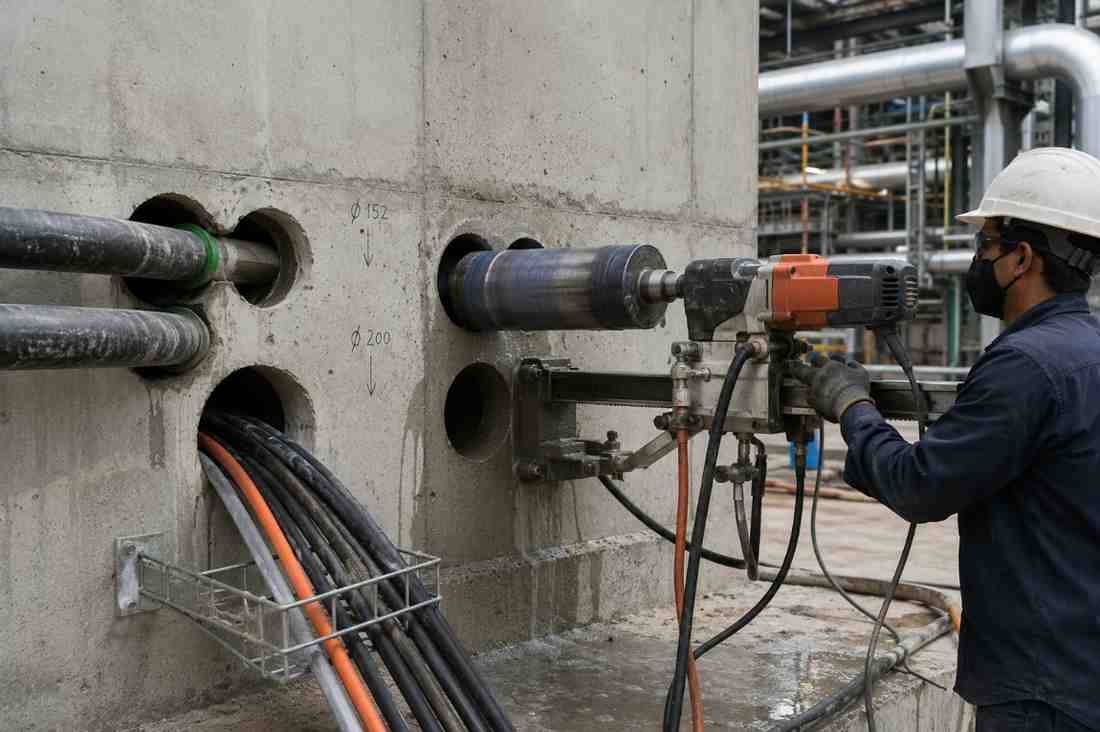
Surat has grown into one of India's most important industrial hubs, home to a thriving textile industry, a globally recognized diamond processing sector, and a rapidly expanding base of manufacturing and chemical units. As these industries scale up, the demand for dependable infrastructure grows alongside them — and one of the most overlooked yet essential parts of that infrastructure is the humble concrete penetration.
Every factory, warehouse, and processing unit depends on a network of utility lines: electrical cabling, water supply and drainage pipes, HVAC ducting, compressed air lines, fire suppression systems, and data cabling. All of these need to pass through concrete floors, walls, and foundations at some point. Doing this correctly — without compromising structural integrity, without unnecessary downtime, and without safety risks — requires specialized concrete penetration services. This is where a professional concrete cutting and core drilling company becomes indispensable.
In this guide, we'll walk through what concrete penetrations for industrial utility lines actually involve, why they matter so much in a city like Surat, the techniques used, and how to choose the right service partner for your facility.
What Are Concrete Penetrations?
Concrete penetration refers to the process of creating precise openings — holes, slots, or channels — through concrete structures such as walls, slabs, beams, and foundations, in order to route utility lines through them. Unlike random demolition, this is a controlled, engineered process that uses specialized equipment to cut clean, accurately sized openings exactly where they're needed.
For industrial facilities, penetrations are typically required for:
- Electrical conduits and cable trays
- Water supply, drainage, and sewage pipelines
- HVAC ductwork and ventilation systems
- Compressed air and gas lines
- Fire sprinkler and suppression piping
- Data and communication cabling
- Machinery foundation bolts and anchoring points
Because industrial buildings often have thick reinforced concrete slabs and structural walls, these penetrations demand precision tools and trained operators — not standard demolition hammers or improvised drilling.
Why Concrete Penetrations Matter for Surat's Industrial Sector
Surat's industrial landscape is unique. The city's textile mills, dyeing and printing units, diamond polishing factories, and chemical processing plants operate in dense industrial zones such as Sachin, Pandesara, Udhna, and Hazira. Many of these facilities run continuous, multi-shift operations, which means any utility installation or upgrade work has to be planned carefully around ongoing production.
A few factors make concrete penetration work especially important in this context:
1. Continuous production environments. Textile and diamond processing units often cannot afford extended downtime. Precision cutting methods allow utility installations to be completed quickly and cleanly, minimizing disruption to machinery and workflow.
2. Retrofitting older industrial buildings. Many industrial units in Surat were constructed years ago and are now being upgraded with modern utility systems — new HVAC lines, additional electrical capacity, upgraded drainage, or fire safety systems. This retrofitting almost always requires cutting into existing concrete structures without weakening them.
3. Structural safety concerns. Reinforced concrete slabs and load-bearing walls are engineered to carry specific loads. Uncontrolled or careless cutting can sever reinforcement bars, crack surrounding concrete, or compromise structural stability. Professional penetration work avoids these risks through careful planning and scanning.
4. Regulatory and safety compliance. Industrial buildings, especially those handling chemicals, dyes, or heavy machinery, must comply with fire safety and building codes. Utility penetrations often need to be sealed and fire-rated correctly after installation to maintain compliance.
Common Techniques Used for Industrial Concrete Penetrations
Different utility lines call for different penetration methods, depending on the size of the opening, the thickness of the concrete, and the location of the work.
Diamond Core Drilling
This is the most widely used method for creating round openings for pipes, cables, and conduits. A diamond-tipped core bit rotates against the concrete surface, cutting a smooth, precise circular hole. Core drilling is valued for being low-vibration, dust-controlled (when done with wet cutting methods), and highly accurate — making it ideal for factories where nearby machinery or delicate equipment cannot tolerate excessive vibration.
Core drilling is commonly used for:
- Single or multiple cable and pipe penetrations
- HVAC duct openings
- Anchor bolt holes for machinery foundations
- Small to medium-sized utility openings in walls, floors, and slabs
Wall Sawing
For larger rectangular or irregular openings — such as those needed for larger ducting, doorways for equipment access, or bigger utility channels — wall sawing is used. This method employs a track-mounted circular saw with a diamond blade to make deep, straight cuts through concrete walls or slabs with high precision.
Wire Sawing
In cases involving very thick concrete, heavily reinforced structures, or unusually shaped openings, wire sawing offers flexibility. A diamond-embedded wire loop is used to cut through concrete of almost any thickness, making it useful for complex industrial retrofit projects.
Slab Sawing (Floor Sawing)
For horizontal penetrations through industrial floors — often needed for underground utility lines, drainage channels, or trenching — slab sawing creates controlled cuts along the floor surface before the concrete section is removed.
The Process: How Professional Concrete Penetration Services Work
A well-executed concrete penetration project generally follows these stages:
1. Site survey and scanning. Before any cutting begins, the area is scanned using ground-penetrating radar (GPR) or rebar detectors to identify the location of embedded steel reinforcement, existing utility lines, and post-tensioned cables. This step is critical to avoid damaging structural elements or live utility lines.
2. Planning and marking. Based on the scan results and the utility routing plan, the exact size and location of each penetration is marked out.
3. Cutting and drilling. Using the appropriate method — core drilling, wall sawing, or wire sawing — the openings are cut with precision, typically using wet-cutting techniques to control dust and reduce heat buildup.
4. Debris removal and cleanup. Concrete slurry and debris are collected and removed, keeping the work area safe and clean, which is especially important in factory environments where dust contamination can affect production.
5. Sealing and fire-stopping. Once utility lines are routed through the penetration, the opening is sealed using fire-rated sealants or fire-stop systems where required, restoring the fire resistance rating of the wall or floor.
Choosing the Right Concrete Penetration Partner in Surat
Given the technical precision and safety considerations involved, industrial facility managers should look for a few key qualities when selecting a concrete cutting contractor:
- Experience with industrial environments. Working around live machinery, production schedules, and hazardous materials requires a different level of planning than residential or commercial projects.
- Proper scanning equipment. A contractor who scans for rebar and embedded utilities before cutting demonstrates a commitment to structural safety.
- Dust and noise control. Wet-cutting methods and containment measures matter greatly in facilities where cleanliness and worker safety are priorities.
- Compliance knowledge. Understanding of fire-stopping requirements and local building codes ensures the work will pass inspection.
- Flexible scheduling. The ability to work during off-peak hours or planned maintenance windows helps minimize disruption to production.
Why Core Cutting India
At Core Cutting India, we specialize in precision concrete cutting and coring services designed specifically for industrial applications across Surat and the surrounding region. Our team works with textile mills, diamond processing units, warehouses, and manufacturing facilities to deliver clean, accurate, and safe concrete penetrations for utility line installations of every kind — electrical, plumbing, HVAC, fire safety, and data infrastructure.
We combine modern diamond drilling and sawing equipment with careful pre-cutting scanning to protect structural integrity, and we work closely with facility teams to schedule cutting work around production timelines wherever possible. Whether you're retrofitting an older industrial building or planning utility routing for a new facility, our team can help design and execute a penetration plan that keeps your operations running smoothly.
If your facility needs reliable concrete penetration services for utility line installation, reach out to our team at [email protected] to discuss your project requirements.
Final Thoughts
Concrete penetrations may seem like a small part of industrial construction and maintenance, but they play a critical role in keeping utility systems functional, safe, and code-compliant. In a fast-growing industrial city like Surat, where factories and processing units operate around the clock, getting this work done right — with precision equipment, proper scanning, and experienced operators — protects both structural safety and business continuity.
Partnering with a specialized concrete cutting company ensures that every penetration, whether it's a single cable opening or a complex multi-utility routing project, is executed cleanly, safely, and with minimal disruption to your operations.
For expert concrete penetration and core drilling services in Surat, contact Core Cutting India at [email protected].