
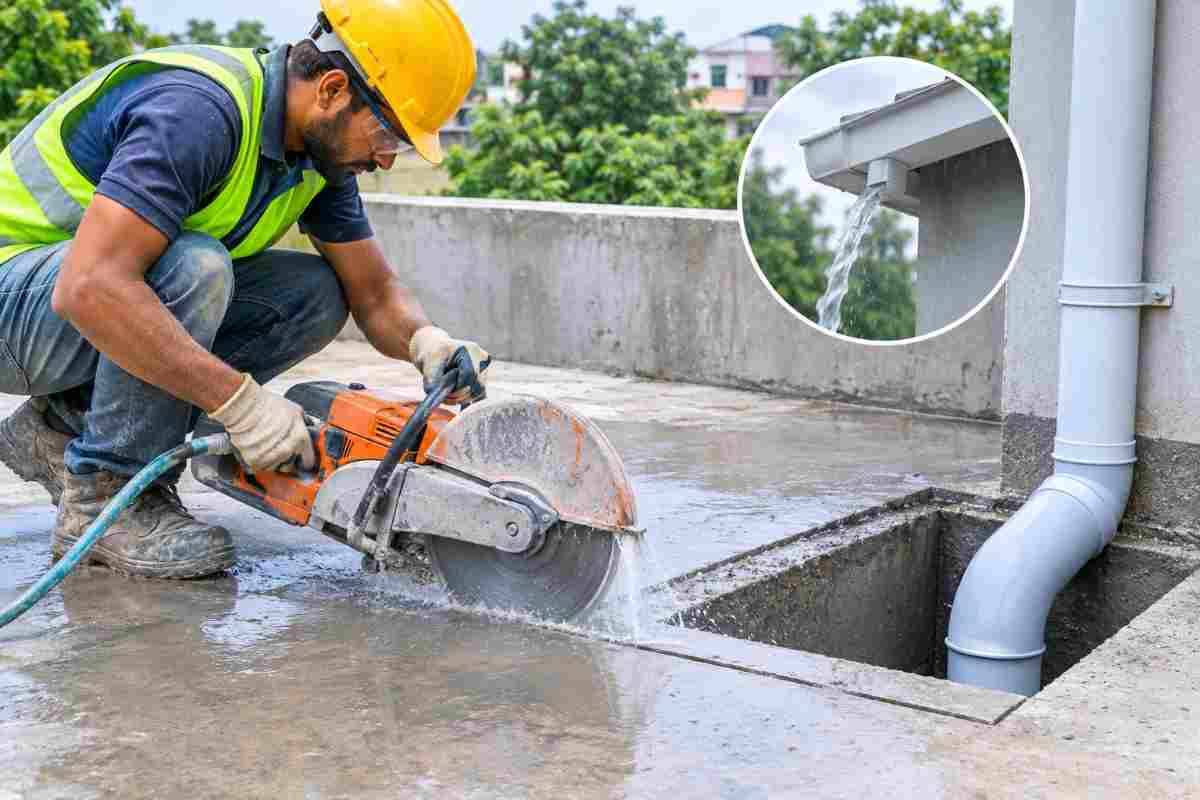
Every building needs a reliable way to move rainwater off its roof, terrace or balcony. When the original drainage plan was missed, the layout changed, or an old outlet has failed, the only solution is to cut a new opening through the concrete slab. Done properly, this gives you a clean, leak-free drainage point. Done badly, it can damage reinforcement, cause cracks and lead to seepage for years.
At Core Cutting India, we handle slab openings for homes, offices, factories and housing societies. This guide explains how concrete slab cutting for rainwater outlet installation works, which methods are best, what to plan for and how to avoid costly mistakes.
Why Rainwater Outlets Need Precise Slab Cutting
A rainwater outlet is a small opening, but it carries a big responsibility. Water that cannot leave a terrace quickly will pond, and standing water is one of the biggest causes of damage in Indian buildings, especially during monsoon.
Poorly placed or poorly cut outlets lead to:
- Water seepage and dampness in ceilings and walls below
- Corrosion of steel reinforcement, which weakens the slab over time
- Cracks and spalling around the opening
- Mosquito breeding and algae growth on terraces
- Costly waterproofing failures
Cutting the opening with the right tool, in the right place and at the right size is the foundation of a good drainage system.
What Is Concrete Slab Cutting?
Concrete slab cutting is the process of creating openings in reinforced concrete (RCC) slabs using diamond-tipped tools. Unlike hammering or breaking, which sends shockwaves through the structure, diamond cutting grinds through the concrete cleanly and with very little vibration.
For rainwater outlets, the most common methods are:
1. Diamond Core Cutting (Core Drilling)
This is the best choice for round openings, which suit most rainwater pipes. A hollow cylindrical diamond bit rotates at high speed, cutting a perfectly circular hole and leaving a solid concrete core that is lifted out. Typical outlet holes range from 50 mm to 200 mm or more, depending on the pipe size and drainage load.
Advantages:
- Smooth, precise, round edges
- Minimal vibration and structural stress
- Little dust when wet cutting is used
- Works through reinforcement steel and thick slabs
2. Slab Saw (Floor Saw) Cutting
When you need a rectangular channel, an expansion opening or a longer trench for a drainage gully, a slab saw with a diamond blade is the right tool. It makes straight, controlled cuts to a specific depth.
3. Wall Saw and Wire Saw Cutting
These are used for very thick slabs or large openings, such as industrial roofs or heavy podium decks. They are less common for standard outlets but useful where extra depth or size is required.
For most residential and commercial rainwater outlets, core cutting is the fastest and cleanest option.
Why Not Just Break the Slab with a Hammer?
Many people try to save money by using a jackhammer or manual breaker. This is risky for several reasons:
- Vibration can crack the surrounding slab and loosen the bond between concrete and steel.
- Edges come out rough and uneven, which makes sealing and waterproofing harder.
- The opening is often larger than needed, so more repair work follows.
- It creates heavy noise and dust, which disturbs occupants and neighbours.
- There is a higher chance of hitting hidden conduits, cables or pipes.
Diamond cutting avoids all of these problems. It is the professional standard for a reason.
Planning the Rainwater Outlet Location
Good installation starts before the machine is switched on. A few planning decisions matter greatly.
Check the Slope
Water flows downhill, so the outlet must sit at the lowest point of the terrace or balcony. If the floor slope (usually 1:80 to 1:100 in Indian construction) leads away from your planned location, the outlet will not drain properly. Mark the lowest point after checking the screed and waterproofing layers.
Decide the Outlet Size
The right diameter depends on the roof area and local rainfall. A larger terrace in a heavy-rain region needs a larger outlet or several smaller ones. As a general guide, common PVC rainwater pipes are 75 mm, 90 mm, 110 mm and 160 mm. The core hole should be slightly larger than the pipe or the outlet sleeve to allow proper fitting and sealing.
Locate Reinforcement and Services
Before cutting, scanning the slab for rebar, post-tension cables, electrical conduits and plumbing lines is strongly advised. In slabs with post-tensioned cables, cutting blindly can be dangerous and expensive. Our team uses detection methods and marks safe cutting zones wherever there is doubt.
Keep a Safe Distance from Beams and Edges
Avoid cutting too close to beams, column heads or slab edges. These are high-stress zones. Where the outlet must be near an edge, an engineer’s opinion may be needed.
Step-by-Step Process of Concrete Slab Cutting for Rainwater Outlets
Here is how a professional job typically proceeds.
Step 1: Site Inspection and Marking
The team visits the site, studies the slab thickness, checks the slope and marks the exact centre of the outlet. Both the top and bottom of the slab are checked so the opening lines up with the drainage pipe below.
Step 2: Scanning for Hidden Elements
The marked zone is checked for rebar and embedded services. If anything is found, the position is adjusted slightly.
Step 3: Machine Setup and Anchoring
The core drilling machine is fixed to the slab using an anchor bolt or a vacuum base. A firm setup prevents the bit from wandering and ensures the hole is perfectly vertical.
Step 4: Wet Cutting with Water Cooling
Water is fed continuously to cool the diamond bit and control dust. This also extends bit life and keeps the cut smooth. A wet vacuum or sponge setup keeps the work area clean, which matters when you are working on a finished floor or above an occupied room.
Step 5: Core Extraction
Once the bit passes through the slab, the concrete core is lifted out. The hole is checked for diameter, edge quality and alignment.
Step 6: Cleaning and Inspection
The opening is cleaned of slurry and debris. If exposed steel is found, it is treated against corrosion.
Step 7: Pipe Fitting and Sealing
The outlet pipe or sleeve is placed, aligned and secured with non-shrink grout or a suitable sealant. A proper collar or flange is added at the top surface so water enters the pipe smoothly.
Step 8: Waterproofing and Finishing
The area around the outlet is waterproofed with a membrane, polymer-modified mortar or a coating. A small depression (a “sump”) around the outlet helps water collect and flow in. A drain cover or grating is then fitted to keep leaves and debris out.
Waterproofing: The Most Overlooked Step
Cutting the hole is only half the job. The junction where the pipe meets the slab is the weakest point for leakage. To make it watertight:
- Use a non-shrink grout between the pipe and the concrete.
- Apply a flexible waterproof membrane extending at least 150 mm around the outlet.
- Turn the membrane into the pipe for a continuous seal.
- Test by ponding water for 24 to 48 hours before final finishing.
This extra care can prevent years of seepage trouble.
Safety Considerations During Slab Cutting
Professional cutting is controlled and safe, but certain precautions are essential:
- Protect the area below. Make sure no one is standing under the slab, and place a catch tray or covering below where needed.
- Use proper PPE. Gloves, goggles, helmets, ear protection and safety shoes are standard.
- Manage water and electricity. Wet cutting needs earthing, ground-fault protection and tidy cable routing.
- Support the core. When cutting through, the core can fall. Retrieval tools or supports prevent damage below.
- Check structural impact. For large or multiple openings, a structural engineer should confirm the slab’s strength is not compromised.
Common Mistakes to Avoid
Cutting at the wrong location. An outlet placed above the lowest point will never fully drain the terrace.
Choosing a pipe that is too small. In heavy rain, a small outlet gets overwhelmed quickly and water overflows.
Skipping rebar detection. Cutting through steel without planning can damage the structure and the bit.
Using hammer and chisel to “enlarge” the hole. This undoes the benefits of clean cutting and can crack the slab.
Ignoring waterproofing. Many leaks come not from the hole itself but from a poorly sealed joint.
Hiring inexperienced labour. An uneven or tilted hole makes pipe fitting difficult and can cause leaks.
Factors That Affect the Cost of Slab Cutting
Pricing varies between projects. The main factors are:
- Hole diameter. Larger bits and longer cutting time cost more.
- Slab thickness. Deeper cuts need more time and bit wear.
- Reinforcement density. Heavily reinforced slabs are slower to cut.
- Number of holes. Multiple outlets in one visit are often more economical.
- Access and height. Upper floors, tight spaces or terraces without lift access add effort.
- Location and travel. Distance from the service base can affect charges.
- Cutting method. Core drilling, slab sawing and wall sawing are priced differently.
A site visit gives the most accurate quotation, and a good provider will explain the cost clearly before starting.
Where Is Slab Cutting for Rainwater Outlets Needed?
This service is useful in many situations:
- Residential terraces and balconies where drainage was not planned or has blocked
- Commercial buildings and malls with large roof areas
- Factories and warehouses with heavy-rain drainage requirements
- Parking decks and podiums that need quick water removal
- Renovation and retrofit projects where layouts have changed
- Housing societies upgrading old, failing drainage points
Why Choose Core Cutting India?
Core Cutting India specialises in precision concrete cutting using modern diamond tools. Our approach is built around accuracy, cleanliness and safety.
- Experienced operators who understand slab structure and reinforcement
- Modern diamond core drilling equipment for clean, accurate holes
- Low-vibration, low-dust methods that protect your property
- Careful site planning to avoid hidden services
- Transparent communication on timing and cost
- Support for residential, commercial and industrial projects
Whether you need a single outlet on a home terrace or several openings across a large commercial roof, we plan the work so that it is neat, safe and long-lasting.
Maintenance Tips After Installation
A good outlet still needs care:
- Clean the drain cover before every monsoon.
- Remove leaves, plastic and silt regularly.
- Inspect the waterproofing around the outlet once a year.
- Check the pipe joints for leakage after heavy rain.
- Make sure the terrace slope remains clear of obstructions.
Simple upkeep can extend the life of both the outlet and the slab.
Frequently Asked Questions (People Also Ask)
How do you cut a hole in a concrete slab for a drain pipe?
The cleanest method is diamond core drilling. A machine with a hollow diamond bit is anchored to the slab and cuts a precise circular hole, using water for cooling. The core is then removed and the pipe is fitted and sealed.
Can you cut a concrete slab without damaging it?
Yes. Diamond cutting creates very little vibration and leaves smooth edges, so the surrounding concrete stays intact. Scanning for rebar and services first reduces risk further.
How thick a slab can be core cut?
Professional core drilling machines can cut through slabs well over 500 mm thick, depending on the bit length and equipment. Standard terrace slabs of 100 mm to 200 mm are cut easily.
What size hole is needed for a rainwater outlet?
It depends on the pipe. For common 75 mm, 90 mm or 110 mm pipes, the hole is cut slightly larger to allow fitting and grouting. Larger roofs may need bigger outlets or additional ones.
How many rainwater outlets does a terrace need?
There is no single rule, as it depends on roof area, slope and local rainfall. Larger terraces usually need more than one outlet to avoid ponding. A site assessment helps determine the right number.
Is it safe to cut through rebar?
Cutting through isolated rebar is common and safe with diamond tools. However, in post-tensioned slabs or heavily reinforced zones, the location must be planned carefully to avoid critical cables and bars.
How long does slab cutting for a drain outlet take?
A single standard hole often takes under an hour of actual cutting, though setup, marking and cleanup add to the total time. Thick or heavily reinforced slabs take longer.
How do I stop leakage around a new rainwater outlet?
Use non-shrink grout around the pipe, apply a flexible waterproofing membrane extending beyond the opening, and test with water ponding before finishing.
Is core cutting better than breaking concrete?
Yes, in almost every case. Core cutting is more accurate, produces less noise and vibration, and protects the surrounding structure.
Final Thoughts
A rainwater outlet may look like a small detail, but it plays a major role in the health of your building. The right location, the right size and a clean diamond-cut opening make the difference between a drainage system that lasts decades and one that causes recurring leaks.
If you are planning a new outlet or upgrading an old one, trust professionals who understand both the cutting and the waterproofing that follows. Reach out to Core Cutting India for a site assessment and a clear quotation.
Get in Touch
Website: https://corecuttingindia.com/
Call or WhatsApp: +91 70096 79903
Precision concrete cutting for cleaner, safer, longer-lasting drainage.