
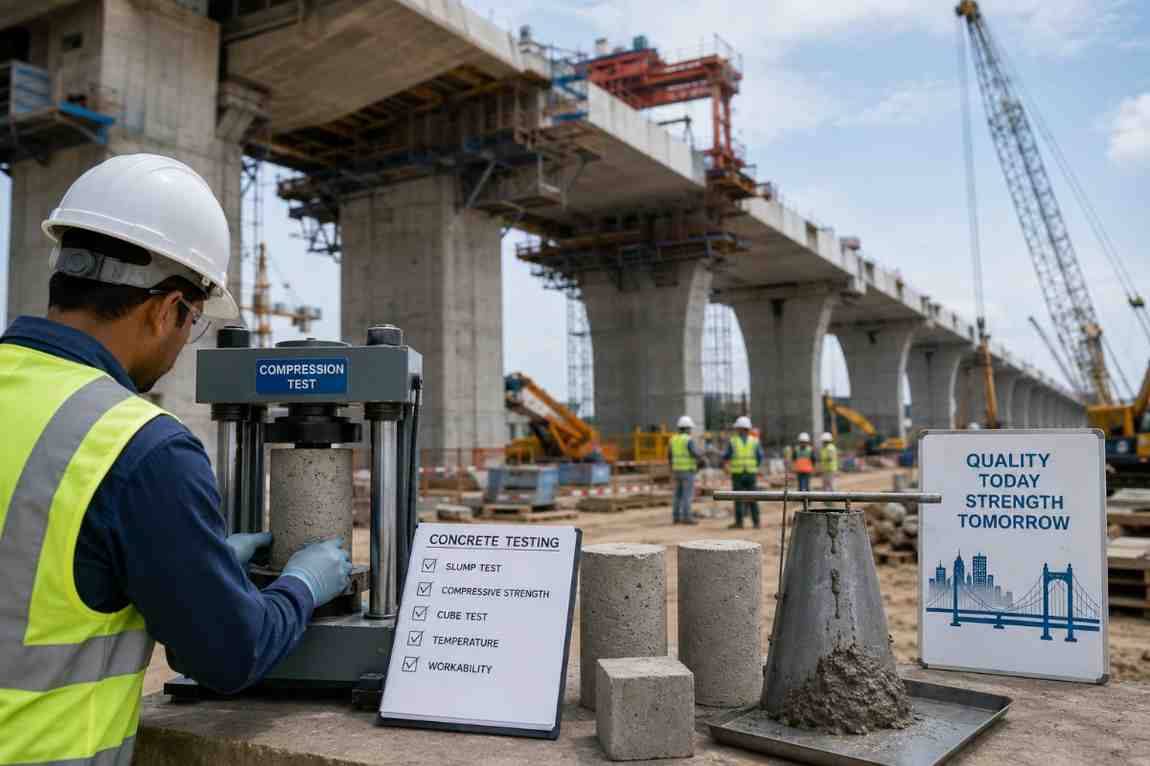
Introduction
Large infrastructure projects—ranging from sprawling multi-lane highways and high-speed railway networks to soaring skyscrapers and massive dams—form the backbone of modern civilization. These structures are designed to endure for decades, often centuries, bearing immense environmental loads, heavy traffic volumes, and severe weather conditions. At the core of every single one of these engineering marvels is a fundamental construction material: concrete.
However, concrete is not a static substance; it is a complex composite whose final strength, durability, and performance depend heavily on mix design, environmental conditions during curing, placement techniques, and internal composition. Because the failure of a bridge pier, a tunnel lining, or a foundation raft can lead to catastrophic structural collapse and loss of life, rigorous quality assurance is non-negotiable.
This is where concrete testing comes into play. By employing a comprehensive suite of destructive and non-destructive testing (NDT) methodologies, engineers can peer inside cured structures, verify material properties, catch anomalies early, and guarantee compliance with rigorous international and national building codes.
In this exhaustive guide, we explore the critical role of concrete testing in large infrastructure projects, examining the testing lifecycle, modern methodologies, regulatory frameworks, and how specialized services provided by industry leaders like [email protected] safeguard the future of modern construction.
The Critical Importance of Quality Control in Infrastructure
Infrastructure development involves capital investments worth billions of dollars and impacts millions of lives daily. Unlike residential buildings, where load requirements are relatively uniform and lower, infrastructure projects endure dynamic, cyclic, and extreme loads.
Quality control (QC) and Quality Assurance (QA) in concrete construction are designed to mitigate risks at every phase of the project lifecycle. Without systematic testing, project managers face several severe vulnerabilities:
-
Premature Structural Degradation: Voids, honeycombing, or inadequate curing can lead to moisture ingress, steel reinforcement corrosion, and spalling.
-
Compliance Failures: Deviations from specified compressive strength requirements can result in costly legal disputes, project delays, and mandatory demolition.
-
Safety Hazards: Unverified structural elements present immediate safety risks to construction workers and future end-users.
Effective concrete testing shifts the paradigm from reactive repairs to proactive quality verification. It provides objective, data-driven insights that instill confidence among stakeholders, investors, and regulatory bodies.
The Concrete Testing Lifecycle: From Mix Design to Post-Construction
To understand how concrete testing functions in large projects, we must examine the testing lifecycle, which spans three distinct phases: pre-construction, construction, and post-construction.
[Pre-Construction Phase] -> Material Selection & Mix Design Verification
         |
[Construction Phase]    -> Fresh Concrete Tests & Early-Age Curing Checks
         |
[Post-Construction]     -> Hardened Concrete Tests, NDT & Core Cutting Analysis
1. Pre-Construction Phase: Mix Design and Raw Material Testing
Before a single cubic meter of concrete is poured on site, the constituent materials—cement, fine aggregates (sand), coarse aggregates, water, and chemical admixtures—must undergo strict laboratory testing.
-
Aggregate Grading and Sieve Analysis: Ensures the particle size distribution promotes optimal packing density and minimizes voids.
-
Cement Consistency and Setting Time: Verifies that the binding agent sets at a predictable rate under standard temperatures.
-
Trial Mix Prototyping: Laboratories create trial batches to achieve the target compressive strength and workability specified by structural engineers.
2. Construction Phase: Fresh Concrete Testing
Once pouring commences on site, rapid, routine tests are conducted on fresh concrete batches delivered by transit mixers to verify consistency and workability before placement.
-
Slump Test: Measures the workability and consistency of fresh concrete to ensure it can be placed and compacted easily without segregation.
-
Air Content Test: Determines the volume of air entrapped in the concrete mix, which is crucial for freeze-thaw resistance in cold climates.
-
Temperature Measurement: Ensures concrete temperature stays within acceptable limits to prevent thermal cracking during early hydration.
3. Post-Construction and Hardened Concrete Testing
After the concrete has hardened and cured, testing shifts toward evaluating its in-situ mechanical properties and long-term durability. This is where advanced diagnostic techniques, such as core cutting and non-destructive testing, become indispensable.
Key Methodologies in Concrete Testing
Modern civil engineering utilizes a balanced mix of destructive and non-destructive testing methods. While destructive testing provides definitive mechanical strength values, non-destructive testing allows engineers to evaluate large surface areas without causing structural damage.
Destructive Testing: Core Cutting and Compressive Strength
When engineers need definitive proof of a structure's internal strength, core cutting is the gold standard.
-
The Process: Specialized diamond-tipped core drills extract cylindrical specimens (cores) directly from hardened structural elements like columns, beams, or slabs.
-
Laboratory Testing: These cores are capped and placed in a compression testing machine until failure, providing an exact measure of in-situ compressive strength.
-
Applications: Resolving disputes over low cube test results, evaluating older structures during retrofitting, or verifying structural integrity after a fire or seismic event. Partnering with seasoned experts via [email protected] ensures that core extraction is performed precisely without compromising surrounding reinforcement.
Non-Destructive Testing (NDT) Techniques
Non-destructive testing allows engineers to assess concrete properties rapidly across vast infrastructure networks.
-
Rebound Hammer Test (Schmidt Hammer): A spring-loaded mass impacts the concrete surface, and the rebound distance is measured. It provides a quick, qualitative assessment of surface hardness and uniformity across large areas.
-
Ultrasonic Pulse Velocity (UPV) Test: Transducers send high-frequency ultrasonic pulses through the concrete. The velocity of the pulse correlates directly with the density, homogeneity, and presence of internal flaws, cracks, or voids.
-
Rebar Locator and Cover Meter Test: Uses electromagnetic induction to locate steel reinforcement bars (rebar) inside concrete and measure the thickness of the concrete cover protecting them from corrosion.
-
Half-Cell Potential Method: Evaluates the corrosion probability of steel reinforcement by measuring electrical potential differences on the concrete surface.
Concrete Testing in Specialized Infrastructure Sectors
Different types of infrastructure impose unique structural demands on concrete, necessitating tailored testing regimes.
1. Highways, Expressways, and Bridges
Highways and bridges experience massive dynamic loads from heavy freight traffic, combined with environmental exposure to de-icing salts and extreme temperature fluctuations.
-
Key Focus Areas: Pavement thickness verification, skid resistance, and chloride penetration resistance.
-
Testing Methods: Falling Weight Deflectometer (FWD) for pavement structural evaluation and core sampling for asphalt/concrete bond strength.
2. Tunnels and Underground Structures
Underground infrastructure faces relentless hydrostatic pressure, groundwater infiltration, and aggressive chemical environments.
-
Key Focus Areas: Shotcrete thickness, lining integrity, and waterproofing performance.
-
Testing Methods: UPV testing for lining voids and localized core extraction for permeability analysis.
3. Dams and Water Retaining Structures
Mass concrete structures like dams must resist immense hydrostatic pressure and thermal stresses caused by the heat of hydration in thick pours.
-
Key Focus Areas: Internal thermal gradients, micro-cracking, and seepage paths.
-
Testing Methods: Embedded thermocouples during construction, sonic logging, and extensive core drilling.
Target-Related Searches & People Also Ask (PAA) Insights
To maximize the value of this guide for engineering professionals, project planners, and researchers, we address the most common queries and search intents associated with concrete testing.
Target-Related Searches Integrated:
-
Concrete core cutting testing services
-
Non-destructive testing of concrete structures
-
Compressive strength testing of hardened concrete
-
In-situ concrete quality control methods
-
Bridge and highway structural integrity testing
People Also Ask (PAA):
Q1: What is the main purpose of concrete core testing?
Answer: Concrete core testing is performed to determine the actual in-situ compressive strength, density, and internal condition of hardened concrete when standard curing cylinder or cube tests are in doubt, or when evaluating existing or older structures for retrofitting.
Q2: What is the difference between destructive and non-destructive concrete testing?
Answer: Destructive testing (such as core cutting and compression tests) physically alters or damages a small sample of the structure to measure exact material properties. Non-destructive testing (such as Schmidt hammer and UPV tests) evaluates structural properties using sound waves, electromagnetic fields, or surface rebound without causing any structural damage.
Q3: How often should concrete testing be conducted on a large infrastructure site?
Answer: Testing frequency is dictated by international standards (such as ASTM, IS, or BS codes) and project specifications. Typically, fresh concrete slump and temperature tests are conducted for every batch or truckload, while compressive strength cylinder/cube tests are performed at intervals of 7, 14, and 28 days for every specified volume of poured concrete.
Best Practices for Implementing a Concrete Testing Program
Executing a successful testing program on a multi-million-dollar infrastructure project requires rigorous adherence to professional protocols:
-
Standardization and Accreditation: Ensure that all testing laboratories and technicians are certified and accredited by recognized bodies (such as NABL, ISO, or equivalent national standards).
-
Calibrated Equipment: All testing devices—from compression machines to ultrasonic transducers—must undergo regular calibration to prevent measurement drift.
-
Comprehensive Documentation: Maintain a centralized, digital QA/QC database where every test result, core location map, and batch report is logged and cross-referenced with structural grid drawings.
-
Early Intervention Protocols: Establish clear thresholds for failing test results so that engineering teams can immediately halt work, investigate causes, and execute remedial measures before subsequent construction layers are poured.
Conclusion
Concrete testing is much more than a regulatory checkbox; it is the ultimate safeguard of public safety, economic investment, and engineering excellence in large infrastructure projects. From initial mix design verifications in the laboratory to precision core cutting and advanced non-destructive evaluations on completed mega-structures, rigorous testing ensures that our built environment stands strong against the test of time.
For professional, reliable, and high-precision concrete testing, core cutting, and structural assessment services tailored to your upcoming infrastructure projects, connect with industry experts at [email protected] and build your legacy on a foundation of absolute certainty.