
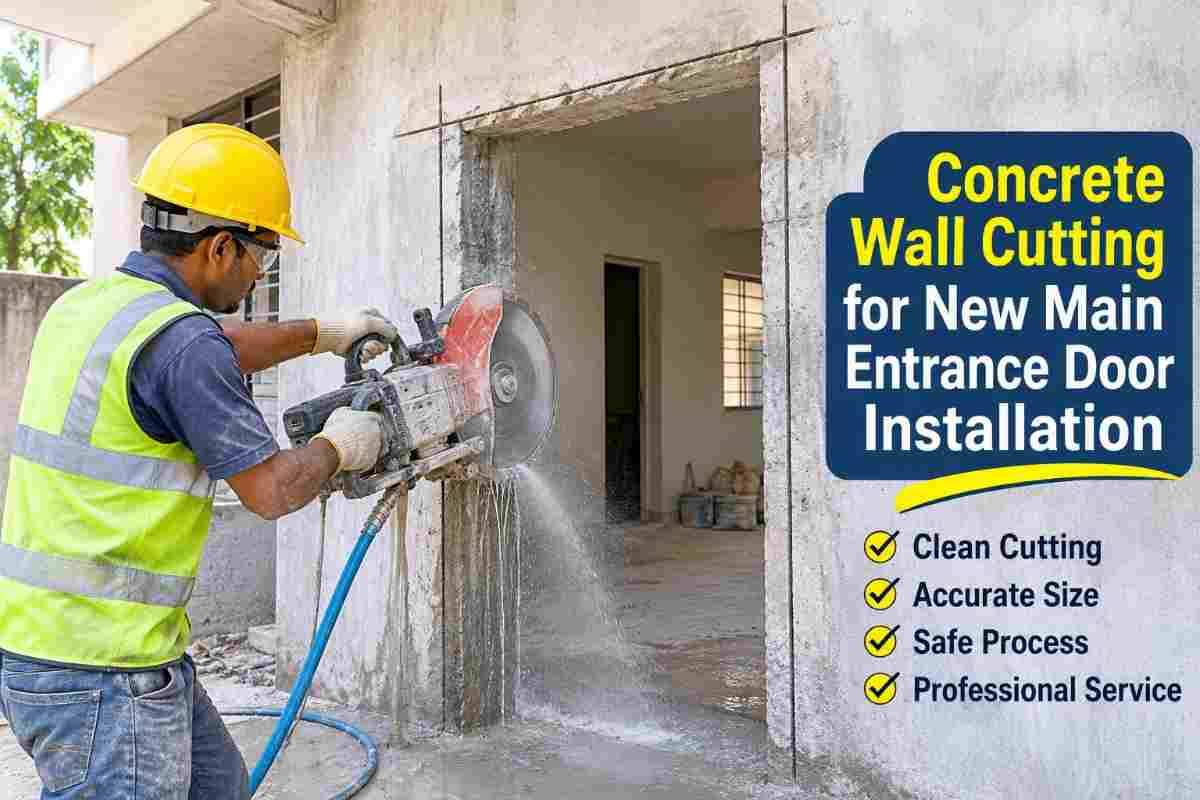
A main entrance is the first thing people see when they arrive at your home, office, showroom, or warehouse. Sometimes the existing entrance no longer works. The layout may have changed, traffic may have grown, or you may simply want a grander, more accessible doorway. When the wall in the way is made of concrete, the job calls for precision equipment and experienced operators, not a hammer and chisel.
This guide explains how concrete wall cutting works for a new main entrance door, what to plan before work begins, how the process unfolds, and how to choose the right contractor. It is written by the team at Core Cutting India, specialists in controlled concrete cutting, coring, and wall sawing.
Why Cut a New Main Entrance in a Concrete Wall?
Most people think of cutting a doorway when they renovate, but the reasons go well beyond aesthetics:
- Changing the layout: Shifting a main entrance can improve the flow of a house, shop, or office.
- Better accessibility: A wider opening can accommodate wheelchairs, trolleys, and equipment.
- Commercial expansion: Showrooms, clinics, and warehouses often need larger or additional entrances as business grows.
- Vastu or design preferences: Many homeowners in India relocate entrances for Vastu alignment or a better facade.
- Merging properties: Connecting two adjoining units requires a new opening in a shared concrete wall.
- Emergency or fire exits: Safety regulations may require additional egress points.
Whatever the reason, the goal is the same: a clean, accurate opening that does not weaken the rest of the structure.
Why Traditional Demolition Is a Bad Idea
Breaking a concrete wall with a sledgehammer or a heavy jackhammer is slow, noisy, and unpredictable. The vibration travels through the structure and can create hairline cracks in neighbouring walls, slabs, and beams. The edges come out ragged, and the debris and dust spread through the building.
Professional wall cutting avoids these problems. A diamond-tipped blade or wire slices through concrete and steel reinforcement in a straight, controlled line. The result is a precise opening with smooth edges that is ready for a door frame with minimal finishing work.
Understanding Your Wall Before You Cut
Not every wall is the same, and the first question is always whether the wall is load-bearing or non-load-bearing.
Non-load-bearing walls (partition walls or infill walls) carry only their own weight. Cutting an opening is comparatively straightforward.
Load-bearing walls support slabs, beams, or floors above. Cutting an opening here without proper engineering can cause serious structural damage. Before any cut, a qualified structural engineer should assess the wall and, if required, specify a lintel, a header beam, or temporary props to carry the load around the new opening.
Other things to confirm before cutting:
- Wall thickness: This determines the type and size of the saw, and how many passes are needed.
- Reinforcement: RCC walls contain steel bars. Diamond tools cut through them, but the operators need to know the density to plan the cut.
- Hidden services: Electrical conduits, water pipes, and gas lines may run inside or behind the wall.
- Adjacent structures: Nearby windows, columns, and shared walls affect how and where the cut is made.
Methods of Concrete Wall Cutting
Depending on the wall, the site, and the required opening size, one or more of the following methods is used.
1. Wall Saw Cutting
A track-mounted wall saw is the most common choice for door openings. The machine is fixed to the wall on a rail, and a large diamond blade, often hydraulically powered, cuts through the concrete in precise, straight lines. Wall saws can cut thick walls, produce exact dimensions, and work at various angles. They are well suited to large main entrance openings.
2. Wire Saw Cutting
Wire saws use a diamond-impregnated cable looped around the section to be cut. They are ideal for very thick walls, heavily reinforced concrete, or places where a circular blade cannot reach. They are slower to set up but remarkably versatile.
3. Hand Saw or Ring Saw Cutting
For smaller openings, tight spaces, or finishing corners, a handheld ring saw or hand saw can be used. They are portable and handy for areas where larger machines do not fit.
4. Core Drilling for Corners
Core drilling is often combined with wall sawing. Overlapping holes are drilled at the corners of the opening so the saw cut can finish cleanly without over-cutting into the wall beyond the marked line. This keeps the corners sharp and the structure intact.
Step-by-Step: How a New Main Entrance Is Cut
Here is how a well-managed concrete wall cutting job typically proceeds.
Step 1: Site Inspection and Planning
The contractor visits the site, studies the wall, reviews drawings, and discusses the exact size and position of the opening. At this stage, the structural engineer’s recommendations are reviewed, and any need for propping or a lintel is confirmed.
Step 2: Marking the Opening
The door outline is carefully marked on the wall, accounting for the door frame size, the clearance required, and the finished floor level. Accurate marking is essential, since concrete cannot be put back once cut.
Step 3: Safety Setup and Protection
The area is cleared and barricaded. Floors, furniture, and nearby surfaces are covered. Temporary supports are installed if the wall is structural. Water supply, slurry collection, and power connections are arranged.
Step 4: Core Drilling at Corners
Holes are drilled at the corners of the marked opening. This allows the saw blade to complete each line without overshooting.
Step 5: Wall Sawing
The wall saw is mounted and aligned. Cutting proceeds along the marked lines, with water cooling the blade and suppressing dust. Depending on wall thickness and reinforcement, several passes may be needed.
Step 6: Removing the Cut Section
Once cut free, the concrete block is secured and removed. For heavy sections, the block is cut into smaller pieces and lifted out with care, so nothing falls unexpectedly.
Step 7: Finishing and Handover
Edges are inspected and, where needed, smoothed. The opening is cleaned, slurry is collected, and the debris is removed from site. The opening is now ready for the lintel (if not already installed), door frame fixing, plastering, and finishing.
Benefits of Professional Concrete Wall Cutting
Precision: Cuts follow your exact measurements, so the door frame fits properly the first time.
Minimal vibration: Diamond cutting causes far less vibration than breaking, protecting the rest of the building.
Clean edges: Smooth, straight edges reduce plastering and finishing effort.
Less dust and noise: Wet cutting controls dust, and the process is much quieter than heavy demolition, which matters in occupied homes, offices, and shops.
Speed: A job that might take days with manual breaking can often be done in hours.
Safety: Controlled cutting, planned propping, and trained operators significantly lower the risk of accidents and structural damage.
Cost efficiency over time: Less rework, less repair, and less cleanup usually offset the cost of professional equipment.
What to Prepare Before the Cutting Team Arrives
A little preparation makes the work smoother and safer.
- Get structural advice if the wall is load-bearing or you are unsure.
- Finalize your door size and frame type before cutting. Allow extra clearance for the frame and finishing.
- Clear the area of furniture, electronics, and valuables on both sides of the wall.
- Arrange water and power access near the work area.
- Inform neighbours, particularly in apartment buildings or shared complexes.
- Check permissions. Society rules, building by-laws, or landlord approval may be required for structural modifications.
- Plan debris removal. Know where the cut concrete will be taken and how it will be moved out.
Factors That Affect the Cost of Concrete Wall Cutting
Pricing is not one-size-fits-all. The main factors include:
- Wall thickness and concrete grade: Thicker, denser walls take longer and wear blades faster.
- Amount of reinforcement: Heavy steel increases cutting time.
- Size of the opening: Larger openings mean more linear metres of cutting.
- Accessibility: Upper floors, tight spaces, or restricted access add complexity.
- Equipment needed: Wall saw, wire saw, or a combination.
- Debris handling: Whether removal and disposal are included.
- Location and timing: Travel distance and any after-hours work requirements.
The best way to get a reliable figure is a site visit and a written quote that clearly lists what is included.
Common Mistakes to Avoid
Cutting before an engineering check. This is the most serious error. Never assume a wall is non-structural.
Choosing the cheapest option blindly. Poor equipment or untrained operators can cost far more in repairs.
Ignoring hidden utilities. Cutting into live cables or pipes is dangerous and expensive.
Wrong door dimensions. Measure twice, and confirm frame dimensions with your carpenter or door supplier before the cut.
Skipping safety measures. Dust control, barricading, and propping are essential, not optional.
How to Choose the Right Concrete Cutting Contractor
When you compare providers, look for the following:
- Experience with RCC wall cutting and door openings specifically
- Modern diamond equipment, including wall saws and wire saws
- Trained operators who understand structures and safety
- Clear, written quotations with no hidden extras
- Dust and slurry management practices
- References or past work you can verify
- Responsive communication before, during, and after the job
Why Choose Core Cutting India?
At Core Cutting India, we specialize in precision concrete cutting for residential, commercial, and industrial projects. Our team uses modern diamond cutting equipment and follows careful safety and cleanliness practices, so your new main entrance is cut accurately with minimal disturbance to your property.
Whether you are opening up a wall in a home, adding an entrance to a showroom, or modifying a factory or warehouse, we help you plan the cut, protect the surrounding structure, and deliver a clean opening ready for your door frame.
Frequently Asked Questions (People Also Ask)
Can you cut a door opening in a concrete wall?
Yes. A door opening can be cut in a concrete wall using a wall saw, wire saw, or similar diamond cutting equipment. If the wall is load-bearing, a structural engineer should confirm the design and any supports required before cutting begins.
How do you cut a new door opening in an RCC wall?
The opening is marked, corners are core drilled, and the wall is cut along the lines with a diamond wall saw. The concrete section is then safely removed, and the edges are cleaned. For structural walls, a lintel or beam is added to carry the load above the opening.
Is it safe to cut a door in a load-bearing wall?
It can be done safely, but only with proper engineering. A qualified engineer must assess the wall, design a lintel or header, and specify temporary support during the work. Never cut a load-bearing wall without this step.
How long does it take to cut a main entrance in a concrete wall?
A standard door opening can often be cut in a few hours to a day, depending on wall thickness, reinforcement, and access. Preparation, propping, and finishing may add additional time.
How much does concrete wall cutting cost?
Cost depends on wall thickness, opening size, reinforcement, equipment, and site conditions. Most professionals price by the running metre or by the job. A site inspection gives the most accurate quote.
Is concrete wall cutting noisy or dusty?
Compared with demolition, it is much quieter and cleaner. Wet cutting keeps dust down, and slurry is collected and removed. Some noise is unavoidable, but it is usually far less disruptive than breaking with heavy hammers.
Do I need permission to cut a new door in a wall?
Often, yes. Apartment societies, housing complexes, and local authorities may require approval for structural changes. Check your building rules and get permission before cutting.
What is the difference between wall sawing and wire sawing?
Wall sawing uses a rigid circular blade on a track for straight, precise cuts. Wire sawing uses a flexible diamond cable and is better for very thick walls, awkward shapes, or hard-to-reach areas.
After the Cut: Fitting Your New Main Entrance Door
Once the opening is ready, the finishing stages begin:
- Lintel or beam installation (if required) to support the wall above
- Frame fixing with proper alignment and levelling
- Grouting and plastering around the frame
- Door shutter installation and hardware fitting
- Painting and final finishing
Because a professionally cut opening has straight, clean edges, the frame fits more accurately, and finishing is faster and neater.
Final Thoughts
A new main entrance can transform how a building looks, feels, and functions. But the quality of the result depends heavily on how the wall is cut. Precision cutting protects the structure, keeps the job clean, and gives you an opening that fits your door perfectly.
If you are planning a new entrance, start with a proper assessment, involve a structural engineer when needed, and choose a contractor with the right equipment and experience.
Ready to get started? Contact Core Cutting India today for a free consultation and site inspection.
📞 Call: +91 70096 79903
🌐 Website: https://corecuttingindia.com/