
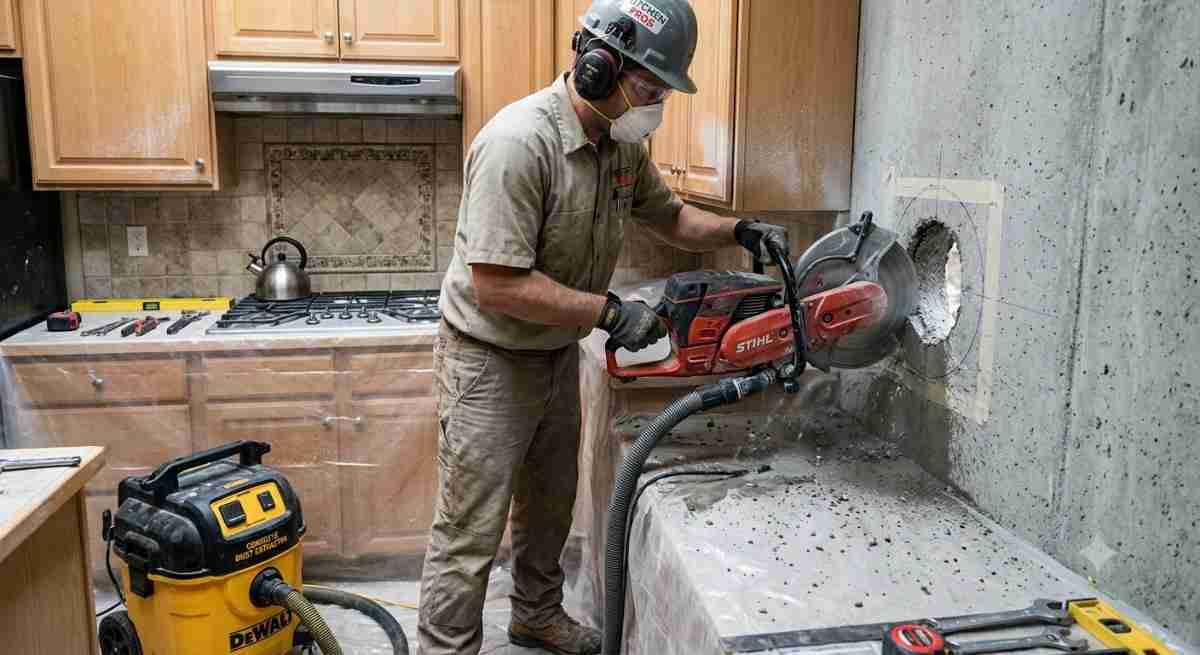
Modern kitchens require efficient ventilation to maintain a clean, breathable, and hygienic cooking environment. Whether you are operating a high-end commercial restaurant kitchen or setting up a robust ventilation system in a residential high-rise, cooking produces smoke, grease, steam, and airborne particulates that must be immediately evacuated. While installing a chimney or exhaust fan in a wooden partition or dry-walled structure is straightforward, dealing with modern reinforced cement concrete (RCC) or brick masonry load-bearing walls presents a structural challenge.
Creating a precise circular or rectangular opening through thick concrete requires specialized machinery, expert diamond-cutting techniques, and strict adherence to structural safety protocols. This comprehensive guide explores everything you need to know about concrete wall cutting for kitchen exhaust fan installation—from machinery and methodologies to safety, compliance, and professional service execution.
Why Professional Concrete Wall Cutting is Essential for Kitchen Ventilation
Many homeowners and interior contractors make the critical mistake of attempting improvised methods—such as hammering, chisel drilling, or using light-duty masonry bits—to create exhaust openings in concrete walls. This approach introduces severe risks:
-
Structural Compromise: Uncontrolled hammering and heavy impact shocks create micro-fractures in the surrounding concrete matrix, weakening the structural load-bearing capacity of the wall.
-
Reinforcement Damage: Concrete walls invariably contain steel rebar grids. Standard drills can get jammed or snap when hitting rebar, leaving jagged edges and exposed steel susceptible to rust.
-
Aesthetic Ruin: Chipping away at concrete leaves rough, uneven cavities that are nearly impossible to seal properly, leading to air leaks, pest entry, and water seepage.
-
Time and Labor Waste: Manual chipping is excruciatingly slow, physically exhausting, and yields unprofessional results.
Professional diamond core cutting and wall sawing utilize diamond-impregnated rotary barrels or track-mounted blades. These tools grind through both aggregate concrete and steel reinforcement cleanly, leaving a smooth, perfectly dimensioned core hole without imparting shock loads to the surrounding structure.
Target-Related Searches & Search Intent
To ensure optimal visibility and address what users are actively searching for across search engines and conversational AI platforms, this guide addresses the following core intent pillars:
-
Core cutting services for kitchen exhaust near me
-
RCC wall core cutting charges for chimney and ventilation
-
How to make a hole in a concrete wall for an exhaust fan
-
Diamond core drilling for kitchen hood extraction pipe
-
Core cutting contractors for residential and commercial kitchens
People Also Ask (PAA): Common Questions Answered
Can I cut a concrete wall myself to install an exhaust fan?
Cutting reinforced concrete requires heavy-duty industrial machinery, constant water cooling to suppress dust, and precise alignment to prevent structural damage. Doing this without professional equipment risks severe wall fracturing and personal injury. It is always recommended to hire trained operators.
What size hole is required for a standard kitchen exhaust fan?
Hole sizes vary based on the fan capacity and duct diameter. Standard residential exhaust fans and chimney pipes typically require core diameters ranging from 4 inches (100 mm) to 8 inches (200 mm), while commercial kitchen hoods often require larger openings between 10 inches and 12 inches (250 mm to 300 mm) or rectangular custom wall sawed ducts.
Does core cutting damage the structural integrity of the wall?
When executed correctly using rotary diamond core drills, the process creates smooth stress-free holes and leaves the surrounding structure completely intact. However, cutting through primary structural beams or heavily loaded columns without structural assessment should be avoided.
Detailed Step-by-Step Installation & Cutting Process
Executing a clean, accurate exhaust fan opening through an RCC wall involves a carefully choreographed engineering workflow:
1. Site Inspection and Structural Assessment
Before touching any machinery, technicians inspect the wall to determine its composition (RCC, brick, or stone masonry), thickness (typically ranging from 6 inches to 12 inches or more), and proximity to electrical conduits, plumbing lines, or primary structural support columns.
2. Marking and Center-Punching
The exact dimensions of the exhaust duct or sleeve are marked on both the interior and exterior surfaces of the wall to ensure absolute alignment. A pilot hole is drilled at the exact center point to anchor the heavy-duty core drilling rig securely.
3. Rig Setup and Water Cooling Connection
A professional diamond core drilling machine is bolted or vacuum-anchored to the wall. Because high-speed diamond cutting generates intense friction, a continuous water feed system is connected to the rig. Water serves two vital purposes:
-
It cools the diamond segments, extending the lifespan of the core bit.
-
It instantly traps silica dust, turning concrete debris into a heavy slurry and keeping the indoor environment clean.
4. Core Extraction
The motor is engaged, and the diamond barrel smoothly advances through the concrete composite, cleanly slicing through both coarse aggregates and internal steel reinforcement bars. Once the depth is reached, the cylindrical concrete core plug is extracted, revealing a flawless circular opening.
5. Finishing and Waterproofing
The edges of the newly cut core hole are cleared of debris and treated with waterproofing agents or sealant around the PVC sleeve/duct pipe to prevent moisture ingress, air drafts, and insect entry.
Technical Specifications & Equipment Used
Professional contractors rely on advanced engineering gear to deliver precise results:
-
Diamond Core Drill Motors: High-torque electric or hydraulic motors capable of spinning core bits from 2 inches up to 24 inches in diameter.
-
Industrial Diamond Bits: Segmented crowns infused with industrial diamond crystals designed to abrade hard aggregate and steel rebar seamlessly.
-
Wall Saws and Ring Saws: Utilized when rectangular openings are required for large industrial exhaust hoods or louvered ventilation boxes.
-
Slurry Containment Systems: Wet vacuum units that capture wastewater instantly during drilling, protecting interior walls, flooring, and modular kitchen cabinets.
Safety Standards and Best Practices
Executing concrete cutting inside finished residential apartments or active commercial kitchens requires strict safety protocols:
-
Electrical Safety: Technicians use scan tools to detect live electrical cables buried inside the concrete prior to drilling. Ground-fault circuit interrupters (GFCIs) protect all power equipment.
-
Personal Protective Equipment (PPE): Operators wear heavy-duty hearing protection, eye shields, steel-toe footwear, and waterproof gear.
-
Dust and Water Control: Plastic sheeting, containment zones, and wet vacuums ensure that surrounding furniture, appliances, and finishes remain pristine.
Partner with Professionals for Flawless Execution
Attempting DIY modifications on load-bearing concrete walls can lead to costly structural repairs, uneven openings, and installation delays. Entrusting your kitchen ventilation project to experienced specialists guarantees precision, speed, and structural safety.
For expert concrete cutting, core drilling, and wall sawing services tailored to your exact kitchen specifications, connect with our professional team today:
-
Website: https://corecuttingindia.com/
-
Instant Rate Estimator: https://corecuttingindia.com/rate-calculator/
-
Direct Call & WhatsApp: +91 70096 79903
-
Email Inquiries: info@corecuttingindia.com