
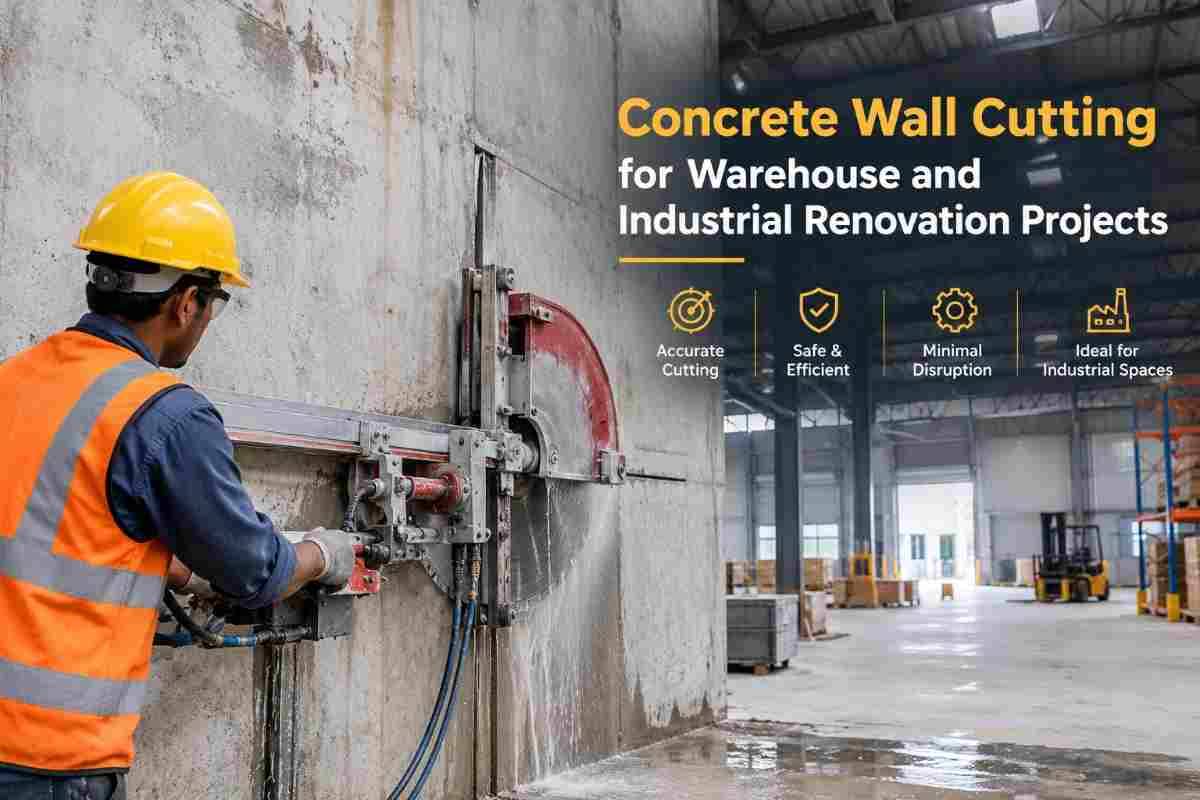
Warehouses and industrial facilities rarely stay the same for long. Supply chains evolve, machinery gets upgraded, storage systems change, and production lines are reorganised. The building that suited your operations ten years ago may now be too cramped, poorly laid out, or simply not built for the way you work today.
Demolishing and rebuilding is expensive, slow, and often unnecessary. In most cases, the smarter answer is concrete wall cutting, a precise, controlled method of removing sections of reinforced concrete without damaging the rest of the structure.
In this guide, we explain how concrete wall cutting works, where it fits in warehouse and industrial renovation, which methods suit which jobs, and what to look for in a contractor. The insights here reflect the practices followed by specialists such as Core Cutting India.
What Is Concrete Wall Cutting?
Concrete wall cutting is the process of slicing through concrete walls, slabs, and structural elements with diamond-tipped tools to create openings or remove sections. Unlike hammering or breaker-based demolition, it produces clean, straight edges with little vibration and minimal damage to the surrounding structure.
The technique relies on diamond abrasives, because diamond is hard enough to cut through concrete and the steel reinforcement (rebar) embedded in it. The cutting tool is usually cooled with water, which suppresses dust, extends blade life, and keeps the cut smooth.
For industrial clients, the result is simple: you get exactly the opening you planned, in exactly the place you planned it, with the rest of the building intact and operational.
Why Warehouse and Industrial Renovations Need Precision Cutting
Industrial concrete is not like residential concrete. Walls are thicker, reinforcement is denser, and the structure often carries heavy loads from roof systems, cranes, mezzanines, or adjoining machinery. Cutting into such a structure carelessly can cause cracking, misalignment, or even partial failure.
Here are the most common reasons facilities opt for wall cutting:
- Creating new openings: Doorways, loading bay access points, and ventilation openings.
- Installing large doors or shutters: Roller shutters and sliding gates for forklifts and trucks.
- Expanding floor space: Removing partition walls to merge storage or production areas.
- Running utilities: Openings for HVAC ducts, cable trays, conveyor lines, and pipework.
- Installing new machinery: Making space or access routes for heavy equipment.
- Removing obsolete structures: Taking out old equipment bases, pits, or redundant walls.
- Retrofitting for compliance: Adding fire exits, ventilation, or emergency access to meet updated regulations.
Each of these tasks demands accuracy. An opening that is off by a few centimetres can mean a door that doesn’t fit or a conveyor that doesn’t align. Diamond cutting keeps tolerances tight.
Key Concrete Wall Cutting Methods
No single method fits every job. The right choice depends on wall thickness, access, the size of the opening, the amount of reinforcement, and the working environment. These are the main techniques used in industrial settings.
1. Wall Saw Cutting
Wall sawing uses a circular diamond blade mounted on a track that is fixed to the wall. The blade runs along the track, cutting in straight lines to form rectangular or square openings.
Best for: Doorways, windows, large openings, and straight cuts in thick walls.
Advantages:
- Very precise, straight cuts
- Can cut deep, often through very thick concrete
- Low vibration, which protects adjacent structures
- Efficient for large, repetitive cuts
Wall saws are the workhorse of industrial renovation, particularly when you need clean-edged openings for roller shutters or machinery access.
2. Wire Saw Cutting
Wire sawing uses a diamond-impregnated wire looped around the section to be cut and pulled through the concrete by a motor. It is the go-to technique when a blade simply can’t reach.
Best for: Very thick walls, massive structural elements, irregular shapes, and sections with restricted access.
Advantages:
- No practical limit on cutting depth
- Works where a wall saw can’t be mounted
- Ideal for removing heavy blocks in manageable pieces
- Suitable for large foundations, machine bases, and bridge-scale elements
On major industrial projects, such as dismantling thick plant walls or heavy machinery foundations, wire sawing is often the only viable approach.
3. Core Drilling
Core drilling uses a hollow cylindrical diamond bit to cut perfectly round holes through concrete. It’s frequently used alongside wall cutting.
Best for: Pipe penetrations, electrical conduits, drainage lines, anchor holes, and corner relief cuts.
Core drilling is also used to make overcut-free corners in wall openings, by drilling at the corners before sawing, which prevents the blade from cutting beyond the intended line.
4. Hand Saw / Ring Saw Cutting
Handheld ring saws and hydraulic hand saws are compact, powerful tools for tight spaces and flush cutting.
Best for: Cutting close to floors or ceilings, finishing corners, and working in confined areas.
Choosing the Right Method
In practice, a single project often combines several of these techniques. An experienced contractor will assess the structure and pick the sequence that gets the job done safely and efficiently.
Advantages of Concrete Wall Cutting in Industrial Environments
Minimal Disruption to Operations
Warehouses and factories lose money when operations stop. Because diamond cutting is localised and controlled, work can be planned around shifts, isolated zones, or off-peak hours. Adjacent areas can often keep running.
Reduced Noise, Vibration, and Dust
Traditional demolition with breakers sends heavy vibration through the structure and generates considerable noise and airborne dust. Wet diamond cutting is far gentler. Vibration is minimal, noise is lower, and water-based dust suppression keeps the air cleaner. This matters in facilities with sensitive equipment, stored goods, or workers nearby.
Structural Integrity Preserved
Because cuts are clean and controlled, there is far less risk of micro-cracking or damage to the rest of the wall, slab, or frame. This is vital when the structure must continue to carry loads after the renovation.
Accuracy and Clean Finishes
Wall sawing produces smooth, straight edges that need little rework. That saves time and cost on finishing, whether you’re fitting a steel frame, door, or shutter.
Faster Project Timelines
Cutting is generally faster than demolition-and-rebuild approaches, and debris is easier to handle because it’s removed in defined sections. That shortens the overall timeline and reduces labour cost.
Cost Efficiency
Although specialist cutting has an upfront price, it typically costs less than the alternative once you factor in avoided repair work, shorter downtime, and lower waste handling.
The Concrete Wall Cutting Process: Step by Step
A professional cutting project follows a clear sequence. Understanding it helps you plan and ask the right questions.
Step 1: Site Survey and Assessment
The contractor inspects the wall, checks thickness, reinforcement density, and access, and reviews structural drawings where available. Scanning tools such as GPR (ground-penetrating radar) may be used to locate rebar, conduits, and hidden services before cutting begins.
Step 2: Structural Evaluation
If the wall is load-bearing, a structural engineer should assess whether it can be cut and what temporary or permanent support (such as props, lintels, or steel framing) will be needed.
Step 3: Planning and Marking
The opening is marked precisely. The cutting sequence, equipment, water supply, slurry handling, and debris removal plan are finalised. Safety measures and work-hour schedules are agreed.
Step 4: Preparation and Protection
The area is cleared and protected. Utilities are isolated where necessary, and barriers are put up. Water management and slurry collection are arranged to keep the site clean.
Step 5: Cutting
Equipment is installed and cutting begins. Corner core holes may be drilled first, then the wall saw or wire saw makes the main cuts. Large sections are secured so they can be lowered or lifted out safely.
Step 6: Removal and Cleanup
Cut sections are removed with lifting equipment or manual handling, depending on weight. Slurry and debris are collected and the area is cleaned.
Step 7: Finishing and Handover
Edges are inspected, and any required finishing, such as framing or sealing, is completed. The opening is then ready for fitting doors, shutters, or services.
Safety Considerations You Shouldn’t Ignore
Cutting concrete in an industrial setting involves real risks. Responsible planning covers:
- Structural stability: Temporary supports and a clear cutting sequence prevent unexpected movement or collapse.
- Hidden services: Scanning for electrical cables, pipes, and post-tensioned cables avoids dangerous strikes. Post-tensioned slabs, in particular, require extreme care.
- Heavy-section handling: Cut blocks can weigh several tonnes and need proper lifting plans.
- Dust and slurry control: Wet cutting and slurry removal protect workers and keep the site safe.
- Electrical and water safety: Equipment must be properly grounded, with sound water and power management.
- PPE and trained operators: Skilled, certified operators with appropriate protective gear are non-negotiable.
Never treat wall cutting as a general labour job. It is specialist work, and shortcuts lead to injuries, damage, and costly delays.
Factors That Affect Concrete Wall Cutting Cost
Pricing varies from project to project. The main factors include:
- Wall thickness and depth of cut: Thicker walls need more time and wear more blades.
- Reinforcement density: More steel means slower, tougher cutting.
- Area or length of cut: Larger openings take longer.
- Access and working height: Tight or elevated work needs extra equipment and effort.
- Method used: Wire sawing and specialised setups usually cost more than standard wall sawing.
- Site conditions: Power, water availability, and debris-handling requirements all matter.
- Timeline and working hours: Night or weekend work to avoid operational downtime can affect pricing.
- Location: Mobilisation costs depend on distance and logistics.
The most reliable way to get an accurate figure is to request a site visit and a written quote.
Common Mistakes to Avoid
- Skipping the structural assessment. Cutting a load-bearing wall without engineering input is risky.
- Choosing on price alone. The cheapest bid may rely on poor equipment or untrained crews.
- Ignoring hidden services. Cutting blind can sever cables or pipes and halt operations.
- Poor planning around operations. Without a schedule that accounts for your workflow, you risk avoidable downtime.
- Underestimating debris and slurry. Waste handling should be planned, not improvised.
- Using the wrong method. A blade where a wire saw is needed (or vice versa) wastes time and compromises quality.
How to Choose a Concrete Cutting Contractor
When selecting a partner for your warehouse or industrial renovation, look for:
- Proven industrial experience: Ask about similar projects and request references.
- Modern equipment: Quality wall saws, wire saws, and core drills make a visible difference in speed and finish.
- Trained, certified operators: Skill and safety culture matter as much as machinery.
- Clear methodology: A good contractor explains the plan, sequence, and safety measures upfront.
- Transparent quotations: Look for itemised pricing with no hidden extras.
- Safety record and insurance: Reliable firms follow documented safety procedures and carry appropriate cover.
- Responsiveness: Quick site visits and clear communication reflect how the project will run.
Specialist providers like Core Cutting India focus on exactly this type of precision work, helping industrial clients modify concrete structures with minimal disruption.
Frequently Asked Questions
Can load-bearing concrete walls be cut?
Yes, but only after a structural engineer has assessed the wall and designed any necessary supports, such as props or lintels. Cutting a load-bearing wall without this is unsafe.
What is the difference between wall sawing and wire sawing?
Wall sawing uses a circular blade on a track and is best for straight, precise cuts in walls of moderate-to-large thickness. Wire sawing uses a diamond wire loop and suits extremely thick sections, irregular shapes, or places where a track-mounted saw can’t be installed.
Is concrete wall cutting noisy or dusty?
Compared with breaker-based demolition, it is much quieter and cleaner. Wet cutting suppresses dust, and the process produces far less vibration, though some noise and slurry are unavoidable.
How long does it take to cut an opening in a concrete wall?
It depends on thickness, reinforcement, and size. A standard door-sized opening may take hours to a day or two, while large or complex industrial cuts can take longer. A site survey gives the most reliable estimate.
Can operations continue during cutting?
Often yes. Because the work is localised and low-vibration, many facilities keep neighbouring areas running, subject to a proper safety plan and work-zone isolation.
What thickness of concrete can be cut?
Wall saws handle very thick walls, and wire saws can go beyond that. With the right equipment, thickness is rarely a limiting factor.
Final Thoughts
Renovating a warehouse or industrial facility doesn’t have to mean demolishing it. With concrete wall cutting, you can create new openings, merge spaces, route utilities, and install modern equipment, all while preserving the structure and keeping disruption to a minimum.
The key to success is choosing the right method, planning the sequence carefully, putting safety first, and working with experienced specialists who understand industrial environments.
If you’re planning a renovation and need precise, reliable concrete cutting, talk to a trusted expert early, ideally before design is finalised, so the cutting plan and structural requirements are built into the project from day one. To explore services and request a consultation, visit Core Cutting India.