
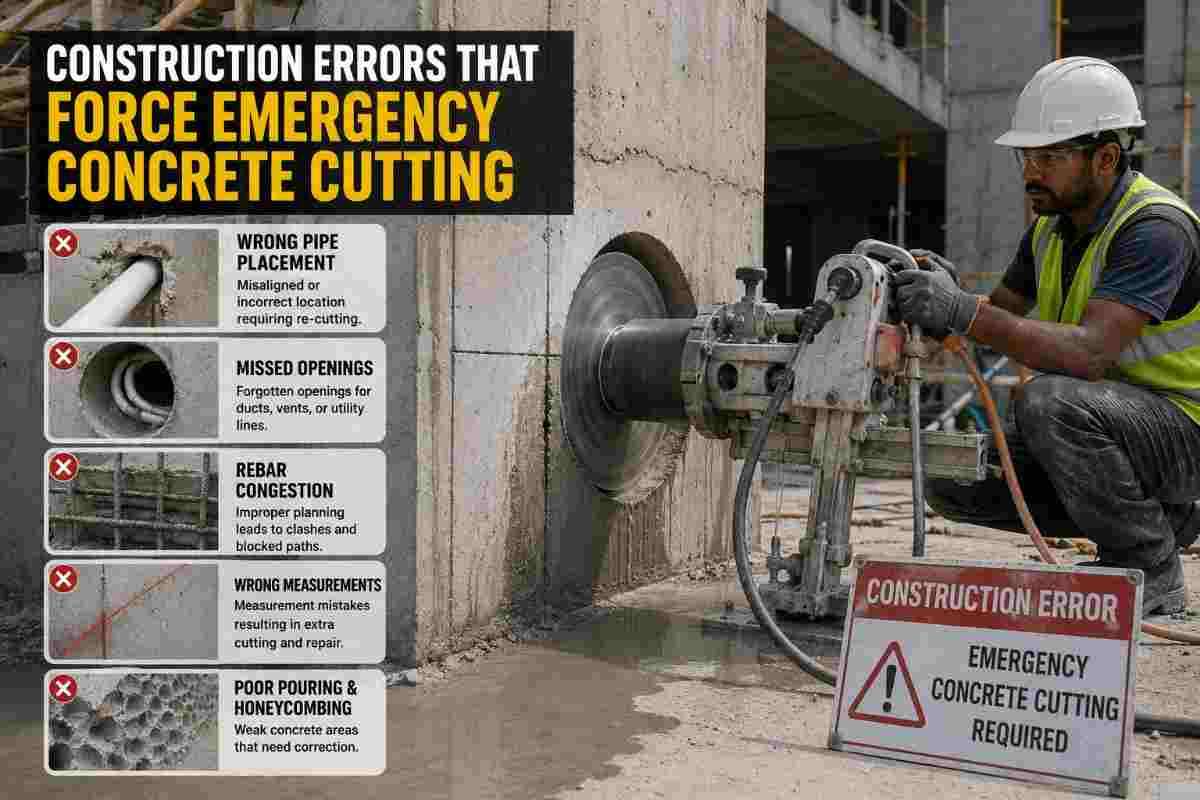
Construction projects rarely go exactly according to plan. Even with architectural drawings, structural calculations, site supervision, and experienced contractors, mistakes can happen. A misplaced opening, incorrectly installed MEP service, wrong slab penetration, inaccurate dimension, or last-minute design change can create a serious problem that needs to be corrected quickly.
In many of these situations, emergency concrete cutting becomes an important solution.
Concrete cutting is not simply about removing unwanted concrete. In a completed or partially completed structure, every cut must be planned carefully because reinforced concrete can contain structural reinforcement, electrical conduits, plumbing lines, post-tensioning cables, and other embedded elements. Professional concrete cutting therefore combines specialized equipment with structural assessment and controlled execution.
For construction companies, developers, facility managers, and property owners, understanding the errors that can lead to emergency cutting can help prevent delays, expensive rework, and unsafe improvisation.
What Is Emergency Concrete Cutting?
Emergency concrete cutting refers to controlled cutting, coring, sawing, or removal of concrete that becomes necessary because of an unexpected construction problem, urgent structural modification, service installation issue, or site error.
Unlike planned concrete cutting, emergency work often happens under time pressure. For example, a contractor may discover that a plumbing route was installed incorrectly after the slab has already been cast. An electrical conduit may be positioned incorrectly. A doorway may have been constructed at the wrong location. An MEP opening may have been omitted from the original formwork.
In such circumstances, breaking the concrete randomly with heavy demolition equipment can create additional damage.
Professional diamond cutting methods can provide more controlled removal with cleaner edges and comparatively low vibration. Wall sawing, core drilling, slab sawing, chain sawing, and diamond wire sawing may be selected according to the size, thickness, location, reinforcement, and structural requirements of the job.
Why Construction Errors Lead to Emergency Concrete Cutting
Concrete becomes much more difficult and expensive to modify after it has hardened. During the initial construction stage, openings can often be incorporated into formwork before concrete is poured.
When those openings are forgotten or placed incorrectly, the problem may only become visible after curing.
At that point, the project team may have to remove part of the completed RCC structure to accommodate the required opening.
Common reasons include:
- Incorrect MEP coordination
- Missing service openings
- Wrong dimensions
- Misplaced door or window openings
- Incorrect staircase locations
- Unplanned plumbing penetrations
- HVAC duct conflicts
- Electrical conduit errors
- Architectural changes after casting
- Incorrect reinforcement placement
- Construction tolerance problems
- Unauthorized or poorly planned modifications
The sooner these problems are identified, the easier they are generally to correct.
1. Missing MEP Openings
One of the most common construction mistakes involves MEP services.
Modern buildings require extensive networks for plumbing, drainage, electrical systems, fire protection, HVAC, data cables, and ventilation. These systems frequently require openings through RCC slabs, walls, and other concrete elements.
If an opening is missing from the original construction drawings or is forgotten during formwork installation, the service contractor may discover the problem only after the concrete has hardened.
This can lead to emergency core drilling or concrete cutting.
For example, a drainage pipe may need to pass through a slab, but no sleeve was installed before concreting. Instead of demolishing a large portion of the slab, a carefully positioned core hole may be created after confirming reinforcement and embedded services.
Professional core drilling provides a much more controlled approach than indiscriminate breaking.
2. Incorrectly Positioned Plumbing Lines
Plumbing errors can become particularly expensive when pipes are installed in the wrong location.
Imagine a bathroom renovation where the drainage outlet does not align with the required plumbing route. If the slab has already been completed, the contractor may need to create a new penetration.
However, drilling immediately without checking what is inside the slab can be dangerous.
A professional team should first determine the proposed cutting location and investigate reinforcement and possible embedded services. Structural risk assessment and non-destructive scanning can help identify important elements before cutting begins.
The objective is not simply to create a hole. The objective is to create the required opening without unnecessarily compromising the structure.
3. Wrong Door or Window Opening
Architectural dimensions can sometimes change after construction begins.
A doorway may have been constructed too narrow. A window may have been positioned incorrectly. An entrance may need to be widened for accessibility or functional reasons.
If the wall is already constructed, emergency wall cutting may be required.
This is particularly important when dealing with RCC walls or structural elements.
A wall should never be assumed to be non-load-bearing simply because it looks like an ordinary partition. The structural drawings and site conditions should be reviewed before cutting.
Diamond wall sawing can create accurate straight cuts for openings while reducing the uncontrolled vibration associated with heavy impact demolition.
4. MEP Coordination Mistakes
Large construction projects involve multiple teams working simultaneously.
Architects, structural engineers, electricians, plumbers, HVAC contractors, fire-safety teams, and interior contractors must all coordinate their work.
When coordination fails, one service can conflict with another.
For example:
- An HVAC duct may conflict with a beam.
- A plumbing pipe may need a penetration through a slab.
- An electrical route may not align with the planned opening.
- A fire-fighting pipe may require an additional penetration.
- A ventilation shaft may have been constructed at the wrong dimension.
These problems can force last-minute concrete modification.
Better Building Information Modeling (BIM), coordinated shop drawings, site measurements, and pre-construction scanning can reduce such mistakes. However, when an error has already occurred, controlled concrete cutting may provide a practical correction method.
5. Incorrect Staircase or Lift Opening
Staircases and lift shafts require large structural openings.
A mistake in the position or dimensions of such an opening can become a major construction problem.
For example, a staircase opening may have been cast several hundred millimetres away from the intended location. Correcting it after the slab has hardened may require significant concrete cutting.
Similarly, lift installation or modernization can require new openings through existing slabs.
These are not ordinary cutting jobs.
Large openings can affect load paths, reinforcement, temporary stability, and surrounding structural elements. The proposed modification should therefore be reviewed by an appropriately qualified structural professional before cutting begins.
Where large or heavily reinforced sections must be removed, specialized wall saws, wire saws, or other diamond cutting systems may be appropriate depending on the project requirements.
6. Incorrect Reinforcement Placement
Reinforcement mistakes can create another reason for corrective concrete cutting.
If reinforcement has been placed incorrectly, the issue may not be obvious until inspection, testing, or subsequent construction work reveals it.
However, simply cutting into concrete to expose or modify reinforcement is not a solution that should be undertaken casually.
Reinforced concrete works because concrete and steel act together. Cutting important reinforcement can change the load-carrying behavior of the element.
Post-tensioned structures require even greater caution because cutting a tensioned cable can result in a sudden release of stored energy.
Before any emergency cutting operation near reinforcement, the structural design and reinforcement arrangement should be investigated.
7. Incorrect Slab Penetrations
Floor slabs often require numerous openings for services.
When a penetration is missed, incorrectly sized, or placed in the wrong location, core cutting may become necessary after concrete has hardened.
This is one of the situations where diamond core drilling can be particularly useful.
A core drill creates a cylindrical opening with controlled dimensions. The technique is commonly used for pipes, cables, HVAC systems, plumbing, and other service requirements.
However, the location should be checked before drilling. Blind drilling can strike reinforcement, utilities, or other embedded elements.
8. Last-Minute Architectural Changes
Construction projects frequently experience design changes.
A client may request a larger doorway. An architect may revise an interior layout. A commercial tenant may require a new service route. A building owner may decide to create an additional ventilation opening.
When such changes happen after concrete has already been cast, cutting becomes part of the modification process.
The problem is not necessarily the change itself.
The risk comes from attempting to implement the change without understanding the existing structure.
Professional structural modification should therefore start with assessment rather than equipment.
9. Concrete Cast in the Wrong Location
Surveying and setting-out errors can result in structural or architectural elements being constructed at incorrect positions.
A wall could be offset from the planned location. An opening could be too small. A structural section could interfere with a planned service route.
In some situations, the correction may require removing a section of hardened concrete.
Diamond cutting can provide a more precise alternative to uncontrolled demolition.
The cutting line, depth, sequence, access, lifting arrangements, and disposal method should all be considered before work begins.
10. Errors During Renovation and Retrofitting
Existing buildings present a different challenge.
Older drawings may be incomplete. Previous owners may have carried out undocumented modifications. Existing reinforcement may differ from available drawings.
A renovation contractor may discover unexpected concrete elements while installing a new service.
This can lead to urgent cutting requirements.
Before modifying an existing structure, a site investigation is particularly important. Structural assessment can include reviewing available drawings, inspecting the building, identifying visible damage, and using non-destructive techniques to locate reinforcement and concealed elements.
Why Random Concrete Breaking Is a Bad Emergency Solution
When a construction mistake creates pressure, some teams may consider using jackhammers or other heavy demolition equipment immediately.
That can create additional problems.
Uncontrolled impact can generate:
- Excessive vibration
- Cracking
- Damage to adjacent finishes
- Unwanted structural disturbance
- Dust
- Noise
- Larger-than-required demolition areas
- Damage to embedded services
Precision diamond cutting can offer better control for many structural modification applications.
The method should nevertheless be selected based on the structure and project conditions rather than assuming that one cutting technique is suitable for every situation.
How Professional Emergency Concrete Cutting Should Be Planned
Even emergency work should follow a controlled process.
Step 1: Understand the Error
The first step is identifying exactly what went wrong.
Is the opening missing? Is the service misplaced? Does a wall need to be widened? Is there a structural obstruction?
Step 2: Inspect the Structure
The proposed cutting zone should be inspected for structural significance, visible cracking, existing modifications, and other warning signs.
Step 3: Locate Reinforcement and Utilities
Rebar, post-tensioning systems, conduits, pipes, and other embedded elements should be identified wherever relevant.
Scanning technologies such as GPR can help map concealed elements before cutting.
Step 4: Obtain Structural Approval Where Required
If the proposed cut affects a structural wall, slab, beam, column, lintel, or other load-bearing component, a structural engineer should determine whether the modification is acceptable and whether temporary support is required.
Step 5: Select the Correct Cutting Method
Depending on the application, the team may use:
- Diamond core drilling
- Diamond wall sawing
- Slab sawing
- Wire sawing
- Chain sawing
- Specialized concrete cutting equipment
Step 6: Control the Cutting Operation
The crew should follow the approved dimensions and sequence while managing water, slurry, dust, access, electrical safety, falling debris, and nearby occupants or workers.
Step 7: Inspect After Cutting
Once the required concrete is removed, the exposed area should be inspected before the next construction stage begins.
How to Prevent Emergency Concrete Cutting
The best emergency cutting job is often the one that never becomes necessary.
Construction teams can reduce avoidable cutting by implementing better coordination during the planning stage.
Coordinate MEP Before Concrete Casting
All major service penetrations should be coordinated before formwork and reinforcement are finalized.
Verify Dimensions on Site
Drawings alone are not enough. Actual site dimensions should be checked before concrete is poured.
Use Accurate Setting Out
Surveying errors can create expensive downstream corrections.
Review Structural Drawings
Structural members and critical zones should be identified before modifications are approved.
Plan Future Openings
Where future services are expected, suitable sleeves or planned penetrations may reduce the need for later drilling.
Scan Before Cutting
When working with existing concrete, reinforcement and concealed utilities should be investigated before drilling or sawing.
Use Experienced Cutting Professionals
Concrete cutting should not be treated as ordinary demolition. Specialized equipment and experienced operators can make a major difference in precision and safety.
The Role of Diamond Concrete Cutting in Construction Corrections
Diamond cutting technology is particularly useful when a construction error has to be corrected without unnecessarily damaging the surrounding structure.
Diamond tools can cut hardened concrete and reinforced concrete with high precision. Different equipment can be selected for different applications.
Core drilling is suitable for circular openings.
Wall sawing is useful for straight cuts in walls and structural sections.
Slab sawing can be used for horizontal concrete cutting.
Wire sawing can be appropriate for large, thick, or heavily reinforced sections.
The correct method depends on the concrete thickness, reinforcement, access, dimensions, structural requirements, and removal strategy.
When Emergency Concrete Cutting Becomes a Safety Issue
Not every construction error is merely a scheduling problem.
Some mistakes can create immediate structural or site-safety risks.
Warning signs that require professional attention include:
- Unexpected cracks near the proposed modification
- Sagging or deflection
- Exposed or damaged reinforcement
- Unknown post-tensioning systems
- Unexplained movement
- Water or gas lines near the proposed cut
- Electrical services in the cutting zone
- Incorrectly supported structural elements
- Previously modified beams or columns
If there is uncertainty about the stability of a structural element, cutting should not proceed simply because the modification is urgent.
Safety must remain the priority.
Why Choosing the Right Concrete Cutting Company Matters
Emergency work creates pressure, but speed should not replace engineering discipline.
A professional concrete cutting company should understand the difference between ordinary demolition and precision structural cutting.
Before hiring a contractor, consider:
- Experience with RCC structures
- Availability of diamond cutting equipment
- Knowledge of structural modification
- Ability to coordinate with engineers
- Experience with reinforced concrete
- Safety procedures
- Equipment appropriate to the project
- Proper debris and slurry management
- Ability to work around occupied buildings and active construction sites
At Core Cutting India, precision concrete cutting is positioned as part of controlled structural modification rather than simply breaking and removing concrete. The company's published guidance emphasizes structural assessment, scanning, sequencing, specialized diamond equipment, and coordination before structural cutting.
Conclusion
Construction mistakes can become expensive when they are discovered after concrete has hardened. Missing MEP openings, incorrect plumbing routes, misplaced doors, wrong slab penetrations, architectural changes, and setting-out errors are among the situations that can create an urgent need for concrete cutting.
The important point is that emergency does not mean uncontrolled.
Even when a project is under pressure, the cutting area should be assessed, reinforcement and utilities should be considered, structural requirements should be reviewed, and the correct diamond cutting technique should be selected.
With proper planning and professional execution, concrete cutting can help correct construction errors while minimizing unnecessary damage to the surrounding structure.
For projects involving RCC walls, slabs, beams, openings, service penetrations, or structural modifications, visit Core Cutting India to explore professional concrete cutting solutions.
People Also Ask (PAA)
1. What construction mistakes require emergency concrete cutting?
Common examples include missing MEP openings, incorrectly positioned plumbing penetrations, wrong door or window dimensions, misplaced slab openings, HVAC conflicts, and last-minute structural or architectural modifications.
2. Is emergency concrete cutting safe?
It can be performed safely when the structure is assessed first, embedded reinforcement and utilities are identified, the appropriate equipment is used, and the work follows an approved cutting procedure. Structural modifications should receive appropriate engineering review.
3. Can concrete cutting fix an incorrectly placed opening?
In many cases, precision wall sawing or core drilling can enlarge, relocate, or create an opening. However, whether the modification is structurally acceptable depends on the specific building and should be assessed before cutting.
4. Can I drill through an RCC slab for a missed plumbing pipe?
Potentially, but the location should be checked for reinforcement, post-tensioning systems, and concealed utilities before drilling. Blind core drilling can create structural and safety risks.
5. What is better for emergency concrete cutting: a jackhammer or diamond saw?
For precision structural modifications, diamond cutting is often preferable because it can provide controlled cuts with less uncontrolled impact than conventional breaking. The appropriate method depends on the structure and the required modification.
6. Can a load-bearing wall be cut after construction?
A load-bearing wall should not be cut without structural assessment and an appropriate modification plan. Depending on the design, temporary support or a new structural framing system may be required.
7. How can construction teams avoid emergency concrete cutting?
Better architectural-structural-MEP coordination, accurate site measurements, reinforcement checks, planned sleeves and openings, BIM coordination, and pre-construction inspections can reduce avoidable concrete cutting.
8. Can concrete cutting damage reinforcement?
Yes. Cutting through reinforcement can affect the structural capacity of an element. This is why reinforcement should be identified before cutting, especially in beams, columns, structural slabs, and load-bearing walls.
9. What equipment is used for emergency RCC cutting?
Depending on the job, professionals may use diamond core drills, wall saws, slab saws, chain saws, or diamond wire saws. Equipment selection depends on the thickness, geometry, reinforcement, access, and required cut.
10. Why should I hire professional concrete cutting services?
Professional cutting teams have specialized equipment and experience in controlled concrete removal. They can help coordinate the cutting process with structural requirements and reduce the risk of unnecessary damage to the surrounding structure.