
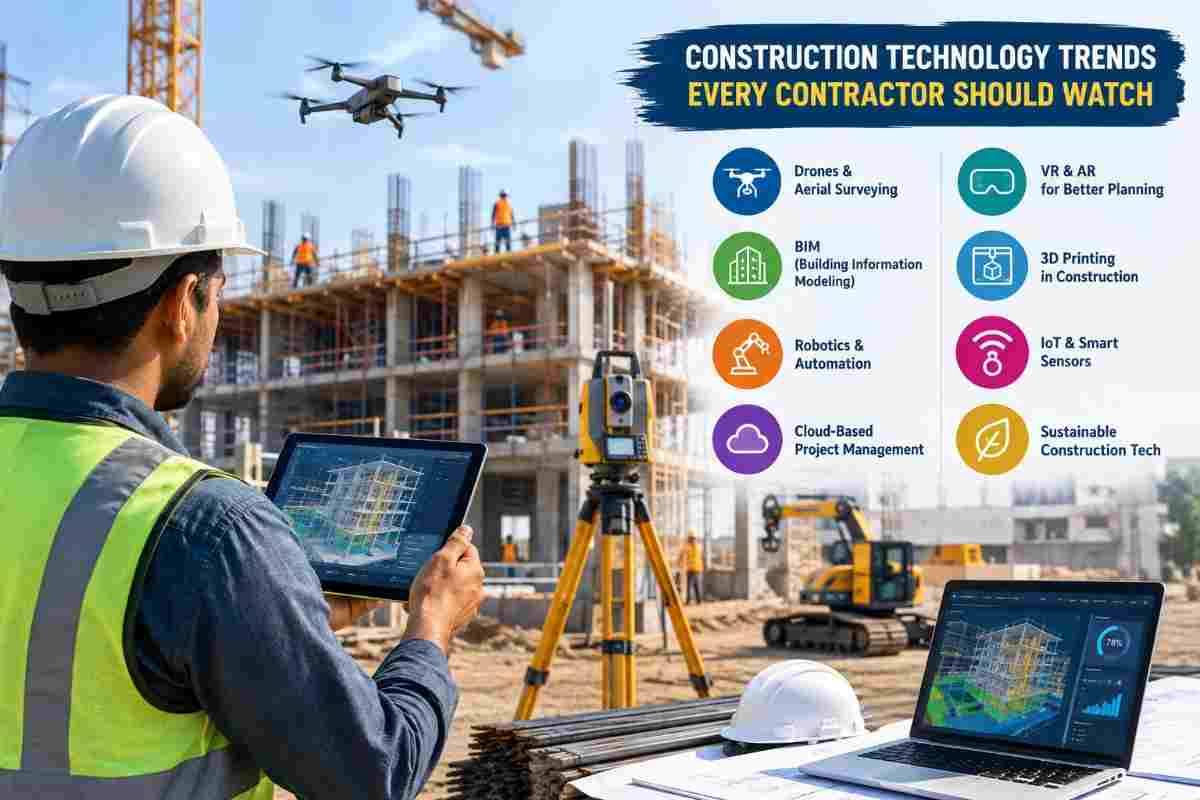
The construction industry is entering a new era where technology is becoming just as important as traditional construction skills. Contractors are facing tighter project schedules, rising material costs, skilled-labour shortages, increasing safety requirements, and growing expectations from clients for better quality and real-time project visibility.
In this environment, relying only on conventional methods can make construction projects slower, less predictable, and more expensive. New technologies such as artificial intelligence (AI), Building Information Modelling (BIM), drones, robotics, Internet of Things (IoT), digital twins, cloud-based collaboration, prefabrication, and automated equipment are changing the way contractors plan and execute projects.
India is also experiencing this shift. Recent industry reporting shows that Indian infrastructure contractors are increasingly adopting BIM, drone surveying, project dashboards, mobile reporting, IoT-based equipment monitoring, and AI-assisted forecasting. However, adoption remains uneven because of cost, skills, interoperability, and workforce-readiness challenges.
For contractors, the goal is not to adopt every new technology simply because it is fashionable. The real objective is to identify technologies that can reduce rework, improve productivity, increase safety, control costs, and provide better project outcomes.
Here are the major construction technology trends every contractor should watch.
1. Artificial Intelligence Is Becoming a Construction Management Tool
Artificial intelligence is one of the most important technologies contractors should monitor.
AI can process large amounts of project data and identify patterns that may be difficult for humans to detect manually. In construction, this can include schedules, labour productivity, material consumption, equipment performance, weather conditions, safety information, and historical project data.
Contractors can use AI for:
- Project delay prediction
- Cost forecasting
- Schedule optimisation
- Automated reporting
- Risk identification
- Document management
- Equipment maintenance prediction
- Safety monitoring
- Resource allocation
Instead of waiting until a project falls behind schedule, AI-assisted systems can help project teams identify potential problems earlier.
For example, if a project management platform detects repeated delays in material deliveries, increasing labour downtime, and weather-related interruptions, it can highlight the possibility of a future schedule problem.
The important shift is from reactive construction management to predictive construction management.
Industry discussions in India are already pointing toward AI being used for delay forecasting, safety-risk prediction, document automation, engineering support, and decision-making.
2. BIM and Digital Twins Will Improve Project Coordination
Building Information Modelling, commonly known as BIM, is no longer simply a 3D design technology.
Modern BIM can connect architectural, structural, mechanical, electrical, quantity, scheduling, and cost information within a coordinated digital environment.
For contractors, one of the biggest advantages of BIM is clash detection.
A BIM model can help identify conflicts between systems before construction begins. For example, a structural beam might interfere with an HVAC duct or plumbing route. Discovering such a conflict digitally is generally easier and less expensive than discovering it after installation.
Digital twins take the concept further.
A digital twin can represent a physical building or infrastructure asset digitally and connect it with real-world information from sensors and other data sources. This can help contractors and asset owners monitor construction progress, equipment, performance, and maintenance requirements.
Indian infrastructure organisations are increasingly exploring BIM and digital twins for clash detection, scenario planning, progress monitoring, and lifecycle management.
Why contractors should care
Better coordination can mean:
- Less rework
- Fewer design conflicts
- Better quantity estimation
- Improved communication
- More accurate scheduling
- Better client presentations
- Improved construction planning
BIM is likely to become increasingly important for contractors working on large commercial, industrial, infrastructure, and government projects.
3. Drone Technology Is Changing Site Surveys and Monitoring
Drones have become one of the most practical technologies for construction site monitoring.
Instead of depending entirely on manual measurements and ground-based inspections, contractors can use drones to capture aerial images and data over large areas.
Applications include:
- Topographic surveys
- Site mapping
- Stockpile measurement
- Earthwork calculations
- Progress monitoring
- Roof inspections
- Infrastructure inspections
- Safety monitoring
- Photogrammetry
- 3D site modelling
Repeated drone flights can also create a visual record of project development over time.
For large projects, this can make progress reporting faster and more objective.
Research published in 2025 found that drone adoption among Indian construction firms remained behind developed markets, while factors such as training, costs, equipment availability, data accuracy, and regulations influenced adoption.
That means drones represent both an opportunity and a learning curve for contractors.
The contractors who build internal expertise around drone data, surveying, compliance, and integration with BIM platforms may have an advantage as adoption expands.
4. Construction Robotics Will Reduce Repetitive Manual Work
Robotics is another major trend worth watching.
Construction involves many repetitive, physically demanding, and potentially hazardous activities. Robotics can help automate selected tasks while allowing skilled workers to concentrate on more complex responsibilities.
Potential applications include:
- Robotic bricklaying
- Automated concrete operations
- Robotic surveying
- Autonomous earthmoving
- Automated material handling
- Robotic inspection
- Automated cutting and drilling
- Construction-site logistics
India is also beginning to see increased interest in indigenous construction automation. Recent developments include construction robots, 3D concrete printing, precision sensors, autonomous quality-assurance systems, and construction exoskeletons.
Robotics does not necessarily mean eliminating the human workforce.
Instead, the more realistic direction is human-machine collaboration.
A skilled worker using automated equipment can potentially complete certain tasks faster, more consistently, and with lower physical strain.
5. IoT Will Make Construction Sites More Connected
The Internet of Things allows physical equipment and devices to collect and exchange information.
In construction, IoT sensors can monitor:
- Equipment location
- Fuel consumption
- Engine performance
- Equipment utilisation
- Temperature
- Humidity
- Concrete conditions
- Worker safety
- Environmental conditions
- Structural performance
For example, a contractor managing multiple excavators, cranes, trucks, and generators can use connected systems to understand which equipment is being used efficiently and which machines are spending excessive time idle.
IoT can also support predictive maintenance.
Instead of waiting for equipment to fail, sensors can identify unusual operating conditions and help maintenance teams investigate problems earlier.
This can reduce unexpected downtime and improve equipment utilisation.
6. Cloud-Based Construction Management Will Become Standard
Construction projects involve architects, engineers, contractors, subcontractors, suppliers, consultants, clients, and site teams.
When information is stored across spreadsheets, email chains, paper documents, messaging applications, and individual computers, coordination becomes difficult.
Cloud-based construction platforms provide a central environment where authorised teams can access current information.
Contractors can use cloud platforms for:
- Drawings
- Project schedules
- Daily reports
- RFIs
- Site photographs
- Quality documentation
- Safety records
- Procurement
- Change orders
- Client communication
The biggest advantage is having a single source of project information.
As construction projects become more complex, cloud collaboration will become increasingly important for maintaining information continuity between office and site teams.
7. Computer Vision Will Improve Quality and Safety Monitoring
Cameras are already common on construction sites. The next step is making those cameras intelligent.
Computer vision systems use AI to analyse images and video.
They can potentially identify:
- Missing personal protective equipment
- Unsafe worker behaviour
- Restricted-area access
- Equipment movement
- Construction progress
- Quality issues
- Site housekeeping problems
For example, an AI-enabled camera could flag when a worker enters a designated hazardous zone without appropriate protection.
Computer vision can also compare actual construction progress with planned work.
This can reduce the dependence on manually reviewing every part of a large project.
However, contractors should implement these systems responsibly, with clear policies around worker privacy, data security, accuracy, and human oversight.
8. Prefabrication and Modular Construction Will Gain Momentum
Traditional construction often involves performing a large percentage of work directly at the project site.
Prefabrication changes this approach by manufacturing components in controlled environments before transporting them to the site.
Examples include:
- Precast concrete components
- Prefabricated bathrooms
- Structural steel assemblies
- MEP modules
- Wall panels
- Modular building sections
The benefits can include faster installation, improved quality control, reduced site waste, and more predictable construction schedules.
Modular construction also fits naturally with BIM and digital fabrication.
A digital model can guide the manufacturing process, while prefabricated components can be installed according to predefined specifications.
For contractors facing tight deadlines, industrialised construction methods can become increasingly attractive.
9. 3D Printing Could Transform Selected Construction Applications
3D construction printing is developing rapidly.
Instead of traditional formwork and layer-by-layer manual construction for certain components, specialised printers can deposit construction materials according to a digital design.
Potential applications include:
- Housing components
- Walls
- Structural elements
- Architectural components
- Site facilities
- Specialised construction forms
The technology is still developing and is not suitable for every construction project.
However, its ability to reduce certain forms of material waste, automate repetitive processes, and produce complex geometries makes it an important technology to watch.
Recent developments in India include indigenous construction automation portfolios featuring 3D concrete and construction printing systems.
10. Smart Construction Equipment Will Improve Productivity
Construction machinery is becoming increasingly connected and intelligent.
Modern equipment can include GPS, telematics, sensors, automated controls, and performance-monitoring systems.
Contractors can use this information to understand:
- Machine utilisation
- Fuel consumption
- Operating hours
- Location
- Maintenance requirements
- Operator behaviour
- Productivity
This is particularly useful for contractors managing large equipment fleets.
Instead of asking, “Where is the machine?” or “Why is this equipment underperforming?”, managers can increasingly obtain answers from real-time equipment data.
11. Advanced Reality Capture Will Improve Accuracy
Reality capture technologies such as laser scanning, LiDAR, photogrammetry, and 360-degree cameras are becoming increasingly useful.
These technologies can capture detailed information about existing structures and construction sites.
Contractors can use reality capture for:
- As-built documentation
- Renovation projects
- Structural inspections
- Quantity verification
- BIM creation
- Progress tracking
- Complex measurements
This is particularly valuable when working on existing buildings where old drawings may be incomplete or inaccurate.
A contractor can capture the existing condition digitally before planning modifications.
This helps reduce assumptions and provides a more reliable basis for engineering and construction decisions.
12. Precision Cutting and Drilling Are Becoming More Technology-Driven
Specialised construction activities such as core cutting, slab cutting, wall cutting, concrete cutting, and controlled drilling are also benefiting from modern equipment and better planning.
Precision diamond cutting technologies can provide controlled cuts while reducing unnecessary damage to surrounding structures.
For renovation, infrastructure, commercial, and industrial projects, accurate cutting can be particularly important when openings must be created in existing concrete structures.
Digital drawings, structural information, accurate measurements, and specialised cutting equipment can work together to improve execution.
For contractors, the broader lesson is important: even individual construction activities are becoming more data-driven and precision-oriented.
You can explore specialised construction solutions and services through Core Cutting India.
13. Sustainable Construction Technology Will Become More Important
Sustainability is no longer limited to choosing environmentally friendly materials.
Technology can help contractors measure and reduce environmental impact throughout a project.
Important areas include:
- Low-carbon materials
- Energy-efficient equipment
- Waste tracking
- Material optimisation
- Water management
- Renewable energy
- Prefabrication
- Digital documentation
- Building energy monitoring
Data can help contractors identify where waste is occurring and where resources can be used more efficiently.
For example, accurate digital quantity estimation can help reduce unnecessary material ordering, while prefabrication can reduce certain forms of site waste.
Sustainable construction will increasingly combine engineering, technology, data, and environmental responsibility.
14. AR and VR Will Improve Training and Site Visualisation
Augmented Reality (AR) and Virtual Reality (VR) are also finding applications in construction.
VR can allow project teams and clients to experience a digital building before construction is completed.
AR can overlay digital information onto the physical environment.
Possible applications include:
- Worker training
- Safety simulations
- Design reviews
- Equipment training
- Installation guidance
- Client presentations
- Site coordination
Imagine a technician looking at a mechanical installation area and seeing digital instructions overlaid onto the physical environment.
As hardware becomes more accessible, these technologies could become useful additions to contractor training and project coordination.
How Contractors Should Prepare for the Technology Shift
The biggest mistake contractors can make is trying to adopt every technology simultaneously.
Technology adoption should be connected to measurable business problems.
Start With Your Biggest Bottleneck
Ask:
- Are projects frequently delayed?
- Is rework expensive?
- Is equipment underutilised?
- Are site reports slow?
- Are drawings frequently outdated?
- Is material wastage high?
- Is safety monitoring difficult?
Then select technology that addresses the specific problem.
Train Your Workforce
Technology is only useful when people know how to use it.
Contractors should invest in training for:
- BIM
- Digital project management
- Drone operations
- Data interpretation
- Equipment telematics
- Safety technologies
- Digital documentation
Start Small
A pilot project can be safer than implementing a new system across the entire company.
Test a technology on one project, measure its results, identify problems, and then expand if the return on investment is clear.
Measure ROI
Technology should produce measurable benefits.
Useful metrics include:
- Reduction in rework
- Reduction in project delays
- Labour productivity
- Equipment utilisation
- Safety incidents
- Material waste
- Reporting time
- Project cost variance
What Construction Technology Will Look Like in the Future
The future of construction is unlikely to be based on one revolutionary technology.
Instead, the biggest transformation will come from technology integration.
Imagine a project where:
A BIM model provides the digital plan.
Drones capture real-world progress.
IoT sensors monitor equipment.
AI analyses project data.
Computer vision checks site conditions.
Cloud platforms distribute information.
Robotics handles selected repetitive tasks.
Digital twins connect construction data with long-term asset management.
Precision equipment executes specialised work according to accurate digital information.
This connected approach is sometimes described as smart or connected construction.
Industry observers in India increasingly expect the next stage of digitalisation to move beyond simply collecting data toward turning that data into actionable insights and autonomous decision support.
Frequently Asked Questions
What is construction technology?
Construction technology refers to tools, equipment, software, digital systems, and innovative processes used to improve construction planning, design, execution, safety, productivity, quality, and project management.
What are the latest construction technology trends?
Major trends include AI, BIM, digital twins, drones, robotics, IoT, cloud construction software, computer vision, prefabrication, 3D printing, reality capture, smart equipment, and sustainable construction technologies.
How is AI being used in construction?
AI can assist with project forecasting, scheduling, risk identification, document management, safety monitoring, predictive maintenance, progress tracking, and data analysis.
Why is BIM important for contractors?
BIM helps contractors coordinate project information, identify design clashes, improve planning, visualise construction, and reduce costly errors and rework.
Are drones useful for construction contractors?
Yes. Drones can support surveying, mapping, progress monitoring, inspections, stockpile measurement, and site documentation, particularly on large or difficult-to-access projects.
Will robots replace construction workers?
Robotics is more likely to automate selected repetitive or hazardous tasks while skilled workers continue to manage complex construction activities, supervision, decision-making, and specialised work.
What is a digital twin in construction?
A digital twin is a digital representation of a physical building, infrastructure asset, or construction environment that can be connected to real-world data for monitoring, analysis, and lifecycle management.
How can small contractors adopt construction technology?
Small contractors can begin with affordable cloud-based project management, digital documentation, mobile reporting, GPS equipment tracking, measurement tools, and selected specialist services rather than investing in expensive technologies all at once.
Target-Related Searches
- construction technology trends
- construction technology trends 2026
- latest construction technology trends
- construction technology for contractors
- emerging construction technologies
- new construction technology
- construction innovations
- smart construction technology
- construction technology in India
- AI in construction
- BIM in construction
- digital twin construction
- construction drones
- construction robotics
- IoT in construction
- construction automation
- prefabrication technology
- 3D printing in construction
- sustainable construction technology
- construction project management technology
- future of construction technology
- modern construction methods
- technology trends in Indian construction industry
People Also Ask
What are the top construction technology trends in 2026?
The major trends include AI, BIM, digital twins, drones, robotics, IoT, computer vision, prefabrication, 3D printing, cloud collaboration, reality capture, and sustainable construction technology.
How is technology changing the construction industry?
Technology is improving project planning, coordination, safety, productivity, quality control, equipment management, reporting, and decision-making.
What is the future of construction technology?
The future is moving toward connected construction in which BIM, AI, IoT, drones, robotics, digital twins, and automated equipment work together.
Is AI useful for construction contractors?
Yes. AI can help contractors analyse project information, forecast delays, optimise schedules, identify risks, automate reports, and improve decision-making.
Why should contractors use BIM?
BIM can improve coordination between project stakeholders and help identify design conflicts before they become expensive construction problems.
How are drones used in construction?
Drones are used for surveying, mapping, inspections, progress monitoring, stockpile measurement, and creating digital site information.
What are digital twins in construction?
Digital twins are connected digital representations of physical buildings or infrastructure that can support monitoring, analysis, maintenance, and lifecycle optimisation.
Will construction become fully automated?
Construction is unlikely to become completely automated in the near future. Instead, automation will increasingly handle repetitive, hazardous, and data-intensive tasks while skilled professionals manage complex work.
Conclusion
Construction technology is moving from an optional advantage to an increasingly important part of competitive construction operations.
For contractors, the opportunity is not simply to purchase the newest equipment or software. The real opportunity is to build a smarter construction workflow where technology helps people make faster, safer, and more accurate decisions.
AI can help predict problems. BIM can improve coordination. Drones can capture site information. IoT can monitor equipment. Robotics can automate repetitive tasks. Digital twins can connect physical assets with digital information. Cloud platforms can keep teams aligned. Precision construction technologies can improve specialised work.
India's construction sector is already moving in this direction, although adoption remains uneven.
Contractors who start by identifying their biggest operational challenges, training their teams, testing practical technologies, and measuring results will be better positioned for the next generation of construction.
The future contractor will not simply build faster.
The future contractor will build with better data, greater precision, stronger collaboration, and smarter technology.
For specialised concrete cutting and precision construction requirements, visit Core Cutting India.