
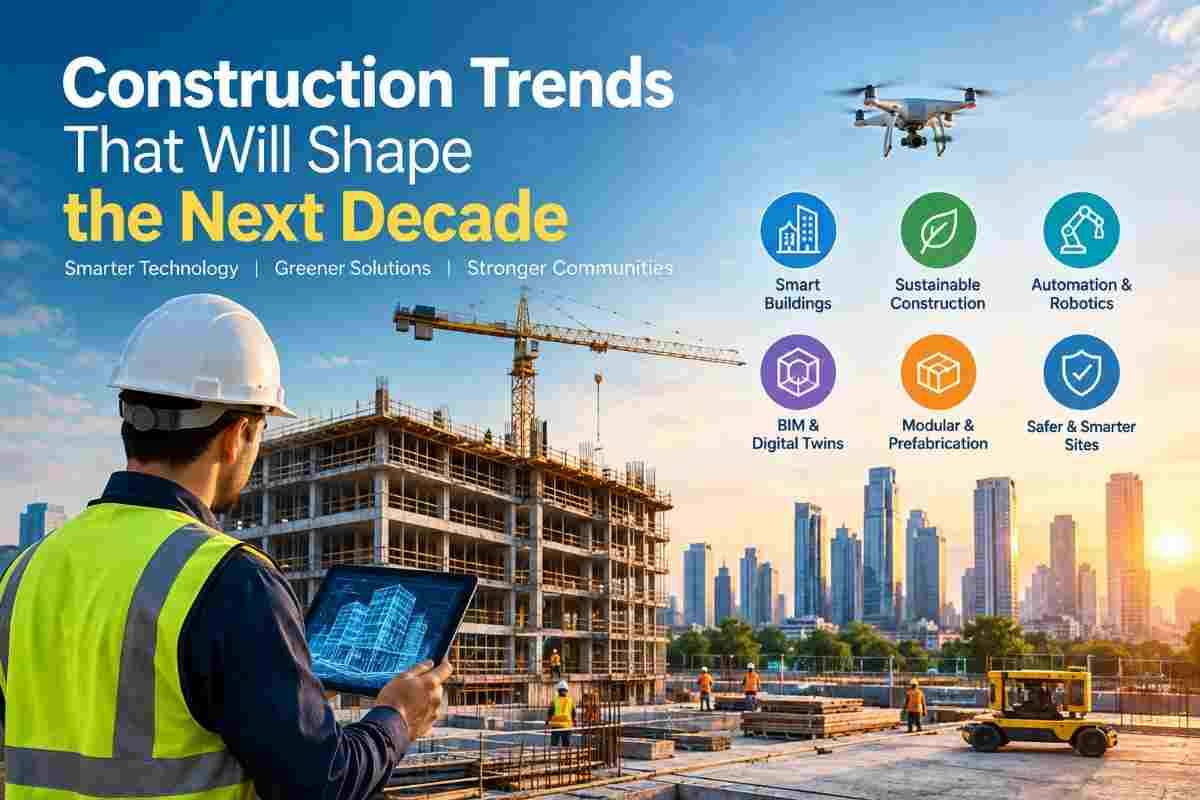
The construction industry is changing faster than ever in living memory. For generations, building meant bricks, mortar, manual labour, and paper plans. Today, drones scan sites, software predicts delays, factories produce entire building sections, and sustainability targets influence design from the first sketch.
India is at the centre of this shift. With rapid urbanisation, large infrastructure programmes, and growing demand for housing, commercial space, and logistics facilities, the country is one of the world's most important construction markets. Builders, contractors, and developers who understand where the industry is heading will have a real advantage over those who wait.
In this guide, we look at the construction trends that will shape the next decade, why each one matters, and how it will change the way projects are planned, built, and maintained. This article is brought to you by Core Cutting India, where precision and modern methods are central to how we think about construction work.
1. Digital Transformation and Building Information Modeling (BIM)
Building Information Modeling, or BIM, has moved from a "nice to have" to an expectation on larger projects. A BIM model is a shared 3D digital representation of a building that carries information about materials, structure, services, cost, and scheduling.
Why it matters: BIM allows architects, engineers, and contractors to detect clashes before work begins. A pipe that would have collided with a beam is spotted on screen instead of on site, saving time, money, and rework.
What to expect in the next decade:
- Wider BIM adoption on public infrastructure and private commercial projects
- Integration of BIM with cost estimation and project scheduling (often called 4D and 5D BIM)
- Use of "digital twins", live virtual copies of buildings that help owners manage maintenance long after handover
Digital planning also supports precision trades. When openings for ducts, pipes, and cables are coordinated in advance, cutting and coring work becomes cleaner, safer, and far more predictable.
2. Sustainable and Green Construction
Sustainability is no longer a marketing angle. It is becoming a regulatory, financial, and reputational requirement. Construction and the built environment account for a significant share of global energy use and emissions, and pressure to reduce that footprint is growing.
Key developments to watch:
- Low-carbon materials: Blended cements, fly ash, slag-based mixes, and recycled aggregates are gaining ground.
- Energy-efficient design: Better insulation, passive cooling, and smart glazing reduce operating energy.
- Green building certifications: Rating systems such as IGBC and GRIHA are increasingly influencing developer decisions and buyer expectations.
- Waste reduction: Contractors are rethinking site waste, reusing materials, and recycling demolition debris.
For India's hot climate, passive design and efficient cooling will be especially important. Developers who build green today are likely to see lower operating costs, stronger demand, and easier access to sustainability-linked financing.
3. Modular and Prefabricated Construction
Imagine building walls, bathrooms, or even entire rooms in a controlled factory and assembling them on site like a giant kit. That is the idea behind modular and prefabricated construction, and it is growing steadily.
Benefits include:
- Speed: Site work and factory work happen at the same time, shortening schedules.
- Quality control: Factory conditions reduce weather-related defects and variation.
- Less waste: Materials are cut and used more efficiently.
- Safer sites: Fewer workers are needed on site at height or in hazardous conditions.
Precast concrete, steel framing, and panelised systems are already common in warehouses, hospitals, affordable housing, and metro infrastructure. Over the next decade, expect prefabrication to expand into mid-rise housing, schools, and commercial buildings.
One important point: even prefabricated structures need accurate on-site finishing, such as openings for services, anchor holes, and adjustments to meet site conditions. This keeps precision cutting and drilling relevant in the modular era.
4. Artificial Intelligence and Data-Driven Project Management
Construction has traditionally been a data-poor industry, with decisions often based on experience and instinct. That is changing. Artificial intelligence and analytics are being applied to nearly every stage of a project.
Practical uses already emerging:
- Forecasting delays by analysing schedules, weather, and supply patterns
- Optimising material orders to avoid shortages and over-purchasing
- Reviewing drawings and specifications to flag errors
- Monitoring site photos and video to track progress and detect safety risks
Over the next decade, AI will move from pilot projects to routine tools. Project managers who learn to interpret data will make faster, better-informed decisions, while firms that ignore it may struggle to compete on cost and timelines.
5. Drones, Robotics, and Automation
Drones are now a familiar sight on large sites. They capture aerial surveys, measure stockpiles, inspect roofs and bridges, and compare progress against plans in a fraction of the time manual methods require.
Robotics is following. Bricklaying machines, rebar-tying robots, autonomous earthmovers, and 3D-printing systems are in development or early commercial use worldwide.
What this means for the workforce:
- Dangerous and repetitive tasks will increasingly be automated
- Demand will grow for skilled operators, technicians, and equipment specialists
- Training and upskilling will become a competitive priority
Automation will not replace skilled trades. It will raise the value of precision, safety, and technical know-how.
6. 3D Printing in Construction
Concrete 3D printing, where a robotic arm or gantry deposits layers of specialised material to form walls and structural shapes, has moved from novelty to real-world application. Pilot homes, small commercial buildings, and architectural elements have already been printed in several countries, including India.
Potential advantages:
- Reduced material waste
- Faster completion for small and repetitive structures
- Design freedom for curved and complex forms
Current limitations: Regulatory approvals, material standards, reinforcement challenges, and scale all need to mature. Over the next decade, 3D printing is likely to find its place in affordable housing, emergency shelter, and custom architectural components rather than replacing conventional construction entirely.
7. Smart Buildings and the Internet of Things (IoT)
Tomorrow's buildings will be built with sensors in mind. Smart buildings use connected devices to monitor lighting, temperature, air quality, occupancy, energy use, and equipment health in real time.
Why developers are investing:
- Lower energy and maintenance costs
- Better occupant comfort and safety
- Predictive maintenance that fixes problems before failures occur
- Higher asset value and tenant appeal
This trend has a direct construction impact. Sensors, conduits, cabling, and new service routes must be integrated into structures, and many older buildings need retrofitting. That creates a steady demand for accurate openings, penetrations, and modifications in concrete and masonry.
8. Retrofitting, Renovation, and Adaptive Reuse
Not every future project will be a brand-new tower. Across India's cities, a vast stock of existing buildings needs upgrading, whether for structural strengthening, fire safety compliance, energy efficiency, or conversion to new uses.
Retrofit and renovation trends include:
- Converting old industrial buildings into offices, retail, or mixed-use spaces
- Adding lifts, staircases, or service shafts to existing structures
- Upgrading buildings for seismic safety
- Installing modern HVAC, plumbing, and electrical systems
Retrofitting is typically more sustainable than demolition and rebuilding because it preserves embodied carbon in existing structures. It also places a premium on non-destructive, precise concrete cutting. Methods such as core drilling, wall sawing, slab sawing, and wire sawing allow openings to be made in reinforced concrete with minimal vibration, controlled dust, and limited damage to surrounding structure. Specialists like Core Cutting India support exactly this kind of work, where accuracy matters as much as speed.
9. Advanced Materials
Material science is quietly reshaping what buildings can do. A few developments to track:
- High-performance and ultra-high-performance concrete (UHPC): Stronger, more durable, and allowing slimmer sections
- Self-healing concrete: Mixes that seal their own small cracks and extend service life
- Cross-laminated timber (CLT): A renewable structural option gaining traction in some markets
- Recycled and bio-based materials: Lower-carbon alternatives to conventional products
- Smart glass and phase-change materials: Improving thermal comfort and reducing energy demand
Stronger and denser materials also mean the tools and methods used to cut, drill, and modify them must keep pace. Modern diamond tooling and well-maintained equipment are essential for working with high-strength concrete and heavily reinforced sections.
10. Worker Safety, Skills, and the Labour Challenge
Construction remains one of the most hazardous industries, and attitudes toward safety are shifting. Wearable sensors, site-monitoring cameras, safer equipment, and stricter compliance are becoming standard on professional sites.
At the same time, many markets, including India, face a skills gap. Experienced workers are ageing, younger people often prefer other careers, and new technologies require new competencies.
What the next decade will demand:
- Structured training and certification programmes
- Investment in safer, lower-vibration, lower-dust methods
- Better working conditions to attract and retain talent
- A culture where safety is treated as a core value, not paperwork
Low-noise, low-vibration cutting methods are part of this picture. They protect workers and occupants, especially in hospitals, schools, offices, and live buildings where operations cannot stop.
11. Infrastructure Growth and Urban Expansion
India's infrastructure ambitions, including metro rail networks, expressways, airports, ports, smart cities, and logistics corridors, will keep construction demand strong for years. Alongside this, rapid urban growth is driving demand for housing, healthcare facilities, data centres, warehouses, and commercial space.
Implications for contractors:
- Large, complex projects with tight timelines and high quality expectations
- Greater emphasis on coordination between multiple trades
- Increasing use of specialist subcontractors for precision tasks
- Strong demand for repair, strengthening, and upgrading of ageing infrastructure such as bridges, flyovers, and industrial plants
Specialist services will matter more as projects grow in complexity. A single wrongly placed opening in a post-tensioned slab or a heavily reinforced beam can cause serious damage, which is why scanning technology such as ground-penetrating radar is increasingly used before cutting begins.
12. Precision, Non-Destructive Methods, and Specialist Services
If there is one theme that connects every trend above, it is precision. Digital design, prefabrication, retrofitting, smart systems, and advanced materials all depend on accurate work at the point where plans meet real structures.
Modern concrete cutting and drilling methods offer:
- Accuracy: Clean, exact openings that match design dimensions
- Reduced vibration: Important for protecting existing structures and sensitive equipment
- Lower dust and noise: Better for health, safety, and neighbouring occupants
- Speed and efficiency: Faster than traditional breaking methods
- Structural protection: Controlled cutting limits damage to surrounding concrete and reinforcement
As construction becomes more technical, working with experienced specialists will be a smart decision rather than an added cost. A professional team with the right equipment, scanning capability, and safety practices reduces risk, avoids rework, and keeps projects on schedule.
How Builders and Developers Can Prepare
Knowing the trends is only the first step. Here is a practical way to get ready:
- Invest in digital skills: Start with BIM, scheduling software, and basic data tools, even on smaller projects.
- Plan for sustainability early: Material and design choices are far cheaper to change on paper than on site.
- Evaluate prefabrication: Identify components that could be built off site to save time and improve quality.
- Prioritise safety culture: Treat training and safer methods as long-term investments.
- Build relationships with specialists: Reliable partners for cutting, scanning, strengthening, and demolition make complex jobs far smoother.
- Stay informed: Standards, codes, and technologies are evolving quickly, so make continuous learning part of your business.
Frequently Asked Questions
What are the biggest construction trends for the next decade?
The most influential trends include digital design and BIM, sustainable building practices, modular and prefabricated construction, AI-driven project management, drones and robotics, smart buildings, and a strong focus on retrofitting and renovation.
How is technology changing the construction industry?
Technology is improving planning accuracy, speeding up schedules, reducing waste, and making sites safer. Tools such as BIM, drones, sensors, and analytics help teams make better decisions and catch problems early.
What is sustainable construction, and why is it important?
Sustainable construction aims to reduce environmental impact across a building's life through efficient design, low-carbon materials, waste reduction, and energy-saving systems. It matters because it lowers operating costs, meets regulatory expectations, and responds to growing demand for greener buildings.
Will robots and automation replace construction workers?
Unlikely in the near term. Automation will take over repetitive and hazardous tasks, but skilled workers, operators, and specialists will remain essential. The workforce will shift toward more technical and supervisory roles.
What is the future of concrete cutting in construction?
As more projects involve retrofitting, renovation, and integration of modern services, demand for precise, low-vibration, low-dust cutting is expected to grow. Methods like core drilling, wall sawing, slab sawing, and wire sawing will remain central, supported by scanning technology to avoid reinforcement and embedded services.
Is prefabricated construction cheaper than traditional construction?
It can be, particularly on projects with repetitive elements and tight schedules, because it saves time, reduces waste, and improves quality control. The cost advantage depends on project scale, design, and logistics.
Why is retrofitting becoming so popular?
Upgrading existing buildings is often faster, more cost-effective, and more environmentally friendly than demolition and rebuilding. It also allows owners to improve safety, efficiency, and functionality while preserving valuable structures.
Conclusion
The next decade of construction will be defined by smarter planning, cleaner materials, faster methods, and a much stronger focus on precision and safety. Digital tools will guide design, factories will produce more of what we build, buildings will become connected and responsive, and existing structures will be adapted for new lives.
Yet no matter how advanced the technology becomes, projects still succeed or fail on execution quality. Accurate, safe, and efficient work on real structures, from a cored hole for a service pipe to a wall opening in a live building, will remain the foundation of good construction.
For contractors, developers, and property owners, the message is clear: embrace innovation, plan ahead, and partner with specialists who understand modern methods. To learn more about professional concrete cutting and related services, visit Core Cutting India.