
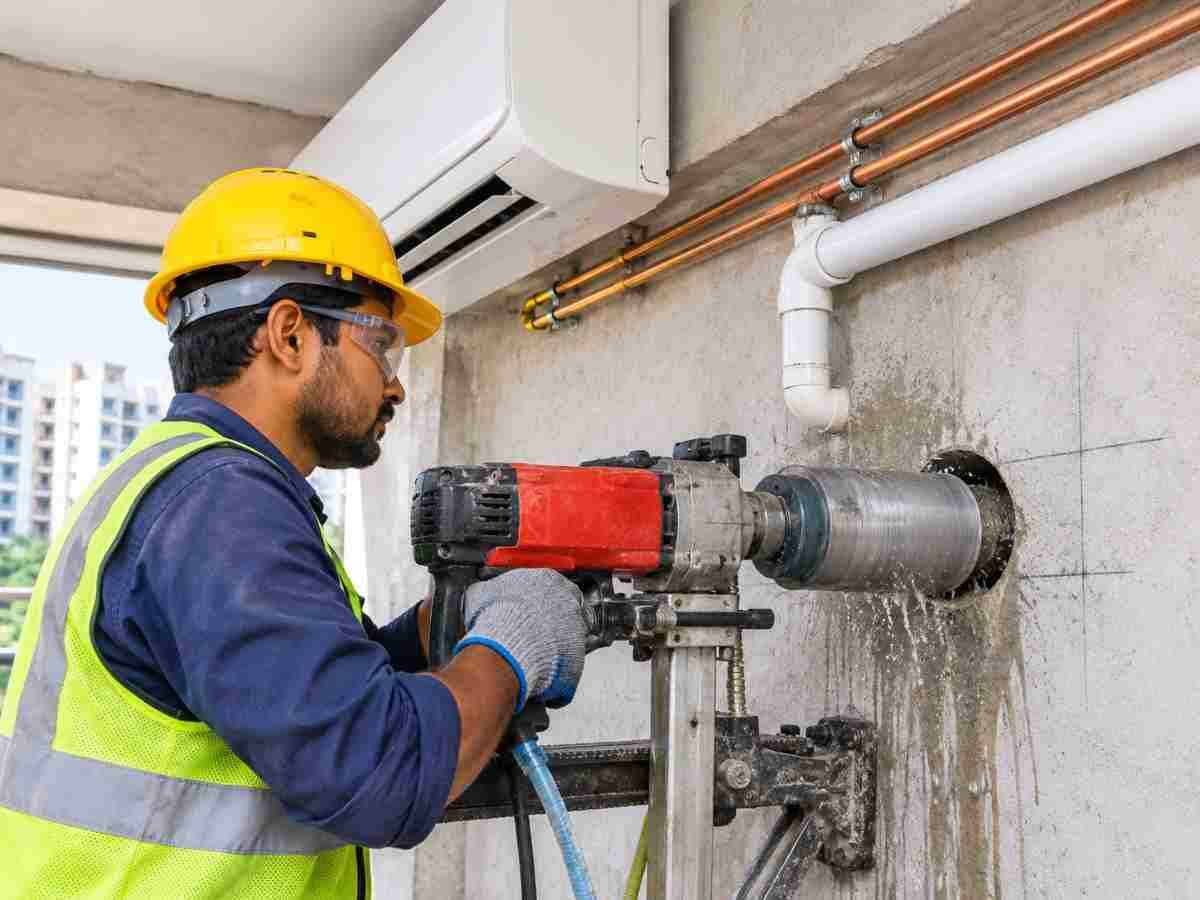
Ghaziabad is growing fast. High-rise societies in Indirapuram and Vaishali, new projects in Crossings Republik and Raj Nagar Extension, and busy commercial complexes across the city all need one thing in summer: reliable air conditioning. Behind every neatly installed AC is a part most people never think about: the hole through which the copper pipes and drain line pass.
If that hole is drilled badly, you pay for it later. Common results include cracked plaster, leaking drain water, damaged reinforcement, and noisy vibrations. This is why more homeowners, builders, and facility managers now choose professional core cutting over traditional hammer drilling. At Corecutting India (https://corecuttingindia.com/), we specialise in precise, dust-controlled core cutting for AC drainage and copper pipe installation across Ghaziabad and the NCR.
This guide explains what core cutting is, why it suits AC installation, how the process works, and what to check before hiring a contractor.
What Is Core Cutting?
Core cutting, also called core drilling or diamond core drilling, uses a hollow cylindrical drill bit with industrial diamond segments on its cutting edge. The bit rotates at controlled speed, usually with water as a coolant, and grinds a perfectly round hole through concrete, brick, stone or reinforced cement concrete (RCC). Instead of pulverising the material, it removes a solid cylinder, called the “core”, leaving a clean, smooth-walled opening.
Typical hole diameters for building services range from 25 mm to well over 300 mm. For AC work, a much narrower range is normally enough.
Why AC Installations Need Properly Cut Holes
A split AC system connects the indoor unit to the outdoor unit through a bundle of services:
- Two insulated copper pipes, one thicker suction line and one thinner liquid line, which carry refrigerant.
- A drain pipe that carries condensate (water collected from the indoor unit) to the outside.
- Electrical and communication cables linking the two units.
All of these usually pass through a single hole in the wall. If the hole is too small, the pipes get pinched and the insulation tears. If it is too large or uneven, you get gaps that let in insects, dust, rain and noise. If it is angled wrongly, drain water has nowhere to go.
Core cutting solves these problems because the diameter, position and angle are all controlled.
Core Cutting vs. Hammer Drilling: Which Is Better for AC Work?
Many local fitters still use a rotary hammer or a chisel to punch a hole through the wall. It is cheap and quick, but it comes with real drawbacks.
Hammer drilling:
- Creates heavy vibration that can crack nearby plaster, tiles and even the wall structure
- Produces ragged, oversized, irregular holes
- Generates a lot of dust and debris, which is bad for furnished rooms
- Can hit reinforcement bars (rebar) and stall or damage the wall
- Gives little control over the hole angle
Core cutting:
- Gives a clean, round, smooth-edged hole
- Causes minimal vibration, which protects surrounding finishes
- Uses water cooling, so it produces very little airborne dust
- Can cut through rebar with diamond segments rather than shattering the concrete
- Allows precise angling for drainage
For thick RCC walls, which are common in Ghaziabad’s multi-storey buildings, core cutting is usually the only safe and professional choice.
Getting the Drain Slope Right
The drain line is the part most often installed badly. Condensate removal works by gravity, so the drain pipe must slope downward from the indoor unit to the outlet. If the slope is flat or reversed, water collects in the pipe and eventually drips from the indoor unit, damaging walls, paint, furniture and electrical fittings.
When we core cut for AC drainage, we plan the hole so the drain pipe can run with a gentle, continuous downward slope. Many installers aim for roughly 1 to 2 percent, but the right value depends on the pipe length and manufacturer guidance. Because core drilling machines can be set at a controlled angle, we can slightly tilt the hole toward the outside so that water drains out naturally instead of pooling inside the sleeve.
Some key drainage points to remember:
- Position the hole low enough so the drain can fall away from the indoor unit without sharp bends.
- Avoid U-shaped sags in the pipe, as they trap water.
- Use a proper sleeve (such as a PVC sleeve) inside the hole to protect pipes and seal gaps.
- Terminate the drain where water will not drip onto neighbours, balconies, or walkways, a common complaint in Ghaziabad’s society buildings.
Hole Size for Copper Pipes: Getting It Just Right
For most residential split ACs, a hole of roughly 50 mm to 80 mm is used to carry the copper pipe pair, the drain pipe and the cable together. Larger capacity units, cassette ACs, VRF/VRV systems and commercial installations with multiple pipe runs may need larger diameters or several holes.
The right size depends on:
- Copper pipe diameter (commonly in the range of 1/4″ to 5/8″ for typical split systems, plus insulation thickness)
- Number of pipes and cables passing through
- Whether a sleeve is fitted, as the sleeve takes up space
- Wall thickness and structure
An experienced technician measures the pipe bundle before choosing the bit. A snug fit with a sleeve and sealant gives the best finish, with no wobble and no gaps.
Step-by-Step: How We Core Cut for AC Installation
Here is how a typical job goes with Corecutting India:
1. Site inspection and marking. We check the wall type and thickness, locate the indoor and outdoor unit positions, and mark the hole so the pipe route stays short and the drain slope is correct.
2. Checking for hidden services. Before cutting, we assess the area for electrical conduits, water lines and rebar, using building drawings where available and a careful visual check. This reduces the risk of accidents.
3. Protecting the surroundings. We cover furniture, floors and fittings, and set up water-control arrangements to manage slurry.
4. Mounting the machine. The core drilling rig is fixed firmly to the wall, using an anchor or vacuum base. Stable mounting is what gives accuracy and safety.
5. Wet drilling. The diamond bit cuts through the wall with water flowing to cool it and suppress dust. The slurry is collected and cleaned up as we work.
6. Removing the core. Once the bit passes through, the solid core is removed, leaving a clean opening.
7. Cleaning and finishing. We clean the hole and surrounding area. If requested, a sleeve is fitted and gaps are prepared for sealing.
The whole process for a standard residential hole is often completed quickly, with far less disruption than traditional breaking.
Key Benefits of Professional Core Cutting for AC Work
Structural safety. Controlled drilling avoids the shock and cracking that chiselling can cause. This matters even more in older buildings and load-bearing walls. Where a hole may affect structural elements, it should be checked with the building’s structural engineer first.
Clean, neat finish. A smooth round hole looks professional and allows tidy sealing and trims around the pipes.
Low dust and noise. Water-cooled cutting keeps your home or office cleaner, a big plus in occupied flats, hospitals, offices and showrooms.
Better insulation and sealing. A correctly sized hole lets you seal around the pipes properly. That helps keep out insects, moisture and noise, and keeps cooling efficient.
Better drainage. Angle control helps your AC drain work as designed, preventing leaks and wall seepage.
Time savings. Precise cutting means less repair work and less plastering afterwards.
Where We Serve in Ghaziabad
Our teams handle AC-related core cutting throughout Ghaziabad, including Indirapuram, Vaishali, Vasundhara, Kaushambi, Raj Nagar Extension, Crossings Republik, Siddharth Vihar, Rajendra Nagar, Sahibabad, Lal Kuan, Govindpuram and Mohan Nagar. We work in apartment societies, independent houses, offices, factories, hospitals, schools and retail spaces.
For housing societies, we understand the importance of following the RWA’s rules on timings, noise, drain outlets and external appearance, and we plan jobs accordingly.
Beyond Residential ACs: Other Applications
The same technique is used for many other services in buildings:
- Ventilation and exhaust ducts
- Plumbing and sewer pipe openings
- Electrical and data cable passages
- Fire-fighting and sprinkler lines
- VRF/VRV refrigerant piping
- Anchor and bolt holes
- Inspection and sampling cores for concrete testing
If you are planning a larger project, such as a full-floor HVAC installation, core cutting can be scheduled in phases alongside other works.
What Affects Core Cutting Cost in Ghaziabad?
Prices vary from job to job, so we quote after understanding your requirements. The main factors are:
- Hole diameter, since larger bits cut more material
- Wall or slab thickness and material, with RCC and heavily reinforced sections taking longer
- Number of holes, as multiple holes on one site are usually more economical
- Access and height, because difficult locations or upper floors need extra setup
- Site conditions, such as water availability and cleanup requirements
Be cautious of unusually low quotes. They can signal worn bits, poor equipment or skipped safety steps, which may cost more through repairs later.
How to Choose a Core Cutting Contractor
When comparing providers in Ghaziabad, ask these questions:
- Do they use proper diamond core drilling machines, not just hammer drills?
- Is wet cutting offered, to minimise dust?
- Are the operators experienced, with a track record on residential and commercial jobs?
- Do they check for hidden pipes and cables before cutting?
- Will they clean up after the work?
- Is the quote clear, with no surprise charges?
- Can they accommodate your schedule, including society timing restrictions?
Tips Before You Book Your AC Core Cutting
- Finalise the AC position first. Decide where the indoor and outdoor units will go, so the hole can be placed once and correctly.
- Keep the pipe run short. Shorter copper pipe runs improve efficiency and reduce installation cost.
- Check the society or landlord rules. Some buildings restrict drilling on external walls or require permission.
- Clear the work area. Move furniture and valuables away from the wall.
- Confirm the sleeve and sealing plan. Decide whether you want a PVC sleeve and who will handle sealing and finishing.
- Plan for the drain outlet. Make sure the water has a safe place to go.
Safety and Quality Standards
Core cutting is precise but powerful work, so safety matters. Good practice includes stable machine anchoring, properly grounded electrical connections, protective gear for operators, controlled water use near electrical points, and checks for hidden services before drilling. At Corecutting India, we follow these principles on every site, from a single AC hole in a flat to multiple openings in a commercial building.
Why Choose Corecutting India in Ghaziabad?
- Specialised equipment for clean, accurate holes in RCC, brick and stone
- Experienced technicians who understand AC pipe routing and drainage slope
- Low-dust, low-vibration working methods suited to occupied homes and offices
- Flexible service for single holes and large projects
- Transparent quotations with clear communication
- Local presence across Ghaziabad and the NCR for quick scheduling
Frequently Asked Questions
What is core cutting in construction?
Core cutting is a method of making clean, round holes in concrete, brick or stone using a hollow diamond-tipped bit, usually with water cooling.
How big should the hole be for AC copper pipes?
For most split ACs, 50 mm to 80 mm is typical, but it depends on pipe size, insulation, the number of lines and whether a sleeve is used. Larger or multi-pipe systems need bigger holes.
Can you drill through an RCC wall without damaging it?
Yes, when done correctly. Diamond core drilling cuts through concrete and reinforcement with far less vibration than hammering. For load-bearing elements, consult a structural engineer first.
What is the difference between core cutting and hammer drilling?
Hammer drilling breaks material through impact, causing vibration, dust and rough holes. Core cutting grinds out a clean cylinder with a rotating diamond bit, giving precision and a smoother finish.
How much does core cutting cost in Ghaziabad?
The cost depends on hole diameter, wall thickness, number of holes and site access. Contact us for a quotation based on your exact requirement.
Is core cutting safe for load-bearing walls and slabs?
It is generally safer than impact methods, but openings in load-bearing walls, beams and slabs should be approved by a qualified structural engineer before cutting.
Book Your Core Cutting Service Today
A well-cut hole is a small detail that decides how cleanly and reliably your AC works for years. Whether you are installing a single split AC in your Indirapuram flat or planning a full HVAC rollout for an office, precise core cutting saves you time, mess and repair costs.
Contact Corecutting India today:
- Website: https://corecuttingindia.com/
- Phone: +91 70096 79903
Call us for an inspection and a clear, no-obligation quote on core cutting for AC drainage and copper pipe installation in Ghaziabad.