
Introduction
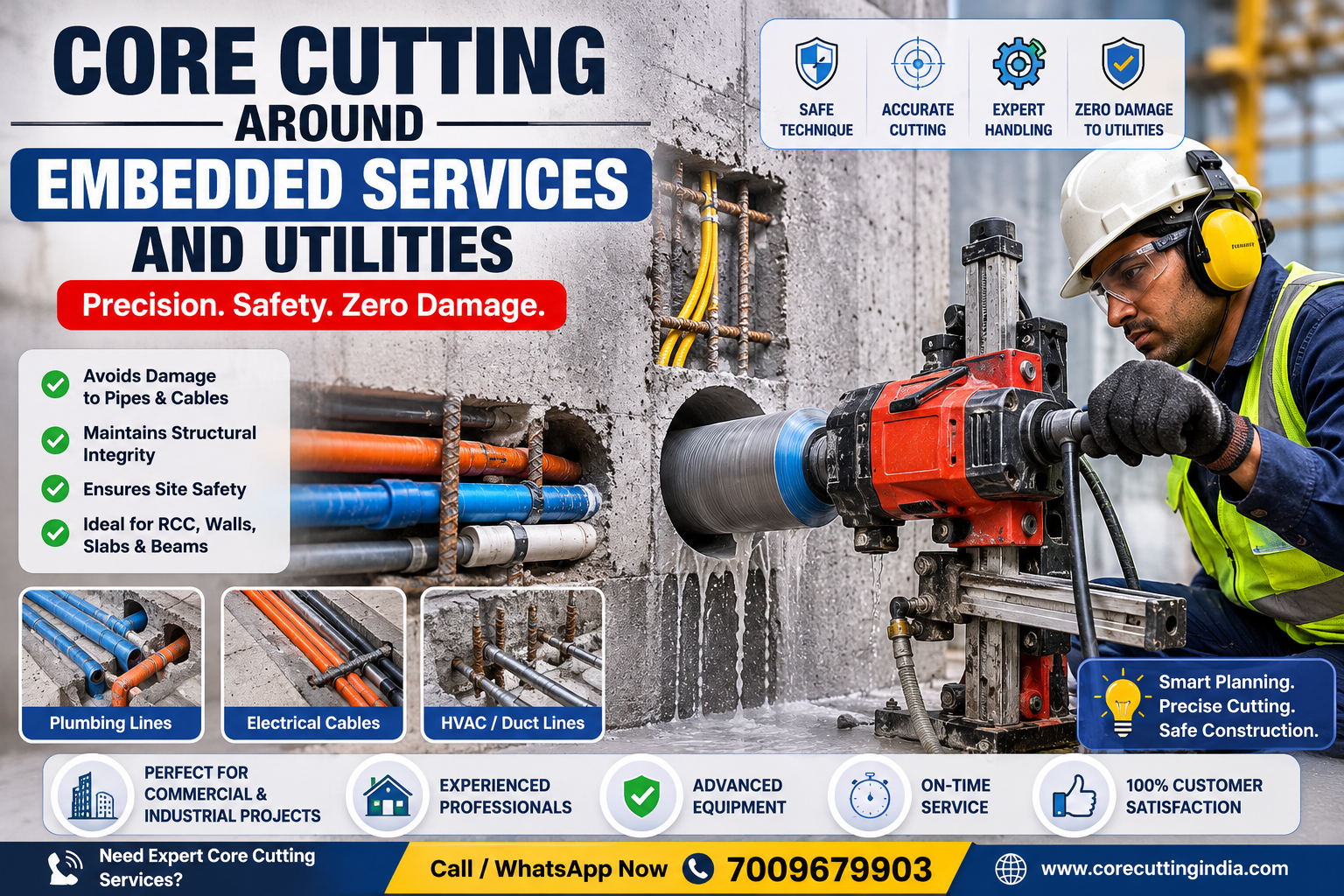
Modern buildings are like living organisms — beneath every wall, slab, and column runs a hidden network of electrical cables, plumbing pipes, HVAC ducts, fire-fighting lines, and telecom conduits. Whenever a builder, contractor, or homeowner needs to create an opening in concrete — for a new AC pipe, a plumbing riser, an exhaust duct, or a cable route — the process used is called core cutting. But there's a catch: cutting blindly into concrete can sever a live electrical cable, rupture a water pipe, or damage a gas line, leading to costly repairs, project delays, or even safety hazards.
This is why core cutting around embedded services and utilities has become one of the most specialised and safety-critical services in India's construction and renovation industry. At Core Cutting India ([email protected]), we specialise in precision core cutting that respects the invisible infrastructure hidden inside every structure — from residential apartments in Pune to commercial towers in Gurugram and metro stations in Chennai.
In this blog, we'll explore what core cutting is, why embedded services complicate the process, the techniques used to cut safely, real Indian examples, and the best practices every property owner or contractor should know.
What Is Core Cutting?
Core cutting (also called core drilling) is the process of using a diamond-tipped, hollow cylindrical drill bit to create precise, round holes through concrete, brick, or stone. Unlike traditional hammer drilling, which can crack or shatter material, core cutting produces clean, accurate holes with minimal vibration and dust.
Core cutting is used for:
- Installing plumbing and drainage pipes
- Running electrical and telecom cables
- Fitting HVAC ducts and exhaust systems
- Creating openings for lift shafts, staircases, or ventilation
- Installing borewell casings and structural anchors
- Retrofitting fire-fighting sprinkler lines in older buildings
The challenge arises because most of these openings need to be made in existing, occupied, or partially built structures — where embedded services are already running through the very concrete being cut.
Why Embedded Services Complicate Core Cutting
An "embedded service" refers to any utility line — electrical, plumbing, telecom, or gas — that has been cast or routed inside a concrete slab, wall, or column during original construction. In India, where buildings often undergo multiple rounds of renovation, retrofitting, and utility upgrades, embedded services are frequently undocumented or poorly mapped, especially in older structures.
Cutting into concrete without knowing what lies beneath can lead to:
- Electrical hazards — Severing a live cable can cause short circuits, fires, or electrocution risks for workers.
- Water damage — Puncturing a plumbing line can flood a floor, damage flooring, and cause seepage into neighbouring units.
- Gas leaks — In buildings with piped natural gas (PNG) connections, cutting into a gas line can be life-threatening.
- Structural weakening — Cutting too close to embedded rebar or structural tendons can compromise a slab or column's load-bearing capacity.
- Project delays and cost overruns — Repairing accidental utility damage often costs far more than the core cutting job itself.
This is precisely why professional core cutting companies in India invest in detection technology and trained technicians rather than relying on guesswork.
How Professionals Detect Embedded Services Before Cutting
At Core Cutting India, every job around embedded services follows a structured detection-and-verification process:
1. Ground Penetrating Radar (GPR) Scanning
GPR scanning sends radar pulses into concrete and reads the reflected signals to map out rebar, conduits, pipes, and voids before any cutting begins. This is now considered the industry standard for high-rise and commercial projects across cities like Mumbai, Bengaluru, and Hyderabad.
2. Cable and Pipe Locators
Electromagnetic cable locators help detect live electrical wiring embedded in walls and slabs, while acoustic and electromagnetic pipe locators trace metallic and non-metallic plumbing lines.
3. As-Built Drawings and BIM Models
For newer commercial and infrastructure projects — such as IT parks in Hyderabad or metro corridors in Delhi and Mumbai — Building Information Modelling (BIM) drawings often provide an accurate digital map of embedded services, reducing the need for extensive on-site scanning.
4. Physical Verification and Trial Cuts
In residential or older structures where documentation is missing, technicians often perform small trial cuts or use borescopes to visually confirm what lies within the concrete before proceeding with the full core cut.
5. Utility Marking and Isolation
Once services are located, they are physically marked on the surface, and where possible, temporarily isolated (e.g., switching off electrical circuits or shutting plumbing valves) before cutting begins.
Core Cutting Techniques Used Near Embedded Services
Different situations call for different core cutting methods:
- Diamond Core Drilling — The most precise method, used for cutting circular holes for pipes, cables, or conduits with minimal vibration, ideal for working close to embedded services.
- Wall Sawing — Used for larger rectangular openings, such as door frames or duct passages, typically kept at a safe distance from known utility routes.
- Wire Sawing — Used for very thick concrete sections, such as bridge piers or industrial floors, where high precision and minimal structural disturbance are required.
- Track-Mounted Core Cutting — Offers greater control and depth accuracy, often used in metro and infrastructure projects where safety tolerances are extremely tight.
Indian Examples: Core Cutting in Action
1. Mumbai Metro and Urban Infrastructure Projects
Mumbai's expanding metro network runs beneath and alongside dense urban infrastructure filled with water pipelines, stormwater drains, and electrical ducts. Contractors working on metro station interconnections rely heavily on GPR scanning and precision core cutting to avoid damaging Municipal Corporation utility lines during station construction.
2. Residential Retrofits in Delhi-NCR
In older housing societies across Delhi and Gurugram built in the 1980s and 90s, homeowners frequently need new plumbing risers or split-AC pipe openings. Because original construction drawings are often unavailable, core cutting teams use handheld cable and pipe locators before every cut to avoid damaging concealed wiring — a common source of insurance claims in Indian housing societies.
3. IT Parks and Commercial Towers in Bengaluru and Hyderabad
Tech parks often need last-minute cabling changes for server rooms and data centres. Core cutting near raised flooring and false ceilings, where fibre-optic and power cables run densely, requires extremely precise, low-vibration diamond drilling to avoid costly network downtime.
4. Hospital and Healthcare Facility Upgrades
Hospitals in cities like Chennai and Pune frequently retrofit medical gas pipelines and additional wiring for new equipment. Because medical gas lines are safety-critical, core cutting teams coordinate closely with facility engineers and use GPR scanning as a non-negotiable first step.
5. Industrial and Manufacturing Units in Pune and Chennai
Factories with buried electrical trenches and compressed air lines require core cutting for machinery foundation bolts and new conveyor routes. A single miscut here can halt production for days, making pre-cut utility mapping essential.
Safety Precautions for Core Cutting Near Embedded Services
Professional core cutting teams in India generally follow this safety checklist:
- Obtain existing drawings wherever possible, even if outdated, as a starting reference point.
- Conduct GPR or electromagnetic scanning before marking the cutting area.
- Isolate power and water supply to the section being worked on, when feasible.
- Use low-vibration diamond core drills rather than impact-based tools near sensitive zones.
- Cut in stages, checking core samples as drilling progresses to catch unexpected utilities early.
- Maintain clear communication with building facility managers or MEP (Mechanical, Electrical, Plumbing) consultants.
- Use PPE and dust/water management systems, since wet diamond cutting is common in Indian conditions to reduce airborne concrete dust.
- Document and photograph the cut area both before and after, useful for compliance and future reference.
Regulatory and Compliance Considerations in India
While there isn't a single unified national code exclusively for core cutting, Indian projects typically follow guidelines drawn from:
- National Building Code (NBC) of India for structural safety norms
- Bureau of Indian Standards (BIS) codes relevant to concrete and structural work
- Local municipal corporation guidelines for utility protection during construction, especially relevant in metro and road-cutting works
- Fire and electrical safety codes when working near fire-fighting systems or high-voltage cabling
Reputable core cutting companies also carry liability insurance, since accidental utility damage — particularly to municipal or shared services — can carry legal and financial consequences.
Choosing the Right Core Cutting Partner
When embedded services are involved, the margin for error is small. Property owners, architects, and contractors should look for a core cutting partner that offers:
- Utility scanning and detection equipment (GPR, cable locators)
- Experienced, trained technicians familiar with Indian building typologies
- Transparent site assessment and quotation before work begins
- Proper safety documentation and insurance coverage
- A track record across residential, commercial, and infrastructure projects
At Core Cutting India, our teams combine modern detection technology with decades of hands-on experience across Indian cities, ensuring every cut is precise, safe, and free of costly surprises. Whether it's a single AC pipe hole in a Mumbai apartment or a large-scale utility corridor in an industrial plant, we bring the same discipline of "scan first, cut second" to every project.
Conclusion
Core cutting around embedded services and utilities is not just a technical task — it's a discipline that blends detection technology, structural knowledge, and on-ground experience. In a country like India, where buildings range from decades-old structures with undocumented wiring to ultra-modern towers with digital BIM models, no two core cutting jobs are the same. The safest approach is always the same, though: locate before you cut.
If you're planning a renovation, retrofit, or new installation that requires cutting through concrete near existing utilities, don't leave it to guesswork. Reach out to the experts at Core Cutting India — [email protected] — for a site assessment and a safe, precise core cutting solution tailored to your project.
Target Related Searches: core cutting services near me, concrete core cutting cost in India, core cutting machine price, core cutting vs core drilling, wall cutting and core cutting contractors, core cutting for plumbing pipes, core cutting for electrical conduit, core cutting safety precautions, GPR scanning before core cutting, core cutting in high-rise buildings, RCC slab cutting services, diamond core drilling India
People Also Ask:
- What is core cutting in construction?
- How do you identify embedded services before core cutting?
- Is core cutting safe for RCC structures?
- What is the difference between core cutting and core drilling?
- How much does core cutting cost in India?
- What precautions are taken while cutting near electrical wiring?
- Can core cutting damage a building's structural integrity?
- Which tools are used for scanning utilities before cutting?