
Precision Demolition Meets Heritage Revival in India
India is sitting on a quiet goldmine of old buildings. Colonial-era warehouses in Kolkata, textile mills in Mumbai, spice godowns in Kochi, havelis in Ahmedabad and Jaipur, and mid-century government structures in Delhi — all of them represent decades of embodied material, craftsmanship, and history. Instead of demolishing these structures and starting from scratch, architects and developers across the country are increasingly choosing adaptive reuse: transforming old buildings into offices, museums, hotels, retail spaces, and cultural centres while retaining their original character.
But adaptive reuse is not simply about polishing old walls. It almost always involves cutting through existing concrete and masonry to introduce new staircases, elevator shafts, service ducts, doorways, skylights, and structural openings. This is where core cutting becomes one of the most critical, and most underappreciated, disciplines in the entire renovation process.
At Core Cutting India (corecuttingindia.com), we work with architects, structural consultants, and heritage conservationists across the country to make these transformations possible — cleanly, safely, and without compromising the structural integrity of the original building. In this blog, we break down what core cutting is, why it matters so much in adaptive reuse, and how it is being used in real Indian projects today.
What Is Core Cutting?
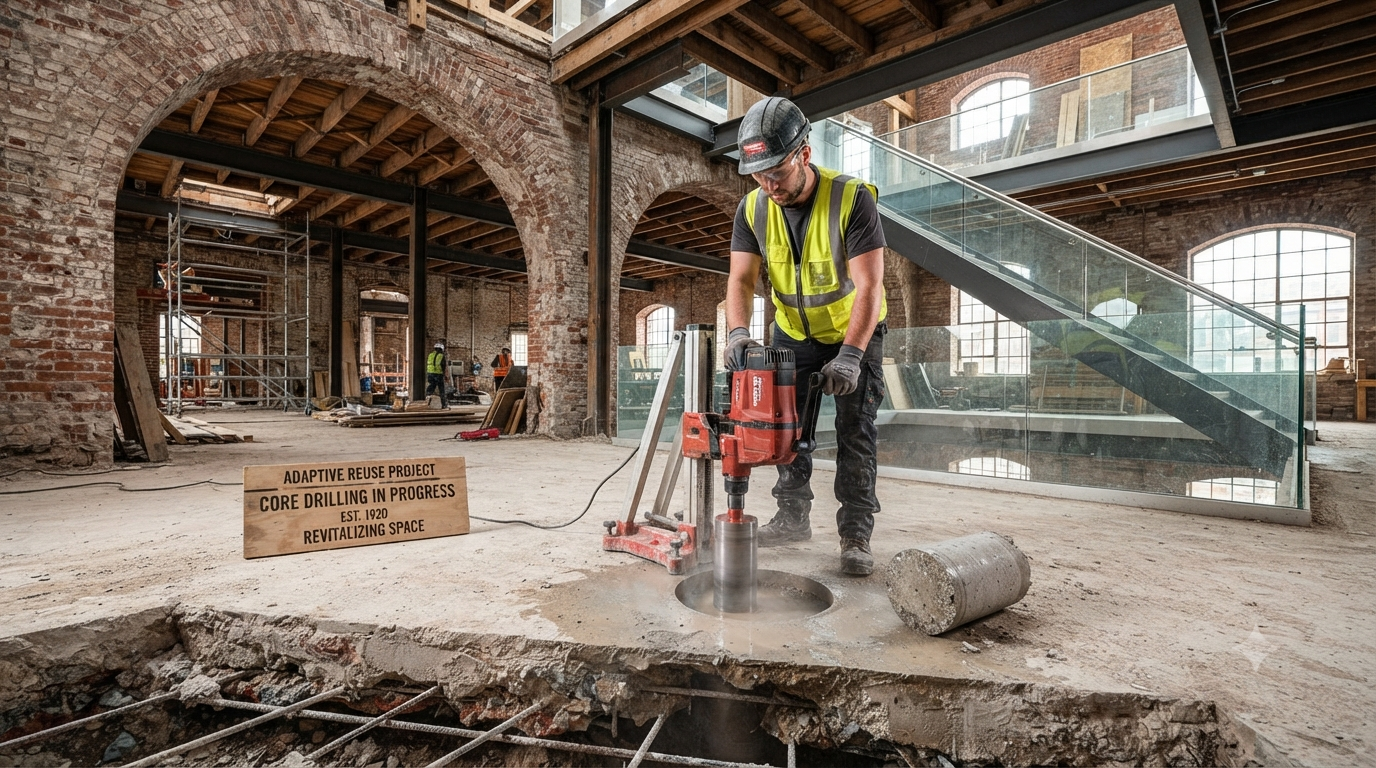
Core cutting is a precision construction technique used to create openings — round or rectangular — in concrete, brick, or stone structures using diamond-tipped cutting and drilling equipment. Unlike traditional demolition, which relies on breakers, hammers, and brute force, core cutting is controlled, low-vibration, and dust-managed. It allows contractors to cut exact-sized holes for pipes, cables, ducts, staircases, lift shafts, windows, and structural connections without damaging the surrounding structure.
Core cutting typically falls into two categories:
- Core drilling — used for smaller, circular openings, usually for pipes, cables, HVAC ducts, or plumbing penetrations.
- Wall and slab sawing (core cutting) — used for larger openings such as doorways, staircases, elevator shafts, or floor openings, often using diamond wire saws or track-mounted wall saws.
Both methods rely on diamond-segmented blades or core bits cooled with water, which minimizes dust, vibration, and micro-cracking in the surrounding concrete — a crucial factor when working on structures that may already be decades or centuries old.
Why Core Cutting Matters So Much in Adaptive Reuse
Adaptive reuse projects are fundamentally different from new-build construction. The structure already exists, often with unknown or partially documented reinforcement, aging concrete, or masonry that has weathered monsoons and decades of use. Every cut made into that structure carries risk. This is exactly why core cutting — rather than conventional breaking or jackhammering — is the preferred method for these projects.
1. Structural Safety
Old buildings were often designed with different structural codes, or none at all. A poorly placed cut using conventional demolition tools can crack a load-bearing wall or destabilize a slab. Core cutting allows contractors to make exact, pre-calculated cuts based on structural drawings and non-destructive testing, minimizing risk to the building's integrity.
2. Low Vibration, Low Noise
Heritage structures — especially those built with lime mortar, brick jack arches, or timber-reinforced masonry — are highly sensitive to vibration. Jackhammering can loosen adjoining plasterwork, cornices, or decorative facades. Diamond core cutting produces significantly less vibration, protecting fragile original fabric nearby.
3. Dust and Debris Control
Adaptive reuse projects often happen in occupied or partially occupied buildings — think of a heritage mill being converted into office space while other floors are already tenanted, or a museum retrofit happening around existing exhibits. Wet-cutting techniques used in core cutting suppress dust dramatically compared to dry demolition, making it far more practical for live sites.
4. Precision for MEP and Service Integration
Every adaptive reuse project needs modern electrical, plumbing, HVAC, fire safety, and IT infrastructure retrofitted into a building that was never designed for it. Core cutting allows precise routing of these services through existing slabs and walls without oversized, structurally risky openings.
5. Preservation of Aesthetic and Historic Value
Adaptive reuse is valuable specifically because it retains the character of the original structure. Core cutting's clean, sharp-edged openings can be finished to blend with the existing material palette — something that ragged, hammer-broken openings simply cannot achieve.
Core Cutting Techniques Used in Adaptive Reuse Projects
Diamond Core Drilling — Used for creating circular holes for plumbing risers, electrical conduits, HVAC penetrations, and anchor bolts. Common diameters range from 50mm to 600mm depending on project needs.
Wall Sawing — Track-mounted diamond saws cut straight lines through masonry and concrete walls, typically used to create new door openings, window enlargements, or connect adjoining spaces in a converted mill or warehouse.
Wire Sawing — Diamond wire saws are used for very large or irregularly shaped openings, such as new atrium spaces, elevator shafts, or entire floor sections that need to be removed for double-height reconfiguration — common in warehouse-to-loft conversions.
Slab Cutting — Precision cutting of floor slabs for new staircases, skylights, service risers, or structural columns, often carried out floor by floor as the adaptive reuse design demands.
Track-Guided Cutting Near Heritage Facades — For protected or heritage-listed facades, cuts are guided along pre-marked lines with minimal blade overrun, protecting adjoining ornamental brick or stonework.
Indian Case Studies: Adaptive Reuse and the Role of Core Cutting
India's adaptive reuse movement has grown substantially over the past decade, and core cutting has quietly enabled many of its most celebrated transformations.
Mumbai's Mill Land Conversions
Mumbai's historic textile mills — once the industrial backbone of the city — have become a defining example of adaptive reuse in India. Compounds like Phoenix Mills and Kamala Mills transformed old spinning and weaving sheds into retail, entertainment, and office precincts. These conversions required extensive core cutting to introduce new staircases, escalators, service shafts, and large glazed openings into thick industrial-era brick and concrete structures, all while retaining the exposed brick and steel-truss character that gives these spaces their identity.
Aspinwall House and Pepper House, Kochi
As the primary venues of the Kochi-Muziris Biennale, these 19th-century trading warehouses along the Kochi waterfront were adapted into gallery and exhibition spaces. Converting cavernous godowns — originally built for spice and coir storage — into flexible art venues required careful cutting of new openings for lighting, climate control, and visitor circulation, all without disturbing the historic timber roof structures and colonial-era masonry walls.
House of MG, Ahmedabad
A converted heritage residence in Ahmedabad's old city, House of MG is now a boutique heritage hotel. Adaptive reuse projects like this typically require core-cut openings for modern plumbing, bathrooms, air conditioning, and fire safety systems to be threaded through original masonry walls without disturbing the carved wooden facades and jharokhas that define the structure's heritage value.
Bikaner House, New Delhi
Originally built in the 1930s as the Delhi residence of the Bikaner royal family, this colonial-era building was adaptively reused as a contemporary cultural and arts centre. The transformation involved sensitive structural interventions — new openings for accessibility, services, and gallery lighting — carried out with minimal disturbance to the original colonial architecture.
Royal Opera House, Mumbai
One of India's most celebrated restoration and adaptive reuse success stories, the century-old Royal Opera House was revived as a performance venue after decades of disuse. Structural upgrades, new service routes, and accessibility features required precision cutting techniques that preserved the ornate plasterwork and heritage detailing throughout the restoration.
These examples share a common thread: none of them could have been executed safely, precisely, or economically using conventional demolition. Core cutting made it possible to introduce 21st-century functionality into structures that are, in some cases, well over a hundred years old.
Challenges Unique to Core Cutting in Heritage and Adaptive Reuse Projects
Core cutting for adaptive reuse is considerably more complex than core cutting in new construction, for several reasons:
- Unknown reinforcement and material composition — Many older Indian buildings predate detailed structural documentation. Contractors often rely on ground-penetrating radar (GPR) scanning before cutting to avoid unexpected rebar, embedded utilities, or historic ironwork.
- Variable material strength — Lime mortar, old brick, and weathered concrete behave very differently under cutting stress compared to modern reinforced concrete, requiring adjusted blade speeds and cooling techniques.
- Heritage regulations — Projects involving listed or protected structures often require approvals from municipal heritage committees or bodies like INTACH before any structural cutting can proceed.
- Working around occupied spaces — Many adaptive reuse projects are phased, with some areas still in use while others are under construction, demanding strict dust and noise control.
- Structural sequencing — Cuts must often be planned in a specific sequence, with temporary shoring or propping in place, to avoid destabilizing the structure mid-project.
Choosing the Right Core Cutting Partner for Adaptive Reuse
Because adaptive reuse projects carry higher structural risk than new-build construction, choosing an experienced core cutting contractor is essential. Look for a partner who can offer:
- Structural assessment coordination with architects and structural engineers before cutting begins
- Non-destructive testing and scanning to identify embedded rebar, conduits, or voids
- Low-vibration, wet-cutting diamond equipment suited to older or heritage materials
- Experience working within heritage approval frameworks
- Dust and debris management suited to occupied or semi-occupied sites
- Precise, code-compliant openings for MEP, staircases, and structural modifications
At Core Cutting India, we specialize in exactly this kind of precision work — supporting architects, contractors, and heritage consultants across India's growing adaptive reuse sector with reliable, safe, and accurate core cutting services.
Conclusion
As Indian cities look inward — reviving mills, warehouses, havelis, and colonial-era buildings rather than demolishing them — core cutting is emerging as one of the quiet but indispensable technologies behind the adaptive reuse movement. It bridges the gap between preservation and modern functionality, allowing old buildings to serve new purposes without losing the character that made them worth saving in the first place.
Whether you're converting a century-old warehouse into a gallery, retrofitting a colonial bungalow into a boutique hotel, or reimagining an industrial mill as a mixed-use precinct, precision core cutting can make the difference between a successful adaptive reuse project and a structurally compromised one.
Planning an adaptive reuse project? Get in touch with our team at corecuttingindia.com or write to us at [email protected] for expert core cutting and core drilling solutions tailored to heritage and adaptive reuse construction across India.