
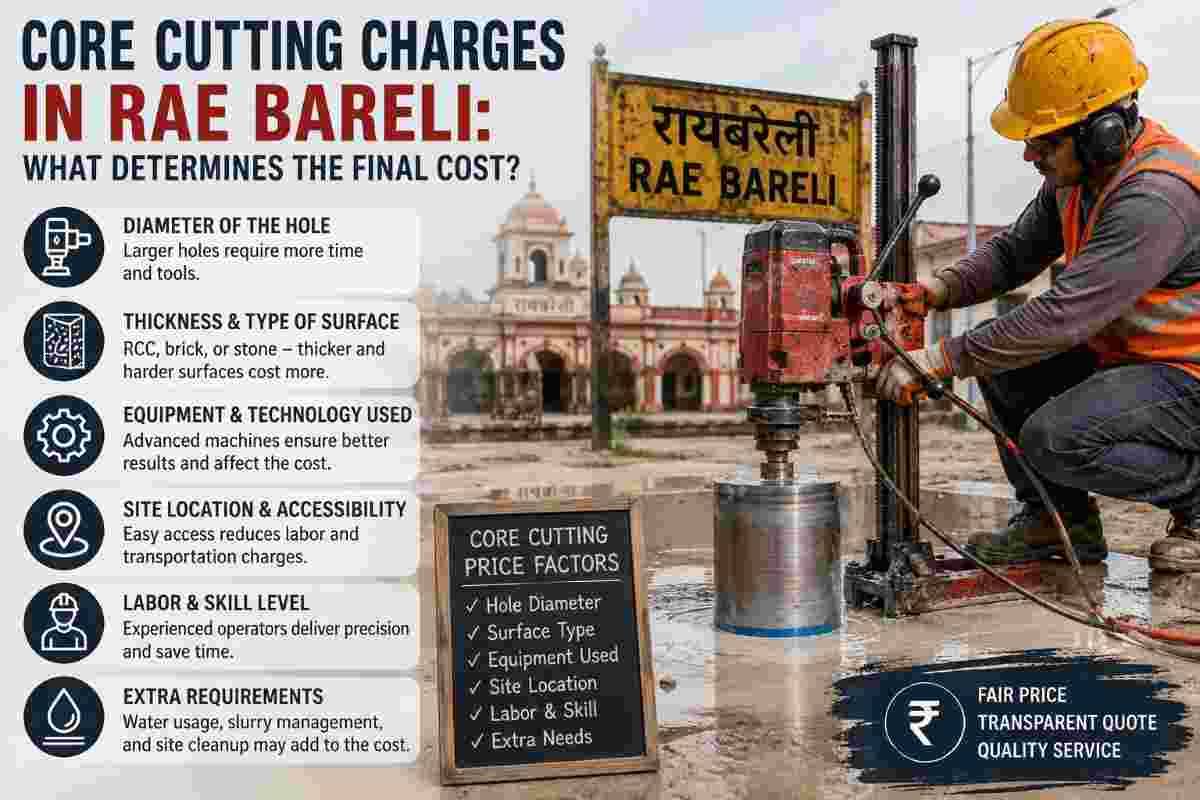
Whether you are expanding a modern residential villa in Indira Nagar, setting up a heavy industrial unit near the Amawan Road industrial belt, or undertaking commercial building renovations in Civil Lines Rae Bareli, structural penetration is an indispensable part of construction. Cutting clean, precise cylindrical openings for air conditioning ducts, plumbing pipelines, electrical conduits, and fire-fighting systems requires heavy-duty engineering solutions.
Manual hammering or conventional demolition methods can micro-fracture surrounding structural concrete, compromise structural integrity, and produce high noise and airborne dust. This is why diamond core drilling has become the gold standard across Uttar Pradesh.
However, when property owners, site managers, and contractors start planning their projects, the most pressing question is: What are the actual core cutting charges in Rae Bareli, and what factors determine the final bill?
At Core Cutting India, we believe in complete pricing transparency. In this comprehensive guide, we unpack the cost mechanics behind concrete core drilling, provide detailed rate estimates per inch and per hole, break down the key technical variables that dictate pricing, and show you how to accurately budget your site work without hidden expenses.
Understanding Core Cutting Rates in Rae Bareli (2026 Price Benchmark)
Core cutting costs in Rae Bareli are structured either on a per-hole lump sum basis (common for small residential utility work) or on a per-inch-depth rate framework (standard for heavy structural and industrial project work).
The total cost is governed by structural hardness, hole diameter, penetration depth, site logistics, and specialized equipment requirements.
Indicative Price Chart: Estimated Core Cutting Charges in Rae Bareli
Note: The prices above represent average baseline rates in the region. For exact pricing tailored to your job specs, try our real-time Core Cutting India Rate Calculator or speak with a local technical specialist directly by calling +91 70096 79903.
7 Critical Factors That Determine Your Final Core Cutting Charges
No two concrete structures in Rae Bareli are identical. A single-brick residential partition wall cut behaves very differently than a heavily reinforced grade M30 concrete shear wall inside a commercial complex. Here is an in-depth look at the primary variables that influence your final estimate:
                          ┌─────────────────────────────────────┐
                          │     FINAL CORE CUTTING COST         │
                          └──────────────────┬──────────────────┘
                                             │
        ┌───────────────────┬────────────────┼───────────────────┬───────────────────┐
        ▼                   ▼                ▼                   ▼                   ▼
┌───────────────┐   ┌───────────────┐  ┌───────────┐   ┌──────────────────┐  ┌───────────────┐
│ Base Material │   │ Hole Diameter │  │ Wall/Slab │   │ Reinforcement    │  │ Site Access & │
│ (Brick vs RCC)│   │  & Bit Wear   │  │   Depth   │   │ Density (Rebar)  │  │ Working Height│
└───────────────┘   └───────────────┘  └───────────┘   └──────────────────┘  └───────────────┘
1. Base Material Type: Masonry Brick vs. Reinforced Cement Concrete (RCC)
The single biggest price driver is the hardness and density of the base material.
-
Red Brick & AAC Block Walls: Masonry offers relatively low resistance to diamond-tipped drill bits. Drilling through a 9-inch brick wall is fast, uses less power, and causes minimal bit wear. Consequently, brick cutting charges sit at the lower end of the pricing spectrum.
-
Reinforced Cement Concrete (RCC): Cutting through high-grade RCC requires industrial water-cooled diamond core rigs. RCC contains hardened stone aggregates and steel rebar grids. Drilling through solid concrete takes more time, draws higher electrical wattage, and wears out expensive diamond segments faster, resulting in higher charges.
2. Diameter of the Core Hole
The core bit diameter directly impacts equipment torque requirements and diamond segment consumption.
-
Small Diameters (1" to 3"): Require standard portable core drilling machines and standard motor power.
-
Medium Diameters (4" to 6"): Require heavy-duty rig mounts to eliminate vibration and ensure true roundness.
-
Large Diameters (8" to 14"+): Demand high-torque anchored hydraulic or electric core rigs. The surface area of the cut scales exponentially with diameter, which increases tool wear and operator time.
3. Wall/Slab Depth and Thickness
Core cutting pricing is fundamentally linked to overall linear penetration. Cutting through a 5-inch residential RCC slab is far faster than penetrating a 14-inch industrial retaining wall or bridge pier. Deep penetrations may also require specialized core bit extensions, anchor setting, and multi-stage extraction, which increases labor time and equipment strain.
4. Steel Rebar Density and Structural Grade
When core drilling RCC, the cutter often encounters high-yield strength rebar (such as Fe500 or Fe550 TMT bars).
-
When drilling through heavy structural beams, columns, or thick raft foundations, the bit must chew through dense steel rods without damaging the structural matrix around the hole.
-
Heavy steel reinforcement slows down penetration speeds and increases diamond segment loss, which contractors factor into their per-inch rate.
+-------------------------------------------------------------------------------+
|                        MATERIAL PENETRATION COMPARISON                        |
+------------------------------------+------------------------------------------+
| MATERIAL                           | AVERAGE CUT TIME (4" CORE, 9" DEPTH)     |
+------------------------------------+------------------------------------------+
| AAC Lightweight Block              | 3 - 5 Minutes                            |
| Red Fly-Ash Brick Wall             | 6 - 10 Minutes                           |
| Standard RCC (M20 Grade, Low Steel)| 15 - 25 Minutes                          |
| Heavy Structural RCC (M35+, Steel) | 35 - 55 Minutes                          |
+------------------------------------+------------------------------------------+
5. Height, Working Angle, and Site Accessibility
Where the hole needs to be cut is almost as important as what is being cut:
-
Standard Ground/Slab Level: Fast set-up, minimal scaffolding, lower setup costs.
-
Overhead & Ceiling Drilling: Inverted ceiling core cutting requires specialized waterproof slurry collection rings, anchored rig plates, and elevated safety staging, which slightly increases site labor costs.
-
High-Rise & Exterior Facades: Working at heights requires secure staging, safety harnesses, and specialized material handling to preserve safety compliance.
6. Job Volume & Project Scale
Contractors incur fixed baseline costs for mobilization, equipment transport, site setup, and technician deployment.
-
Single Hole Demands (e.g., 1 AC Hole): Single-hole service calls are priced with a minimum mobilization threshold to cover travel and setup expenses.
-
Bulk Commercial Projects (20+ Openings): When you book multiple openings across a residential building complex or commercial site, the cost per hole decreases significantly due to shared mobilization overheads.
7. Power Supply and Slurry Management Needs
Core drilling equipment requires consistent electricity and continuous water cooling.
-
Power Source: Professional heavy rigs run on stable 220V/415V power. If your remote site lacks line power, deploying portable heavy generators can add minor auxiliary fees.
-
Clean Slurry Vacuuming: In finished homes, corporate interiors, or operational hospitals, water slurry must be captured immediately using industrial wet vacuums to protect walls and floors. Specialized clean-site management may carry a nominal surcharge over raw construction-site drilling.
The Math Behind Per-Inch Core Cutting Calculations
To understand how professional core cutting contractors compute quotes, let’s look at a practical calculation example.
Formula for Per-Inch Pricing:
Practical Example:
Suppose you are renovating a commercial property in Rae Bareli and need four 4-inch diameter plumbing holes cut through 9-inch thick RCC beam structures.
-
Diameter Rate (4-inch RCC): Estimated at ~₹150 per inch depth.
-
Thickness per Hole: 9 inches.
-
Cost per Hole: ₹150 × 9 inches = ₹1,350 per hole.
-
Subtotal for 4 Holes: ₹1,350 × 4 = ₹5,400.
-
Combined Project Total: Approximately ₹5,400 – ₹6,000 (inclusive of site setup and slurry management).
Want to eliminate manual calculations? Use the official Core Cutting India Online Rate Calculator to adjust specifications, choose wall materials, and generate instant, transparent job estimates.
Why Diamond Core Cutting Outperforms Manual Chipping
Some property owners consider traditional manual hammering or jackhammering to save costs. However, crude mechanical impact often leads to much higher long-term repair costs:
┌───────────────────────────────────────┬───────────────────────────────────────┐
│       PRECISION DIAMOND DRILLING      │       TRADITIONAL MANUAL CHIPPING     │
├───────────────────────────────────────┼───────────────────────────────────────┤
│ ✔ Smooth, clean, circular finishes    │ ✖ Rough, jagged, oversized breaches   │
│ ✔ Zero micro-cracking in concrete     │ ✖ Causes micro-fractures in matrix    │
│ ✔ Preserves surrounding structural integrity│ ✖ Weakens adjacent beams/slabs  │
│ ✔ Low noise, dust-free wet process    │ ✖ High noise, excessive toxic dust    │
│ ✔ Fast execution (minutes per hole)   │ ✖ Labor-intensive and time-consuming  │
│ ✔ No extra masonry patch-up needed    │ ✖ Requires costly plaster repair work │
└───────────────────────────────────────┴───────────────────────────────────────┘
Step-by-Step: What to Expect During a Professional Core Cutting Job
When you hire Core Cutting India for your project in Rae Bareli, our team follows a streamlined, professional process:
[Step 1: Site Inspection & Marking] ➔ [Step 2: Utility Scanning & Clearance]
                                               │
                                               ▼
[Step 4: Precision Core Extraction] ◄─ [Step 3: Rig Anchoring & Water Setup]
-
Site Inspection & Precise Marking: The site engineer checks wall thickness, identifies structural members, and marks exact center-points based on architectural drawings.
-
Rebar & Conduit Detection: High-performance scanning tools verify that hidden live electrical lines, water conduits, or critical structural rebar are not damaged unintentionally.
-
Rig Anchoring & Coolant Hookup: The diamond core rig is anchored to eliminate drift, ensuring perfectly straight, true-to-spec penetrations. Water supply lines are attached to keep the diamond segments cool and suppress dust.
-
Precision Core Drilling & Extraction: The high-torque rig cuts smoothly through masonry and rebar. The solid concrete core is removed intact, leaving a smooth, burr-free opening ready for immediate pipe or duct installation.
How to Get the Best Value on Core Cutting in Rae Bareli
Here are four practical tips to optimize your site budget:
-
Consolidate Your Scope: Instead of booking single holes piecemeal across different days, identify all AC, plumbing, electrical, and chimney points early. Booking them in one batch significantly lowers your cost per hole.
-
Provide Clear Access & Power: Ensure the work zone is clear of debris and that a reliable 220V power supply and clean water outlet are available. This helps technicians get to work immediately without delay.
-
Mark Structural Points Early: Work with your project engineer or plumber to finalize exact hole coordinates before the crew arrives.
-
Choose Specialized Technicians: Hiring non-specialized labor with worn equipment can ruin core edges, jam bits, or crack adjacent concrete. Professional contractors complete jobs faster and preserve structural integrity.
Frequently Asked Questions (PAA)
1. How much does AC core cutting cost in Rae Bareli?
AC core cutting (typically 3-inch to 4-inch diameter holes) generally costs between ₹350 and ₹600 per hole in standard brick walls, and ₹650 to ₹1,100 per hole in RCC walls, depending on wall thickness and site elevation.
2. What is the per-inch rate for RCC core cutting in Uttar Pradesh?
The per-inch rate for RCC core cutting typically ranges from ₹60 to ₹300 per inch depth. The exact rate depends on hole diameter, concrete grade, and structural rebar density.
3. Why is diamond core drilling preferred over manual chipping?
Diamond core drilling produces smooth, precise, circular openings without vibration. It eliminates micro-cracking in surrounding concrete, protects structural strength, minimizes dust and noise, and avoids expensive post-drilling plaster repairs.
4. How long does it take to cut a 4-inch hole in an RCC wall?
With heavy-duty commercial equipment, cutting a standard 4-inch diameter hole through a 9-inch RCC wall typically takes 15 to 25 minutes, depending on the steel rebar concentration and concrete hardness.
5. Is wet core drilling safe for residential interiors?
Yes. Wet core drilling uses water to cool the diamond bit and trap concrete dust. When performed by professional teams using slurry containment rings and wet industrial vacuums, the process keeps interior spaces clean and dust-free.
Get a Fast, Transparent Quote from Core Cutting India
Don't let unexpected core drilling expenses push your renovation or construction project over budget. Whether you need a single AC sleeve cut in a private residence or hundreds of utility penetrations across an industrial development, Core Cutting India delivers fast, precise, vibration-free diamond core drilling tailored to your exact requirements.
-
Explore Rates Online: Calculate live pricing instantly on our Core Cutting India Rate Calculator.
-
Website: Visit https://corecuttingindia.com/ to explore our nationwide concrete cutting services, project portfolios, and engineering capabilities.
-
Direct Helpline & WhatsApp: Speak directly with our technical coordinator for same-day site estimates: +91 70096 79903.