
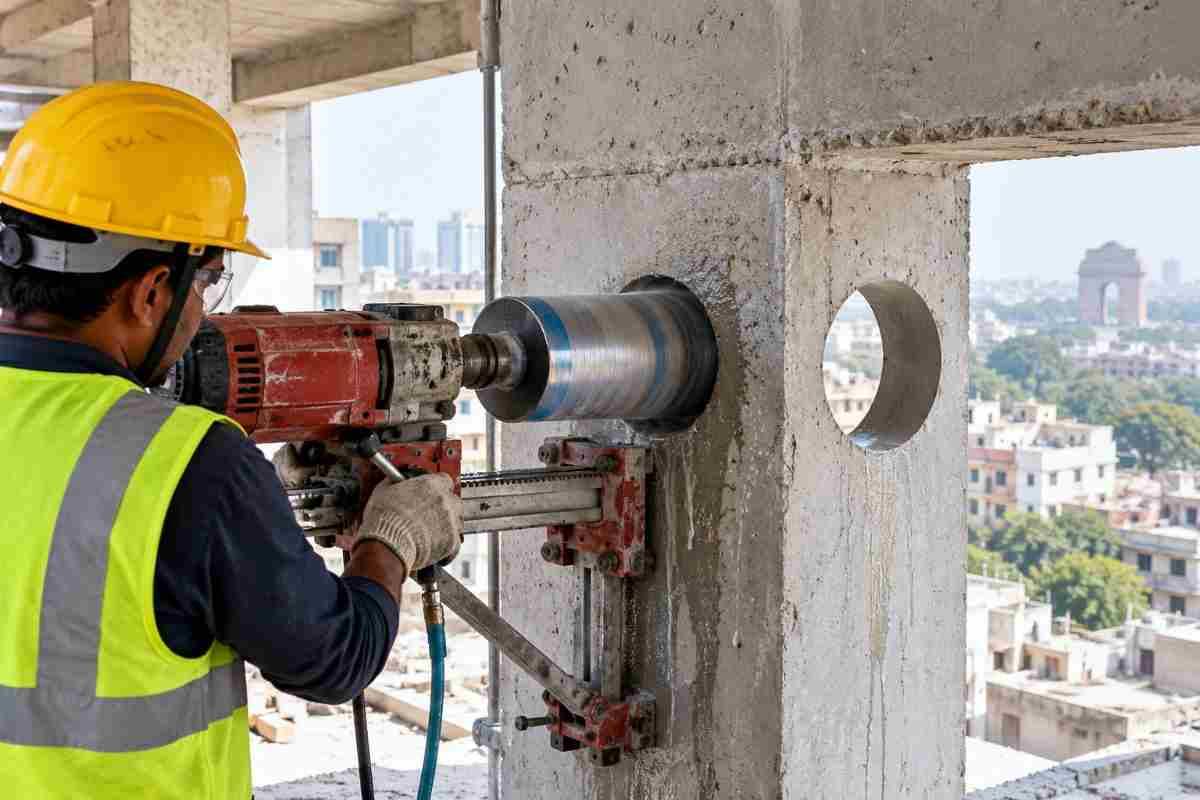
Every contractor in Delhi knows the pressure. Tight plots, old buildings, crowded lanes, strict timelines and clients who want results yesterday. In that environment, one wrong move during renovation or retrofitting can cost lakhs: a cracked slab, a damaged beam, a cut reinforcement bar or a neighbour’s complaint about vibration.
This is why concrete core cutting has become a standard method on serious projects across Delhi-NCR. Instead of smashing through concrete with hammers and breakers, core cutting uses diamond-tipped tools to create clean, accurate openings with minimal impact on the surrounding structure.
In this guide, from the team at Core Cutting India, we explain how core cutting protects structures, where it fits into Delhi’s construction landscape, and what contractors should do to get the best results.
Why Structural Damage Is a Real Risk on Delhi Projects
Delhi’s building stock is unusually varied. A single contractor might work on a 1960s residential block in one week and a modern commercial tower in Gurugram or Noida the next. Each comes with its own risks:
- Ageing RCC structures. Older buildings often have carbonated concrete, corroded rebar or inconsistent construction quality. They tolerate shock poorly.
- Dense surroundings. Buildings in colonies, markets and mixed-use areas often share walls or sit just metres apart. Vibration travels.
- Hidden services. Post-tension cables, electrical conduits, water lines and rebar cages are not always visible, and drawings may be outdated or missing.
- Modification culture. Owners frequently add plumbing shafts, AC ducts, staircases, lift openings or new floors to existing buildings.
When contractors use crude methods in these conditions, damage is not a possibility but a probability. Unnecessary structural damage means rework, delays, safety concerns, disputes with owners and, in the worst cases, compromised building integrity.
What Is Core Cutting?
Core cutting, also called diamond core drilling, is a precision method of making circular holes in concrete, brick, stone and masonry. A hollow cylindrical drill bit, embedded with industrial diamond segments, rotates at controlled speed, usually with water cooling. It grinds through material rather than breaking it, and removes a clean cylindrical “core” of concrete.
Related techniques use the same diamond-cutting principle for larger or more complex jobs:
- Wall sawing for straight cuts in walls, shear walls and slabs, ideal for doorways and window openings.
- Slab or floor sawing for expansion joints, trenches and removing slab sections.
- Wire sawing for very thick, heavy or awkwardly shaped concrete elements.
- Hand sawing and ring sawing for confined areas and flush cuts.
All of these methods share a key advantage: they remove material without hammering the structure.
The Problem with Traditional Breaking Methods
To understand the value of core cutting, look at what it replaces. Conventional jackhammers, chisels and demolition breakers work by brute impact. That causes several problems.
1. Vibration and micro-cracking. Impact tools send shock waves through the concrete. Even if the opening looks fine, micro-cracks can radiate into adjoining slabs, beams and columns. These cracks admit moisture, speed up corrosion and weaken the structure over time.
2. Uncontrolled over-breakage. A breaker does not stop where you want it to. Openings end up irregular and larger than planned, and edges spall. Patching these requires extra material and labour, and the repaired area is rarely as strong as the original.
3. Damage to reinforcement. Hammering can bend, loosen or fracture rebar, and it can break the bond between steel and concrete. This directly reduces load-bearing capacity.
4. Noise, dust and nuisance. In Delhi’s dense neighbourhoods, jackhammering triggers complaints from residents, offices and schools, and can bring work to a halt.
5. Risk to adjacent elements. Breaking a hole for a pipe can crack a neighbouring beam, tile finish or partition wall. Contractors then absorb the cost of repairs that were never in the budget.
How Core Cutting Prevents Unnecessary Structural Damage
1. Virtually Vibration-Free Cutting
Diamond cutting grinds through concrete with rotational action, so it transfers far less shock into the structure than impact tools do. This matters most in old buildings, in heritage or sensitive structures, and in buildings that remain occupied during work. Lower vibration means far lower risk of micro-cracking in surrounding members.
2. Precision That Matches the Drawing
A core drill creates a hole of exact diameter, in an exact location, at the required angle. Wall saws and slab saws make straight, clean cuts to marked lines. This precision means:
- No oversized openings that weaken slabs or walls
- Smooth edges that need little or no patching
- Accurate sleeve and pipe fits
- Predictable results that engineers can verify in advance
For a contractor, precision is not just about quality. It reduces the risk of disputes about workmanship.
3. Protection of Reinforcement and Embedded Services
When core cutting is combined with a proper pre-scan (more on this below), operators can position holes to avoid rebar, post-tension tendons and conduits. Where a cut through steel is unavoidable and approved by the structural engineer, a diamond bit slices through cleanly rather than tearing or bending it.
4. Preserving Structural Integrity
Clean, controlled openings let engineers plan modifications with confidence. They can calculate the effect of a given opening on load paths and add trimmer reinforcement or edge strengthening where needed. Uncontrolled breaking, by contrast, creates unpredictable weaknesses that nobody can model properly.
5. Reduced Dust and Noise
Wet core cutting, where water cools the bit and suppresses dust, produces dramatically less airborne dust than dry breaking. Noise levels are generally lower and more consistent. This helps contractors stay on good terms with neighbours, building managers and resident welfare associations, and it improves working conditions for site workers.
6. Less Rework and Fewer Repairs
Because the hole is made correctly the first time, there is little need for patching, plastering, re-casting or grouting around oversized breakage. That saves labour and material, and it protects the schedule.
7. Safer Worksites
Controlled cutting reduces flying debris, sudden concrete failure and the fatigue injuries that come with long hours of jackhammering. It also lowers the chance of unexpected collapse of weakened sections.
The Role of Pre-Cutting Surveys
Even the best equipment cannot protect a structure if the operator does not know what is inside it. Responsible core cutting starts with investigation.
Concrete scanning and rebar detection. Ground penetrating radar (GPR) or electromagnetic scanners help locate reinforcement, conduits and voids before drilling begins. Marked results guide the placement of each hole.
Review of drawings and site conditions. Contractors should check structural drawings where available, note beam and column positions, and identify any post-tensioned slabs, which require extra caution.
Engineer approval. For openings in beams, columns, shear walls or load-bearing elements, the structural engineer must approve location and size. Core cutting is a precise tool, but it does not replace engineering judgement.
Marking and layout. Clear marking of centres, diameters and cutting lines on the surface avoids on-site confusion and mistakes.
Contractors who build this survey step into every job consistently report fewer surprises and cleaner outcomes.
Common Applications of Core Cutting in Delhi Projects
Core cutting suits a wide range of work across Delhi-NCR:
- Plumbing and drainage: openings for soil pipes, water lines and sleeves through slabs and walls
- HVAC and ducting: holes for AC refrigerant lines, exhaust ducts and ventilation shafts
- Electrical and data: conduit and cable pass-throughs in thick walls and floors
- Fire-fighting systems: sprinkler and riser penetrations
- Anchor and dowel holes: precise drilling for anchor bolts, rebar dowels and retrofit connections
- Lift and staircase openings: larger openings made through wall and slab sawing
- Door and window openings: clean cut-outs in existing RCC or brick walls
- Renovation and retrofitting: modifications in occupied buildings with minimal disruption
- Road, bridge and industrial work: testing cores, drainage holes and cutting of thick sections
In each case, the goal is the same: make the necessary opening without harming what should remain.
Delhi-Specific Considerations for Contractors
Occupied and congested sites. Many Delhi projects are renovations in functioning homes, offices, hospitals and shops. Low-vibration, low-dust cutting is often the only practical option.
Old construction practices. Variable concrete quality and inconsistent rebar placement make scanning especially valuable on older buildings.
Environmental rules. Delhi-NCR has strict rules on dust and construction pollution, particularly during high-pollution periods. Wet cutting and dust-control practices help contractors stay compliant and avoid work stoppages. Contractors should always check the latest local and CPCB/DPCC guidelines applicable to their site.
Neighbour sensitivity. Shared walls, narrow lanes and close-set buildings mean complaints about noise and shaking travel fast. Cleaner methods protect your reputation as well as the structure.
Access and logistics. Narrow lanes and upper-floor sites call for compact, portable equipment and experienced operators who can work efficiently in tight spaces.
How to Choose the Right Core Cutting Contractor in Delhi
Not all core cutting services are equal. When you hire a provider, check for:
- Experience with your type of project. Residential retrofits, commercial fit-outs and industrial work each have their own demands.
- Modern diamond equipment. Well-maintained machines and quality bits give cleaner cuts and faster work.
- Scanning capability. A provider who scans before cutting is protecting your project.
- Trained operators. Skill with stand setup, anchoring and cutting technique matters as much as the machine.
- Safety and dust-control practices. Ask about wet cutting, slurry management and PPE.
- Clear quotations. Rates should be explained by diameter, depth, number of holes or running metre, with no vague add-ons.
- Reputation and references. Ask for past work and client feedback.
At Core Cutting India, the focus is on precision, safety and structural care, so that contractors can finish jobs without collateral damage.
The Cost Advantage: Spending a Little to Save a Lot
Some contractors hesitate because breaking by hand looks cheaper per hole. That comparison usually ignores the full picture. Consider what the cheaper method can add:
- Patching and finishing of oversized openings
- Repair of cracks in adjoining slabs or walls
- Extra labour hours and longer schedules
- Complaints, penalties or stoppages from nuisance
- Possible structural strengthening if damage occurs
- Loss of client trust
Core cutting often pays for itself by avoiding even one of these. For jobs involving structural elements, the question is not whether you can afford precision cutting, but whether you can afford not to use it.
Best Practices for Contractors Using Core Cutting
- Scan first, cut second. Never drill blind in a structural element.
- Get engineer sign-off for any opening in beams, columns, shear walls or post-tensioned slabs.
- Plan locations early. Coordinate plumbing, electrical and HVAC trades so holes are cut once, not repeatedly.
- Keep openings as small as the job allows, and keep them away from beam zones and supports where possible.
- Use wet cutting to control dust and extend bit life.
- Secure the work area. Barricade below and around cutting zones, and manage slurry.
- Protect finished surfaces with sheeting before cutting in completed spaces.
- Document the work. Photographs and a simple log of hole locations help with handover and future modifications.
- Seal and finish openings properly. Use fire-stopping, waterproofing or grout where required once pipes or ducts are installed.
Frequently Asked Questions
What is core cutting in construction?
Core cutting is a method of making clean, round holes in concrete, brick and stone using a diamond-tipped hollow drill bit. It is widely used for pipes, ducts, cables and anchors.
Is core cutting safe for RCC structures?
Yes, when done correctly. With pre-scanning, engineer approval and trained operators, core cutting is considered far safer for the structure than impact breaking, because it creates minimal vibration and keeps openings controlled.
Can core cutting damage rebar?
It can cut through rebar if it is in the path of the bit. That is why scanning before drilling is essential. Where rebar must be cut, the structural engineer should approve it first.
What is the difference between core cutting and core drilling?
The terms are often used interchangeably. Both refer to using a diamond core bit to make cylindrical holes. “Cutting” is also used more broadly for sawing operations such as wall sawing and slab sawing.
How much does core cutting cost in Delhi?
Cost depends on hole diameter, depth, material, reinforcement density, site access, height and the number of holes. Providers usually quote per hole or per running metre, and rates vary by project. Contact the service provider for a project-specific quote.
Does core cutting create a lot of dust or noise?
Wet core cutting keeps dust low, and noise is generally lower and steadier than jackhammering. This makes it well suited to occupied buildings.
Do I need permission before cutting openings in a building?
For structural elements, you should obtain approval from a qualified structural engineer, and in societies or leased premises, from the building management or owner. Check local regulations for your project.
How deep can a core drill cut?
With extension rods and suitable equipment, core drills can cut through thick slabs and walls. Very thick sections may call for wire sawing.
Conclusion
For Delhi contractors, protecting a structure is not optional. It is central to safety, reputation and profit. Core cutting delivers what traditional breaking cannot: clean openings, minimal vibration, accurate placement, less dust and far lower risk of cracks and hidden damage. Combined with proper scanning and engineering approval, it turns risky modifications into predictable, controlled work.
If your next project involves plumbing shafts, duct openings, anchor holes, door cut-outs or any alteration to existing concrete, consider precision diamond cutting from the start. To discuss your requirements with experienced professionals, visit Core Cutting India and get your project done without unnecessary structural damage.