
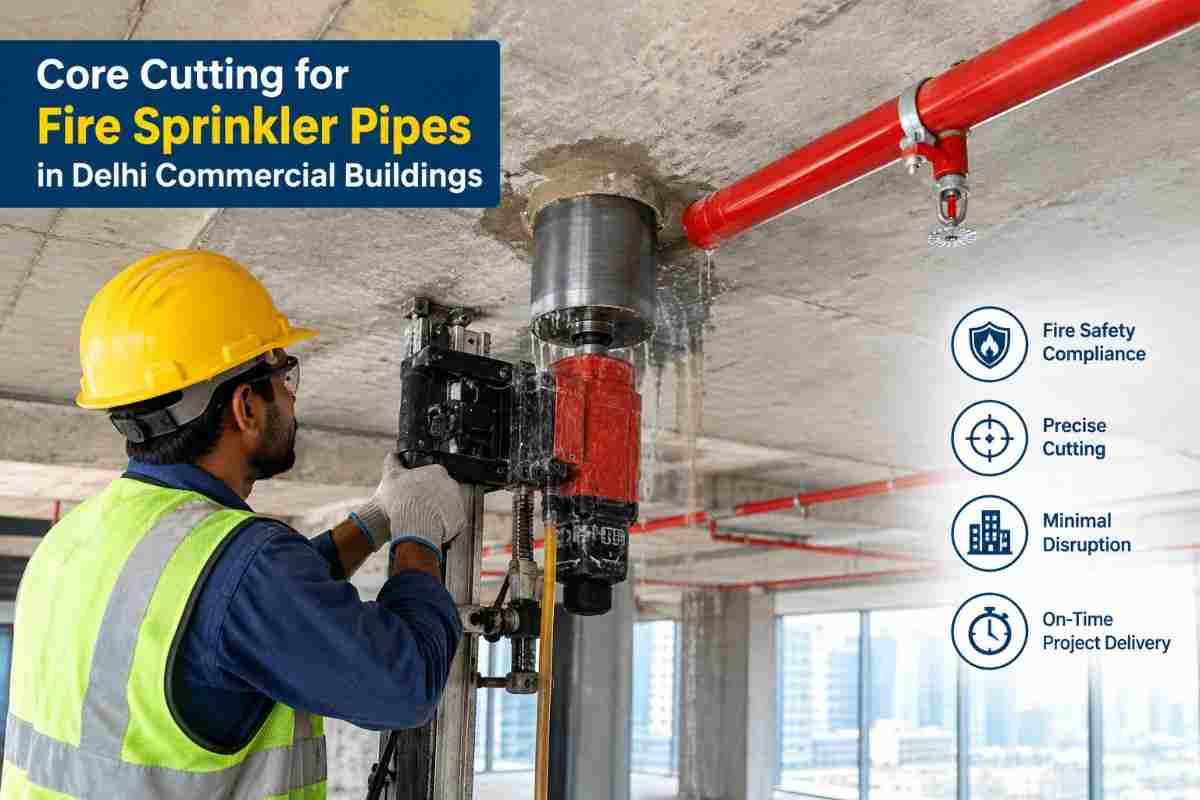
Delhi’s skyline keeps growing. Shopping malls, corporate towers, hospitals, hotels, data centres and co-working spaces are going up across Connaught Place, Nehru Place, Aerocity, Saket, Dwarka and Okhla. Every one of these buildings needs a reliable fire protection system, and at the heart of most of them is an automatic fire sprinkler network.
Sprinkler pipes cannot simply be run through solid reinforced concrete. Floors, beams, shear walls and shafts all need precise openings, and the cleanest way to make them is core cutting. At Corecuttingindia.com, we have seen how the quality of this one step affects the speed, safety and compliance of an entire fire protection installation.
This guide explains what core cutting is, why it matters for sprinkler pipes, how the process works, what to consider in Delhi, and how to choose the right contractor.
What Is Core Cutting?
Core cutting, also called core drilling or diamond core drilling, is a method of making precise, round holes in concrete, brick, stone and other hard materials. A hollow cylindrical drill bit with diamond segments on its cutting edge is rotated at controlled speed, usually with water cooling. It grinds through the material and leaves behind a solid cylinder, the “core”, which is then removed.
Compared with hammer drilling or manual chipping, core cutting offers:
- Clean, accurate holes with smooth walls and exact diameters
- Minimal vibration, which protects the structure and neighbouring spaces
- Low noise and dust, important in occupied commercial buildings
- The ability to cut through steel reinforcement without damaging surrounding concrete
- Holes of almost any size, from small pipe sleeves to large shaft openings
For fire sprinkler work, where accuracy and structural integrity both matter, these advantages make core cutting the preferred technique.
Why Fire Sprinkler Pipes Need Core-Cut Openings
A typical commercial sprinkler system includes a main riser, cross mains, branch lines and droppers connected to sprinkler heads. Moving water from the pump room and overhead tanks to every floor and zone means pipes must pass through slabs, beams, columns, shear walls and fire-rated partitions.
Core cutting is needed for several kinds of penetration.
1. Vertical riser openings. Main risers carry water between floors. These need openings of 100 mm to 300 mm or more, depending on pipe diameter and any insulation or sleeve.
2. Horizontal penetrations through walls and beams. Cross mains often pass through RCC walls, service core walls or basement retaining walls, so the cut has to be accurate and has to avoid critical reinforcement.
3. Retrofit work. Many older Delhi buildings were built before today’s sprinkler requirements. Adding sprinklers means making new openings in finished, often occupied, structures, where core cutting’s low impact is a big advantage.
4. Sleeve installations. Pipes passing through fire-rated floors and walls are usually fitted with sleeves and sealed with fire-stopping material. The sleeve must fit the opening closely for the seal to work.
The Role of Core Cutting in Fire Safety Compliance
Fire protection in Indian commercial buildings is governed by the National Building Code of India (NBC 2016), Part 4: Fire and Life Safety, relevant Bureau of Indian Standards codes such as IS 15105 for sprinkler systems, and local regulations. In Delhi, the Delhi Fire Service inspects and certifies buildings, and a Fire NOC is typically needed for commercial occupancies.
Core cutting does not install the sprinklers, but it affects compliance in several ways:
- Structural safety. Openings made carelessly can cut through reinforcement or weaken load paths. Planned, engineer-approved core cutting preserves structural integrity.
- Fire compartmentation. Every opening in a fire-rated slab or wall is a potential path for fire and smoke. Accurate cores make proper fire-stopping possible. Oversized or ragged holes are hard to seal correctly.
- Installation quality. Well-aligned openings mean pipes sit straight, supports fit properly and hydraulic performance is not compromised by awkward bends.
Specific requirements vary by building type, height and occupancy, so always confirm them with your fire consultant, structural engineer and the authorities.
Step-by-Step: How Core Cutting for Sprinkler Pipes Works
Step 1: Planning and Marking
The process starts with the approved fire protection drawings. Locations, diameters and depths of all required openings are marked on the slab or wall. Coordination with the MEP team is important, because sprinkler pipes, HVAC ducts, electrical conduits and plumbing often compete for the same space.
Step 2: Scanning for Reinforcement and Services
Before any cutting, professionals scan the concrete using GPR (ground-penetrating radar) or a rebar detector. This locates reinforcement bars, post-tension cables, embedded conduits and hidden pipes. In dense commercial slabs, scanning prevents costly accidents and structural damage.
Step 3: Setting Up the Equipment
A core drilling machine is fixed to the surface using an anchor bolt, vacuum base or a wall-saw rig for vertical work. Stable fixing is vital, because any wobble leads to oversized or crooked holes. Water supply and slurry collection are arranged to keep the work area clean.
Step 4: Drilling
The diamond bit is lowered at a controlled rate. Water cools the bit and flushes out slurry. If the bit meets rebar, it cuts through it. Depth and alignment are checked as drilling progresses.
Step 5: Core Removal and Cleaning
Once the bit has broken through, the concrete core is extracted. Slurry is vacuumed and the opening cleaned so the sleeve, pipe or fire-stopping material can be fitted.
Step 6: Inspection and Handover
The finished opening is checked for size, alignment and wall quality, then handed to the sprinkler contractor. Any required grouting or sleeve fixing follows.
Typical Core Sizes for Sprinkler Applications
Sizes depend on pipe diameter, sleeve thickness and insulation. As a general guide:
| Application | Typical Core Diameter |
|---|---|
| Branch line penetration | 50 mm – 100 mm |
| Cross main through wall or slab | 100 mm – 200 mm |
| Main riser opening | 150 mm – 300 mm |
| Large shaft or header openings | 300 mm and above |
These figures are indicative only. Final sizes should follow the project’s engineering drawings.
Challenges of Core Cutting in Delhi Commercial Buildings
Working in Delhi has its own conditions.
Dense reinforcement. Many Delhi commercial structures use heavy reinforcement in slabs, beams and shear walls. Scanning and experienced operators are essential.
Occupied buildings. Retrofit work in operating offices, hospitals or malls demands low noise, controlled dust and minimal water spillage. Wet core cutting with slurry collection suits these sites well.
Access restrictions. Basements, congested shafts, high-rise floors and tight ceiling voids can make setup difficult. Compact, portable rigs help.
Strict timelines. Fire safety work is often tied to occupancy certificates and inspection dates, so reliable scheduling matters.
Weather and water management. Delhi’s monsoon and extreme summers can affect site logistics. Good planning keeps work moving without damaging finished surfaces.
Regulatory coordination. Fire NOC and building approvals often depend on documented compliance, so contractors need to work cleanly alongside fire consultants.
Benefits of Professional Core Cutting for Sprinkler Installations
Structural integrity is protected. Controlled cutting with rebar scanning avoids accidental damage to critical elements.
Precise fit. Accurate cores let sleeves and pipes fit snugly, which improves fire-stopping and reduces rework.
Speed. Core drilling is much faster than manual chipping, helping fire protection projects stay on schedule.
Lower disruption. Reduced vibration, noise and dust mean tenants can keep working.
Cleaner finish. Smooth walls save time on patching and make for a more professional result.
Fewer defects. Cracked edges, spalling and irregular holes, all common with poor methods, are largely avoided.
Core Cutting vs. Other Methods for Making Pipe Openings
| Method | Precision | Vibration | Dust/Noise | Suitability for Sprinkler Work |
|---|---|---|---|---|
| Diamond core cutting | Very high | Very low | Low | Excellent |
| Hammer drilling | Moderate | High | High | Poor for large holes |
| Manual chipping | Low | High | High | Not recommended |
| Wall/slab sawing | High | Low | Moderate | Good for large rectangular openings |
For round pipe penetrations, diamond core cutting is the clear winner.
Safety Practices in Core Cutting
Professional crews follow strict safety practice:
- Confirm structural clearance from the project engineer before cutting
- Scan for rebar, conduits and live services
- Isolate electricity near the work area and use proper earthing and RCCBs for wet drilling
- Use personal protective equipment including helmets, gloves, safety shoes, eye protection and hearing protection
- Barricade areas below the work when cutting through slabs, so falling cores cannot hurt anyone
- Control slurry to avoid slips and water damage to finished floors
- Follow lockout and tag-out rules where building systems are involved
Choosing the Right Core Cutting Contractor in Delhi
The contractor you choose affects your project’s safety, schedule and cost. Look for the following.
Experience with commercial and fire protection projects. Ask about previous sprinkler and fire-fighting work in similar buildings.
Modern equipment. Diamond bits in a range of sizes, stable drill rigs and GPR scanning capability show a serious operator.
Trained operators. Skilled technicians can handle rebar, tight spaces and unusual angles.
Clear scope and quotation. A good quote states hole sizes, quantity, depth, rates, and who handles slurry removal and making good.
Safety record. Ask about their site safety procedures and insurance cover.
Responsiveness. Fire safety deadlines are tight, and a contractor who can mobilise quickly across Delhi NCR is valuable.
How Core Cutting Costs Are Typically Calculated
Pricing in Delhi usually depends on:
- Hole diameter. Larger cores need bigger bits and more time.
- Depth of cut. Thick slabs, beams and walls cost more than thin ones.
- Reinforcement density. Heavy rebar slows cutting and wears bits faster.
- Site access and height. Basements, shafts and upper floors may need extra setup.
- Number of holes. Bulk work often brings better per-hole rates.
- Working hours. Night or weekend work in occupied buildings can carry a premium.
Always ask for a site visit and a written estimate instead of relying on a generic rate.
Best Practices for Property Owners, Facility Managers and Contractors
- Plan openings early. Wherever possible, include sleeves or cut-outs in the original design to reduce later core cutting.
- Get engineer approval. Never cut structural members without sign-off from the structural engineer.
- Coordinate trades. Share a marked-up layout with the MEP, HVAC and electrical teams to avoid clashes.
- Protect finished areas. Cover floors and equipment, and arrange water and slurry management.
- Plan fire-stopping. Make sure fire-stop products and sleeves are ready so openings are not left unsealed.
- Document everything. Keep records of cut locations, sizes and approvals for inspections and the Fire NOC process.
- Schedule smartly. For occupied buildings, work outside business hours to reduce disruption.
Frequently Asked Questions (People Also Ask)
Is core cutting safe for fire sprinkler pipe installation?
Yes, when done by trained professionals using rebar scanning and engineer-approved locations. Core cutting is considered one of the safest and most controlled methods for creating openings in structural concrete.
How much does core cutting cost in Delhi?
Costs vary by hole diameter, depth, reinforcement and site conditions. Pricing is commonly per hole or per centimetre of depth. A site visit gives the most accurate quote.
How long does it take to core cut a hole for a sprinkler pipe?
A standard hole through a typical slab can often be cut in minutes to an hour, depending on size, thickness and rebar. Setup, scanning and cleanup add to the total time.
Can you core cut through reinforced concrete (RCC)?
Yes. Diamond core bits are designed to cut through both concrete and steel reinforcement. Even so, cutting through main structural bars should only be done with the structural engineer’s approval.
Do you need permission before core cutting in a commercial building?
Generally you need approval from the building owner or management, the structural engineer and, for fire-rated elements, the fire consultant. Check applicable building and fire regulations for your property.
What size hole is needed for a sprinkler pipe?
The hole should be slightly larger than the pipe or sleeve being installed. Exact sizing depends on pipe diameter, insulation and fire-stopping requirements, so follow the design drawings.
Can core cutting be done in an occupied building?
Yes. Wet core cutting produces little noise, dust and vibration, so it is well suited to occupied offices, hospitals and malls, especially when scheduled outside peak hours.
Do cut openings need fire-stopping afterwards?
Penetrations in fire-rated floors and walls generally must be sealed with approved fire-stopping materials after the pipe or sleeve is installed, in line with the design and applicable standards.
Why Delhi Projects Trust Specialist Core Cutting Services
Fire protection leaves little room for error. A misplaced or poorly cut opening can mean delays, rework, structural concerns or failed inspections. By choosing a specialist, you get the right equipment, trained operators and an understanding of how core cutting fits into the broader fire protection scope.
Whether you are fitting a sprinkler system into a new commercial tower, upgrading an older office block, or expanding fire protection in a mall or hospital, precise core cutting is the foundation of a smooth installation.
Conclusion
Core cutting is a small step in a large fire protection project, but it has an outsized effect on quality, safety and compliance. Clean, accurate openings let sprinkler pipes be installed efficiently, protect the building’s structure and make proper fire-stopping possible. In Delhi’s busy commercial landscape, where deadlines are tight and buildings are often occupied, low-vibration, low-dust diamond core cutting is the practical choice.
If you are planning a fire sprinkler installation or retrofit in Delhi NCR, work with experienced professionals who understand both the technical and regulatory sides of the job. Visit Corecuttingindia.com to learn more about our core cutting services and request a site assessment for your next commercial project.