
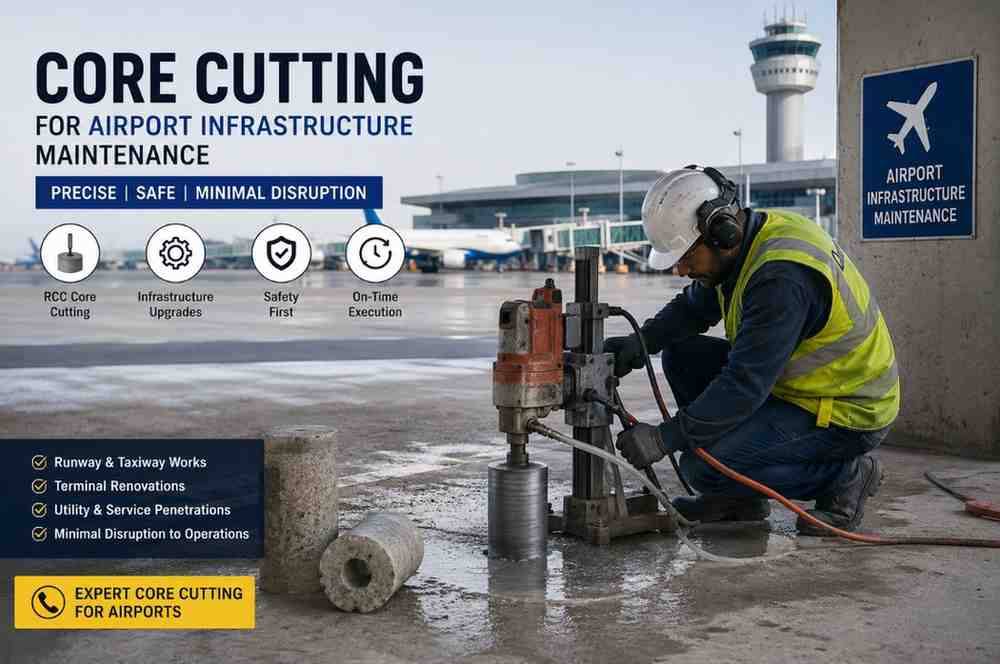
Modern aviation demands absolute precision, uncompromised safety, and continuous operational uptime. Behind every smooth landing and seamless terminal transition lies a complex network of heavy-duty concrete and asphalt infrastructure.
Among the various engineering methodologies required to keep global transit hubs running, concrete core cutting stands out as an indispensable technique. Maintained by specialized service providers like [email protected], core cutting ensures that modern airports can expand, repair, and evaluate their structural integrity without triggering catastrophic downtime.
1. Understanding Airport Infrastructure Realities
Airports are subject to some of the most grueling structural environments in the world. A single wide-body commercial aircraft can weigh upwards of several hundred tons, putting massive dynamic and static loads onto runways, taxiways, and aprons.
Furthermore, airport management teams face a unique paradox:
-
The Safety Mandate: Every millimeter of pavement, drainage system, and lighting fixture must comply with strict international aviation standards.
-
The Time Constraint: Runways cannot afford prolonged closures. Revenue loss and flight schedule disruptions run into millions of dollars daily.
This high-stakes environment requires non-destructive or minimally invasive intervention strategies—making precision core cutting a preferred choice for engineers worldwide.
2. What is Concrete Core Cutting in Aviation?
Core cutting involves the precise extraction of cylindrical samples (cores) or the creation of clean, circular openings through reinforced concrete (RCC), asphalt, and composite pavement layers. Utilizing diamond-impregnated drill bits, modern core cutting machinery can slice through heavily reinforced structures smoothly, creating zero micro-cracks and maintaining the integrity of the surrounding material.
At [email protected], advanced hydraulic and electric core drilling systems are deployed to manage intricate airport requirements, ensuring high-speed execution with minimal noise and vibration.
3. Key Applications of Core Cutting in Airport Maintenance
Core cutting serves multiple critical functions across both airside and landside zones of an airport facility:
A. Quality Control and Pavement Structural Analysis
Before major upgrades or to investigate wear-and-tear, engineers need to test the load-bearing capacity of runways.
-
Core Sampling: Technicians drill cylindrical cores from runways and taxiways to evaluate thickness, layer bonding, density, and compressive strength in accredited laboratories.
-
NDT Correlation: Lab data obtained from core samples helps validate Non-Destructive Testing (NDT) results, giving airport authorities a clear picture of remaining pavement life.
B. Runway and Taxiway Lighting (Inpavement Fixtures)
Modern airfields rely heavily on precision centerline lighting, touch-down zone lights, and signage.
-
Installing or replacing these inset lights requires exact core drilling to house light cans and electrical conduits.
-
Clean cuts ensure that the fixtures fit flush with the pavement surface, preventing hazardous bumps or Foreign Object Debris (FOD) that could damage jet engines.
C. Drainage and Utility Upgrades
Water accumulation is a primary threat to runway safety, leading to hydroplaning risks.
-
Core cutting enables the installation of transverse drains, sub-surface utility lines, and plumbing networks through thick concrete slabs without fracturing adjacent zones.
D. Expansion Joint and Retrofitting Works
When retrofitting old terminal buildings or strengthening aprons, core cutting allows engineers to create precise openings for new structural tie-ins, dowel bars, and cabling pathways.
4. Why Diamond Core Cutting is Essential for Aviation
Traditional demolition methods—such as hammering or breaking—generate severe shockwaves, micro-fractures, and uncontrolled spalling. In aviation infrastructure, these side effects are unacceptable.
| Feature | Traditional Demolition | Diamond Core Cutting ([email protected]) |
| Structural Impact | High vibration; causes internal micro-cracks | Low vibration; preserves structural integrity |
| Precision | Irregular edges; requires extensive patching | Clean, cylindrical holes with exact dimensions |
| FOD Risk | High risk of loose debris and fragments | Zero loose concrete debris; vacuum-assisted extraction |
| Execution Speed | Slow cleanup and higher repair overheads | Rapid turnaround, ideal for tight maintenance windows |
5. Overcoming Operational Challenges During Maintenance
Airport maintenance crews usually have narrow execution windows—often limited to overnight slots between the last and first flights of the day. Core cutting technology facilitates these fast-paced turnarounds.
-
Wet Drilling and Dust Suppression: Advanced rigs use integrated water-cooling systems that eliminate silica dust, keeping the air clear and adhering to strict environmental and health regulations.
-
Deep-Depth Capability: Whether piercing through a standard 12-inch apron slab or deep utility trenches, heavy-duty diamond rigs can reach significant depths cleanly.
-
Versatile Angles: Core drills can operate vertically, horizontally, or at precise angles, allowing technicians to navigate crowded utility paths beneath terminals and tarmac zones.
6. Best Practices for Airport Core Cutting Projects
Executing core cutting projects within an active airport demands rigorous adherence to protocol:
-
Pre-Survey Scanning: Ground-Penetrating Radar (GPR) and electromagnetic scanning must precede any drilling to map hidden live electrical cables, fuel lines, and reinforcement grids.
-
FOD Prevention Protocols: Strict protocols must ensure that slurry, core plugs, and metal fragments are instantly cleared to protect aircraft safety.
-
Partnering with Experts: Utilizing seasoned professionals guarantees adherence to international civil aviation organization (ICAO) standards and local regulatory frameworks.
Conclusion
Core cutting is far more than a simple drilling procedure; it is a vital surgical intervention for aviation infrastructure. By ensuring structural longevity, seamless utility integration, and zero-compromise safety, core cutting keeps the wheels of global commerce turning.
For expert advice, reliable execution, and advanced diamond drilling solutions tailored to heavy civil and aviation needs, reach out to the specialists at [email protected] to secure your infrastructure for the future.