
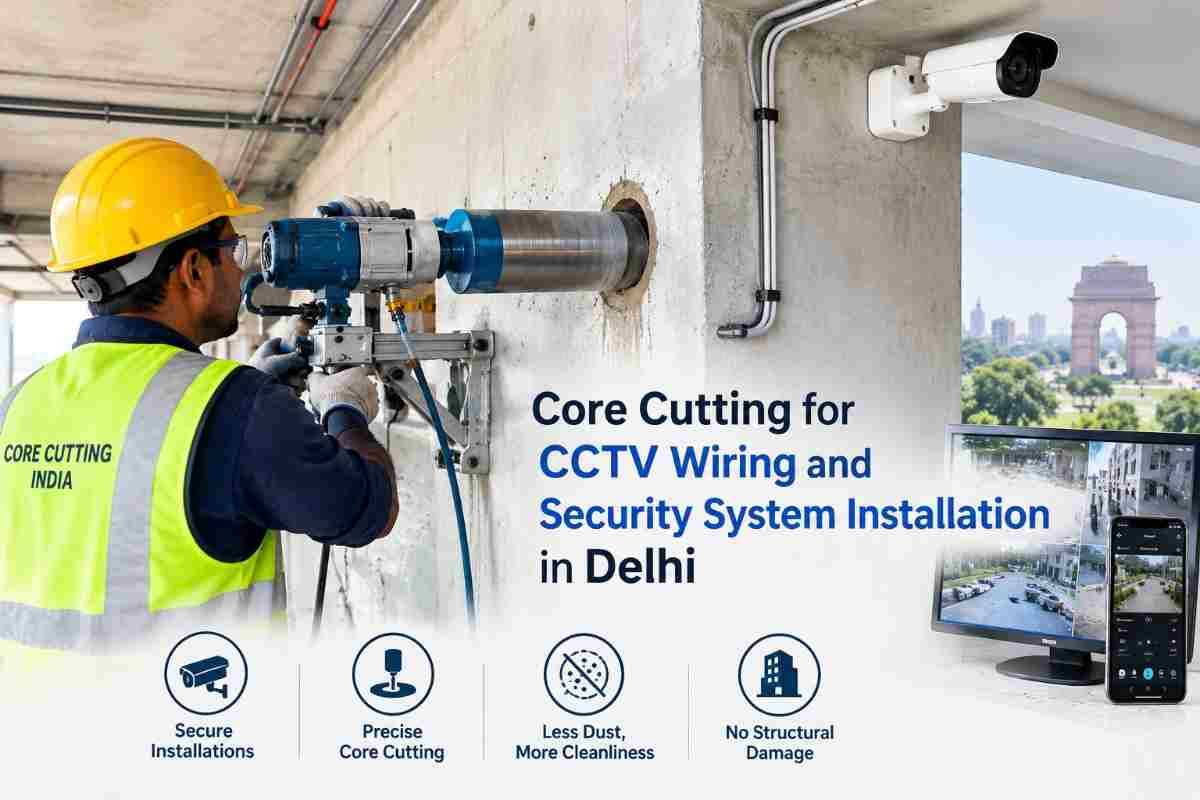
Delhi is a city of concrete. From the high-rise apartments of Dwarka and Rohini to the commercial towers of Nehru Place, Connaught Place and Gurugram’s border, most buildings rely on reinforced cement concrete (RCC) for their walls, slabs and columns. That strength is good for safety, but it makes installing CCTV cameras, access control systems and alarm networks much harder.
Running cables through thick concrete with a hammer drill or chisel is slow, noisy and risky. It can crack walls, damage hidden reinforcement and leave rough openings that look unprofessional. Core cutting solves this problem, and it has become the preferred method for security system installation across Delhi NCR.
In this guide, we explain what core cutting is, why it suits CCTV wiring, how the process works, what it costs, and how to choose a reliable provider like CoreCuttingIndia.com.
What Is Core Cutting?
Core cutting, also called core drilling or diamond core drilling, is a method of making precise, circular holes in hard materials such as concrete, brick, stone and asphalt. Instead of pounding the material into rubble, a hollow cylindrical drill bit with diamond-embedded segments grinds through it and leaves a clean, smooth-walled hole. The solid cylinder of material it removes is called the “core.”
The equipment usually includes:
- A core drilling machine, either handheld or rig-mounted
- Diamond core bits in diameters from about 20 mm to over 500 mm
- A water supply to cool the bit and control dust
- An anchoring or vacuum system to keep the rig steady
Because the cut is controlled, the surrounding structure stays intact. That is exactly what you want when you are installing delicate security infrastructure in a finished building.
Why CCTV and Security Installations Need Core Cutting
A modern security setup is more than a few cameras on a wall. It often includes IP cameras, NVRs and DVRs, access control readers, biometric devices, intrusion alarms, fire and safety interfaces, and networking and power cabling. All of these need cable routes between floors, rooms, rooftops, basements and outdoor areas.
In Delhi’s concrete buildings, those routes often have to pass through:
- Load-bearing walls between rooms or offices
- RCC slabs between floors
- Boundary walls for external cameras and gate systems
- Basement and parking walls with heavy reinforcement
- Shafts and risers that were never designed for extra cabling
Without a proper opening, installers resort to exposed surface conduits, gaps under doors or crude holes made with impact tools. Core cutting provides a neat, engineered alternative.
Key Benefits of Core Cutting for CCTV Wiring
1. Precision and Clean Finish
Core cutting makes holes of exact size, such as a 25 mm hole for a single cable or a 100 mm hole for a conduit bundle. The edges are smooth, so cables are not nicked or stressed as they pass through, and the finished work looks professional.
2. Minimal Structural Damage
Hammer drilling sends heavy vibrations through the structure and can cause micro-cracks that weaken it over time. Diamond core drilling is far gentler. With proper planning and scanning for rebar, it keeps the integrity of walls, beams and slabs.
3. Low Noise and Vibration
Residential societies, hospitals, schools, banks and offices in Delhi cannot afford long periods of loud construction noise. Core cutting produces much less vibration and fewer disruptive sounds than breaking concrete by hand, so installation can happen in occupied buildings with limited disturbance.
4. Reduced Dust
Wet core cutting suppresses dust at the source. This matters in apartments, server rooms and commercial spaces, where fine concrete dust can damage electronics and irritate lungs, and it keeps the cleanup after installation light.
5. Faster Installation
A skilled team can finish a core hole through a wall in minutes, even through thick RCC. That speeds up the whole project, which helps when you are securing a shop, warehouse or office on a tight timeline.
6. Better Cable Protection and Security
Concealed cable routes are harder to tamper with. When cables run through core-cut openings with proper sleeves or conduits, intruders cannot easily cut or disconnect the system, which protects your investment.
7. Future-Proofing
Core-cut openings can be sized with spare capacity, so you can pull additional cables later when you add cameras or upgrade to higher-bandwidth networking, without cutting new holes.
Common Applications in Delhi
Core cutting for security systems is useful across many property types in the city:
Residential Societies and Independent Houses. Cameras for entrances, staircases, parking and perimeter walls need cable routes from outdoor positions to a central recorder. Core cutting avoids ugly external cabling and exposed junctions.
Commercial Offices and Showrooms. Offices in places like Okhla, Saket, Karol Bagh and Lajpat Nagar often have thick walls and finished interiors. Clean openings keep interiors tidy while linking cameras, access panels and servers.
Warehouses and Factories. Industrial areas such as Bawana, Narela, Mayapuri and Mundka have heavy concrete structures where cables must cross sturdy walls or floors between production, storage and control rooms.
Schools, Colleges and Hospitals. These institutions need extensive coverage with minimal disruption, which makes low-noise, low-dust cutting very valuable.
Retail Malls and Hotels. Large complexes require systematic cable management through slabs and shafts across many floors.
Government and Banking Facilities. High-security installations need discreet, protected cable paths that resist tampering.
How the Core Cutting Process Works for CCTV Wiring
Understanding the process helps you know what to expect and what a good contractor should do.
Step 1: Site Survey and Planning
The team studies the building plan and the camera layout. They decide where cables must pass, the number and diameter of holes, and the best locations. Good contractors also consider the cable type, whether coaxial, Cat6 or power, and leave room for future expansion.
Step 2: Scanning for Rebar and Utilities
Before cutting, the area should be checked for steel reinforcement, electrical conduits, water pipes and other hidden services. Scanning equipment such as GPR or rebar detectors helps avoid hitting a live wire or a structural bar. This step matters most in older Delhi buildings, where records may be incomplete.
Step 3: Marking and Setup
Hole positions are marked precisely. The core drilling rig is fixed in place with an anchor bolt or vacuum base, and the water supply is connected. Protective sheets and dust barriers are placed to keep the area clean.
Step 4: Drilling
The operator starts slowly and then drills at a steady rate with continuous water flow. The diamond bit cuts through concrete, brick and, if necessary, rebar. The core is removed when the cut completes.
Step 5: Cleaning and Finishing
Slurry and debris are cleaned up, and the opening is checked for size and smoothness. If needed, sleeves, grommets or conduits are fitted to protect cables.
Step 6: Cable Routing and Sealing
Once cables are installed, the gaps are sealed with fire-rated or weatherproof materials, depending on the location. This keeps rodents, water, dust and smoke from passing through, and it preserves fire compartmentation in commercial buildings.
Core Cutting vs. Traditional Drilling vs. Chiselling
| Factor | Core Cutting | Hammer Drilling | Manual Chiselling |
|---|---|---|---|
| Hole accuracy | Very high | Moderate | Low |
| Structural impact | Minimal | Moderate | High |
| Noise level | Low to moderate | High | Very high |
| Dust | Low (wet cutting) | High | Very high |
| Suitable for large holes | Yes | Limited | Messy |
| Finish quality | Smooth and neat | Rough | Rough and uneven |
For small, shallow holes in soft walls, a standard drill may be enough. For thick RCC, slabs, boundary walls and any hole larger than a few centimetres, core cutting is clearly the better choice.
Safety and Structural Considerations
Core cutting is safe when done by trained professionals, but it should never be treated casually. Keep these points in mind:
- Avoid cutting through structural elements without approval. Beams, columns and post-tensioned slabs need special care. If you are unsure, consult a structural engineer.
- Check permissions. In housing societies, commercial complexes and leased premises, get approval from the RWA, building management or owner before cutting.
- Check for hidden services. Always confirm that no live cables or pipes are in the cutting path.
- Use proper PPE. Operators should wear gloves, goggles, helmets, and safety shoes, and should use ground-fault protection for electrical equipment.
- Control water and slurry. Slurry should not run into drains, electrical panels or neighbouring units.
A responsible provider will follow these practices as a matter of routine.
How Much Does Core Cutting Cost in Delhi?
Costs vary widely, so treat any figure you hear as an estimate until you receive a written quote. The main factors are:
- Hole diameter. Larger bits cost more to use and wear faster.
- Depth and material. A thick RCC slab with heavy rebar costs more than a brick wall.
- Number of holes. Bulk jobs often get better per-hole rates.
- Access and height. Cutting on upper floors or in cramped spaces takes more effort.
- Location and logistics. Equipment transport and water access can affect pricing.
- Urgency. Same-day or night-time work may carry a premium.
For CCTV projects, the holes are usually small to medium in diameter, so core cutting is typically an affordable part of the overall installation budget. Ask for a clear, itemised quote and confirm that it covers cleaning, sleeves and any rebar cutting.
How to Choose the Right Core Cutting Service in Delhi
With many contractors in Delhi NCR, quality varies. Look for these qualities:
- Experience with security installations. CCTV work calls for neatness and coordination with installers.
- Modern equipment. Diamond bits, rigs and scanners give better results than improvised tools.
- Trained operators. Skilled technicians reduce the risk of damage.
- Transparent pricing. Avoid vendors who will not give a clear estimate.
- Clean working practices. Dust control and tidy sites matter in finished buildings.
- Responsiveness. Reliable contractors show up on time and keep communication clear.
- References and reviews. Ask about similar past projects.
CoreCuttingIndia.com offers core cutting services for residential, commercial and industrial clients across Delhi NCR, including support for CCTV wiring and security system installation. Visit the website to discuss your requirements and request a quote.
Tips for Planning Your CCTV Cable Routes
A little planning before you call a core cutting team saves time and money.
- Create a camera map. Mark the camera positions, recorder location and cable route on a simple floor plan.
- Combine holes where possible. One properly sized opening with a conduit can carry multiple cables, which reduces the number of cuts.
- Plan for expansion. Add a spare conduit or oversize the hole slightly.
- Choose the right cable. Use outdoor-rated, UV-resistant cable where it will be exposed.
- Think about weatherproofing. External openings should slope slightly downward and be sealed so rainwater does not enter.
- Coordinate with your installer. Make sure the security installer and core cutting team agree on hole sizes and positions before work begins.
Common Mistakes to Avoid
- Cutting without scanning, which risks hitting rebar, wires or pipes
- Using the wrong bit size, leaving loose cables or oversize gaps
- Skipping sleeves and sealing, which allows water, pests and smoke through
- Ignoring permissions, which can cause disputes with neighbours or building management
- Hiring on price alone, since cheap, unskilled work can lead to expensive repairs
- Poor planning, which leads to extra holes and wasted money
Frequently Asked Questions
What is core cutting in CCTV installation?
It is the use of a diamond core drill to make clean, round holes through concrete or masonry so CCTV and security cables can pass between rooms, floors or outdoor areas without damaging the structure.
Is core cutting better than normal drilling for CCTV wiring?
For thick RCC walls, slabs and larger openings, yes. Core cutting is more precise, creates less vibration and leaves a neater finish than hammer drilling or chiselling.
Will core cutting weaken my building?
When done correctly, with proper scanning, planning and avoidance of critical structural elements, it generally does not compromise the building. Consult a structural engineer for any cuts near beams, columns or post-tensioned slabs.
Can core cutting be done in an occupied home or office?
Yes. Because wet core cutting is relatively quiet and low in dust, it suits occupied spaces. Professionals usually protect furniture and clean up afterwards.
How long does it take to cut one hole?
Typically from a few minutes to around half an hour, depending on diameter, thickness and reinforcement.
Do I need permission before core cutting in Delhi?
In most apartments, societies and commercial buildings, you should get consent from the owner, RWA or building management. Rules vary, so confirm locally.
What hole size is needed for CCTV cables?
It depends on how many cables or conduits pass through. Single cables may need only about 20–32 mm, while bundled conduits may need 50–100 mm or more. Your installer can advise.
Can core cutting be done on rooftops and boundary walls?
Yes. It is commonly used for rooftop cable routes, gate camera wiring and boundary wall passages.
How do I find core cutting services near me in Delhi?
Search for experienced providers, compare quotes and check their equipment and past work. You can start with CoreCuttingIndia.com for services across Delhi NCR.
Final Thoughts
A strong security system depends on more than good cameras. It also depends on clean, protected, well-planned cabling, and in Delhi’s concrete-heavy buildings that often means core cutting. The method delivers precise holes with minimal damage, low noise and dust, faster installation and a professional finish, while keeping your cables safer from tampering and weather.
Whether you are securing a home in South Delhi, an office in Nehru Place, a showroom in Karol Bagh or a warehouse in Bawana, the right core cutting partner makes the project smoother from start to finish. Plan your routes carefully, insist on proper scanning and safety, and choose a provider with real experience.
Ready to get started? Visit CoreCuttingIndia.com to request a site assessment and a quote for your CCTV wiring and security system installation in Delhi.