
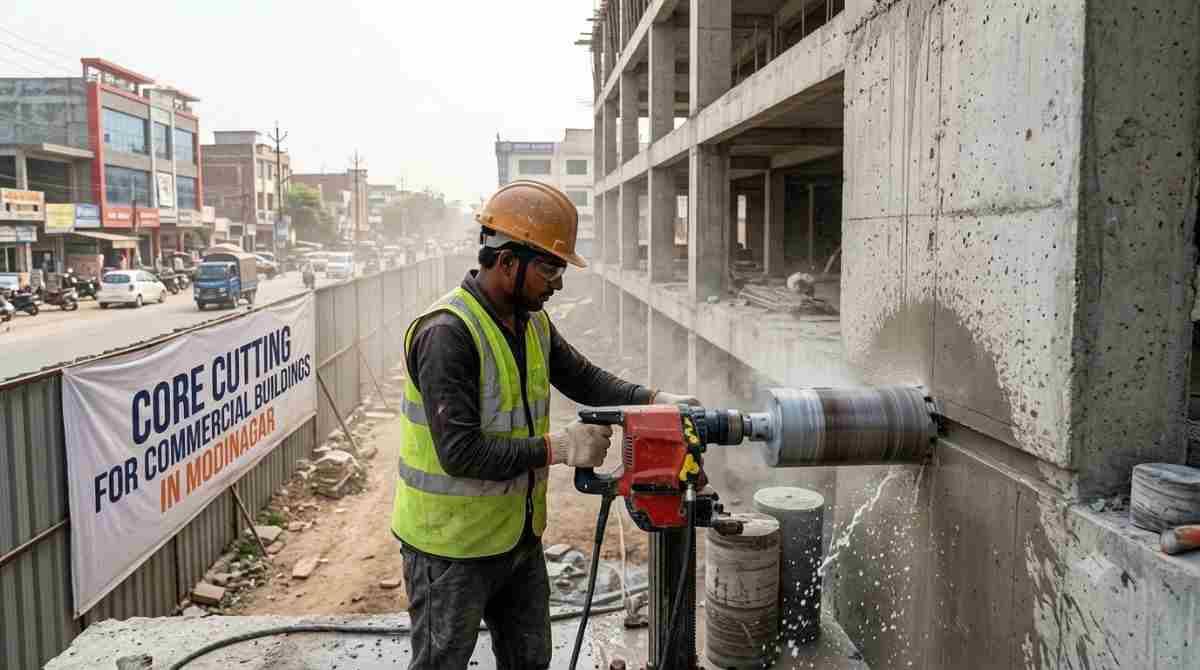
Modinagar—strategically positioned along the vital Delhi–Meerut industrial and residential corridor (NH-58) within the Ghaziabad district—is experiencing rapid commercial growth. From multi-story retail plazas and corporate office complexes to manufacturing units, hospitals, and educational institutions, commercial infrastructure in Modinagar is evolving constantly. Modernizing these structures to accommodate advanced heating, ventilation, and air conditioning (HVAC) systems, electrical conduits, plumbing networks, and fire safety systems requires absolute precision. Traditional methods of breaking concrete using heavy hammers or pneumatic chisels are no longer acceptable because they cause micro-cracks, compromise structural integrity, and produce disruptive noise and dust.
This is where professional core cutting for commercial buildings in Modinagar comes into play. Utilizing state-of-the-art diamond core drilling technology, specialized contractors can create flawless, clean circular openings in heavily reinforced cement concrete (RCC), brick masonry, and stone without jeopardizing the building's structural framework.
Through trusted providers like Core Cutting India, commercial developers, builders, architects, and facility managers have direct access to professional execution, advanced machinery, and transparent service metrics. For inquiries, site inspections, or urgent bookings, you can reach out directly via phone or WhatsApp at +91 70096 79903.
Understanding Core Cutting in Commercial Structures
Core cutting—often referred to as concrete core drilling—is a specialized construction and deconstruction technique designed to extract cylindrical cores of concrete or masonry to create perfectly round holes. In commercial building construction and retrofitting, these openings are non-negotiable for modern utility management.
Unlike residential properties, commercial buildings feature extensive utility layouts. Integrating centralized air conditioning ductwork, heavy-duty electrical wiring trays, multi-floor plumbing risers, fire sprinkler pipelines, and data fiber optics requires hundreds of precise penetrations through thick RCC slabs, beams, columns, and shear walls.
Why Traditional Demolition Fails in Commercial Projects
-
Uncontrolled Fracturing: Impact hammers transmit severe shockwaves throughout the concrete matrix, loosening rebar bonds and causing random, hairline structural cracks.
-
Costly Repairs: Patching up haphazard breakages requires intensive grouting, shuttering, and structural repair work that delays project timelines.
-
Operational Disruption: Heavy hammering generates massive amounts of choking silica dust and unbearable noise, rendering neighboring offices or active retail floors unusable.
-
Lack of Dimensional Accuracy: Manual breaking results in ragged, uneven edges that complicate pipe sealing and waterproofing.
Diamond core drilling completely eliminates these bottlenecks by utilizing a rotary drill fitted with an industrial diamond-impregnated annular bit. It shears through aggregate and steel rebar smoothly, preserving the structural load-bearing capacity of the surrounding elements.
Key Applications of Core Cutting in Modinagar’s Commercial Sector
Commercial infrastructure projects in areas spanning from the Modinagar Main Market to industrial setups near Hapur Road require diverse cutting solutions. The primary applications include:
1. HVAC and Ventilation Pass-Throughs
Modern commercial spaces rely heavily on climate control. Installing large-diameter refrigerant lines, fresh-air intake ducts, and exhaust systems requires wide-bore core holes—often ranging from 150mm to 300mm or more—through thick concrete walls and floor slabs.
2. Electrical Tray and Conduit Routing
Vertical and horizontal routing of heavy electrical supply cables across multi-level commercial properties mandates clean core drilling through intermediate floors to prevent cable pinching and insulation wear.
3. Plumbing, Drainage, and Fire Suppression Risers
Commercial plumbing and fire safety compliance require rigorous core drilling for water supply lines, soil pipes, storm-water drainage, and high-pressure fire sprinkler grid connections passing through concrete beams and foundations.
4. Structural Sampling and Material Testing
Before undertaking major structural modifications or vertical extensions, civil engineers frequently commission core cutting to extract cylindrical concrete test samples. These samples are sent to accredited laboratories to evaluate compressive strength, density, and internal condition via Non-Destructive Testing (NDT).
5. Anchor Bolting and Rebar Grouting
Installing heavy machinery, structural steel columns, elevators, or facade scaffolding requires deep anchor holes and Hilti epoxy rebar grouting to seamlessly extend existing reinforced concrete frameworks.
The Technical Process: How Professional Core Cutting Works
Executing a commercial core cutting job requires meticulous engineering, calibration, and adherence to safety protocols. Professional contractors follow a systematic workflow to ensure safety and precision:
-
Initial Site Assessment & Engineering Review: Technicians inspect the site to verify wall thickness, concrete grade, diameter requirements, and structural positioning. Openings in primary load-bearing members must always be vetted by a structural engineer.
-
Scanning and Rebar Detection: Before turning on any machinery, ground-penetrating radar (GPR) or electromagnetic rebar scanners locate internal steel reinforcement bars, live electrical conduits, and post-tension cables to map out a safe drilling path.
-
Rig Anchoring & Setup: Heavy-duty drill rigs are securely anchored to the concrete surface using heavy-duty bolts or high-vacuum suction bases. Rigid stabilization ensures zero bit wandering, guaranteeing a perfectly straight, plumb hole.
-
Diamond Wet Core Drilling: Water is fed continuously through the core barrel core bit. Water serves a dual purpose: it cools the industrial diamond segments to prevent overheating and traps airborne silica dust by turning it into manageable slurry.
-
Core Extraction and Cleanup: Once the bit cuts completely through the material, the solid concrete core slug is extracted cleanly. The slurry is vacuumed up, leaving a spotless, ready-to-use opening with smooth, finished edges.
Advantages of Diamond Core Cutting for Commercial Properties
Commercial building owners and contractors in Modinagar choose diamond core cutting over conventional methods for several distinct performance benefits:
-
Vibration-Free Operation: Because diamond cutting operates via smooth rotational abrasion rather than percussive impacts, it produces zero harmful vibrations that could weaken surrounding mortar joints or structural bonds.
-
Flawless Precision and Tolerances: Holes are drilled to exact millimeter specifications, eliminating gaps that require costly filling or secondary patching.
-
Speed and Efficiency: Professional rigs complete standard diameter holes quickly, helping tight commercial construction schedules stay on track.
-
Clean Working Environment: Wet drilling techniques capture dust and debris at the source, allowing retrofitting work to take place inside active, partially occupied commercial buildings without disrupting day-to-day business operations.
Factors Influencing Core Cutting Costs in Modinagar
Project budgets are a critical consideration for commercial developers. The cost of core cutting services varies based on several site-specific parameters:
-
Diameter and Depth of the Hole: Larger diameters and deeper cuts require heavier machinery, higher-grade diamond bits, and more operational time.
-
Material Composition and Steel Density: Cutting through high-strength RCC with dense rebar matrices takes longer and causes more bit wear than drilling through plain brick masonry or lightweight concrete blocks.
-
Access and Orientation: Vertical floor slab drilling is generally straightforward, whereas inverted overhead drilling, tight shaft spaces, or elevated exterior wall coring require specialized scaffolding and safety rigging.
-
Urgency and Scheduling: Emergency interventions or after-hours night shifts requested to prevent disruption to commercial tenants may influence overall pricing.
For transparent estimates tailored to your project specifications, you can visit Core Cutting India or connect directly with regional experts at +91 70096 79903.
Choosing the Right Core Cutting Contractor
Selecting a reliable contractor is just as important as choosing the right technique. When hiring a core cutting service provider for a commercial building in Modinagar, look for the following credentials:
-
Proven Commercial Experience: Ensure the contractor has a solid track record of handling complex industrial and commercial retrofitting projects.
-
Modern Equipment Fleet: Reliable contractors use well-maintained electric and hydraulic drill rigs, high-end diamond bits, and professional water-management systems.
-
Trained and Certified Operators: Core cutting requires skilled technicians who understand material behavior, torque control, and safety precautions around live utility lines.
-
Comprehensive Safety Compliance: Look for adherence to industrial safety standards, including personal protective equipment (PPE), secure rig anchoring, and rigorous electrical safety checks on wet sites.
Frequently Asked Questions (FAQ)
1. How much does core cutting cost in Modinagar?
Core cutting prices depend on variables such as hole diameter, slab or wall thickness, material composition (brick vs. heavy RCC), and total volume. Basic wall core holes generally start at affordable per-hole rates, while heavy industrial slab drilling is quoted based on depth and diameter. Contact Core Cutting India at +91 70096 79903 for an immediate, transparent estimate.
2. Is core cutting safe for old or multi-story commercial buildings?
Yes, core cutting is exceptionally safe when performed by experienced professionals. Unlike pneumatic hammers, diamond core drills generate zero impact vibration, meaning they will not cause structural cracking or loosen neighboring masonry. However, any core cutting through primary structural beams or load-bearing columns must be cleared by a structural engineer.
3. Can core cutting be carried out in an operational commercial building?
Absolutely. Because wet diamond core drilling controls dust completely and operates at low noise levels compared to conventional demolition, it is regularly performed in occupied offices, shopping complexes, hospitals, and hotels with minimal disruption to occupants.
4. How long does it take to drill a core hole?
A standard core hole (e.g., 4 inches to 6 inches in diameter through a normal concrete wall or slab) can often be completed within 15 to 30 minutes. Deep cores or heavily reinforced commercial foundation structures require additional time for setup and drilling.
5. How can I book a core cutting service in Modinagar?
Booking is simple and fast. You can call or WhatsApp service specialists directly at +91 70096 79903 or submit your project details online through Core Cutting India to schedule a prompt site inspection.
Conclusion
Upgrading commercial infrastructure in Modinagar requires precision, safety, and uncompromising technical execution. Whether you are running a retail retrofit, installing a centralized HVAC duct system, or routing complex electrical grids, choosing professional diamond core cutting ensures your project is completed cleanly, accurately, and without structural risk.
Partner with industry experts who understand the unique structural demands of modern commercial construction. Get in touch with Core Cutting India at https://corecuttingindia.com/ or call +91 70096 79903 today to discuss your requirements and secure dependable service for your next project.