
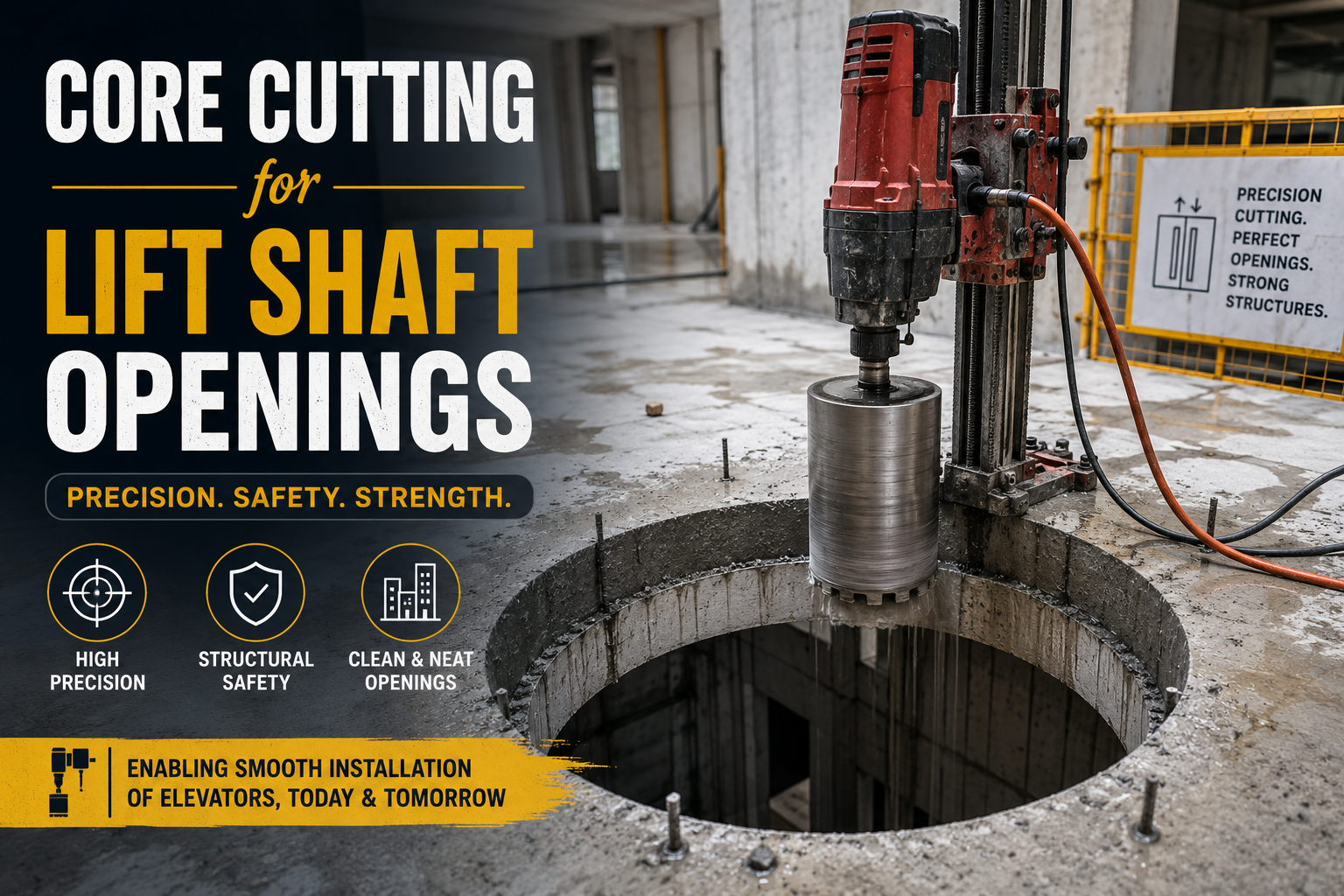
In the fast-paced world of high-rise construction, every structural decision matters. When it comes to installing vertical transportation systems like elevators, there is absolutely no room for error. Core cutting for lift shaft openings has emerged as the industry-standard solution for creating the precise, clean, and structurally sound penetrations necessary for modern elevator systems.
At [email protected], we understand that a lift shaft is more than just a hollow space; it is the backbone of vertical connectivity in a building. Whether you are working on a new development or a complex renovation, choosing the right method for creating these openings is critical to the longevity, safety, and efficiency of your structure.
What is Core Cutting?
Core cutting is a sophisticated, non-impact construction technique designed to create perfectly cylindrical holes or precise linear openings in hard materials, including reinforced concrete, stone, masonry, and asphalt.
Unlike traditional methods like jackhammering, which rely on brute force and high-impact vibrations, diamond core cutting utilizes industrial-grade, diamond-tipped drilling bits to grind through the surface. This process ensures that the structural integrity of the surrounding wall, slab, or column remains completely intact, leaving behind a clean, smooth, and dimensionally accurate opening.
Why Diamond Core Cutting is Essential for Lift Shafts
Elevator shafts require exacting tolerances to ensure the elevator car, guide rails, and safety systems function without friction or mechanical stress. Here is why diamond core cutting is the preferred method for this high-stakes application:
1. Unmatched Structural Integrity
Traditional impact tools, such as hydraulic breakers or jackhammers, send shockwaves through concrete. This vibration can cause micro-cracking in the surrounding material, potentially weakening load-bearing elements. Diamond core cutting is low-vibration, ensuring the building’s structural stability is preserved during and after the process.
2. Extreme Precision
When installing a lift shaft, the openings for doors, electrical conduits, and ventilation must align perfectly with the engineering blueprints. Diamond drilling allows for millimetre-perfect accuracy, eliminating the need for costly and time-consuming rework.
3. Dust and Noise Control
Construction sites in occupied buildings or dense urban areas have strict requirements for noise and dust management. Diamond cutting, especially when used with wet-cutting systems, significantly reduces dust pollution and operates at much lower noise levels compared to conventional demolition methods.
The Technical Process: From Site Assessment to Completion
Achieving a professional-grade opening for a lift shaft involves several critical steps to ensure success.
-
Step 1: Structural Analysis & Scanning: Before any drilling occurs, experts must use GPR (Ground Penetrating Radar) or rebar locators to identify the position of reinforcement bars, electrical conduits, and plumbing lines.
-
Step 2: Marking & Layout: Once the subsurface is mapped, the opening is marked according to the exact architectural specifications for the lift shaft.
-
Step 3: Controlled Cutting: The diamond drilling equipment is securely mounted to the structure. The operator then uses a controlled, water-cooled process to cut through the concrete, ensuring smooth edges that require no further finishing.
-
Step 4: Cleanup & Quality Assurance: After the core is removed, the area is cleared, and the final opening is inspected to ensure it meets the required dimensions for the lift installation.
Safety Measures: A Top Priority
Safety is non-negotiable at [email protected]. Concrete work involves inherent risks, which is why we adhere to rigorous safety protocols:
-
Personal Protective Equipment (PPE): All operators are equipped with safety glasses, hearing protection, gloves, and high-visibility gear.
-
Hazard Management: Before cutting, we conduct a full site briefing to identify potential hazards like hidden utilities or falling debris.
-
Site Organization: An organized workspace is a safe workspace. We ensure that pathways remain clear and equipment is properly stored to prevent accidents.
Target-Related Searches
-
Professional concrete cutting for elevators
-
Diamond core drilling services near me
-
Reinforced concrete opening for lift shaft
-
Structural concrete cutting for commercial buildings
-
Precision diamond drilling for construction
People Also Ask (PAA)
Q: Does core cutting weaken the lift shaft wall?
A: No. Because diamond core cutting is a non-impact, vibration-free method, it does not cause micro-cracking or structural damage to the surrounding concrete, maintaining the integrity of the lift shaft.
Q: Can you cut through steel reinforcement bars?
A: Yes. Diamond-tipped equipment is specifically designed to cut through both concrete and embedded steel reinforcement (rebar) with ease.
Q: How do you prevent dust during core cutting?
A: We use wet-cutting techniques, where water is pumped through the drill bit to suppress dust at the source, resulting in a cleaner and safer work environment.
Q: Is it necessary to scan the concrete before drilling?
A: Absolutely. Scanning with GPR or rebar locators is a critical safety step to avoid damaging structural steel, electrical lines, or plumbing, which could be catastrophic to the project.
Why Choose Us?
At [email protected], we bring years of experience to every lift shaft project. We combine state-of-the-art diamond technology with a commitment to precision and safety that is unmatched in the industry. Whether your project is a high-rise tower or a residential facility, we deliver results that are accurate, efficient, and reliable.
Contact us today at [email protected] to discuss your project requirements and ensure your lift shaft openings are completed to the highest standards.