
Target-related searches: core cutting for leakage detection, water seepage investigation methods, RCC slab core cutting cost India, terrace leakage core cutting, bathroom leakage core cutting near me, core cutting machine for concrete, water tank leakage core cutting, monsoon leakage diagnosis India, core cutting vs demolition, concrete coring services India
People Also Ask:
- What is core cutting used for in leakage detection?
- How much does core cutting cost in India?
- Is core cutting safe for RCC structures?
- How long does a core cutting investigation take?
- Can core cutting damage the building structure?
- What is the difference between core cutting and drilling?
- How is water leakage traced in multi-storey buildings?
- Who should be hired for core cutting work — a plumber or a specialist contractor?
Water leakage is one of the most frustrating and financially draining problems that Indian homeowners, builders, and housing societies face. A damp patch on the ceiling, a mysterious drip in the parking basement, or a persistently wet wall can indicate a leakage source that is often several feet away from where the damage actually appears. This is because water travels along the path of least resistance — through cracks, construction joints, and porous concrete — before showing up as visible damage. Traditional guesswork or repeated surface-level waterproofing repairs rarely solve the problem permanently. This is where core cutting for water leakage investigation becomes an essential, science-based diagnostic technique.
At Core Cutting India ([email protected]), we specialise in precision core cutting services that help identify the exact source of water seepage in residential apartments, commercial complexes, basements, terraces, and industrial structures across India. In this guide, we explain what core cutting is, why it is so effective for leakage investigation, how it is carried out, and why it has become the preferred method for engineers and housing societies dealing with chronic seepage issues.
What Is Core Cutting?
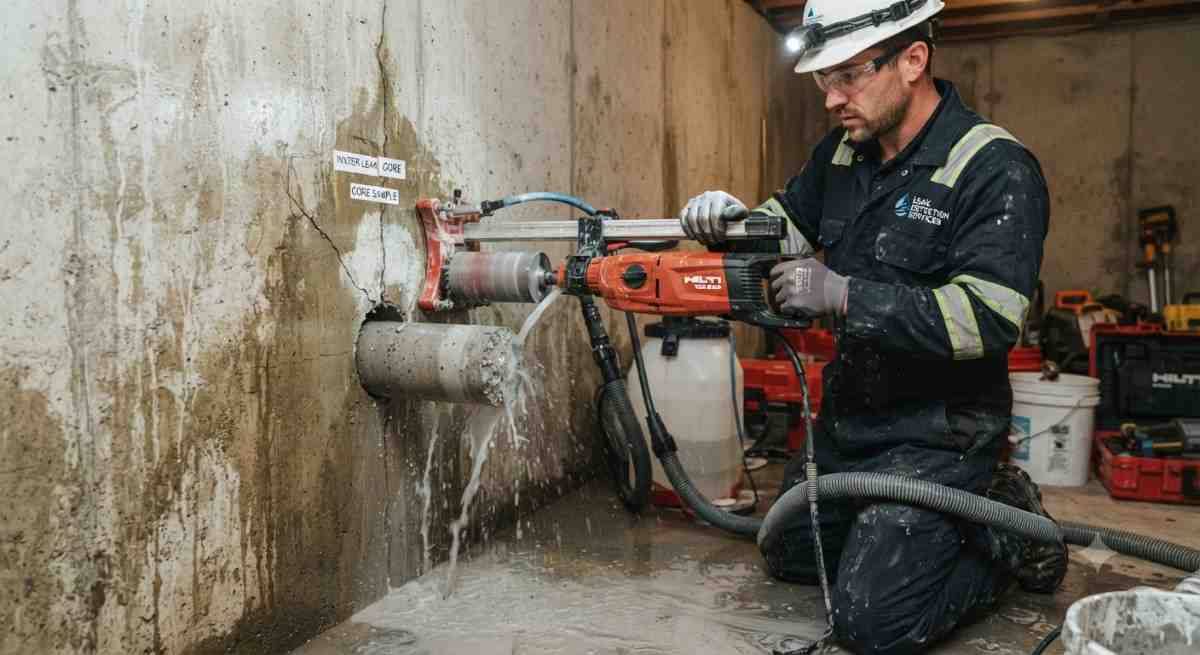
Core cutting is a specialised concrete cutting technique that uses a diamond-tipped, hollow cylindrical drill bit to bore precise, clean holes through concrete, RCC slabs, walls, or floors. Unlike conventional breaking or chiselling, which causes vibration, cracking, and dust, core cutting produces smooth, accurate holes with minimal disturbance to the surrounding structure.
While core cutting is widely used for installing plumbing lines, electrical conduits, HVAC ducts, and structural testing, one of its most valuable applications in the Indian construction and real estate context is water leakage investigation. By cutting a small-diameter core (typically 25mm to 150mm) at strategic points, engineers can physically inspect the internal condition of a slab, check for water accumulation, trace seepage paths, and even collect concrete samples for laboratory analysis — all without demolishing large sections of the structure.
Why Water Leakage Investigation Is So Challenging in India
India's climate and construction practices create unique challenges for leakage diagnosis:
1. Intense Monsoon Seasons Cities like Mumbai, Chennai, Kolkata, and Kochi experience heavy monsoon rainfall for several months each year. Waterproofing membranes that were adequate a decade ago often fail under repeated saturation cycles, leading to seepage in terraces, external walls, and basements.
2. Ageing Housing Stock Many residential societies in cities such as Delhi, Mumbai, Pune, and Bengaluru are 20 to 40 years old. Original waterproofing materials have degraded, and RCC slabs have developed micro-cracks due to structural settlement, thermal expansion, and reinforcement corrosion.
3. Dense, Multi-Storey Construction In high-rise apartment complexes common in Gurugram, Noida, Hyderabad, and Bengaluru, a leak on the fifth floor may actually originate from a bathroom or kitchen slab on the seventh floor. Water can travel laterally along beams and through construction joints before dripping down several floors below, making visual inspection alone unreliable.
4. Illegal Alterations and Plumbing Modifications It is common in Indian homes for residents to modify bathroom layouts, shift toilet seats, or add extra plumbing points without updating waterproofing. These undocumented changes make it difficult to predict where pipes run beneath tiled floors, complicating leak tracing.
5. Podium and Basement Leakage in Gated Communities Large townships in cities like Pune, Noida, and Bengaluru often have podium-level parking with landscaped gardens above. Water from irrigation and rain seeps through the waterproofing membrane and appears as leakage in the basement parking below, sometimes many metres away from the actual entry point.
Because of these factors, guessing the source of a leak based on where the stain appears can lead to unnecessary and expensive repairs that don't actually fix the problem. Core cutting removes the guesswork.
How Core Cutting Helps Pinpoint Leakage Sources
1. Direct Visual Access to the Slab Interior
By cutting a small core through a suspected slab or wall, technicians can directly observe water ingress, dampness, or stagnant water trapped between layers — something that cannot be assessed from the surface.
2. Tracing Water Movement Paths
In multi-storey buildings, a core cut at a suspected junction (such as a bathroom-to-living-room slab interface) allows engineers to observe whether water is actively seeping through, confirming or ruling out that location as the leak source.
3. Testing Waterproofing Membrane Condition
Cores taken from terraces or podium decks reveal whether the waterproofing membrane underneath the tiles has degraded, cracked, or was never properly applied — a common issue in budget housing projects across Tier 2 and Tier 3 Indian cities.
4. Identifying Plumbing Line Leakage
When a concealed pipe is suspected of leaking beneath a bathroom or kitchen floor, a strategically placed core cut allows a plumber or investigator to physically confirm pipe condition without breaking the entire floor.
5. Minimal, Targeted Damage
Because core cutting creates small, circular holes rather than large broken sections, the investigation causes far less disruption than traditional jackhammer-based inspection — an important consideration in occupied apartments and offices.
The Core Cutting Process: Step by Step
Step 1: Preliminary Assessment An engineer inspects the affected area, reviews building drawings if available, and identifies probable leak zones based on the pattern of dampness, moisture meter readings, and thermal imaging where applicable.
Step 2: Marking Core Points Based on the assessment, specific points are marked — often near bathroom wet areas, terrace parapets, expansion joints, or plumbing shafts — where cores will be cut.
Step 3: Core Cutting Operation Using a diamond core cutting machine with water-cooled drilling (to reduce dust and heat), technicians cut precise holes of the required diameter and depth. For RCC slab investigations, reinforcement scanning is often done beforehand using a rebar detector to avoid cutting through steel bars.
Step 4: Physical and Visual Inspection The extracted concrete core (a cylindrical sample) is examined for moisture content, cracks, honeycombing, or voids. The hole itself is inspected using an endoscopic camera in many cases, allowing technicians to see inside wall cavities or between slab layers.
Step 5: Leak Confirmation Test Water is sometimes poured at a suspected entry point on the floor above, while the core hole is monitored below to confirm whether that specific area is indeed the source — a technique known as a flood test combined with core observation.
Step 6: Reinstatement Once the investigation is complete, the core hole is filled and sealed using non-shrink grout or appropriate waterproofing compounds, restoring structural integrity.
Common Applications of Core Cutting for Leakage in India
- Residential Apartments: Investigating bathroom and kitchen slab leaks in societies across Mumbai, Delhi NCR, and Bengaluru.
- Basement Parking: Diagnosing seepage in podium-level and underground parking in gated townships.
- Terraces and Roof Slabs: Assessing waterproofing failure on flat RCC roofs common in Indian residential and commercial buildings.
- Water Tanks (Sumps and OHTs): Checking for cracks or leakage in overhead tanks and underground sumps.
- Commercial Complexes and Malls: Locating leaks in expansion joints and service ducts in large retail and office spaces.
- Industrial Structures: Investigating leakage in factory floors, cold storage units, and warehouses where moisture can damage stored goods.
Advantages of Core Cutting Over Traditional Methods
| Factor | Traditional Breaking | Core Cutting |
|---|---|---|
| Precision | Low, often over-breaks the area | High, targeted small holes |
| Structural Impact | Can weaken surrounding RCC | Minimal impact, controlled diameter |
| Noise & Dust | High | Low (wet cutting method) |
| Time Required | Longer, more labour-intensive | Faster, mechanised process |
| Reinstatement Cost | Higher due to larger damage | Lower, easy to patch and seal |
| Accuracy of Diagnosis | Often based on assumption | Based on direct physical evidence |
Why Professional Expertise Matters
Core cutting near reinforcement bars, post-tensioned slabs, or structural beams without proper planning can compromise the integrity of a building. This is why core cutting for leakage investigation should always be carried out by trained professionals who understand structural drawings, use rebar locators, and follow safety protocols — particularly in older Indian buildings where original structural plans may be unavailable or outdated.
A qualified team will also coordinate with structural engineers and waterproofing contractors so that once the leak source is confirmed, the repair — whether it is membrane reapplication, injection grouting, or pipe replacement — is carried out effectively the first time, avoiding the frustrating cycle of repeated, unsuccessful patchwork repairs that many Indian households experience.
Cost Considerations
The cost of core cutting for water leakage investigation in India varies based on:
- Diameter and depth of the core
- Number of investigation points required
- Accessibility of the site (high floors, basements, tight service shafts)
- Whether reinforcement scanning and endoscopic inspection are included
- Reinstatement and sealing work after investigation
While exact pricing depends on project specifics, investing in a proper core cutting investigation is almost always more economical in the long run than repeated, unsuccessful surface-level repairs that fail to address the actual source of the leak.
Choosing the Right Core Cutting Contractor in India
When selecting a service provider for water leakage investigation, look for:
- Experience with RCC structures, waterproofing diagnostics, and Indian building codes.
- Use of modern equipment — diamond core drills, rebar detectors, and endoscopic cameras.
- A clear investigation-and-reporting process, not just drilling without documentation.
- Proper safety measures and liability coverage for working in occupied buildings.
- Coordination with waterproofing and plumbing teams for complete resolution, not just diagnosis.
Conclusion
Water leakage is rarely as simple as it looks on the surface. In India's diverse building stock — from ageing housing societies to sprawling modern townships — pinpointing the true source of seepage requires more than assumptions and repeated patch repairs. Core cutting offers a precise, minimally invasive, and evidence-based approach to water leakage investigation, allowing engineers to see exactly what is happening inside a slab, wall, or waterproofing layer before recommending a permanent fix.
If you are dealing with persistent seepage, damp ceilings, or unexplained water stains in your home, society, or commercial property, a professional core cutting investigation can save you significant time, money, and repeated frustration.
For expert core cutting and water leakage investigation services across India, reach out to Core Cutting India at [email protected].
Website: corecuttingindia.com | Contact: [email protected]