
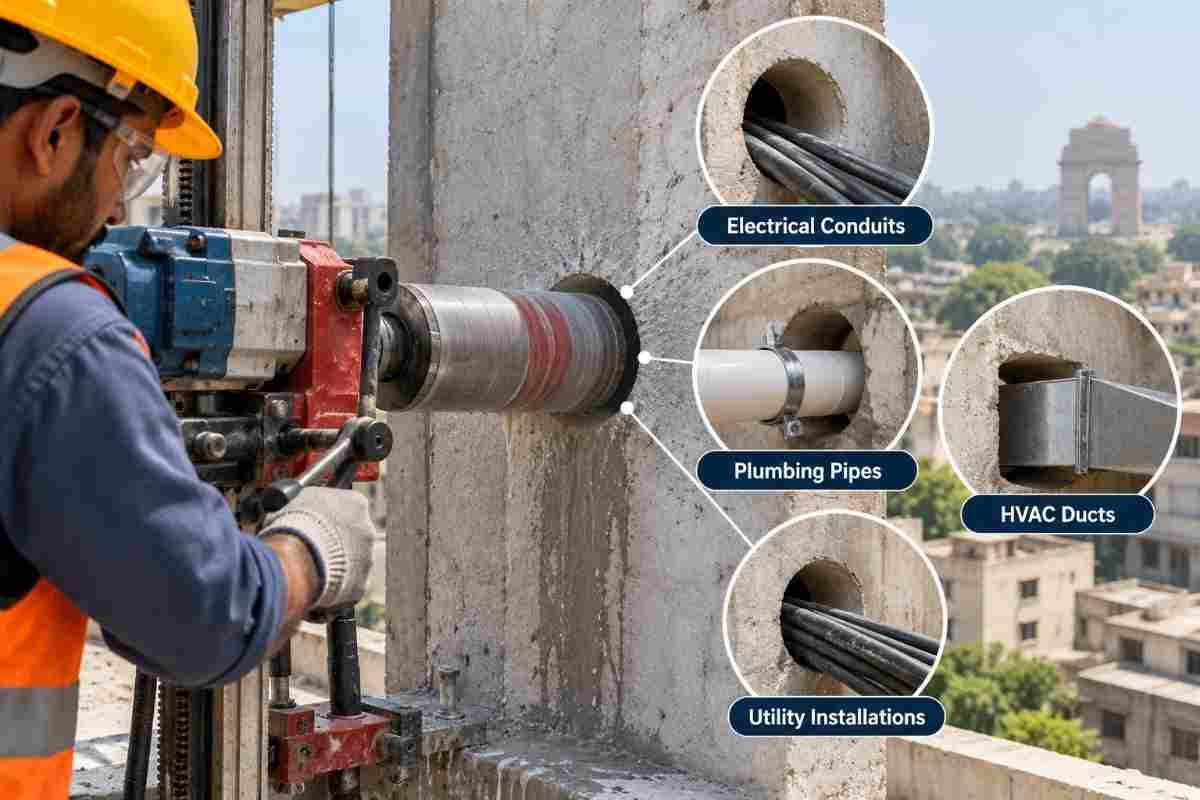
Delhi never stops building. Metro corridors extend, high-rises climb higher, old buildings get retrofitted, and commercial spaces are redesigned every year. In this environment, one of the least glamorous but most important techniques on any site is core cutting.
A core hole may look like a small circle in a wall or slab, but it often decides whether a plumbing line, air-conditioning duct, or electrical conduit gets installed cleanly or whether the structure suffers cracks, vibration damage, and costly rework. This guide explains what core cutting is, where it is used in Delhi’s construction landscape, and why professional services such as Core Cutting India are becoming the preferred choice for builders, contractors, architects, and homeowners.
What Is Core Cutting?
Core cutting, also called diamond core drilling, is a method of making precise, round holes in hard materials such as reinforced concrete (RCC), brick, stone, masonry, and asphalt. Instead of using a hammer-action drill that pounds the material, a core drill uses a hollow, cylindrical bit embedded with industrial diamond segments. The bit spins at controlled speed and grinds through the material, leaving a clean-walled hole and extracting a solid cylinder of material, called the “core.”
Key features of the method include:
- Diamond-tipped bits: The diamonds grind through concrete and embedded steel reinforcement with far less force than impact tools.
- Water cooling: Water usually flows through the bit during drilling to cool it, flush out slurry, and reduce dust.
- Rig or hand-held operation: Large-diameter holes typically use a stand-mounted rig anchored to the surface, while smaller holes can be drilled with a hand-held machine.
- Wide diameter range: Holes can range from a few centimetres for small conduits to several hundred millimetres for large pipes and ducts.
The result is a smooth, accurate opening with minimal vibration, which is why core cutting has largely replaced chiselling and hammer drilling for serious work.
Why Core Cutting Matters in Delhi
Delhi’s construction environment has some specific demands that make precise cutting valuable.
1. Dense urban surroundings. Many projects sit close to occupied buildings, markets, hospitals, and offices. Jackhammering a wall sends vibration and noise through the neighbourhood. Core drilling is quieter and more controlled.
2. Renovation-heavy market. A large share of work in Delhi involves modifying existing buildings, from old residential blocks in South Delhi to commercial complexes in Nehru Place and Connaught Place. Retrofitting means cutting into structures that must stay safe and standing.
3. Dust and air-quality concerns. Delhi’s air quality is a recurring public issue, and authorities regularly impose dust-control and construction restrictions, especially in winter. Wet core drilling produces far less airborne dust than dry demolition methods, which helps sites stay compliant and considerate of residents.
4. Fast-paced timelines. Developers want predictable schedules. A clean core hole can be drilled in minutes, avoiding the patching, plastering, and repairs that rough breaking often requires.
5. Structural caution. Delhi lies in a seismically active zone, so preserving the integrity of slabs, beams, and walls is important. Controlled drilling reduces the risk of micro-cracking compared with percussion methods.
Practical Uses of Core Cutting in Delhi
1. Plumbing and Drainage Penetrations
Every building needs pipes passing through floors and walls. Core cutting creates exact openings for water supply lines, soil pipes, waste pipes, and stormwater drains. In multi-storey apartment projects, drilling sleeves for vertical stacks through slabs is routine. In renovations, a bathroom shift or new kitchen layout often requires fresh openings through an existing slab, and core drilling keeps surrounding concrete intact.
2. HVAC and Air-Conditioning Work
Delhi’s extreme summers make air conditioning essential in homes, offices, and showrooms. Installing split ACs, VRV/VRF systems, and ducted ventilation requires holes for refrigerant pipes, drain lines, and exhaust ducts. Core cutting produces circular openings sized exactly for the pipe or duct, which makes sealing and insulation much easier and prevents leaks or heat loss.
3. Electrical Conduits and Cable Routing
Electricians need pathways for conduits, cable trays, and bus ducts through walls and slabs. Core cutting allows neat, correctly sized openings in structures where chasing or breaking would be messy. In data centres, server rooms, and corporate offices, precise penetrations support organised cabling and fire-stopping.
4. Fire Safety and Sprinkler Systems
Fire-protection pipework must pass through floors and fire-rated walls. Accurate openings allow installers to fit fire-stop collars and sealants properly, helping maintain the fire rating of the barrier. Sprinkler risers and hydrant lines often require larger-diameter core holes through thick slabs and shear walls.
5. Anchor and Dowel Holes
Not all core holes are for passing services through. Smaller-diameter drilling is used for anchor bolts, rebar dowels, and fixing heavy equipment. When extending an existing structure, engineers drill holes into old concrete to anchor new reinforcement bars with chemical grout. Clean-walled holes help the bonding material perform as intended.
6. Lift Shafts, Staircases, and Slab Openings
Sometimes a project needs a bigger opening, such as a new lift shaft, a staircase void, or a skylight cut-out. While wall saws and wire saws handle large rectangular openings, core drilling is often used to create corner relief holes or to remove material in controlled stages. Combining methods lets contractors cut openings without damaging adjacent structure.
7. Concrete Core Sampling and Structural Testing
Core cutting is not only a construction technique but also a diagnostic one. Engineers extract cylindrical cores from existing concrete and send them to laboratories to test compressive strength and assess quality. In Delhi, this is common for:
- Evaluating old buildings before renovation or vertical extension
- Structural audits and safety assessments
- Verifying concrete quality on new projects when cube test results are questioned
- Insurance, legal, or dispute-resolution purposes
The extracted core also lets engineers inspect internal conditions such as reinforcement cover, voids, and signs of deterioration. Testing should always follow the applicable Indian Standards and be carried out by qualified professionals.
8. Road, Pavement, and Infrastructure Work
Roads, flyovers, and metro structures also need core drilling. Contractors use it to check pavement thickness and quality, install drainage outlets, set up road studs and barriers, and create openings for utilities. Its precision suits infrastructure projects where tolerances are tight.
9. Bridge and Industrial Applications
In factories and industrial plants across the NCR, core cutting helps install machinery foundations, pipe racks, cooling lines, and cable penetrations. Because it limits vibration, it can be used near sensitive equipment or in facilities that cannot afford extended shutdowns.
Key Benefits of Core Cutting
Precision and Clean Finish
Core holes have smooth, straight walls and exact diameters. Pipes and sleeves fit tightly, so there is less patching, less grouting, and a more professional finish.
Reduced Vibration and Structural Damage
Hammer drilling can cause micro-cracks and loosen the surrounding concrete. Diamond drilling cuts through the material with minimal impact, protecting the structure and nearby finishes such as tiles, plaster, and false ceilings.
Ability to Cut Through Reinforcement
RCC contains steel bars that stop ordinary drills. Diamond bits can cut through both concrete and rebar, though engineers should always plan hole positions carefully to avoid cutting critical reinforcement.
Lower Noise and Dust
Wet drilling controls dust and generally operates at lower noise levels than demolition-style methods. This matters in occupied buildings, hospitals, schools, and residential societies.
Speed and Efficiency
A trained team can finish many holes in a single day. Faster work means fewer delays for plumbers, electricians, and HVAC installers who follow behind.
Flexibility
Core drilling works horizontally, vertically, and at angles, and can be done in tight spaces, basements, ceilings, and high walls with the right equipment.
Cost Savings in the Long Run
Rough breaking may seem cheaper at first, but it creates repair costs, rework, and potential structural problems. A precise opening often saves money overall.
Safety and Planning: What Professionals Check Before Drilling
Good core cutting begins before the machine is switched on. Reliable contractors typically follow these steps:
- Review drawings and structural plans. Locating beams, columns, and post-tensioned elements prevents dangerous cuts.
- Scan for hidden services. Detectors or ground-penetrating radar can reveal rebar, electrical conduits, and pipes inside the concrete.
- Mark the exact position and diameter. Accurate layout avoids cutting the wrong spot.
- Secure the rig properly. Anchoring or vacuum-mounting keeps the machine stable so the bit does not bind or wander.
- Control water and slurry. Slurry is collected and removed to protect floors, ceilings, and electrical systems below.
- Use protective equipment. Operators wear safety gear, and the work area is cordoned off.
- Coordinate with the structural engineer. For large holes or cuts through critical members, engineer approval is essential.
Skipping these steps can lead to damaged cables, burst pipes, or compromised structural elements. This is the main reason to choose experienced professionals instead of improvising on site.
Core Cutting vs. Other Methods
| Method | Best For | Limitations |
|---|---|---|
| Core drilling | Clean round holes, rebar-reinforced concrete | Round shapes only |
| Hammer drilling | Small holes in brick or light masonry | Vibration, rough edges, poor in heavy RCC |
| Wall/slab sawing | Large rectangular openings, doors, windows | Needs rail setup, more space |
| Wire sawing | Very thick or massive structures | Specialised, slower setup |
| Manual breaking | Small non-critical demolition | Noise, dust, cracks, structural risk |
In practice, many projects combine methods. For example, a team may drill corner core holes and then complete a rectangular opening with a wall saw.
Factors That Affect Core Cutting Cost in Delhi
People often ask about pricing. Costs vary by contractor and project, but common factors include:
- Hole diameter: Larger diameters need bigger bits and more time.
- Depth or thickness: A thick slab or wall costs more than a thin one.
- Material: Heavily reinforced concrete is harder than brick or block.
- Access and location: High ceilings, basements, and tight spaces need extra setup.
- Number of holes: Bulk work usually reduces the per-hole cost.
- Water and power availability: Sites lacking utilities may need extra arrangements.
- Urgency and timing: Rush jobs and night work may carry a premium.
The best way to get an accurate figure is to request a site visit or a detailed quotation rather than relying on a generic rate.
How to Choose a Core Cutting Contractor in Delhi
Not all providers offer the same quality. When comparing options, look for:
- Experience with projects similar to yours, whether residential, commercial, or industrial
- Modern diamond equipment and a range of bit sizes
- Trained operators who understand structures and safety
- Detection and scanning capability to avoid hitting hidden services
- Clear quotations with no hidden charges
- Responsiveness and coverage across Delhi and the NCR
- Safety practices and respect for site rules
A specialist such as Core Cutting India focuses on this kind of work, helping clients plan and execute cuts safely and efficiently instead of treating drilling as an afterthought.
Common Mistakes to Avoid
- Drilling without checking drawings. This risks cutting beams, columns, or post-tension cables.
- Ignoring hidden conduits and pipes. A single strike can cause outages or flooding.
- Choosing the cheapest option blindly. Poor equipment and untrained crews lead to oversized, crooked, or damaged holes.
- Forgetting slurry management. Wet slurry can stain floors and damage finishes.
- Skipping engineer approval for big openings. Large holes can weaken load-bearing elements.
- Leaving penetrations unsealed. Gaps around pipes and cables should be sealed with proper fire-stop and waterproofing materials.
Frequently Asked Questions
What is core cutting in construction?
Core cutting is a drilling method that uses a hollow diamond-tipped bit to create precise round holes in concrete, brick, stone, and other hard materials. It is widely used for pipes, ducts, cables, anchors, and sampling.
Is core cutting safe for RCC structures?
When planned and carried out correctly, yes. Core drilling produces much less vibration than hammering. However, it is important to scan for rebar and services and to consult a structural engineer for larger holes or critical members.
How is core cutting different from normal drilling?
Normal drilling removes material by pounding or twisting a solid bit, often with impact. Core cutting grinds a ring-shaped path using diamond segments and extracts a solid core, giving a cleaner and more accurate hole.
Can core cutting go through steel reinforcement?
Yes. Diamond bits can cut through rebar embedded in concrete, but positions should be chosen with structural guidance to avoid weakening key elements.
Does core drilling create a lot of dust or noise?
Wet core drilling controls dust effectively and is generally quieter than demolition-style methods. Some noise and slurry are still produced, so basic site management is needed.
What diameters of holes can be made?
Core holes range from small sizes for conduits and anchors to large openings of several hundred millimetres for ducts and heavy pipes. The exact range depends on the equipment.
How long does core cutting take?
Small holes may take only minutes each, while large or deep holes through heavily reinforced slabs can take longer. The total time depends on the number of holes, access, and site conditions.
How much does core cutting cost in Delhi?
Pricing depends on diameter, depth, material, access, and quantity. A site assessment gives the most reliable quotation.
Can core cutting be done in occupied buildings?
Yes, and it is often preferred in such settings because of lower vibration, controlled dust, and faster completion. Proper protection of furniture, floors, and electronics is recommended.
Is core cutting used to test concrete quality?
Yes. Cores extracted from existing structures are tested in laboratories to estimate compressive strength and assess condition, supporting audits, renovations, and safety checks.
The Bigger Picture: Small Holes, Large Impact
In a city like Delhi, where construction, renovation, and infrastructure upgrades go on almost continuously, the quality of small details determines the quality of the whole project. A neat, accurately placed core hole means a pipe that does not leak, a duct that fits, a cable that runs safely, and a structure that stays sound for decades.
Core cutting also reflects a broader shift in the industry toward precision, safety, and respect for surrounding communities. Cleaner methods, lower noise, and better dust control match the expectations of today’s clients, regulators, and residents.
Whether you are a homeowner planning an AC installation, an architect designing a commercial fit-out, or a contractor managing a large building site, the right core cutting partner can save time, reduce risk, and protect your investment.
Conclusion
Core cutting may involve small holes, but its benefits in construction are substantial. From plumbing and HVAC to electrical routing, fire safety, structural testing, and infrastructure work, it offers precision, speed, and safety that older methods struggle to match. In Delhi’s crowded, fast-moving, and environmentally sensitive building landscape, it has become a practical necessity instead of a luxury.
Choosing an experienced provider, planning carefully, and following safety practices ensure that every hole serves its purpose without harming the structure. If you are planning a project and need clean, accurate openings in concrete or masonry, consider consulting the specialists at Core Cutting India for a site-specific assessment and quotation.