
Target-Related Searches
-
Concrete core cutting services in Delhi and Mumbai
-
Diamond core drilling for MEP retrofitting in India
-
Non-destructive concrete cutting methods in residential buildings
-
Safety precautions for core cutting in active commercial spaces
-
RCC wall and slab cutting contractor pricing India
People Also Ask (PAA) Questions
-
How do you safely perform core cutting in an already occupied building?
-
What is the cost of concrete core cutting services in major Indian cities?
-
Does core cutting compromise the structural stability of old Indian apartment complexes?
-
What equipment is used to minimize dust and noise during indoor core cutting?
-
What legal permissions or structural audits are required before core cutting in India?
Introduction: The Challenge of Retrofitting Occupied Spaces
Urban landscapes across India—from the high-rise residential societies in Noida and Gurugram to bustling commercial hubs in Mumbai, Bengaluru, and Chennai—are constantly evolving. As modern lifestyle demands shift, existing structures frequently require retrofitting. Whether it is upgrading fire safety systems, installing centralized HVAC piping, laying advanced IT cabling, or routing modern plumbing, creating pathways through reinforced cement concrete (RCC) is inevitable.
However, executing heavy structural modifications like core cutting in occupied buildings presents a unique set of challenges. Unlike vacant construction sites, occupied buildings house residents, office workers, sensitive electronics, and delicate finishes. Managing noise, vibration, airborne silica dust, and structural integrity requires meticulous planning.
Brought to you by [email protected], this definitive guide explores the step-by-step framework, safety compliances, and modern methodologies required to execute seamless core cutting projects in live, occupied Indian environments.
Understanding Core Cutting and Its Vital Role in Modernization
Core cutting involves drilling clean, circular holes through hard construction materials like RCC slabs, beams, columns, and brick masonry using diamond-tipped drill bits.
In older Indian buildings—many constructed decades ago under older municipal bylaws—introducing new utility lines without proper planning can spell disaster. Traditional demolition methods using hammers and chisels cause uncontrolled micro-fractures, extensive structural weakness, and heavy debris. In contrast, modern diamond core drilling delivers vibration-free, millimeter-precise openings, preserving the surrounding integrity of the wall or floor.
Key Phases in Planning Core Cutting for Occupied Buildings
To ensure zero mishaps, minimal occupant friction, and strict adherence to structural safety, project managers must follow a structured four-stage execution roadmap.
[Phase 1: Structural Audit & Non-Destructive Testing]
                     │
                     ▼
[Phase 2: Pre-Execution Safety & Occupant Communication]
                     │
                     ▼
[Phase 3: Execution via Wet Diamond Core Drilling]
                     │
                     ▼
[Phase 4: Post-Cutting Clean-up & Grouting]
Phase 1: Structural Audit and Non-Destructive Testing (NDT)
Before a single machine touches a wall or floor slab in an occupied Indian apartment or commercial plaza, a certified structural engineer must vet the drawing layout.
-
Rebar Scanning: Utilizing tools like Ground Penetrating Radar (GPR) or pachometers to map internal steel reinforcement bars (rebar) and electrical conduits. Cutting blindly through primary load-bearing rebar can critically compromise structural safety.
-
Core Mapping for MEP: Aligning core locations with Mechanical, Electrical, and Plumbing (MEP) consultants to ensure openings do not fall on high-stress zones like column-beam junctions.
Phase 2: Pre-Execution Safety, Containment, and Occupant Communication
Occupied buildings run on trust and minimal disruption. Managing resident or tenant anxiety is just as important as managing the machinery.
-
Notice and Timing: Issuing notices at least 48 to 72 hours prior. Restricting heavy drilling to off-peak or stipulated daytime hours per local municipal (RWA or builder association) guidelines.
-
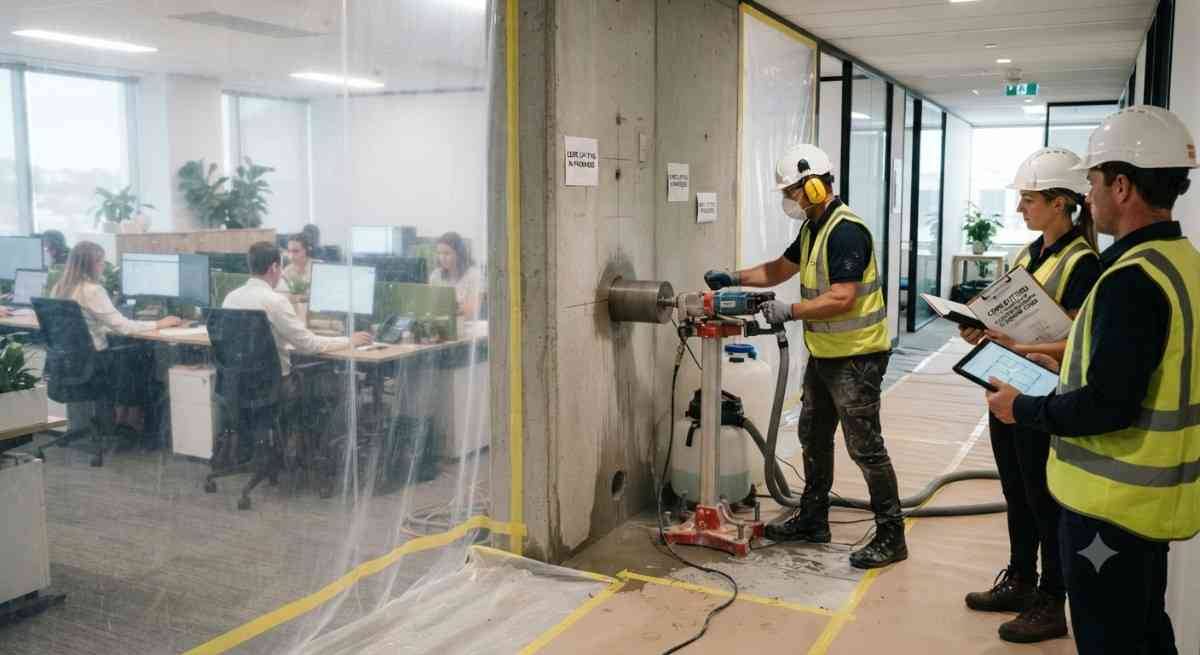
Dust and Water Containment Setups: Erecting heavy-duty polythene zip-walls and airtight containment zones around the work area. Industrial wet-vacuums must be deployed instantly alongside the drill to capture slurry.
-
Electrical Isolation: Tracing and temporarily shutting off active concealed lines passing directly through the designated coring zone.
Phase 3: Controlled Execution via Wet Diamond Core Drilling
For occupied indoor environments, dry drilling is strictly discouraged due to hazardous silica dust clouds.
-
Wet Cutting Technology: Specialized electric or hydraulic core rigs use a continuous, controlled stream of water fed directly to the diamond bit. This cools the blade, extends equipment life, and traps 99% of dust particles instantly into a manageable slurry.
-
Anchoring and Stability: Machines are vacuum-anchored or bolted securely to prevent rig slippage, ensuring absolute precision even on vertical walls or overhead ceilings.
Phase 4: Waste Management, Slurry Extraction, and Structural Grouting
Once the concrete core cylinder is cleanly extracted:
-
Slurry Cleanup: Industrial vacuums extract all liquid waste, preventing seepage into lower floors or finished interiors.
-
Core Restoration / Sleeve Insertion: If the hole is meant for utility passage, UPVC or PVC sleeves are inserted, and annular gaps are sealed using high-strength, non-shrink structural grouts (such as Fosroc or equivalent grade mixes).
Special Considerations for Indian Real Estate Contexts
Executing core cutting projects within the Indian regulatory and architectural ecosystem requires keeping specific localized nuances in mind:
| Parameter | Residential Societies (RWA Governed) | Commercial IT Parks & Offices |
| Timing Constraints | Strict windows (typically 10:00 AM – 1:00 PM and 3:00 PM – 5:00 PM); no work on Sundays/holidays. | Often executed during late-night shifts or weekends to avoid business hour disruption. |
| Permissions | Society RWA clearance, builder NOC, and adherence to local civic body norms (e.g., MCD, MCG, BMC). | Facility Management (FM) clearance, fire department alignment, and IT asset protection. |
| Common Application | AC copper piping, chimney exhaust holes, bathroom plumbing retrofits. | Server room cooling ducts, core routing for fire suppression sprinkler networks. |
Safety Guidelines and Personal Protective Equipment (PPE)
Operating heavy diamond-cutting machinery in confined, populated spaces introduces multiple operational hazards. Professional operators contracted via [email protected] strictly adhere to safety standards:
-
Silica Dust Protection: Mandating N95 or half-mask respirators to prevent inhalation of crystalline silica, which causes long-term respiratory hazards like silicosis.
-
Electrical Safety: Using waterproof industrial grade distribution boxes with Earth Leakage Circuit Breakers (ELCB) to eliminate shock hazards from wet cutting processes.
-
Ergonomics & Anti-Vibration Gear: Protecting operators against hand-arm vibration syndrome during prolonged drilling sessions.
Why Professional Expertise Matters
Attempting DIY or unverified local labor interventions for core cutting in active buildings frequently results in structural cracking, water seepage into living spaces below, blown electrical fuses, and damaged main utility lines. Hiring certified specialists guarantees that your project benefits from advanced hydraulic and electric diamond tools, engineered precision, and minimal downtime.
For expert consultation, tailored project assessments, and professional execution standards customized to your property's exact structural requirements, reach out to the industry leaders at [email protected].
Conclusion
Carrying out core cutting in occupied buildings is a delicate balance of engineering precision, advanced machinery deployment, and stringent occupant management. By prioritizing pre-work NDT structural scans, deploying wet diamond cutting technology for dust suppression, and strictly honoring local housing society or commercial facility guidelines, property owners can achieve seamless structural modernizations safely and efficiently. Trust certified professionals to safeguard your building's structural health while upgrading its functional capabilities.