
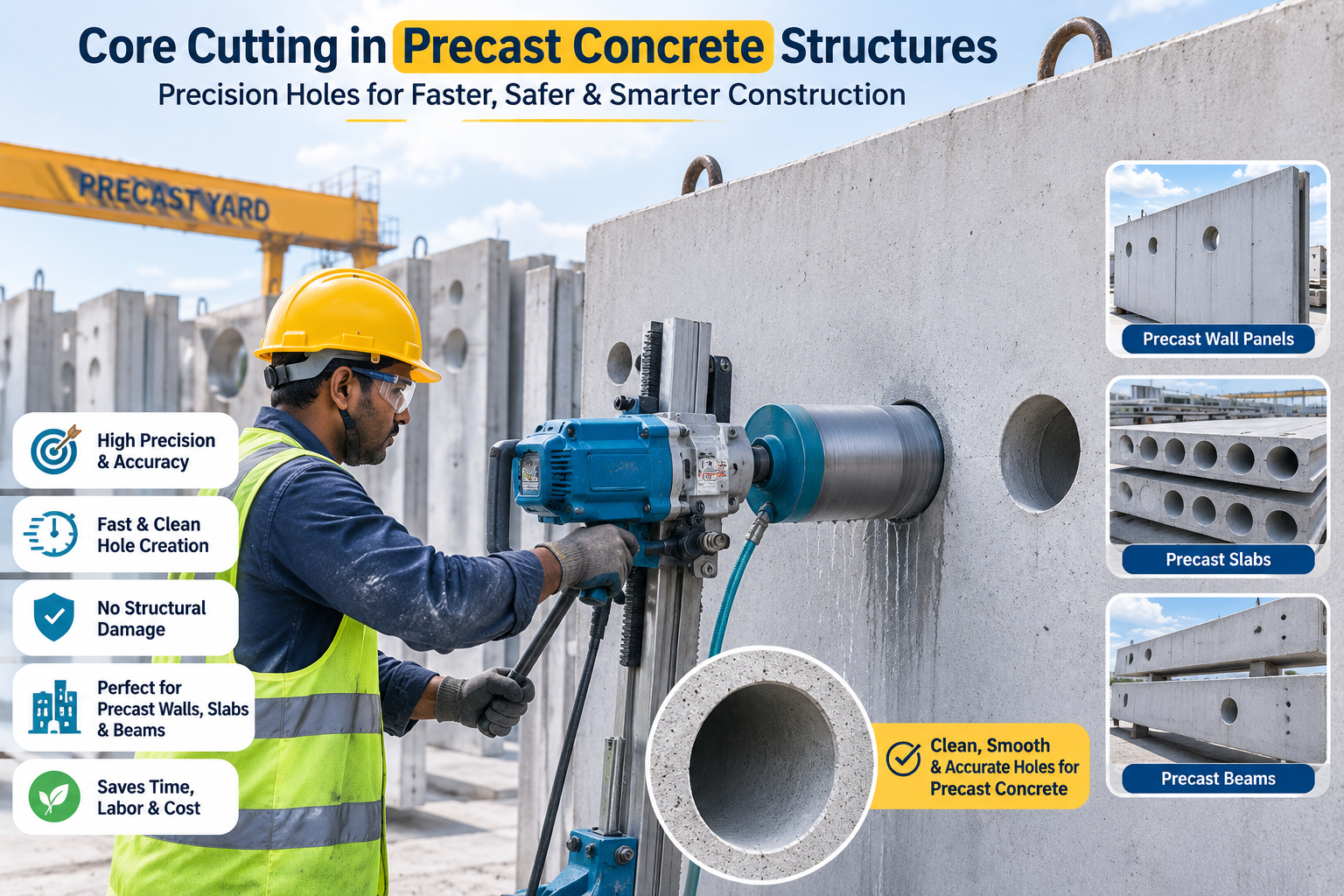
Precast concrete has transformed the way India builds — from metro stations and flyovers to residential townships and industrial sheds. Its speed of construction, consistent quality, and reduced on-site labour dependency have made it the preferred choice for large infrastructure projects across the country. But precast construction brings a unique challenge that many project teams underestimate until it's too late: core cutting.
Whether it's creating an opening for a plumbing riser, an electrical conduit, an HVAC duct, or a structural connection between two precast members, cutting through factory-cast, high-strength precast concrete requires specialised expertise. At Core Cutting India ([email protected]), we work with precast contractors, MEP consultants, and structural engineers across India to deliver precise, non-destructive core cutting solutions that protect the integrity of the structure while meeting tight project timelines.
In this blog, we explore what core cutting in precast concrete actually involves, why it differs from cutting conventional cast-in-situ concrete, the equipment and techniques used, and real-world examples from Indian construction projects.
What Is Core Cutting?
Core cutting, also known as core drilling, is the process of creating circular or shaped openings in concrete, masonry, or stone using diamond-tipped drilling equipment. Unlike jackhammering or chiselling, which cause vibration, cracking, and unpredictable damage, core cutting uses rotary diamond core bits cooled by water to cut clean, precise holes without disturbing the surrounding structure.
In precast concrete specifically, core cutting is used to create:
- Openings for plumbing pipes, drainage lines, and sanitary risers
- Passages for electrical conduits and cable trays
- Ducts for HVAC systems
- Holes for structural bolts, dowels, and rebar connections between precast panels
- Openings for fire-fighting systems and sprinkler lines
- Access points for lifting hardware removal or grouting
Why Precast Concrete Requires Specialised Core Cutting
Precast elements are manufactured in controlled factory conditions using high-strength concrete mixes, often reaching compressive strengths of M40 to M60 or higher — considerably stronger than typical site-mixed M20-M25 concrete used in cast-in-situ work. This higher density and strength has direct implications for core cutting:
1. Higher Reinforcement Density Precast panels, beams, and hollow-core slabs are engineered with tightly spaced reinforcement, prestressing strands, or welded wire mesh to withstand transportation and erection stresses. Cutting through these members without a proper scan risks severing critical reinforcement, which can compromise structural capacity.
2. Prestressed and Post-Tensioned Elements Many precast beams and slabs used in Indian metro viaducts and flyovers are prestressed. Core cutting near prestressing tendons without careful planning can lead to sudden tendon release — a serious safety hazard. This is why core cutting contractors must review structural drawings and, where necessary, use ground-penetrating radar (GPR) or rebar scanners before drilling.
3. Higher Compressive Strength The denser, higher-grade concrete used in precast units requires more robust diamond core bits, higher-torque drilling rigs, and controlled cutting speeds compared to standard cast-in-situ concrete.
4. Tight Tolerances Precast elements are manufactured to precise dimensional tolerances. Any core cutting performed post-installation must maintain this precision so that MEP services fit correctly without on-site rework.
Techniques and Equipment Used in Core Cutting
Professional core cutting for precast structures typically involves the following process:
1. Pre-Cutting Survey and Scanning
Before any cutting begins, the location is scanned using rebar detectors or GPR equipment to map the position of reinforcement, prestressing strands, and embedded conduits. This step is non-negotiable for precast elements given their dense reinforcement layout.
2. Marking and Layout
Based on approved shop drawings and MEP coordination drawings, the exact cutting points are marked on the precast element.
3. Diamond Core Drilling
A diamond core drill — handheld or rig-mounted, depending on the diameter and orientation (vertical, horizontal, or overhead) — is used to cut the opening. Core bit diameters typically range from 25mm for small conduit openings to 300mm or more for large duct and riser penetrations.
4. Wet Cutting for Dust Control
Water-cooled cutting is standard practice, as it reduces dust generation (important for occupied sites and RERA-regulated projects), extends the life of the diamond bit, and prevents overheating of the concrete around the cut, which could otherwise cause micro-cracking.
5. Core Removal and Finishing
Once cut, the concrete core is removed, edges are cleaned, and — where required — the opening is treated with epoxy grout or sealant to restore structural continuity or achieve fire-rating compliance.
Applications of Core Cutting in Indian Precast Projects
India's precast industry has expanded rapidly across metro rail, highways, industrial parks, and affordable housing. Here are some representative examples of where core cutting plays a critical role:
Metro Rail Viaducts and Stations
Indian metro systems — including the Delhi Metro, Mumbai Metro, Pune Metro, and Nagpur Metro — rely heavily on precast segmental box girders and precast station elements. Core cutting is used extensively at these sites to create openings for drainage scuppers, cable ducting for signalling and traction systems, and expansion joint hardware. Given the prestressed nature of these girders, core cutting teams must coordinate closely with structural consultants to avoid tendon zones.
Precast Housing and Township Projects
Large-scale affordable housing projects developed using precast wall and slab technology — a method increasingly adopted under schemes aligned with India's urban housing push — require extensive core cutting for plumbing stacks, electrical risers, and exhaust ducting in bathrooms and kitchens. Because entire wall panels are cast as single monolithic units, any opening missed during the factory casting stage must be created on-site via precision core cutting rather than breaking, to avoid damaging the panel.
Industrial and Warehousing Facilities
Precast portal frames and wall panels used in industrial sheds and logistics parks across hubs like Bhiwandi, Sriperumbudur, and the Delhi-NCR belt often need core-cut openings for fire hydrant lines, compressed air piping, and cable trays added after erection, once the final layout of machinery and utilities is confirmed.
Flyovers and Elevated Corridors
Precast segmental construction is widely used for elevated road corridors in cities such as Hyderabad, Bengaluru, and Ahmedabad. Core cutting here is typically required for drainage outlets and utility conduit crossings integrated into the deck slab.
Precast Boundary Walls and Compound Structures
On industrial and institutional campuses, precast compound wall panels sometimes require core-cut openings for utility crossings, gate automation wiring, or security camera conduits — work that demands minimal disturbance to the panel's structural integrity.
Advantages of Professional Core Cutting Over Traditional Methods
| Aspect | Core Cutting | Traditional Breaking/Chiselling |
|---|---|---|
| Precision | High — clean, accurate diameter and depth | Low — irregular, oversized openings |
| Vibration Impact | Minimal, safe for prestressed elements | High risk of micro-cracks and tendon damage |
| Dust and Noise | Controlled with wet cutting | Significant dust and noise generation |
| Reinforcement Damage | Avoided through pre-scanning | High risk of cutting rebar/tendons |
| Structural Integrity | Preserved | Often compromised |
| Finish Quality | Clean edges, ready for sealing | Rough, requires patching |
Safety Considerations in Precast Core Cutting
Core cutting in precast structures, particularly prestressed elements, carries specific risks that must be managed by trained professionals:
- Structural Assessment First: Never core cut without reviewing approved structural drawings or consulting the design engineer, especially near prestressing tendon zones.
- Scanning Before Drilling: Use rebar detectors or GPR scanning on every precast element before drilling, regardless of how routine the opening seems.
- Controlled Drilling Rigs: Use rig-mounted diamond drills for larger diameters to maintain verticality and avoid drill wander, which can cause off-centre cuts.
- Water Management: Wet cutting requires proper water collection and vacuum systems, particularly on upper floors or occupied buildings, to prevent water damage.
- PPE and Site Safety: Operators must use appropriate PPE, and cutting zones should be cordoned off, particularly for overhead or horizontal cutting near live areas.
Choosing a Core Cutting Contractor for Precast Projects
Given the technical complexity involved, selecting the right core cutting partner is critical for precast projects. Key factors to evaluate include:
- Experience with Prestressed and High-Strength Concrete — Ask for references from metro, highway, or large precast housing projects.
- Scanning Capability — Confirm the contractor uses rebar/GPR scanning as standard practice, not as an optional add-on.
- Equipment Range — Ensure they have diamond core bits and rigs suitable for the diameter range and orientation (vertical, horizontal, overhead) required on your project.
- Compliance and Documentation — For metro, highway, and government projects, contractors should be able to provide method statements, risk assessments, and completion documentation.
- Turnaround Time — Precast projects run on tight erection schedules; the contractor should be able to mobilise quickly without compromising quality.
Cost Factors in Core Cutting
Core cutting costs in India generally depend on:
- Core diameter — larger diameters cost more per cut due to bit wear and drilling time
- Concrete strength and thickness — higher-grade precast concrete takes longer to cut
- Orientation — overhead and horizontal cutting typically cost more than vertical, floor-level cutting due to rig setup and safety requirements
- Site accessibility — upper floors, congested sites, or occupied buildings may add mobilisation costs
- Reinforcement density — additional scanning time for heavily reinforced precast elements
- Quantity and repetition — bulk cutting across multiple identical precast units (common in housing and industrial projects) often reduces the per-unit cost
For an accurate, project-specific quotation, it's best to share your structural drawings and opening schedule directly with a specialised contractor.
Conclusion
Core cutting in precast concrete structures is far more specialised than standard concrete drilling. The combination of high-strength mixes, dense reinforcement, and prestressing tendons found in Indian precast elements — whether in metro viaducts, housing townships, or industrial facilities — demands a careful, scan-first, precision-cutting approach. Done correctly, core cutting preserves the structural integrity of precast members while enabling the MEP and utility integration that every modern building depends on.
As India's precast construction industry continues to grow across metro rail, affordable housing, and industrial infrastructure, the demand for skilled, safety-conscious core cutting professionals will only increase.
Need reliable core cutting services for your precast project? Get in touch with Core Cutting India at [email protected] for expert diamond core drilling solutions tailored to precast concrete structures across India.
People Also Ask
1. What is core cutting in construction? Core cutting is a precision drilling technique that uses diamond-tipped core bits to cut circular openings in concrete, masonry, or stone for utilities such as plumbing, electrical, and HVAC systems, without causing the vibration or cracking associated with traditional breaking methods.
2. Why is core cutting difficult in precast concrete compared to cast-in-situ concrete? Precast concrete is typically higher strength, more densely reinforced, and often prestressed or post-tensioned, making it harder to cut and riskier if reinforcement or tendons are struck without prior scanning.
3. What tools are used for core cutting in precast structures? Diamond core drilling machines (handheld or rig-mounted), water-cooling systems for dust control, and rebar/GPR scanners for pre-cutting surveys are the primary tools used.
4. Is core cutting safe for structural precast elements? Yes, when performed by trained professionals who scan for reinforcement and prestressing tendons beforehand and follow approved structural drawings, core cutting is a safe, minimally invasive method for creating openings in precast elements.
5. How much does core cutting cost in India? Costs vary based on core diameter, concrete strength, orientation of cutting, site accessibility, and quantity of cuts required. Bulk or repetitive cutting across identical precast units generally reduces the per-unit cost. Contact [email protected] for a project-specific quote.
Target-Related Searches: core cutting services near me, precast concrete core drilling cost, diamond core drilling machine, concrete core cutting for pipes, core cutting for electrical conduits, precast beam drilling, core cutting vs chiseling, RCC core cutting contractors, concrete coring for HVAC ducts, core cutting company in Delhi NCR
Published by Core Cutting India — your trusted partner for precast and cast-in-situ concrete core cutting services across India.