
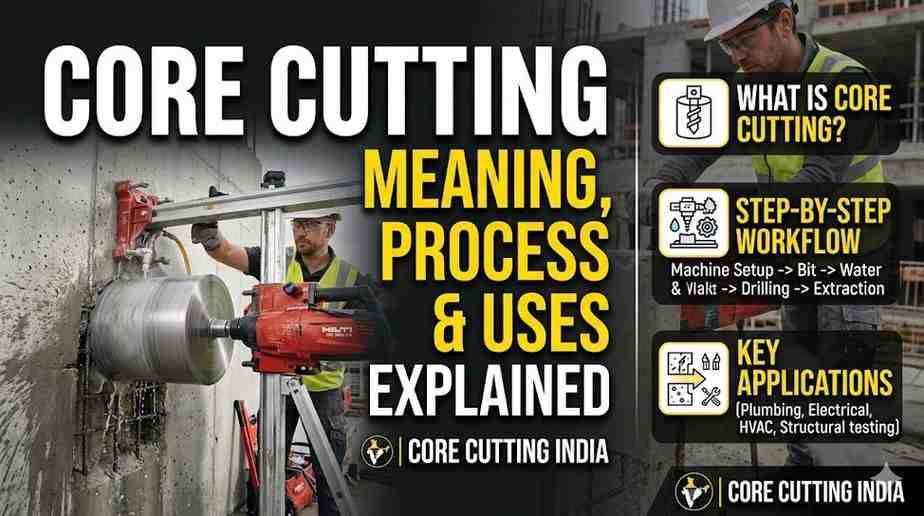
If you've ever watched a contractor cut a perfectly round hole through a concrete wall or slab without cracking it, you've seen core cutting in action. But what exactly does "core cutting" mean, and why has it become the go-to method across construction, plumbing, electrical, and HVAC industries? This guide breaks down the core cutting meaning, the process behind it, where it's used, and how to choose the right service provider for your project.
What Is Core Cutting?
Core cutting, also known as core drilling or diamond core drilling, is a precision construction technique used to cut clean, round holes through concrete, RCC (Reinforced Cement Concrete), brick, stone, or asphalt. The process uses a hollow cylindrical drill bit lined with diamond segments, mounted on a motorized rig, to "core out" a cylindrical section of material — leaving a smooth, accurately sized opening.
The removed cylindrical piece is called the "core," which is where the technique gets its name. Unlike hammer drilling or manual breaking, core cutting doesn't shatter the surrounding material. It cuts cleanly through it, even when the structure contains steel reinforcement bars.
In simple terms: core cutting means creating a precise hole through a hard structural surface using a rotating diamond bit, without damaging the surrounding structure.
How Does Core Cutting Work?
Understanding the process makes the meaning even clearer. Here's how a typical core cutting job is carried out:
- Site assessment and marking — The exact location and diameter of the hole are marked based on engineering or service requirements (plumbing, electrical, HVAC, etc.).
- Rebar scanning — Before drilling into RCC, a rebar detector locates embedded steel bars so the cutting position avoids critical reinforcement.
- Rig anchoring — The core drilling machine is securely fixed to the wall, slab, beam, or floor using anchors or vacuum mounts.
- Diamond core drilling — A diamond-tipped core bit rotates at a controlled speed, cutting through the material while water is fed continuously to cool the bit and suppress dust.
- Core extraction — Once the cut is complete, the cylindrical concrete core is removed from the opening.
- Finishing and inspection — Edges are checked and cleaned, and the hole is verified against the required diameter before handover.
This entire process can cut through several hundred millimetres of concrete with minimal vibration and dust — something traditional breaking methods simply cannot achieve.
Types of Core Cutting
Core cutting isn't a one-size-fits-all process. Depending on the project, different methods and equipment are used:
- Wet core cutting — Uses water to cool the diamond bit and control dust; ideal for thick RCC structures.
- Dry core cutting — Used for smaller diameters or where water access is limited, often with dust extraction systems.
- Handheld core drilling — For smaller holes (up to ~150mm) in walls and partitions.
- Rig-mounted core drilling — For larger diameters and deeper cuts in slabs, beams, and footings.
- Horizontal, vertical, and angled core cutting — Depending on whether the service line needs to pass straight through or at an angle.
Common Uses of Core Cutting in Construction
Core cutting is used across almost every trade that needs to pass something through a concrete structure without compromising it:
- Plumbing — Creating openings for water supply, drainage, and sewer pipes
- Electrical work — Cutting holes for conduits, cable routing, and junction boxes
- HVAC — Drilling for ductwork, AC pipes, and ventilation openings
- Fire safety systems — Openings for sprinkler lines and fire-fighting pipework
- Structural inspection — Extracting concrete core samples to test strength and quality
- Renovation and retrofitting — Adding new utility lines to existing buildings without major demolition
- Telecom and data cabling — Routing fiber and network cables through walls and slabs
Why Core Cutting Is Preferred Over Traditional Methods
1. No Structural Damage
Because the diamond bit cuts cleanly rather than smashing through material, the surrounding concrete and reinforcement remain intact and structurally sound.
2. Precision and Accuracy
Core cutting produces exact, consistent hole diameters — essential when pipes, conduits, or ducts need a tight, leak-free, or dust-free fit.
3. Minimal Dust and Vibration
Wet diamond drilling keeps dust suspended in water and produces far less vibration than hammer drilling, making it safe for occupied buildings, hospitals, and finished interiors.
4. Works on Any Thickness
From thin partition walls to thick RCC footings and shear walls, core cutting rigs can be adjusted to handle varying material thickness.
5. Faster and Cost-Effective
A clean cut the first time means no rework, no patching of accidental cracks, and faster project handover.
Core Cutting vs. Core Drilling vs. Wall Cutting: Is There a Difference?
These terms are often used interchangeably, but here's a quick clarification:
- Core cutting / Core drilling — Refers specifically to cutting round holes using a diamond core bit.
- Wall cutting — A broader term that can include core cutting as well as straight-line concrete cutting (using wall saws) for openings like doors and windows.
- Concrete cutting — The umbrella term covering all concrete cutting methods, including core cutting, wall sawing, and floor sawing.
So while "core cutting" is technically a type of concrete cutting, it's distinct in that it always produces a circular opening using a hollow diamond bit.
How to Choose the Right Core Cutting Service Provider
Since core cutting affects the structural safety of a building, choosing an experienced contractor matters. Look for:
- Rebar detection equipment to avoid cutting through reinforcement
- A range of diamond core bit sizes to match different project needs
- Experience across plumbing, electrical, and HVAC core cutting
- Proper water management to avoid mess in finished spaces
- Safety compliance for working at height or in occupied premises
- Transparent, upfront pricing
Why Choose Core Cutting India
At Core Cutting India, we specialise in precision core cutting services for residential, commercial, and industrial projects across the country. Our experienced team uses advanced diamond core drilling machines combined with rebar scanning to deliver clean, accurate, structurally safe openings every single time — for plumbing, electrical, HVAC, and structural sampling needs.
What makes us the right choice:
- Skilled operators trained in core cutting across all applications
- Dust-controlled, low-vibration drilling suitable for occupied buildings
- All diameters covered, from small conduit holes to large sewer cores
- Fast turnaround to keep your project schedule on track
- Pan-India service with local teams for quick site visits
📞 Need Core Cutting Services? Get a Free Quote Today
Whatever the application — plumbing pipes, electrical conduits, HVAC ducts, or structural testing — our team delivers precise, damage-free core cutting every time.
Call or WhatsApp now: 7009679903 Email us: [email protected] Visit: corecuttingindia.com
Don't risk cracked walls or weakened slabs with improper cutting methods. Message us on WhatsApp at 7009679903 for instant quotes and quick site visit scheduling, anywhere in India.
Related Services You May Need
- RCC Core Cutting for Plumbing Pipes
- Core Cutting for Electrical Conduits
- RCC Wall Cutting Services
- Concrete Core Drilling for HVAC Ducts
(Replace placeholder links with your actual internal page URLs for maximum interlinking SEO value.)
Frequently Asked Questions (FAQ)
1. What is the meaning of core cutting? Core cutting means using a diamond-tipped, hollow cylindrical bit to cut a precise, round hole through concrete, RCC, or stone without damaging the surrounding structure.
2. What is the difference between core cutting and core drilling? Core cutting and core drilling are essentially the same process — both refer to cutting circular holes through hard surfaces using a diamond core bit. The terms are used interchangeably in the industry.
3. What is core cutting used for? Core cutting is used for plumbing pipe openings, electrical conduit routing, HVAC ductwork, fire sprinkler lines, telecom cabling, and extracting concrete samples for structural testing.
4. Does core cutting damage reinforcement bars in concrete? No, when done correctly. Professional core cutting includes rebar scanning before drilling, ensuring the cutting position avoids embedded steel bars.
5. What is the difference between core cutting and wall cutting? Core cutting produces round holes using a diamond core bit, while wall cutting is a broader term that can include straight-line cuts made using wall saws for larger openings like doors or windows.
6. How big can a core-cut hole be? Core cutting can produce holes ranging from as small as 20-25mm in diameter for cables or small pipes, up to 300mm or larger for major sewer, drainage, or ventilation openings.
7. Is core cutting safe for occupied buildings? Yes. Wet diamond core drilling is dust-controlled and produces minimal vibration, making it suitable for use in occupied homes, offices, and hospitals.
8. How much does core cutting cost? Core cutting cost depends on the material thickness, hole diameter, location, and number of holes required. Contact us at 7009679903 for a customised quote based on your project.
9. Do you provide core cutting services across India? Yes, Core Cutting India offers core cutting services across multiple cities in India. Call or WhatsApp 7009679903 to check service availability in your location.
Get in touch today for fast, professional, and safe core cutting services for any application. 📞 Call/WhatsApp: 7009679903 | 📧 [email protected] | 🌐 corecuttingindia.com