
📋 Table of Contents
- What is Core Cutting? (Meaning & Definition)
- Why Core Cutting Matters in Indian Construction
- Types of Core Cutting
- Core Cutting Machines & Diamond Bits
- Step-by-Step Core Cutting Process
- Where Core Cutting is Used in India
- Key Benefits of Core Cutting
- Core Cutting Cost in India (2025 Rates)
- Core Cutting in RCC Structures — Special Considerations
- Safety Precautions
- Core Cutting vs Core Drilling — What's the Difference?
- How to Choose the Right Core Cutting Contractor in India
- Frequently Asked Questions
Quick Answer: Core cutting meaning in construction is the process of creating precise, clean, circular holes in concrete, RCC slabs, brick walls, marble, or asphalt using a diamond-tipped core cutting machine — without cracking or damaging the surrounding structure. It is essential for plumbing, electrical work, HVAC, and structural modifications across residential, commercial, and infrastructure projects.
1. What is Core Cutting? (Meaning & Definition)
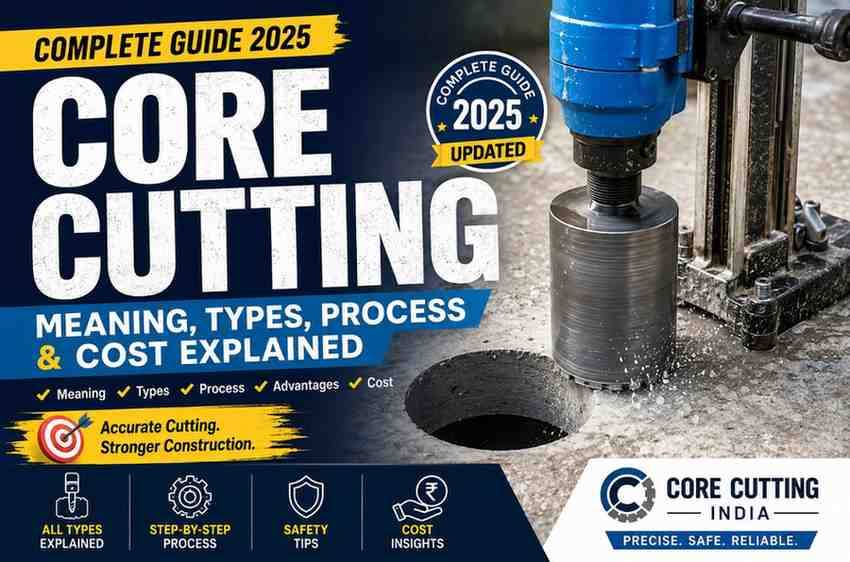
Core cutting is a modern, precision-based construction technique in which a cylindrical, rotating diamond-tipped drill bit is used to cut perfectly round holes through hard building materials — primarily concrete, reinforced cement concrete (RCC), brick, stone, marble, asphalt, and tile.
The name "core cutting" comes from the cylindrical "core" of material that is removed during the drilling process. The extracted core is a solid cylinder of whatever material was drilled — concrete, stone, asphalt — and is removed cleanly once the hole is complete.
Simple core cutting meaning: Drilling a clean, round hole in concrete or stone using a powerful machine with a diamond-studded hollow drill bit — without hammering, chiseling, or cracking the surrounding surface.
Unlike older methods that relied on jackhammers and chisels (which cause micro-cracks, dust clouds, and unpredictable edges), core cutting uses rotary diamond drilling to achieve:
- Perfectly circular, smooth-edged holes
- Minimal vibration and noise
- No structural damage to surrounding material
- Precise diameter control (from 25 mm to 1,000 mm+)
2. Why Core Cutting Matters in Indian Construction
India's construction boom — from high-rise apartments in Mumbai and Bengaluru to metro tunnels in Delhi and industrial parks in Pune — has made core cutting an absolutely essential trade. Here's why:
- Modern RCC buildings cannot be modified with manual hammering without risking structural damage
- MEP (Mechanical, Electrical, Plumbing) work in finished buildings requires openings that are too precise for manual methods
- Government infrastructure projects (roads, bridges, dams) require concrete core samples for quality testing — extracted by core drilling
- Urban renovation and retrofitting of old buildings demands clean, controlled opening creation
Today, core cutting services are in demand across 500+ cities in India, from Tier-1 metros to Tier-2 and Tier-3 towns where construction activity is accelerating rapidly.
3. Types of Core Cutting
Core cutting is not a single technique. Different project requirements call for different methods. Here are the main types practiced in India:
3.1 Concrete Core Cutting (Core Drilling)
The most common form — drilling cylindrical holes through plain or reinforced concrete slabs, walls, columns, and beams. Used extensively for plumbing and electrical work. Hole diameters typically range from 25 mm to 300 mm for building applications.
3.2 RCC Core Cutting
RCC (Reinforced Cement Concrete) core cutting involves drilling through concrete that contains steel rebars. This requires higher-power machines and diamond bits specially designed to cut through both concrete and steel. A rebar locator scan is recommended before cutting to avoid critical structural steel.
3.3 Wall Sawing
Wall sawing uses a large circular diamond blade mounted on a track system to cut vertical or angled openings in concrete walls — typically for creating new door frames, window openings, ventilation slots, or structural modifications in load-bearing walls.
3.4 Slab Sawing (Floor Sawing)
Slab sawing cuts horizontal surfaces — concrete floors, road pavements, bridge decks, and industrial floors. The machine is a walk-behind saw with a large diamond blade. Widely used for road repair, drainage channel cutting, and slab repairs.
3.5 Wire Sawing
Wire sawing uses a continuous diamond-beaded steel wire loop to cut through extremely large, thick concrete structures — bridge pillars, dam walls, deep foundations, large beams. It can cut virtually any thickness and is used where conventional circular blades can't reach.
3.6 Stitch Drilling
Stitch drilling (also called stitch cutting) involves drilling a series of overlapping core holes in a line to create a large rectangular or irregular opening without a wall saw. Each hole slightly overlaps the previous one until a passage is formed — ideal for thick walls where a saw track cannot be anchored.
|
Type |
Surface |
Common Use in India |
Typical Diameter / Depth |
|
Core Drilling |
Walls, Slabs, Columns |
Plumbing, electrical, HVAC holes |
25 mm – 300 mm |
|
RCC Core Cutting |
Reinforced concrete |
High-rise buildings, bridges |
50 mm – 200 mm |
|
Wall Sawing |
Vertical walls |
Door/window openings |
Up to 600 mm deep |
|
Slab Sawing |
Horizontal floors/roads |
Road repair, drainage, floor modification |
Up to 450 mm deep |
|
Wire Sawing |
Massive structures |
Bridges, dams, demolition |
Unlimited thickness |
|
Stitch Drilling |
Thick walls |
Creating large openings without a saw |
Multiple overlapping cores |
4. Core Cutting Machines & Diamond Bits
The quality of a core cutting job depends entirely on the machine and the diamond bit used. Here's what you need to know:
4.1 Types of Core Cutting Machines
- Electric Core Drills: Most common in India. Suitable for holes up to 200 mm in standard concrete. Brands include Hilti, Bosch, Weka, and several Indian manufacturers.
- Hydraulic Core Drills: Higher torque for heavy-duty RCC and large-diameter cutting (200 mm+). Used in industrial and infrastructure projects.
- Pneumatic Core Drills: Air-powered machines used in environments where electricity is unavailable or unsafe (e.g., wet sites, underground work).
4.2 Diamond Core Bits
The cutting element of a core machine is the diamond core bit — a hollow cylindrical tube with diamond segments embedded in the cutting edge (the "crown"). Diamonds are the hardest natural material on earth, which makes them uniquely suited for cutting reinforced concrete.
- Soft bond diamonds → for hard concrete (diamonds wear slowly to expose fresh cutting surface)
- Hard bond diamonds → for soft/abrasive concrete and brick
- Reinforced segment bits → can cut through both concrete and steel rebar
4.3 Water Cooling System
All core cutting operations require a continuous flow of water through the drill bit. Water serves two purposes:
- Cooling: Diamond bits overheat and lose their cutting ability without water
- Dust suppression: Water converts concrete dust into slurry, keeping the air clean and the site safe
💡 Pro tip: Dry core cutting bits exist for small holes (up to 50 mm) but should only be used with a vacuum attachment to capture dust. For larger diameters, always insist on wet cutting with a proper water supply.
5. Step-by-Step Core Cutting Process
1
Site Inspection & Structural Assessment
A qualified technician inspects the surface and identifies rebar positions using a rebar scanner or GPR (Ground Penetrating Radar) to avoid cutting critical reinforcement. The exact location, diameter, and depth of the required hole is confirmed.
2
Marking the Drilling Point
The center of the hole is marked with chalk or a pencil. For precise locations (e.g., waterproofing-sensitive areas), a pilot hole may be drilled first.
3
Anchoring the Machine
The drill rig is anchored to the surface using a chemical anchor bolt or a vacuum mounting pad. This is critical — a loose machine causes oval-shaped holes and broken bits.
4
Wet Diamond Drilling
Water flows through the hollow drill shaft to the diamond crown. The machine is started at low speed, gradually increasing as the bit engages the surface. The operator applies steady downward pressure.
5
Core Extraction
Once the required depth is reached, the drill is reversed slightly and the core (a solid cylinder of concrete) is extracted from inside the drill barrel. On through-holes, the core drops out the other side.
6
Finishing & Cleanup
The hole is cleaned of concrete slurry, checked for accuracy, and inspected. The surrounding surface is cleaned. The contractor hands over the completed hole for pipe or cable installation.
6. Where Core Cutting is Used in India
Residential Construction & Home Renovation
- Installing new plumbing pipes through RCC slabs (bathroom additions, kitchen remodelling)
- Running electrical conduits through walls and ceilings
- Installing exhaust fans, AC units, and ventilation ducts
- Bore well and drainage connections through compound walls
Commercial & Institutional Buildings
- MEP (Mechanical, Electrical, Plumbing) installations in offices, hospitals, malls, and hotels
- Fire suppression and sprinkler system piping
- Cable management and data center wiring runs
- Creating new door/window openings in existing concrete structures
Infrastructure & Government Projects
- Core sampling from roads and bridges for quality testing (as per BIS/IRC norms)
- Underground cable duct crossings on national highways
- Metro tunnel wall penetrations for drainage and signaling cables
- Dam inspection core sampling
Industrial Applications
- Machine foundation bolt anchor holes in industrial floors
- Chemical pipe routing through containment walls
- HVAC installation in factories and warehouses
7. Key Benefits of Core Cutting
|
Benefit |
Why It Matters |
|
✅ Precision |
Holes are perfectly circular and sized to fit pipes/cables exactly, reducing the need for patching or sealing |
|
✅ No Structural Damage |
Zero impact vibration — surrounding concrete, tiles, and waterproofing remain intact |
|
✅ Speed |
A 150 mm hole through a 200 mm slab takes 10–20 minutes vs 2+ hours with a jackhammer |
|
✅ Dust-Free Operation |
Wet cutting converts dust to slurry — safe for finished interiors and occupied buildings |
|
✅ Minimal Noise |
Core drills are significantly quieter than jackhammers — important for residential buildings and hospitals |
|
✅ Versatility |
Can cut in any direction: downward through slabs, horizontal through walls, overhead through ceilings |
|
✅ Cost-Effective |
Less repair and patching cost after the job — cleaner work means lower finishing expenses |
8. Core Cutting Cost in India (2025 Rates)
Core cutting charges in India vary based on several factors. Here is a realistic guide to current market rates:
Pricing Factors
- Diameter of hole: Larger holes cost more (more bit wear, more time)
- Depth / wall thickness: Deeper cuts require more passes or longer bits
- Material: Plain concrete is cheaper to cut than heavily reinforced RCC
- Direction: Overhead cutting (ceiling) carries a 20–30% premium
- Location: Metro cities like Mumbai, Delhi, Bengaluru have higher rates than Tier-2 cities
- Access: Scaffolding, narrow spaces, and upper floors add cost
|
Hole Diameter |
Standard Concrete (per hole) |
RCC (per hole) |
Rate per Inch |
|
50 mm (2") |
₹200 – ₹400 |
₹350 – ₹600 |
₹40 – ₹80 |
|
75 mm (3") |
₹350 – ₹600 |
₹500 – ₹900 |
₹50 – ₹100 |
|
100 mm (4") |
₹500 – ₹900 |
₹750 – ₹1,400 |
₹60 – ₹120 |
|
150 mm (6") |
₹900 – ₹1,500 |
₹1,400 – ₹2,500 |
₹80 – ₹150 |
|
200 mm (8") |
₹1,500 – ₹2,500 |
₹2,200 – ₹4,000 |
₹100 – ₹200 |
💡 India-specific note: Most local contractors quote "per inch" (diameter) rates for small quantities and switch to "per hole" rates for larger jobs. Always clarify whether the rate includes water supply, scaffolding, and slurry disposal.
9. Core Cutting in RCC Structures — Special Considerations
RCC (Reinforced Cement Concrete) is the dominant building material in India — virtually every slab, column, and beam in a modern Indian building is RCC. Core cutting through RCC requires extra care:
Always Scan Before Cutting
Use a rebar locator or Ground Penetrating Radar (GPR) scan to map steel reinforcement before drilling. Cutting through a main reinforcing bar (especially in beams or columns) can create dangerous stress concentrations.
Structural Clearance
For holes in structural members (beams, columns), always obtain approval from a structural engineer. For slabs, holes up to 100 mm diameter are generally acceptable at midspan, but this varies by design.
Sleeve Installation
After core cutting in RCC, install a PVC or MS sleeve pipe in the hole before the surrounding slab is used again. This protects the hole edges and provides a clean finish for pipe/cable entry.
10. Safety Precautions During Core Cutting
Core cutting is a high-power construction activity. These safety measures are mandatory:
- 🦺 PPE: Safety glasses/face shield, hearing protection, steel-toe boots, cut-resistant gloves
- 💧 Water supply: Never run a diamond bit dry on diameters above 50 mm
- ⚓ Machine anchoring: Always anchor the rig — a spinning unsecured core drill can cause serious injury
- ⚡ Electrical isolation: Before cutting walls, confirm no live cables are present in the cutting path
- 🚧 Exclusion zone: Keep non-essential personnel away from the cutting area
- 🌊 Slurry management: Contain and dispose of concrete slurry properly — it should not flow into drains as it can harden and block them
- 🔋 ELCB / RCD: All electric core drills on Indian sites must be connected through an Earth Leakage Circuit Breaker
11. Core Cutting vs Core Drilling — What's the Difference?
In India, "core cutting" and "core drilling" are used interchangeably by most contractors and clients. Technically:
|
Term |
Strict Technical Meaning |
Indian Usage |
|
Core Drilling |
Drilling vertically downward through horizontal slabs |
Same as core cutting |
|
Core Cutting |
Any diamond-bit hole-making, including walls, ceilings, angled cuts |
The dominant term in India |
|
Core Coring |
Extracting concrete samples for structural lab testing |
Used in government/infrastructure testing |
For SEO and communication purposes, when you search "core cutting meaning" or "core drilling meaning" in the Indian context, both refer to the same service — precision hole-making through concrete using diamond-tipped machines.
12. How to Choose the Right Core Cutting Contractor in India
With hundreds of contractors offering core cutting services across Indian cities, here's how to evaluate them:
✅ Checklist for Hiring a Core Cutting Contractor
- Experience: Minimum 3–5 years of active core cutting work
- Equipment quality: Ask if they use branded machines (Hilti, Bosch, Weka) or local alternatives — branded machines are safer and more precise
- Diamond bit quality: Cheap bits break more often and create rough holes
- Rebar scan: A professional contractor will always scan before cutting RCC — if they don't, that's a red flag
- Insurance: Ensure the contractor has workmen's compensation insurance
- Written quotation: Get a clear quote that specifies diameter, depth, number of holes, material, and inclusions
- References: Ask for recent project references in your city
- GST registration: Prefer GST-registered contractors for commercial jobs
Looking for trusted core cutting contractors near you?
🔍 Find Verified Core Cutting Services in Your City →
500+ verified contractors across India · Instant quotes · No middleman
13. Frequently Asked Questions (FAQ)
Q1. What is core cutting meaning in construction?
Core cutting in construction means the process of drilling precise, cylindrical holes through hard surfaces like concrete, RCC slabs, brick walls, marble, and asphalt using a diamond-tipped core cutting machine. It creates clean openings for pipes, cables, HVAC ducts, and structural modifications without damaging surrounding material.
Q2. What is core cutting used for?
Core cutting is used for creating holes for plumbing pipes, electrical conduits, HVAC ducts, exhaust fans, AC piping, structural openings (doors/windows), underground drainage, and for sampling concrete cores for structural testing.
Q3. What is the cost of core cutting in India?
Core cutting cost in India typically ranges from ₹40 to ₹250 per inch depending on diameter, depth, material (plain concrete vs RCC), and location. A standard 4-inch (100 mm) diameter hole through a 6-inch RCC slab costs approximately ₹750–₹1,400 per hole including water and cleanup. Get a written quote before work begins.
Q4. What machines are used in core cutting?
Core cutting machines include electric, hydraulic, and pneumatic core drills fitted with diamond core bits. Popular brands used in India include Hilti, Bosch, Weka, and several Indian manufacturers. The machines are paired with a water supply system for cooling and dust suppression.
Q5. Is core cutting harmful to structural integrity?
When done correctly by a qualified contractor, core cutting does not harm structural integrity. However, improper positioning — particularly cutting through load-bearing reinforcement in beams or columns — can weaken the structure. Always hire a professional who conducts a rebar scan or GPR scan before cutting RCC members.
Q6. What is the difference between core cutting and core drilling?
Core cutting and core drilling are used interchangeably in India. Technically, "core drilling" refers to drilling vertically down through horizontal slabs, while "core cutting" is the broader term covering horizontal wall cutting, angled cuts, and all sawing operations. In everyday Indian construction usage, both terms mean the same service.
Q7. How long does core cutting take?
A standard 100 mm (4-inch) diameter hole through a 200 mm (8-inch) RCC slab takes approximately 15–30 minutes for an experienced operator. Larger diameters, thicker slabs, and heavily reinforced concrete take longer. A single contractor can typically complete 10–20 standard holes per day.
Q8. Can core cutting be done in a residential building?
Yes — core cutting is routinely done in occupied residential buildings in India. The low vibration and dust-controlled operation (wet cutting) make it suitable for apartments, bungalows, and villas. Noise levels are significantly lower than jackhamering. Ensure the contractor uses wet cutting and proper slurry containment.
Q9. What is a core cutting machine called in Hindi?
In Hindi and common Indian construction site language, it is called कोर कटिंग मशीन (Core Cutting Machine) or कंक्रीट ड्रिलिंग मशीन (Concrete Drilling Machine). The service itself is referred to as कोर कटिंग का काम.
Q10. Is there a standard for core cutting in India?
For structural concrete sampling (not routine construction cutting), the Bureau of Indian Standards (BIS) code IS 516 governs the extraction and testing of concrete cores. For construction work, core cutting is governed by general construction safety regulations under the Building and Other Construction Workers (BOCW) Act and site-specific structural engineer approvals.
Conclusion
Core cutting is no longer a niche construction technique — it is the standard, professional method for making precision openings in concrete and hard surfaces across India. Whether you're a homeowner adding a bathroom, a builder running MEP in a high-rise, or a government contractor extracting road samples, understanding core cutting meaning, types, and process will help you make better decisions, hire the right contractor, and ensure your building's structural integrity is never compromised.
The key takeaway: always choose precision over speed. A few hundred rupees saved by using a jackhammer instead of a core cutter can cost thousands in repairs to waterproofing, tiles, and surrounding concrete — not to mention the risk of unseen structural damage.
Need core cutting done right?
📞 Get Instant Quotes from Verified Contractors Near You →
Free quotes · No obligation · Serving 500+ cities across India