
Introduction
Modern construction, renovation, and retrofitting projects frequently require precise modifications to existing concrete structures. Among these, core cutting and drilling are essential for running new plumbing, HVAC ducts, and data cables. However, the task becomes exponentially more hazardous when operations must take place in proximity to active, live electrical services.
Striking a live electrical conduit can result in catastrophic consequences, including severe electrocution, fatal injuries, massive power outages, expensive equipment destruction, and site-wide shutdowns. At [email protected], we emphasize that safety, precision, and technical preparation must always take precedence over speed. This comprehensive guide explores the critical safety protocols, advanced detection technologies, and operational best practices required when performing core cutting near live electrical infrastructure.
Understanding the Hazards of Core Cutting Near Electrical Services
Concrete may appear solid, uniform, and impenetrable, but beneath its surface lies a complex web of structural elements and utilities. In commercial, industrial, and residential structures, electrical conduits are frequently embedded directly within concrete slabs, walls, and foundational pillars.
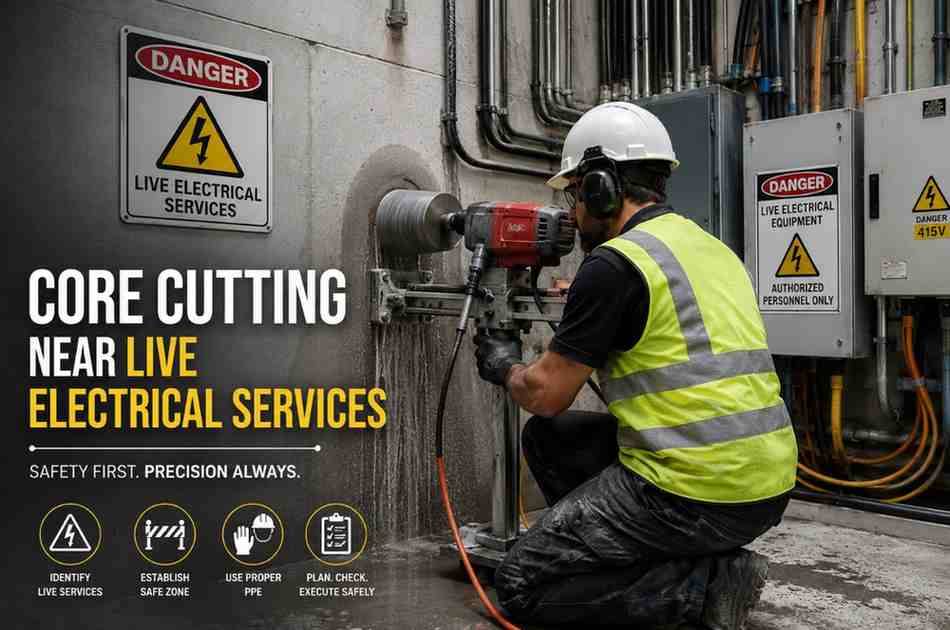
When a high-powered diamond core drill bit intersects a live electrical wire or metallic conduit, several immediate hazards occur:
-
Risk of Electrocution and Arc Flash: A spinning steel drill bit saturated with water creates a highly conductive path. If the bit breaches a live wire, the electrical current can travel directly through the machine to the operator, leading to severe or fatal shock. An arc flash can also cause severe thermal burns and blinding light.
-
Explosive Equipment Kickback: Hitting hidden metallic obstacles can cause sudden binding, jamming, or violent mechanical kickbacks, making the operator lose control of heavy machinery.
-
Collateral Infrastructure Failure: Severing a primary power line can instantly shut down critical infrastructure, posing severe risks in sensitive environments like hospitals, data centers, and manufacturing plants.
Step-by-Step Safety Protocols for High-Risk Core Cutting
Mitigating electrical risks requires a strict, multi-layered approach from the planning stage to project completion.
1. Comprehensive Subsurface Scanning and Mapping
Never rely solely on architectural or as-built blueprints, as field modifications frequently deviate from original designs. Before a single core drill is mounted:
-
Deploy Ground Penetrating Radar (GPR): GPR technology allows technicians to non-destructively image the interior of concrete elements, identifying the exact depth and layout of rebar, post-tension cables, and electrical conduits.
-
Electromagnetic Detection: Use cable locators to pick up active electromagnetic signals running through energized lines.
-
Marking the Surface: Clearly map and paint the clearance zones directly on the concrete substrate to ensure operators maintain a safe buffer zone.
2. De-Energization and Lockout/Tagout (LOTO) Procedures
Whenever structurally and operationally feasible, the gold standard for electrical safety is total isolation:
-
Coordinate with facility managers to identify the specific circuits running through the target zone.
-
Implement a strict Lockout/Tagout (LOTO) protocol to ensure that power cannot be accidentally re-energized while work is underway.
-
Verify zero energy states using calibrated multimeters or non-contact voltage detectors right before cutting commences.
3. Engineering Controls and Wet Cutting Techniques
When live services cannot be shut down due to operational constraints, specialized engineering controls are mandatory:
-
Use Ground Fault Circuit Interrupters (GFCI): GFCIs must be integrated into the power supply of all core cutting equipment to instantly cut power if a ground fault or current leakage is detected.
-
Controlled Water Flow: While wet cutting is standard for dust suppression (mitigating hazardous crystalline silica dust) and cooling diamond bits, water management must be carefully monitored to prevent pooling around electrical panels or exposed wires.
Essential Personal Protective Equipment (PPE)
Even with advanced engineering controls, operators working near live electrical services must wear certified Personal Protective Equipment (PPE) to minimize injury risks:
-
Electrical Insulated Gloves: Rubber insulating gloves rated for the specific voltage class protect against accidental shocks.
-
Dielectric Safety Footwear: Non-conductive boots with composite or reinforced non-metallic toes prevent grounding through the feet.
-
Eye and Face Protection: Safety goggles and full-face shields protect against flying concrete debris, slurry, and potential spark spatter.
-
Respirators: N95 or P2 respirators guard against toxic airborne silica dust particles generated during concrete drilling.
Best Practices for Project Execution and Team Communication
Operational success relies heavily on clear communication and disciplined execution on the job site:
-
Pre-Work Safety Briefings (Toolbox Talks): Conduct a mandatory briefing with all technicians, site engineers, and electricians to review GPR scans, identify potential hazard zones, and outline emergency response steps.
-
Maintain Situational Awareness: Experienced operators monitor changes in motor sound, vibration patterns, and feed resistance. Any unexpected friction or hesitation can indicate contact with embedded elements.
-
Establish Clear Perimeters: Cordon off the work zone using physical barriers and warning signs to keep unauthorized personnel away from active heavy machinery and electrical hazards.
Conclusion
Core cutting near live electrical services is a high-stakes operation that leaves zero room for error. Neglecting proper scanning, bypassing safety protocols, or failing to de-energize lines when possible can lead to catastrophic accidents, legal liabilities, and project delays. By prioritizing comprehensive subsurface imaging, strict LOTO compliance, appropriate engineering controls, and professional execution, organizations can protect their workforce and infrastructure.
For professional, safe, and precise core cutting and concrete drilling solutions tailored to your project's exact requirements, reach out to the experts at [email protected] today. Let us help you execute your structural modifications safely, efficiently, and with absolute precision.