
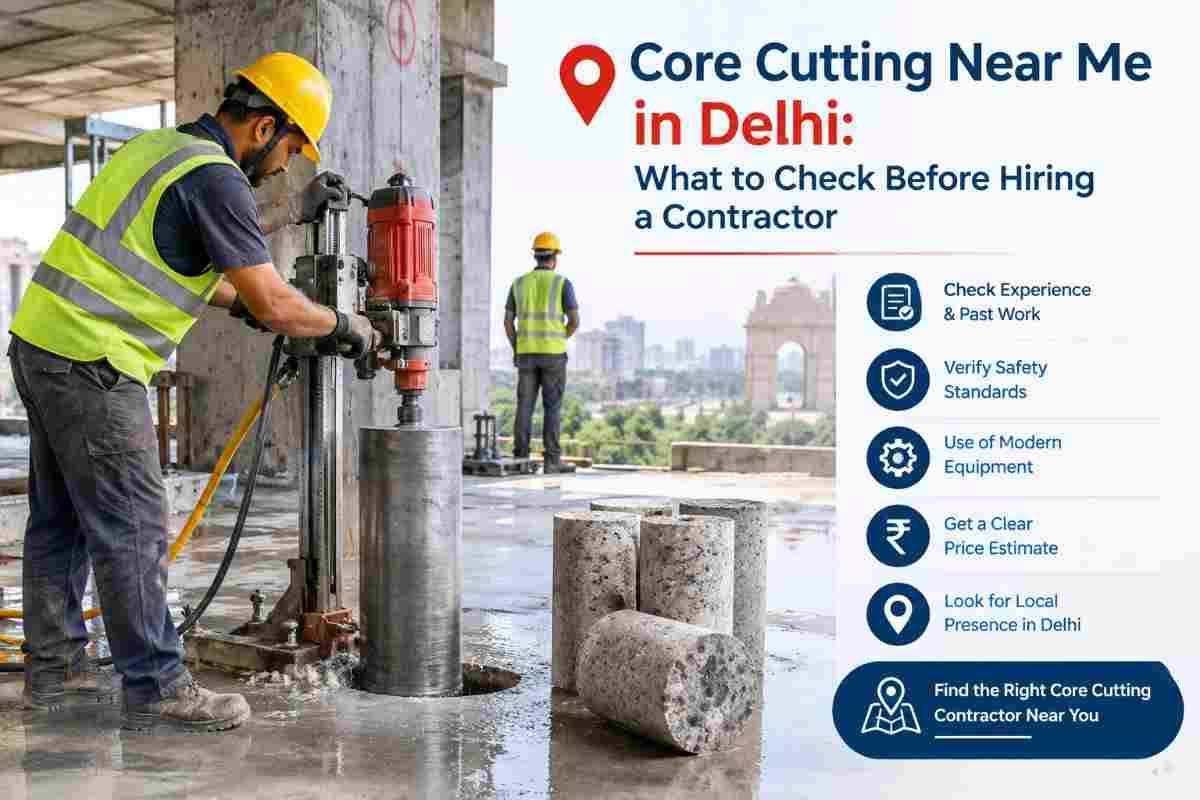
If you have typed "core cutting near me" into a search bar in Delhi, chances are you have a real job waiting: a hole for an AC duct, a sleeve for plumbing, a passage for electrical conduits, or a cut for a drainage line through a thick RCC slab. Whatever the reason, the work looks simple from the outside. A circular hole, a few minutes of drilling, and the job is done.
In practice, core cutting is precision work inside load-bearing concrete. A careless operator can hit reinforcement bars, damage embedded cables, crack a slab, flood a lower floor with slurry, or create a safety hazard that costs far more than the original job. In a dense city like Delhi, where buildings are packed tightly, many are old, and residents are close to every work site, the margin for error is smaller still.
This guide explains what core cutting is, why proximity matters but should not be your only filter, and exactly what to check before you hire a contractor. Use it as a checklist whether you are a homeowner, a facility manager, an architect, or a site engineer. You can also explore professional services at Core Cutting India.
What Is Core Cutting? A Quick Primer
Core cutting, also called core drilling or diamond core drilling, is a method of making clean, round holes in concrete, brick, stone and masonry using a hollow cylindrical drill bit. The bit is embedded with industrial diamond segments and is usually cooled with water. As it rotates, it grinds through the material and leaves behind a solid cylinder of concrete called a core, which is removed to complete the hole.
Compared with hammer drilling or manual chiselling, core cutting offers several advantages:
- Clean edges: The hole is smooth and exact, with minimal chipping.
- Low vibration: This protects the surrounding structure from micro-cracking.
- Precision: Diameters range from small holes of a few centimetres to large openings of several hundred millimetres.
- Reinforcement handling: Diamond bits can cut through steel rebar when the operator chooses to do so.
- Less noise and dust: Wet cutting controls dust and reduces noise compared with percussion methods.
Common applications in Delhi include HVAC and AC pipe openings, plumbing and drainage sleeves, electrical and cable routing, fire-fighting pipelines, anchor and dowel holes, borewell and water-line penetrations, and sample extraction for concrete strength testing.
Why "Near Me" Matters in Delhi (And Where It Falls Short)
Searching for a local contractor makes sense. Delhi's traffic, distances and strict entry rules mean a nearby team can mobilise faster, handle small jobs economically and return quickly if something needs correction. Local operators also tend to understand neighbourhood-specific conditions, such as older construction in areas like Karol Bagh and Lajpat Nagar, newer high-rises in Dwarka and Rohini, or commercial buildings around Connaught Place and Nehru Place.
But "near me" is only the starting point. A contractor who is ten minutes away yet uses poor equipment, untrained labour or unsafe methods is a worse choice than a well-equipped team coming from further away. Treat proximity as a tie-breaker, not the main criterion. The rest of this article covers what should actually decide your choice.
1. Check Experience and a Verifiable Track Record
Experience in core cutting is not just about years in business. It is about the variety and complexity of jobs completed. Ask the contractor:
- How long have you been doing core cutting specifically, not general civil work?
- What types of structures have you worked on: residential flats, commercial offices, hospitals, factories, metro or infrastructure projects?
- Can you share photos, references or client contact details for recent jobs in Delhi?
- Have you handled post-tensioned slabs or heavily reinforced sections?
A genuine professional will answer without hesitation. Be cautious of contractors who give vague responses, refuse to share references, or claim they can do "any job at any rate." Reviews on Google and local directories are helpful, but a direct reference from a recent client is more reliable.
2. Inspect the Equipment They Use
Equipment determines accuracy, speed, safety and finish quality. A serious contractor will be open about what they bring to site. Look for:
- Professional core drilling rigs: Rig-mounted or stand-mounted machines offer stable, vertical or angled cuts. Handheld-only setups are limited to small, shallow holes.
- Quality diamond bits: Good segments cut faster and cleaner. Worn bits cause vibration, overheating and rough edges.
- A range of diameters: The team should carry bits that match your required size instead of forcing a different size and "adjusting" it.
- Water supply and slurry control: Wet drilling needs a controlled water feed and a way to collect slurry.
- Dust-collection and vacuum tools: Particularly important for interiors, offices and occupied buildings.
- Anchoring systems: Vacuum bases or expansion anchors that hold the rig firmly in place.
If the crew arrives with a single worn-out machine and improvises everything, that is a warning sign. Proper equipment is an indicator of professionalism and investment in the trade.
3. Confirm They Scan Before They Cut
This is one of the most important checks, and many property owners overlook it. Concrete slabs and walls in Delhi buildings routinely contain rebar, electrical conduits, water pipes, and sometimes post-tensioned cables. Cutting blindly can sever a conduit, puncture a pressurised pipe or, in the worst case, damage structural reinforcement.
Ask whether the contractor uses a concrete scanner or GPR (ground-penetrating radar) or at minimum a rebar locator before marking the cutting point. Ask how they decide where to drill and what they do if they find reinforcement. A responsible contractor will also consult your structural engineer or architect when the cut involves a beam, column or any load-bearing element.
As a rule, never allow core cutting through beams or columns without written approval from a qualified structural engineer.
4. Verify Safety Practices and Worker Protection
Core cutting involves electricity, water, rotating machinery and heavy tools, often at height or in confined spaces. Safety is not optional. Before you hire, check:
- Do workers wear helmets, gloves, safety shoes, eye protection and, where needed, ear protection and dust masks?
- Is the electrical supply protected with an RCCB or earth-leakage device? Water and electricity must be managed carefully.
- How do they secure the area below a slab where the core might fall? Falling concrete cylinders are heavy and dangerous.
- Are scaffolds or platforms stable and appropriate for the height?
- Do they hold insurance or worker-injury coverage, or accept responsibility for accidents on site?
If an accident happens on your property and the contractor is uninsured, you may bear part of the liability. Ask for clear answers before work begins.
5. Ask About Dust, Water and Noise Control
Delhi buildings are often occupied while work takes place: families live above and below, offices run through business hours, and hospitals cannot pause. A good contractor plans for minimal disruption.
Discuss the following in advance:
- Slurry management: Wet cutting produces grey slurry. The team should collect it with a vacuum or channels instead of letting it flow onto floors, walls or neighbouring flats.
- Dust control: Even with water, some dust is created during marking and finishing. Ask how they protect furniture, flooring and electronics.
- Noise levels: Core cutting is quieter than a hammer drill, but it still makes noise. Agree on working hours that respect residents and local rules.
- Clean-up: The site should be left tidy, with cores and debris removed.
This is where an experienced contractor stands out. Cheap operators usually leave the mess for you.
6. Demand a Clear, Itemised Quotation
Price is naturally a major factor, but the lowest quote is rarely the best deal. Core cutting charges usually depend on hole diameter, depth, material (plain concrete, reinforced concrete, brick or stone), number of holes, access difficulty, height of the work area and whether special equipment is needed.
A professional quotation should clearly state:
- Rate per hole or per unit depth, with diameter slabs clearly listed
- Whether rebar cutting is included or charged extra
- Charges for height, difficult access or night work
- Mobilisation, transport and any minimum charge for small jobs
- Whether water, electricity and cleanup are included or expected from you
- GST details and payment terms
Be wary of quotes that look too good to be true, or contractors who refuse to put anything in writing. Hidden extras often appear mid-job, when you have little room to negotiate. Compare at least three quotes, but compare scope and quality as carefully as the number at the bottom.
7. Check Availability, Timelines and Responsiveness
Delays are expensive, especially when core cutting sits in the middle of a larger project such as an AC installation, plumbing upgrade or fit-out. Ask how soon the team can start, how long each hole takes, and whether they can work extra shifts if needed. Responsiveness before the contract is signed is a good predictor of behaviour afterwards. If the contractor takes days to reply to a call or message, expect similar delays on site.
For urgent or small requirements, a locally available team is a genuine advantage, which is why searches such as "core cutting near me" make sense. Just make sure the local option also ticks the quality boxes above.
8. Understand Permissions, Society Rules and Structural Approvals
In Delhi, cutting through walls and slabs is not always something an owner can decide alone. Consider:
- Resident Welfare Association (RWA) or society rules: Many societies restrict work hours, require prior intimation and limit what can be altered.
- Landlord or building management consent: Tenants should obtain written permission.
- Structural engineer approval: Essential for any cut near beams, columns, shear walls or in older buildings.
- Fire and utility considerations: Holes through fire-rated walls or near utility lines may need special sealing or coordination.
A reputable contractor will raise these points themselves. If a contractor says "no permission is needed, we will just do it," be careful. Unapproved cuts can lead to disputes, penalties or structural problems later.
9. Look for Red Flags Before You Hire
Some warning signs should make you pause or walk away:
- No site visit or measurement, but a firm quote over the phone for a complex job
- Reluctance to scan for rebar or utilities
- Use of chisels or hammer drills where core cutting is expected
- Unusually low pricing combined with vague scope
- No identifiable business name, address or contact details
- Workers without basic protective gear
- Pressure to pay the full amount upfront
- No willingness to provide references or photos of past work
One or two of these may be explainable. Several together usually mean trouble.
A Quick Pre-Hiring Checklist
Before you confirm a contractor, run through this short list:
- Verified experience with references from similar jobs
- Modern rigs, diamond bits and suitable diameters available
- Scanning or rebar detection planned before cutting
- Written approval from your structural engineer for any critical element
- Safety gear, electrical protection and insurance in place
- Dust, slurry and noise control plan agreed
- Itemised written quotation with clear exclusions
- Timeline and working hours confirmed
- RWA, landlord or building permissions obtained
- Payment schedule tied to progress, not full advance
Questions to Ask Every Core Cutting Contractor
Keep these handy when you call or meet:
- What diameter and depth ranges can you handle?
- How do you detect reinforcement and utilities before drilling?
- Will you cut through rebar, and is it charged separately?
- How do you manage water and slurry in an occupied building?
- What happens if a hole is misplaced or damages something?
- Can you provide recent client references in Delhi?
- Who will be on site, and are they trained operators?
How they answer matters as much as what they say. Clear, confident, specific replies point to a dependable professional.
Frequently Asked Questions About Core Cutting in Delhi
What is core cutting and how does it work? Core cutting uses a hollow diamond-tipped drill bit, cooled by water, to cut a clean circular hole through concrete, brick or stone. The cylinder of material inside the bit, called the core, is removed once the cut is complete.
What is the difference between core cutting and core drilling? The terms are used interchangeably in India. Both refer to creating round holes with a diamond core bit. Some people use "core cutting" for larger openings and "core drilling" for smaller holes or sample extraction, but the method is essentially the same.
How much does core cutting cost in Delhi? There is no single price. Cost depends on hole diameter, depth, the type of material, reinforcement, number of holes, height and access conditions. The best approach is to request an itemised quotation after a site visit and compare it across a few contractors.
Can core cutting weaken my slab or wall? When planned and executed properly, a small, well-placed core hole has minimal impact. Problems arise when holes are cut through beams, columns or heavily reinforced zones without engineering approval, or when too many holes are placed close together. Always consult a structural engineer for critical elements.
Is core cutting noisy or messy? It is generally quieter and cleaner than hammer drilling, but it is not silent or completely mess-free. Wet cutting produces slurry, so a good contractor will use vacuums and protective sheets to keep the area clean.
How long does core cutting take? A single standard hole in a wall or slab can take from several minutes to around an hour, depending on diameter, depth and reinforcement. Setup, marking and clean-up add additional time, so ask for a realistic schedule for the whole job.
Do I need permission for core cutting in my apartment or office? Usually yes. Many societies, landlords and building managers require approval, and structural approval is advisable for any cut near load-bearing elements. Confirm requirements before work begins.
Can core cutting be done in an occupied building? Yes. With proper dust, slurry and noise control, core cutting is commonly done in homes, offices, hospitals and malls while they remain in use. Planning and communication with occupants make a big difference.
Final Thoughts: Make "Near Me" Work in Your Favour
Searching for core cutting near you in Delhi is a smart first step, because a local team means faster response and easier coordination. But the real value lies in what you check afterwards. Verify experience, inspect the equipment, insist on scanning, confirm safety practices, understand the quotation and obtain the right permissions. These steps take a little time, yet they protect your property, your budget and the people working on site.
If you are planning a project and want a professional team with the right tools and expertise, visit Core Cutting India to learn more about core cutting services and request a quote. Choose carefully, ask the right questions, and your core cutting job will be clean, precise and stress-free.