
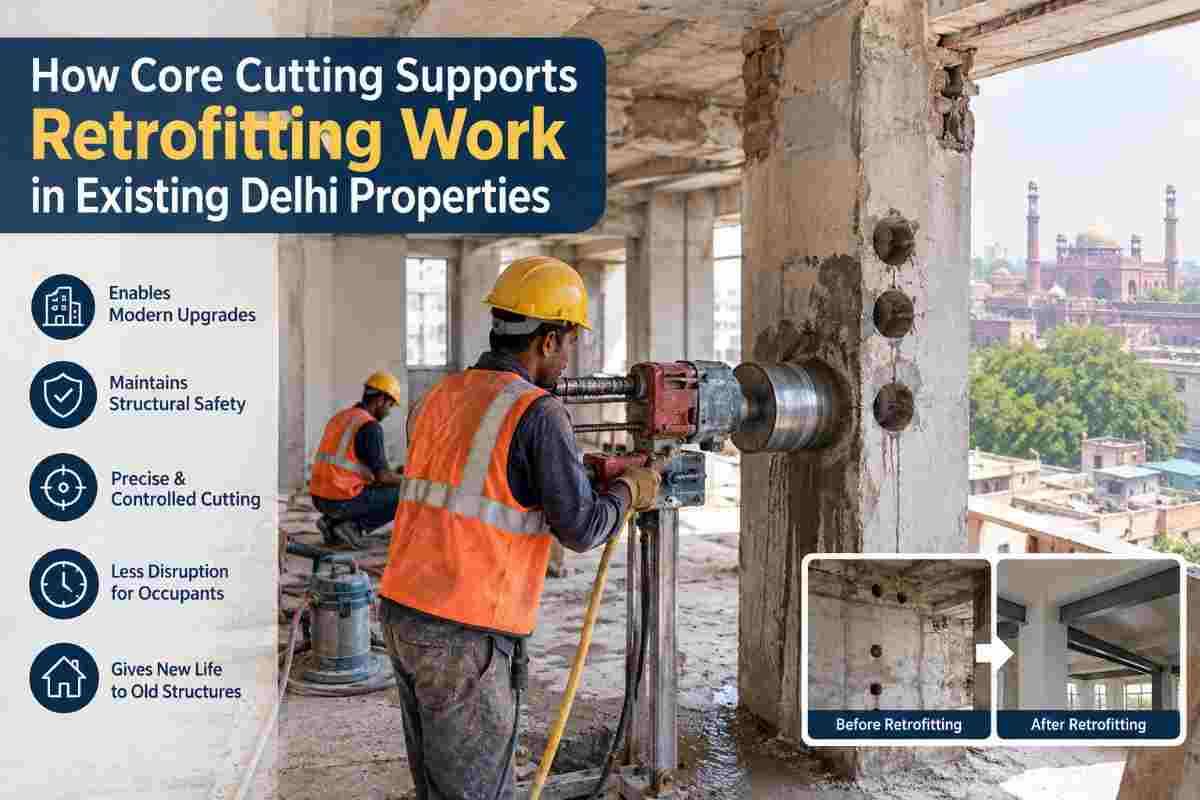
Delhi is a city of layers. Colonial-era bungalows in Lutyens’ zone, post-Partition colonies in Lajpat Nagar and Rajouri Garden, builder floors in Dwarka and Pitampura, and aging commercial complexes in Nehru Place and Connaught Place all stand side by side. Many of these buildings are structurally sound but were never designed for today’s needs: split air conditioners, concealed plumbing, fibre and CCTV cabling, elevators, fire-safety systems, solar installations and modern drainage.
Demolishing and rebuilding is rarely practical, affordable or even permitted. Retrofitting, which means upgrading an existing structure to meet new functional, safety or regulatory requirements, is the smarter route. But retrofitting means working inside concrete and masonry that is already in service, often with people living or working next door.
This is where concrete core cutting becomes one of the most valuable techniques available. At Core Cutting India, we see every week how precise, low-vibration cutting makes upgrades possible that would otherwise damage the building or disrupt its occupants. This guide explains how core cutting supports retrofitting in existing Delhi properties and what to consider before starting.
What Is Core Cutting?
Core cutting, also called core drilling or diamond core drilling, is a method of creating clean, circular holes in concrete, reinforced cement concrete (RCC), brick, stone and masonry. A hollow cylindrical drill bit with diamond segments on its cutting edge is fitted to a motor-driven rig. The bit grinds through the material and leaves behind a solid cylinder of concrete, the “core,” which is then removed.
Several features set it apart from conventional methods:
- Precision: Holes can be made in diameters from roughly 25 mm up to several hundred millimetres, with smooth, accurate walls.
- Low vibration: Unlike hammer drills or breakers, diamond coring does not send shock waves through the structure, which reduces the risk of micro-cracking.
- Reinforcement handling: Diamond bits can cut through steel rebar when needed, though this must be planned with a structural engineer.
- Controlled dust and noise: Most professional work uses water cooling, which suppresses dust and keeps bits cool.
These traits matter most in retrofitting, where the aim is to change a building without weakening it.
Why Retrofitting Is Growing in Delhi
Several forces are driving retrofitting across the capital.
Aging building stock. A large share of Delhi’s residential and commercial buildings are decades old. Their services, such as sewer lines, electrical conduits and water supply, were designed for far lower loads than people use now.
Space and redevelopment limits. Plots are small, land is expensive and approvals for fresh construction can be complex. Owners prefer to improve what they have.
Seismic awareness. Delhi lies in a high seismic zone, and structural strengthening of older buildings has become a serious concern for owners, resident welfare associations and institutions.
Changing lifestyles and technology. Modular kitchens, attached bathrooms added to old layouts, ducted air conditioning, EV charging points, rooftop solar and structured cabling all demand new penetrations through slabs and walls.
Environment and comfort. Delhi’s extreme summers and poor winter air quality push owners toward better ventilation, air purification and energy-efficient systems, many of which need openings in existing structures.
In nearly every one of these projects, someone has to make a hole in a wall or slab. Doing it badly can crack a beam, sever a hidden cable or compromise a load-bearing element. Doing it well is where core cutting earns its place.
Key Retrofitting Applications of Core Cutting
1. Plumbing and Drainage Upgrades
Older Delhi homes often have corroded cast-iron or galvanised pipes and undersized drains. When owners add a bathroom, relocate a kitchen or replace a stack, new pipe sleeves must pass through floor slabs and walls.
Core cutting produces round, clean openings sized exactly to the pipe or sleeve. This helps with proper slope for drainage, tight sealing with sleeves and firestop or waterproofing materials, and fewer leakage issues compared with ragged, hand-chiselled openings. A neat, correctly sized opening is also far easier to waterproof, which matters in monsoon-prone conditions.
2. Air Conditioning and Ventilation
Retrofitting split ACs, VRF systems and exhaust fans is one of the most common reasons people call a core cutting contractor. Refrigerant piping, drain lines and cables must pass through exterior walls, so a precisely angled, round hole is needed.
Core cutting also suits larger ventilation openings, such as kitchen exhausts, ducting for commercial kitchens, fresh-air intakes and smoke extraction in offices and restaurants. In a heavily built-up area, avoiding the heavy vibration and debris of breaking tools is a major advantage.
3. Electrical, Data and Security Cabling
Modern buildings need much more cabling than older ones were planned for: high-capacity power feeds, UPS lines, LAN and fibre, CCTV, access control and fire alarms. Core cutting creates neat penetrations for conduits and cable trays through beams, slabs and shear walls without chasing out large channels.
When existing walls are thick brick or RCC, coring gives a predictable route for new services, and the openings can be properly fire-stopped afterwards.
4. Lift and Staircase Retrofits
Many older low-rise buildings in Delhi lack elevators. As the population ages, owners and societies increasingly want to add lifts. Doing this involves cutting openings in slabs, preparing shaft walls and drilling for anchor fasteners and guide rail brackets.
Core drilling and, where larger openings are required, wall and slab cutting, allow these changes to be made in controlled stages. Smaller anchor-hole coring also supports the installation of platform lifts and stairlifts.
5. Structural Strengthening and Anchoring
Seismic and load-upgrade retrofits often involve steel jacketing, concrete jacketing, fibre-reinforced polymer wraps, new shear walls or added columns. All of these depend on drilling accurate holes for dowel bars, anchor bolts and epoxy-grouted rebar that tie new elements to existing concrete.
Because diamond coring creates a clean, true hole with minimal damage to surrounding concrete, bond quality is better and the existing structure is disturbed less. A structural engineer should always specify the diameter, depth and spacing of these holes, and the cutting team should follow that design exactly.
6. Rooftop Solar, Water Tanks and Telecom Installations
Rooftop solar and overhead tank installations in Delhi require cable routes down through slabs and fixings into roof structures. Core cutting provides clean penetrations for conduits and drainage, along with anchor holes for mounting frames.
7. Fire Safety Compliance
Older commercial buildings frequently need new sprinkler lines, hydrant risers, smoke detection cabling and ventilation upgrades to meet current fire-safety expectations. These services often pass through multiple floors, and core cutting is the standard method for making vertical and horizontal penetrations without major demolition.
8. Heritage and Sensitive Properties
Delhi has many heritage and protected structures where aggressive demolition is neither acceptable nor lawful. Low-vibration, low-impact coring lets installers add discreet services while respecting the fabric of the building. Any work on protected property should, of course, follow the relevant heritage permissions.
Advantages of Core Cutting Over Traditional Methods
Minimal structural disturbance. Hammering and breaking can create micro-cracks that spread over time. Diamond coring removes only the material in the hole.
Clean, accurate finishes. Smooth edges reduce rework, plastering and patching.
Lower noise and vibration. This is crucial in occupied homes, hospitals, schools, offices and neighbourhoods with tightly packed buildings.
Less debris. Water-cooled coring creates slurry rather than clouds of dust, and the cores can be removed in one piece.
Faster work. What might take hours of chiselling can often be done in minutes with a properly set-up rig.
Ability to cut through reinforced concrete. Diamond bits handle rebar and hard aggregate that would defeat conventional drills.
Reduced risk to neighbours and adjoining structures. In Delhi’s closely spaced buildings and shared walls, controlling vibration is as much a courtesy as a safety measure.
The Core Cutting Process in a Retrofit Project
A professional retrofit coring job generally follows these steps.
1. Site assessment. The team reviews the structure, wall or slab thickness, the purpose of each opening and the working conditions, such as access, power and water supply.
2. Scanning and marking. Before any cut, the area should be checked for embedded rebar, conduits, post-tension tendons and pipes. Ground-penetrating radar or rebar detectors are widely used for this. Hitting an unseen live conduit or tendon can cause serious injury and damage.
3. Structural approval. For holes in beams, columns, shear walls or any load-bearing element, a structural engineer should approve location and size before work begins.
4. Rig set-up. The drilling rig is anchored to the surface using an anchor bolt or vacuum base so it stays stable and the hole stays straight.
5. Drilling with water cooling. The diamond bit cuts through concrete while water cools the bit and controls dust. Slurry is collected and managed to protect finishes below.
6. Core removal and cleanup. The core is extracted, edges are checked and the area is cleaned.
7. Finishing. Sleeves, fire-stop sealants, waterproofing or grouting are installed as required by the trade that follows.
Safety and Structural Considerations in Delhi
Retrofitting through core cutting is safe when planned properly, but a few points deserve attention.
Never cut blind. Always locate reinforcement and services first. In older Delhi buildings, as-built drawings are often missing or inaccurate, so on-site detection is essential.
Respect load paths. Cutting too many holes close together, or placing them near beam-column joints, can weaken a structure. Get an engineer’s advice for anything beyond routine small penetrations.
Check approvals. Structural alterations may need permission from the relevant authority, such as the MCD or the local development authority, and from your housing society or RWA. Rules vary by property type, area and the extent of the change, so confirm requirements with a qualified professional before starting.
Manage water. Slurry and cooling water must be controlled so it doesn’t damage floors, electrical equipment or lower-floor occupants.
Work-at-height and confined-space safety. Rooftop and shaft work demands proper harnesses, barricades and trained operators.
Protect people and property. Cover furniture, restrict access below drilling areas and coordinate timings with residents or staff.
How to Choose a Core Cutting Contractor in Delhi
The quality of the result depends heavily on the team you hire. Look for:
- Experience with retrofit work specifically, not just new construction.
- Modern diamond equipment with a range of bit sizes and stable rigs.
- Scanning capability or a clear process for detecting rebar and services.
- Trained operators who understand safety, water control and site discipline.
- Clear quotations that explain diameter, depth, number of holes and what is and isn’t included.
- Willingness to coordinate with your structural engineer, architect, MEP contractor or facility manager.
- Track record and references from similar Delhi projects.
At Core Cutting India, we focus on exactly this kind of precision work for homes, offices, institutions and industrial properties across Delhi NCR.
What Affects Core Cutting Cost?
Pricing varies from job to job, and a site visit is the most reliable way to get an accurate figure. The main factors include:
- Hole diameter and depth
- Material (brick, plain concrete or heavily reinforced RCC)
- Number of holes, since larger batches are often more economical
- Access conditions, such as height, confined space or restricted working hours
- Need for scanning or special safety measures
- Whether wall or slab cutting is required in addition to core drilling
- Location within Delhi NCR and mobilisation logistics
Choosing the cheapest option can backfire if it leads to a damaged beam, a leak or a repeat job. Value matters more than the lowest quote.
Planning Tips for a Smooth Retrofit
- Plan all penetrations together. Coordinating plumbing, electrical, HVAC and fire services at the design stage avoids repeated cutting.
- Document existing conditions. Photographs, drawings and scan results help future maintenance.
- Schedule around occupants. In offices, clinics or schools, weekends or after-hours work reduces disruption.
- Protect finishes. Cover flooring, furniture and equipment before work starts.
- Allow for finishing trades. Sleeves, sealing and waterproofing should be planned immediately after coring while access is easy.
- Keep records of approvals from engineers, authorities and societies.
Frequently Asked Questions
Is core cutting safe for old buildings in Delhi?
Yes, when done correctly. Diamond core drilling produces much less vibration than hammering, which makes it suitable for aging structures. Safety still depends on scanning for hidden rebar and services and, for structural elements, getting engineer approval first.
Can core cutting be done in RCC slabs and beams?
Yes, diamond bits can cut through concrete and reinforcing steel. However, holes in beams and columns can affect structural capacity, so they should only be made as specified by a qualified structural engineer.
How long does a core cutting job take?
A single standard hole often takes only minutes to a few tens of minutes, depending on diameter, depth and reinforcement. Larger projects with many holes are planned over hours or days.
Does core cutting create a lot of mess?
Wet coring produces slurry rather than airborne dust. With proper containment and cleanup, mess can be kept low, which is one reason it’s preferred in occupied properties.
What size holes can be cut?
Core drilling covers a wide range, from small holes for cables and anchors to large openings for ducts and pipes. Very large openings may use wall or slab cutting instead.
Do I need permission before cutting into my building?
It depends on what you’re cutting and why. Minor service penetrations may not need formal approval, but structural changes can. Check with a structural engineer, your RWA or society and the local authority.
Is core cutting better than breaking with a hammer?
For precision, vibration control, finish quality and structural safety, yes. Hammering is faster for rough demolition but is a poor choice when you must preserve the surrounding structure.
Can core cutting be used in homes, or only commercial buildings?
Both. Homeowners commonly use it for AC piping, bathroom additions, exhaust fans, cable routes and solar installations.
Conclusion
Retrofitting is the practical future of construction in a city as dense and historic as Delhi. Owners, builders and facility managers are upgrading existing assets rather than replacing them, and that work depends on being able to modify concrete and masonry precisely, safely and with little disruption.
Core cutting makes this possible. Whether you are routing plumbing in a 1970s builder floor, adding ducts to a busy office, anchoring a seismic strengthening scheme or installing a lift in an older low-rise, diamond core drilling offers the accuracy and control that retrofitting demands. Combined with proper scanning, engineering input, and an experienced crew, it protects both the structure and the people who use it.
If you’re planning a retrofit in Delhi NCR, talk to a specialist early. Visit Core Cutting India to discuss your project and get guidance on the right approach for your property.