
The rapid vertical and horizontal expansion of Indian cities—spanning commercial hubs in Mumbai, IT parks in Bengaluru, and massive high-rise residential complexes in the National Capital Region (NCR)—has brought building safety into sharp focus. With tighter regulatory frameworks, particularly following the stringent guidelines outlined in the National Building Code (NBC) Part 4, property owners and facility managers are under immense pressure to upgrade their aging infrastructure (Menon, n.d.).
Installing modern active fire protection systems—such as automated sprinkler grids, high-pressure riser lines, gas-flooding suppression systems, and heavy-duty ventilation ducts—in an already constructed building is a complex engineering challenge. This is where diamond core cutting for retrofitting fire safety systems becomes indispensable.
At [email protected], we recognize that cutting through heavily reinforced cement concrete (RCC) without compromising structural integrity requires surgical precision. Below is an in-depth look at how diamond core drilling bridges the gap between old structures and modern life-safety compliance.
The Regulatory Imperative: Why Retrofitting Fire Safety is Non-Negotiable in India
Urban fire safety standards in India have evolved dramatically. Local municipal corporations, fire services departments, and state urban development authorities strictly mandate compliance with the Bureau of Indian Standards (BIS) codes. Older buildings frequently fall short of these contemporary requirements because they were designed under legacy codes that did not anticipate modern density or high-load fire hazards.
Retrofitting a building involves introducing new mechanical, electrical, and plumbing (MEP) pathways into cured, hardened concrete structures. Whether it is boring through 300mm-thick shear walls for sprinkler mains or creating openings in multi-storey floor slabs for emergency smoke extraction shafts, traditional demolition techniques like hammering or chiseling are no longer viable. They cause micro-cracking, compromise load distribution, and disrupt building occupants.
What is Diamond Core Cutting and Why is it Essential?
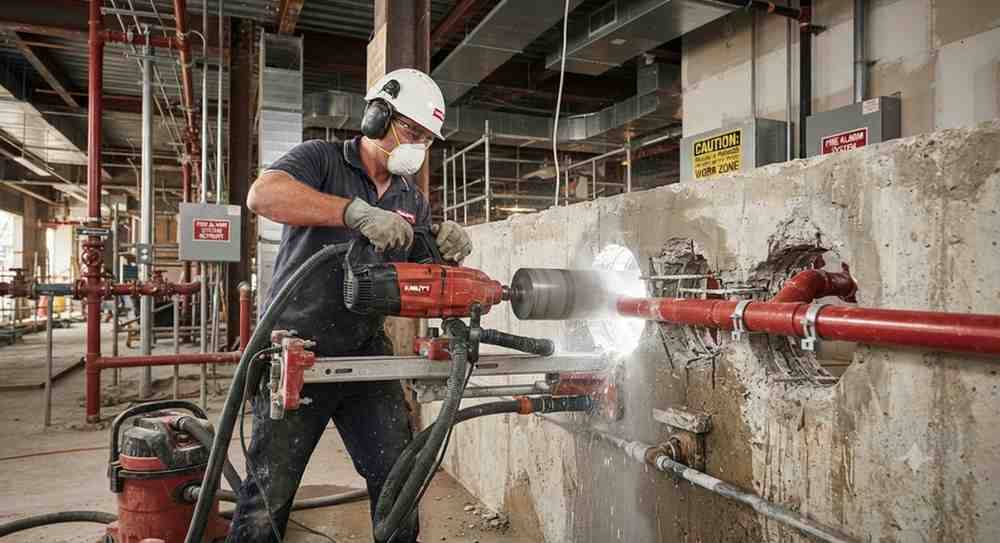
Diamond core cutting is an advanced, vibration-free construction technique that utilizes industrial diamond-impregnated drill bits mounted on high-powered hydraulic or electric rigs. It allows engineers to extract clean, cylindrical cores or create precise circular openings ranging from small utility holes to massive diameters without inducing structural shock.
Key Advantages for Fire Safety Upgrades:
-
Vibration-Free Precision: Unlike jackhammers that generate high-frequency impacts capable of weakening surrounding concrete bonds, core cutting runs smoothly, preserving structural load paths.
-
Dimensional Accuracy: Clean circular cuts eliminate the need for extensive post-repair patching, ensuring tight seals around pipes and conduits to maintain fire compartmentation.
-
Dust and Noise Control: Utilizing wet-cutting techniques minimizes airborne silica dust, making it ideal for occupied commercial and residential retrofitting projects across India.
-
Reinforcement Management: Diamond bits cleanly slice through steel rebar embedded within RCC slabs and beams without tearing or destabilizing the concrete matrix.
Technical Workflow: Integrating Fire Systems via Core Cutting
Executing a fire safety retrofit requires meticulous planning, structural assessment, and flawless execution. The typical engineering workflow involves several distinct phases:
1. Structural Mapping and NDT (Non-Destructive Testing)
Before a single cut is made, structural consultants must map out the internal layout of the reinforcement bars. Using tools like Rebar Locators or Ground Penetrating Radar (GPR), engineers identify safe zones to avoid severing primary structural load-bearing bars. In cases where critical members must be bypassed or modified, specialized structural strengthening—such as carbon fiber wrapping or steel jacketing—is planned in tandem.
2. Sizing and Layout for Fire Services
Fire protection engineering demands specific penetration dimensions:
-
Sprinkler Branch Lines: Smaller diameter core holes (50mm to 100mm) through beams and walls for water distribution.
-
Wet Risers and Downcomers: Medium-to-large core cuts (150mm to 300mm) through multiple floor slabs to run high-pressure vertical water columns.
-
Smoke Management Ducts: Rectangular or large circular clusters formed by stitching core holes together to accommodate massive ventilation and exhaust shafts required by NBC Part 4.
3. Execution of Wet Diamond Drilling
Water-cooled diamond core rigs are anchored securely to floors or walls. The rotation speed is calibrated according to the aggregate hardness and rebar density of the Indian standard concrete mixes (typically ranging from M25 to M40 grades commonly found in commercial structures).
Case Study Perspectives across Indian Metros
Commercial High-Rises in Mumbai and Bengaluru
In bustling commercial districts like BKC in Mumbai or Electronic City in Bengaluru, office retrofits must happen with zero downtime for businesses. Core cutting allows service contractors to bore through thick basement and podium levels overnight, routing fire suppression gas manifolds and electrical control cabling without halting daily operations.
High-Density Residential Societies in NCR
Modern high-rise residential towers in Noida and Gurugram frequently undergo fire audits mandated by local fire departments. Installing external or internal dry riser retrofits often requires piercing through deep transfer slabs and shear walls. Professional core cutting ensures that these penetrations do not compromise the seismic resistance of earthquake-zoned high-rises.
Best Practices for Facility Managers
When planning a fire safety retrofit utilizing core cutting services, facility managers and project heads should adhere to these critical guidelines:
-
Hire Certified Specialists: Always partner with experienced civil engineering contractors who understand load distributions and possess advanced hydraulic diamond cutting equipment.
-
Seal Penetrations Properly: Every core-cut hole created for fire pipe passes must be sealed using certified fire-stop mortars, intumescent pillows, or silicone fire-stop sealants to maintain the building's fire compartmentalization integrity.
-
Ensure Debris Management: Wet slurry generated during core cutting must be contained and vacuumed efficiently to prevent slip hazards and environmental contamination on site.
Conclusion
Retrofitting fire safety systems is an indispensable investment in human life, property longevity, and statutory compliance. As Indian infrastructure grows denser and safety codes become more rigorous, traditional destructive methods are rapidly being replaced by precision engineering. Diamond core cutting provides the exact, vibration-free, and structurally sound methodology required to weave modern fire protection networks through aging concrete.
For expert consultation, precise execution, and professional diamond core cutting services tailored to your building safety upgrades, reach out to us at [email protected] and ensure your infrastructure is secure, compliant, and future-ready.