
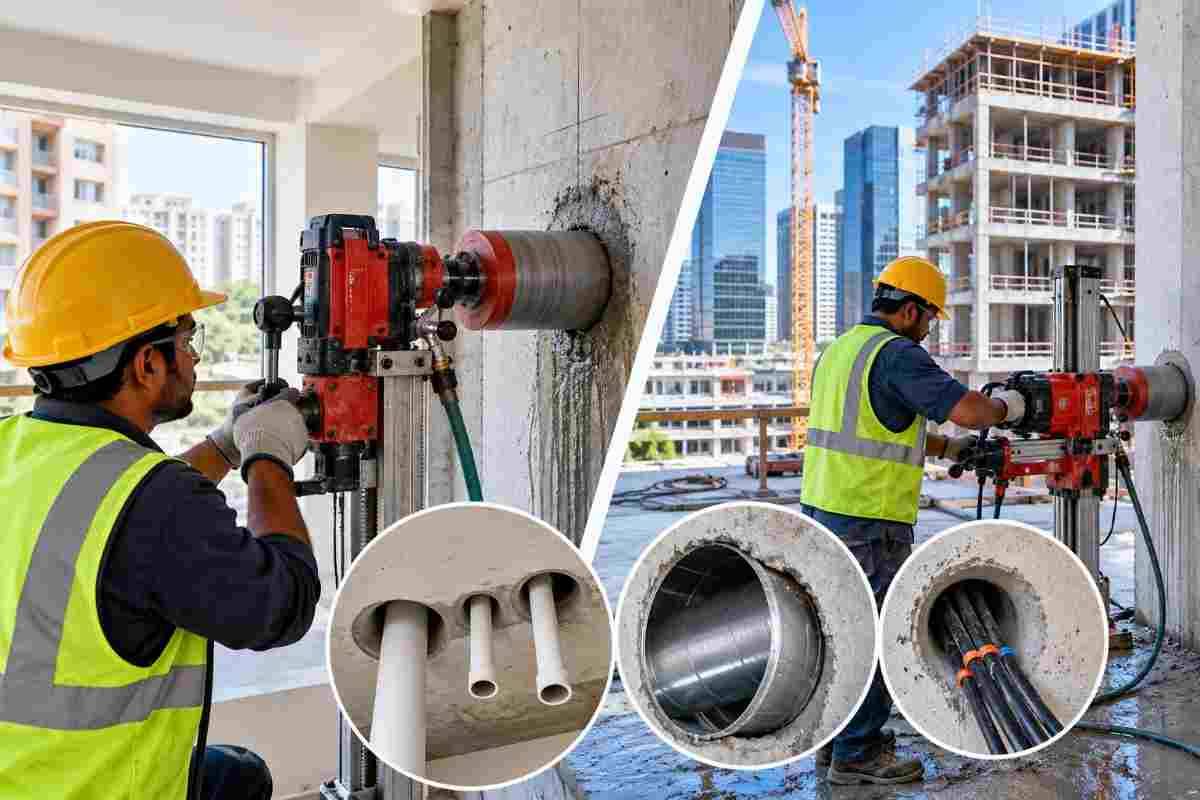
Delhi never stops building. Apartments are being renovated in Dwarka and Vasant Kunj, offices are being fitted out in Connaught Place and Nehru Place, and warehouses and retail spaces keep appearing across the NCR. Almost every one of these projects eventually needs a clean, accurate hole through concrete, brick or stone for plumbing, electrical conduits, HVAC ducts or drainage. Hammering through a slab is slow and noisy, and it often damages the structure around the opening.
This is where professional core cutting comes in. At Core Cutting India, we provide precise concrete core cutting for homeowners, builders, architects and facility managers across Delhi. This guide explains what core cutting is, how it works, where it is used, and how to choose the right service provider for your residential or commercial project.
What Is Core Cutting?
Core cutting, also called core drilling, is a method of making clean, round holes in hard materials using a hollow cylindrical drill bit with diamond-impregnated segments. The machine spins the bit at controlled speed, usually with water cooling. The bit grinds through the material and leaves a neat cylindrical “core” that is removed in one piece.
The result is a smooth, accurate hole with no cracks around the edges. Traditional hammer drilling and manual chiselling send vibrations through the structure and can cause micro-cracks, spalling and weakened reinforcement. Core cutting avoids most of this damage.
Core cutting works on:
- Reinforced cement concrete (RCC) slabs, beams and columns
- Brick and block walls
- Stone and marble
- Asphalt and road surfaces
- Pre-stressed and post-tensioned concrete (with proper scanning)
Hole diameters range from small 25 mm openings for pipes and cables to large openings of 500 mm or more for ducts and drainage.
Why Delhi Projects Need Professional Core Cutting
Delhi’s building landscape has its own challenges. Many structures are densely packed. Older buildings in areas like Karol Bagh, Lajpat Nagar and Old Delhi have aging concrete and tightly designed layouts. Newer high-rises and commercial complexes have heavily reinforced slabs with dense rebar. In either case, careless drilling can lead to structural problems and expensive repairs.
Professional core cutting helps because it offers:
- Precision: Holes are drilled at exact positions, diameters and angles, which matters when pipes, sleeves or ducts must fit precisely.
- Minimal vibration: The structure around the hole stays intact, which is vital in occupied buildings and older construction.
- Lower noise and dust: Wet drilling keeps dust down, which matters in apartments, offices, hospitals and schools.
- Speed: A diamond core drill can cut through thick slabs far faster than manual methods.
- Safety: Trained operators use rebar detection and proper anchoring, which reduces the risk of hitting live cables or structural steel.
Core Cutting Services for Residential Projects
Homeowners often assume core cutting is only for big construction sites. In reality, it is widely used in residential work, from small renovations to complete rebuilds.
Plumbing and Drainage Openings
When you redesign a bathroom or kitchen, new drainage lines, water supply pipes and waste outlets often need to pass through floor slabs or walls. Core cutting creates exact openings for these lines without cracking tiles or damaging surrounding finishes.
Electrical and Cable Routing
Modern homes need conduits for air conditioners, inverters, smart-home wiring, CCTV and internet cables. Core cutting makes neat openings for these services through load-bearing and partition walls.
Air Conditioner Piping
Installing split or ducted ACs usually requires a hole through an external wall for refrigerant piping and drainage. A proper core cut creates a clean sleeve-sized hole with the right slope for drainage, which prevents leaks and wall damage.
Exhaust Fans and Chimney Openings
Kitchen chimneys, exhaust fans and ventilators need accurate round openings. Core cutting leaves finished edges that are easy to seal and cover.
Renovation and Remodelling
When you merge rooms, add a staircase or install a lift in an existing building, you may need to cut openings in slabs or walls. In these cases, controlled concrete cutting is far safer than demolition by hammer.
Solar and Rooftop Installations
Rooftop solar systems, water tanks and railing posts often need anchor holes or conduit passages through terrace slabs. Core drilling makes these openings with care for waterproofing layers.
Core Cutting Services for Commercial Projects
Commercial projects have tighter schedules, stricter safety rules and more complex engineering. Core cutting plays a central role in office buildings, malls, hospitals, hotels, warehouses and industrial units.
HVAC and Ducting
Large buildings need many openings for ducts, chilled water pipes and ventilation shafts. Core cutting delivers consistent hole sizes across floors, which keeps installations aligned and speeds up the work.
Fire Fighting and Sprinkler Systems
Fire safety systems need sleeves and pipe openings across floors and fire-rated walls. Accurate core holes make it easier to install fire stops and seals that meet safety requirements.
Electrical Risers and Data Cabling
Corporate offices and data centres need risers for power, networking and communication cables. Core cutting creates clean vertical openings that are easy to manage.
Plumbing and Sanitary Systems
Commercial washrooms, pantries and kitchens need many floor penetrations. Core drilling keeps these openings neat and sized for waterproof sleeves.
Retrofitting Existing Buildings
Companies often move into older buildings and need to add new services. Because tenants and neighbouring units may still be operating, low-vibration and low-dust core cutting is the practical way to add openings without disturbing them.
Industrial and Warehouse Applications
Factories and warehouses use core cutting for machine foundations, anchor bolts, drainage and cable trenches, often in thick, heavily reinforced concrete.
How the Core Cutting Process Works
Understanding the process helps you judge the quality of a service provider. A professional job typically follows these steps:
1. Site assessment. The team inspects the area, checks the structure and discusses requirements such as hole size, depth, number of holes and access.
2. Scanning and marking. Before any drilling, the operator may use a rebar detector or ground-penetrating scanner to locate reinforcement, conduits and cables inside the concrete. The exact drilling points are then marked.
3. Machine setup. The drill rig is anchored to the surface with a vacuum base or anchor bolt, which keeps the machine stable and the hole straight.
4. Drilling. The diamond bit is cooled with water and cuts steadily through the material. The operator adjusts speed and pressure depending on the material and the presence of rebar.
5. Core removal. Once the bit is through, the core is extracted and the hole is checked for size and finish.
6. Cleaning. Slurry and debris are cleaned up, leaving the site tidy and ready for the next trade.
Benefits of Choosing Professional Core Cutting Over DIY or Manual Methods
Some contractors try to save money by using hammer drills or chisels. The savings are usually short-lived. Here is why:
- Structural risk: Uncontrolled impact can crack slabs and damage reinforcement.
- Rough edges: Manual holes are irregular and need extra repair work.
- Rework costs: Plastering, sealing and patching add time and expense.
- Safety hazards: Hitting a live cable or gas line can be dangerous.
- Disturbance: Noise and vibration upset occupants and neighbours.
Professional core cutting delivers a cleaner result the first time, which reduces total project cost and delay.
Factors That Affect Core Cutting Cost in Delhi
Customers often ask about pricing. There is no single fixed rate, because the cost depends on several factors:
- Hole diameter: Larger holes need bigger bits and more time.
- Depth and thickness: A thick slab or deep wall costs more than a thin partition.
- Material hardness: Dense, heavily reinforced concrete takes longer than brick.
- Number of holes: Bulk work usually lowers the per-hole rate.
- Location and access: Work at height, in tight spaces or on upper floors can need extra setup.
- Site conditions: Availability of water and power, and any working-hour restrictions, also play a role.
The best approach is to request a site-specific quote so you know exactly what you are paying for.
How to Choose the Right Core Cutting Contractor in Delhi
With many providers across the city, it helps to know what to look for.
Experience and track record. Ask about previous residential and commercial projects, and whether the team has handled complex jobs like post-tensioned slabs.
Modern equipment. Good contractors use quality diamond bits, stable drill rigs and, where needed, rebar scanners. Old or poorly maintained machines produce poor results.
Trained operators. Skilled operators understand material behaviour, safe drilling angles and structural sensitivity.
Safety practices. Look for the use of protective gear, proper anchoring, and care around electrical and plumbing lines.
Clean working methods. Wet drilling, slurry control and tidy-up should be part of the service, especially in occupied homes and offices.
Transparent pricing. A reliable contractor explains what is included and does not surprise you with hidden charges.
Timely service. Delhi projects often work on tight deadlines, so punctuality and quick mobilisation matter.
Tips to Prepare for a Core Cutting Job
A few simple steps make the work smoother:
- Share drawings or photos of the area, along with hole sizes and positions.
- Ask your structural engineer or architect to approve openings in beams, columns and load-bearing walls.
- Clear the work area of furniture, valuables and obstacles.
- Confirm water and power access for the machine.
- Check for hidden services, such as electrical lines, gas pipes or water lines, behind the surface.
- Inform neighbours or building management if the work is in a housing society or shared commercial building.
Safety and Structural Considerations
Core cutting is generally safe when done correctly, but a few points deserve emphasis. Never cut through a structural beam or column without engineering approval. Cutting reinforcement bars can reduce a member’s strength, so the location of each hole should be planned. In post-tensioned slabs, which are common in some modern buildings, cutting a tendon can be dangerous, so scanning is essential. A responsible contractor will stop and consult if the scan shows anything unexpected.
Why Choose Core Cutting India?
At Core Cutting India, our focus is on accurate, clean and dependable concrete core cutting for projects of every size across Delhi and the NCR. Our approach is built around a few simple commitments:
- Precision work that gives you exact hole sizes and clean edges
- Low-vibration, low-dust methods suitable for homes, offices and occupied buildings
- Skilled operators who understand both the equipment and the structure
- Flexible service for single-hole jobs as well as large commercial contracts
- Clear communication and honest quotes from the first call to the final cleanup
Whether you are renovating a flat, fitting out an office floor or managing a large construction site, we aim to make the core cutting stage fast, safe and stress-free.
Frequently Asked Questions
What is core cutting used for?
Core cutting is used to create clean, round holes in concrete, brick and stone for pipes, cables, ducts, drainage, anchor bolts and ventilation.
Is core cutting safe for my building?
Yes, when done by trained professionals with proper scanning and planning. It causes far less vibration and cracking than hammer drilling. Openings in structural members should always be approved by an engineer.
How long does core cutting take?
A single standard hole can often be completed in a short time, while larger or deeper holes in heavily reinforced concrete take longer. Your contractor can estimate this after seeing the site.
Does core cutting create a lot of dust and noise?
Wet core drilling controls dust effectively, and the noise level is generally lower than demolition methods. It is well suited to occupied homes and offices.
What is the difference between core cutting and wall sawing?
Core cutting makes round holes, while wall sawing or slab sawing cuts larger straight-line openings such as doorways and windows.
Can core cutting be done in an occupied building?
Yes. Because of its low vibration and controlled dust, core cutting is a popular choice for retrofits in occupied residential and commercial buildings.
How do I get a core cutting quote in Delhi?
Contact the service provider with the number of holes, their diameter, the depth or slab thickness, and the location. A site visit helps produce an accurate quote.
Final Thoughts
Core cutting is one of the most practical techniques in modern construction and renovation. It provides accuracy, speed and cleanliness, which are exactly what busy Delhi projects need. From a single AC pipe hole in a flat to hundreds of openings in a commercial tower, the right approach protects your structure, your schedule and your budget.
If you are planning a project and need reliable core cutting services in Delhi, visit Core Cutting India to discuss your requirements and get a quote tailored to your site.