
Picture this. Your new split AC has arrived, the technician is at the door, and the only way to run the copper piping outside is through a thick reinforced concrete wall. He picks up a regular drill. Twenty minutes later the bit is blunt, the wall is cracked, and your living room looks like a construction zone.
This scene plays out across West Delhi every week. The fix is not a stronger drill. It is a different method entirely: diamond core cutting.
If you are in Janakpuri and need holes made in concrete, this article walks you through how professional drilling works on RCC structures, where it is used, what to ask before booking, and how to avoid costly mistakes. For a local team that handles exactly this kind of work, see the dedicated core cutting service in Janakpuri page.
Quick help: Call or WhatsApp 7009679903 with your hole size, wall or slab thickness and location. You will get clear guidance and a quote.
First, What Exactly Is RCC?
RCC stands for Reinforced Cement Concrete. It is concrete that has steel bars (rebar) embedded inside it. Concrete is excellent at resisting compression, and steel handles tension. Together they form the skeleton of most modern buildings in Delhi, including the beams, columns, slabs, staircases and retaining walls you see in Janakpuri's apartment blocks, builder floors, showrooms and commercial complexes.
This combination is what makes RCC so strong, and also what makes it so hard to drill. A standard bit meets steel and either stalls or wanders. A diamond core bit is designed to grind through both materials.
How Diamond Core Cutting Works on RCC
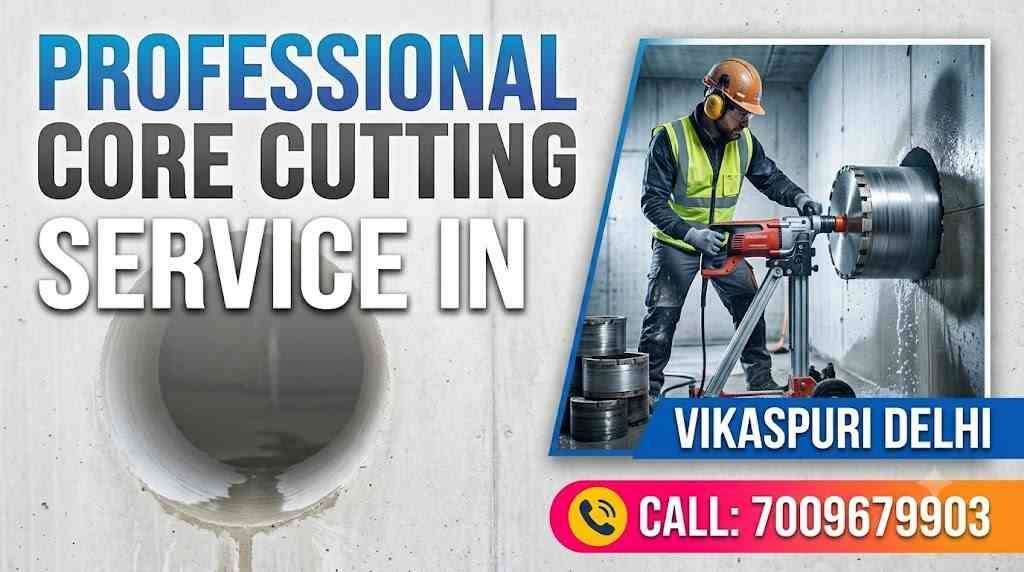
A core cutting machine uses a hollow, cylindrical bit with diamond-impregnated segments along its rim. As the bit rotates, it grinds a ring-shaped groove into the concrete. Water flows through the bit to carry away slurry and keep the diamonds from overheating. Once the bit goes through, a solid cylinder of concrete (the "core") slides out.
Why this suits RCC:
- It cuts a clean circular edge, with no jagged breakage.
- It transfers very little shock into the surrounding structure.
- It can pass through embedded steel without bending or jamming the bit when handled correctly.
- It leaves a hole that matches the pipe or sleeve you plan to fit.
Where RCC Core Cutting Is Used in Janakpuri
Janakpuri has a unique mix of old DDA flats, cooperative group housing societies, independent houses that have been rebuilt, and busy commercial areas around the District Centre. Each of these has its own needs.
In homes and societies
- Pipe penetrations for kitchens and bathrooms during renovation
- AC piping and drain holes through external walls
- Exhaust fan and chimney openings
- Water lines, solar water heater pipes and RO drains
- Cable and conduit passage between floors
In shops, offices and showrooms
- Ducts for central or cassette AC systems
- Sprinkler and fire-line sleeves through slabs
- Cable trays and data line openings
- Plumbing for new washrooms or pantries
- Signage and ventilation penetrations
In construction and retrofit projects
- Dowel bar holes for adding beams, columns or extensions
- Anchor bolt holes for machines, racks and steel structures
- Lift and shaft-related small openings
- Drainage and utility sleeves in basements or parking areas
A Word of Caution: Not Every RCC Element Is Equal
This is where a professional approach matters most. In a reinforced concrete building, some elements carry heavy loads and others do not. Cutting through the wrong one can weaken a structure.
- Slabs: Small holes between reinforcement bars are generally manageable, but their position matters.
- Beams and columns: These are primary load-bearing elements. Cutting through them is a decision for a structural engineer, not a drilling contractor alone.
- Walls: Load-bearing and non-load-bearing walls behave very differently.
Our advice: If your plan involves a beam, a column, a shear wall or an unusually large opening, get written approval from your structural consultant before drilling. A responsible core cutting team will ask these questions and will not rush you into a risky cut.
The Step-by-Step Process You Should Expect
Here is what a well-run job looks like from your side.
Step 1: Enquiry. You call or send a message on WhatsApp with the hole diameter, depth, number of holes and the building type.
Step 2: Estimate. The team gives you a price. You can cross-check it with the core cutting rate calculator before confirming.
Step 3: Site preparation. Furniture is moved, floors are covered and water and power points are identified.
Step 4: Marking. Positions are marked and confirmed with you or your plumber or electrician.
Step 5: Drilling. The rig is fixed firmly and the cut is made with continuous water cooling.
Step 6: Cleanup. Slurry is removed, the area is wiped and the cores are cleared away.
Step 7: Final check. You verify the position and size before the crew leaves.
Myths About Core Cutting That Cost People Money
Myth 1: "A strong hammer drill is enough for concrete." It may work for tiny holes in plain masonry, but RCC with rebar and larger diameters needs diamond tooling. Forcing a hammer drill damages the wall and the tool.
Myth 2: "Core cutting is too expensive for small jobs." When you count the repair, repainting and rework caused by rough breaking, core cutting is often cheaper overall.
Myth 3: "It will fill my house with dust." Water-cooled cutting suppresses most of the dust. The main mess is slurry, which is easy to control with proper preparation.
Myth 4: "Any hole can be drilled anywhere." Technically the machine can do a lot, but structure comes first. Position and size should always respect the building's safety.
Myth 5: "Prices are the same everywhere." Rates depend on diameter, depth, material, access and quantity. Be careful of any quote that skips these details.
What Decides the Price of Core Cutting in Janakpuri?
When you ask for a rate, a professional will ask you a few simple questions. Here is why each one matters.
| Factor | Why it affects cost |
|---|---|
| Hole diameter | Bigger bits are costlier and cut slower |
| Wall or slab thickness | More depth means more time and wear |
| Material type | Brick, plain concrete and dense RCC behave differently |
| Number of holes | Bulk jobs typically work out cheaper per hole |
| Floor and access | Upper floors, ceilings and tight spaces need more setup |
| Utilities on site | Water and power availability changes the logistics |
Instead of guessing, enter your measurements into the core cutting rate calculator to see an estimate in seconds. Then call or WhatsApp to confirm the final amount for your exact situation.
Seven Questions to Ask Before You Hire
Use these to filter out weak options quickly.
- What equipment do you use? Look for proper rigs and diamond bits, not improvised tools.
- What diameters can you handle? Make sure the range matches your requirement.
- How do you control water and slurry? A neat team has a plan for this.
- Can you work in occupied homes or offices? Experience in lived-in spaces shows in the details.
- How soon can you attend? Local availability reduces delays for your plumber, electrician or AC installer.
- Is the quote based on my actual specifications? Avoid vague, one-size-fits-all pricing.
- Will you advise me if a location seems risky? The right answer is yes.
Why Janakpuri Residents and Businesses Choose Core Cutting India
Core Cutting India supports homeowners, builders, interior contractors, plumbers, electricians and facility managers across Delhi, including Janakpuri and surrounding areas. The aim is simple: accurate holes, tidy sites and honest communication.
Here is what you can count on:
- A straightforward conversation about your requirement and site conditions
- Estimates linked to real specifications, not guesses
- Coverage for residential, commercial and industrial work
- Neat finishing with low dust and controlled water
- Easy booking by call, WhatsApp or email
Whether you live in a flat near Janakpuri West metro station, own a shop at the District Centre or manage a site along Pankha Road, the process stays the same: tell us what you need, get a clear quote and get it done.
Areas We Cover Around Janakpuri
Along with Janakpuri itself, core cutting support is available in nearby West Delhi localities such as Vikaspuri, Uttam Nagar, Tilak Nagar, Hari Nagar, Rajouri Garden, Paschim Vihar, Dwarka and Najafgarh. Call to confirm availability for your exact address.
If you are near Uttam Nagar, you can also explore the Uttam Nagar core cutting service.
Practical Preparation Checklist
A few minutes of preparation can save a lot of time on the day.
- Decide the exact pipe or sleeve size and the hole position.
- Confirm those details with your plumber, electrician or AC technician.
- Clear the area and protect floors and furniture.
- Switch off power to nearby wiring if there are concealed cables.
- Keep a bucket and mop ready for slurry cleanup.
- Share any known drawings or details of hidden services.
- Keep children and pets away from the work zone.
Book Professional RCC Core Cutting in Janakpuri
Good drilling is invisible. Nobody notices a perfect hole. They only notice the bad ones. If you want your project to move forward without cracked walls, delays or extra repair costs, work with a team that treats RCC with respect.
Call or WhatsApp now: 7009679903
- WhatsApp: Message us on WhatsApp
- Email: [email protected]
- Website: corecuttingindia.com
- Rate estimate: Core cutting rate calculator
- Service page: Core cutting in Janakpuri
Frequently Asked Questions (FAQ)
1. Who provides professional core cutting services in Janakpuri, Delhi?
Core Cutting India provides concrete core cutting for homes, offices, shops and construction projects in Janakpuri and nearby areas. You can call or WhatsApp 7009679903 to discuss your requirement.
2. Can you drill through RCC slabs and walls?
Yes. Diamond core cutting is designed for reinforced concrete and can cut through concrete and embedded steel. For structural members such as beams and columns, consult your structural engineer first.
3. How much does core cutting cost in Janakpuri?
The price depends on hole diameter, thickness, material, number of holes and access. Use the rate calculator for an estimate and confirm the final quote with the team.
4. Will core cutting damage my wall or slab?
When done properly, core cutting is far less damaging than hammering or chiselling because it produces little vibration and a clean edge.
5. Is core cutting messy?
It is much cleaner than breaking. Water-cooled drilling reduces dust, and the slurry can be controlled and cleaned up with basic preparation.
6. What is core cutting commonly used for in homes?
AC piping, plumbing lines, exhaust fans, drainage, cable conduits and renovation work are the most common residential uses.
7. Do you handle commercial and industrial projects?
Yes. Services cover offices, showrooms, warehouses, factories and ongoing construction sites, including HVAC, fire fighting, electrical and anchor holes.
8. How do I book a core cutting appointment?
Call or send a WhatsApp message to 7009679903 with your hole size, depth, quantity and location. You can also email [email protected].
9. Do I need to arrange water and power?
Basic water and electricity access helps the job run smoothly. Let the team know in advance if either is unavailable so alternatives can be planned.
10. Which areas near Janakpuri do you serve?
Services extend across West Delhi, including Vikaspuri, Uttam Nagar, Tilak Nagar, Hari Nagar, Rajouri Garden, Paschim Vihar, Dwarka and Najafgarh. Call to confirm your location.
conclusion
RCC is the backbone of Delhi's buildings, and it deserves careful handling. Whether you are installing an AC, upgrading plumbing, fitting out a shop or retrofitting a commercial space, the right core cutting partner makes the work faster, cleaner and safer.
Ready to get started? Call or WhatsApp 7009679903, email [email protected], or visit corecuttingindia.com to request your quote today.