
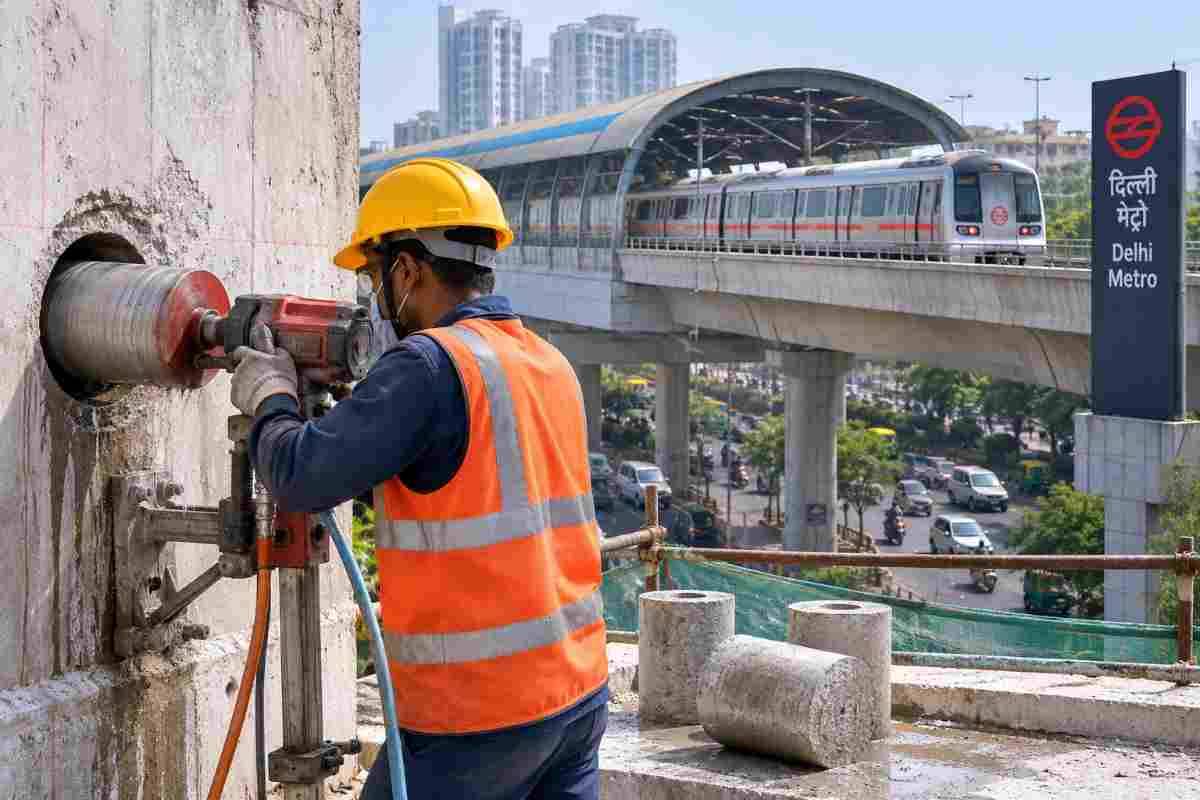
Delhi never really slows down. Around the Metro corridors, from Connaught Place and Nehru Place to Dwarka, Noida Sector 18 and Cyber Hub in Gurugram, commercial buildings, hospitals, malls, offices and residential towers all sit within a short walk of a station. Every one of these buildings needs maintenance, upgrades and retrofitting at some point, and that often means cutting through reinforced concrete.
That is where core cutting comes in. Whether you are running a plumbing line through a slab, installing an HVAC duct, adding electrical conduits or creating an opening for a lift shaft, you need clean, precise holes without damaging the structure. Doing this work next to a Metro station, a crowded market or an occupied building is a different challenge from working on an open plot.
In this guide, we walk through how to plan core cutting around busy Delhi locations: what to check before work begins, how to manage noise, dust and safety, and how to choose a contractor you can trust. The guidance reflects the practices followed by Core Cutting India (https://corecuttingindia.com/), a team that works on projects across Delhi NCR.
What Is Core Cutting and Why Is It Used in Urban Projects?
Core cutting, also called core drilling, uses a diamond-tipped hollow cylindrical bit to cut a circular hole through concrete, brick, stone or asphalt. A drill rig holds the bit, and water usually cools it while flushing away slurry. The result is a clean, smooth-walled hole with a cylindrical “core” removed intact.
Compared with traditional hammer drilling or chiselling, core cutting has clear advantages in dense urban environments:
- Precision: Holes are accurate in diameter and position, which matters when you are working around existing services.
- Lower vibration: Diamond cutting transmits far less shock to the surrounding structure than percussion methods, so the risk of micro-cracks is lower.
- Cleaner finish: Smooth edges make it easier to install pipes, sleeves and cables.
- Controlled noise and debris: Wet cutting reduces airborne dust, and the process is quieter than breaking concrete by hand.
In a city where space is tight and tolerance for disruption is low, these benefits are not just nice to have. They often decide whether a job can proceed at all.
Why Metro-Adjacent Locations Need Extra Planning
Work near a Metro line, station or busy junction brings constraints you will not face on a quiet site. Understanding them early saves time, money and unpleasant surprises.
1. Restricted Access and Heavy Traffic
Roads around Metro stations are congested through much of the day. Parking is limited, and loading and unloading zones are often restricted. Getting a core drilling rig, water supply, generator and crew into position takes planning, particularly for multi-storey buildings where equipment has to be moved by lift or staircase.
2. Crowds and Public Safety
Stations and surrounding markets attract large footfalls. Any work at ground level, on façades or near entrances must account for pedestrians. Barricading, signage and safe slurry disposal are essential so that nobody slips, trips or is exposed to dust or falling debris.
3. Structural and Utility Sensitivity
Underground Metro infrastructure, utility corridors and older buildings add layers of risk. Even when your site is not directly connected to Metro property, nearby construction has to be handled carefully. Knowing what lies inside a slab or wall, such as rebar, post-tensioned cables, conduits and pipes, is critical before a single hole is cut.
4. Time Windows
Many commercial buildings near Metro stations only permit noisy or disruptive work at night or on weekends. Hospitals, offices, banks and retail outlets each have their own rules. A project that looks simple on paper can become complex once these windows are factored in.
Step One: Survey the Site and Scan the Structure
The most important part of any core cutting job happens before the drill starts. A proper pre-work survey should cover:
Structural review. Check drawings where available to understand slab thickness, beam locations and load paths. If drawings are missing, which is common in older Delhi buildings, a site inspection becomes even more important.
Reinforcement and service detection. Ground-penetrating radar (GPR) or rebar scanners can map steel, conduits and embedded pipes. Cutting through a live electrical conduit or a post-tensioned cable is dangerous and expensive. Scanning removes the guesswork.
Marking and layout. Once the scan is complete, hole positions are marked precisely. Small adjustments of even a few centimetres can help avoid reinforcement or services.
Access and logistics check. Note lift dimensions, staircase widths, power availability, water supply and the nearest drainage point for slurry.
At Core Cutting India, this survey stage is treated as non-negotiable, because it is what keeps a job on schedule and safe.
Step Two: Sort Out Permissions and Building Rules
In Delhi, the permissions you need depend on the property type, the nature of the work and the location. It is wise to check the following well in advance:
- Building management or RWA approval. Housing societies, malls and commercial complexes usually require written permission, along with details of the contractor, working hours and crew.
- Structural engineer’s sign-off. For any opening in a load-bearing wall, beam or slab, a structural engineer’s approval is strongly advisable.
- Authority or landlord NOCs. Some properties, especially leased premises, require the owner’s consent for structural modifications.
- Proximity rules. If your site is close to Metro infrastructure or other sensitive installations, additional clearance or coordination may be needed. Check with the relevant authority or your project consultant.
Rules change, so always confirm current requirements with the concerned bodies rather than relying on assumptions. A reliable core cutting contractor will usually be familiar with the process and can guide you through the documentation.
Step Three: Schedule Around the City’s Rhythm
Timing can make or break a core cutting project in a busy area. Consider these approaches:
Night work. For offices, hospitals and retail spaces, scheduling after business hours reduces disruption. Core cutting is quieter than most demolition methods, which often makes night work more acceptable, but you should still confirm permitted hours and noise limits.
Weekend or holiday work. Commercial buildings are often emptier on Sundays and public holidays, which gives crews more freedom to complete larger scopes.
Phased execution. On big projects, splitting the work into zones or floors helps limit disruption. Tenants can be informed in advance about which areas will be affected and when.
Buffer for the unexpected. Delhi traffic, weather, power cuts and last-minute access issues all happen. Build a little slack into the schedule rather than promising impossibly tight deadlines.
Step Four: Control Noise, Dust and Slurry
Core cutting is one of the cleaner ways to cut concrete, but “cleaner” does not mean “mess-free”. In an occupied or public environment, containment matters.
Noise
Diamond core drilling produces a steady, moderate noise, far less than breakers or jackhammers. For sensitive environments, notify occupants in advance, use sound-dampening where practical and schedule the noisiest operations carefully.
Dust
Wet core cutting suppresses most dust at the source. Where dry cutting is unavoidable, use vacuum attachments and protective sheeting. Crews should wear appropriate respiratory protection, since concrete dust contains fine silica particles that are harmful when inhaled.
Slurry
The water and concrete fines created during wet cutting turn into slurry. It must be collected with wet vacuums or containment rings and disposed of responsibly rather than allowed to flow into drains or onto public areas. In a building with finished interiors, plastic sheeting and drop cloths protect floors and furniture.
Step Five: Prioritise Safety on Every Job
Working near crowded transport hubs raises the stakes on safety. A well-run core cutting project should include:
- Barricading and signage around the work zone, especially at ground level.
- Proper PPE for the crew, including helmets, safety shoes, gloves, goggles, ear protection and respiratory masks.
- Electrical safety. Because water and electricity are used together, drills should be connected through appropriate protection devices such as RCCBs, and cables should be properly insulated and routed.
- Rig stability. The drill stand must be firmly anchored, whether by vacuum base, anchor bolts or bracing, to prevent slipping or binding.
- Core catching and falling-object control. When cutting through floors or slabs, the core and any debris must be controlled so nothing falls onto people or property below.
- Emergency readiness. Know the nearest exits, first-aid provisions and emergency contacts for the site.
Safety is not an add-on to the job. It is part of the quality of the work.
Step Six: Choose the Right Core Cutting Contractor
The contractor you hire will shape the outcome more than any other decision. When comparing providers around Delhi, look at:
Experience in urban and occupied settings. Ask about previous work in malls, offices, hospitals and metro-adjacent buildings. A contractor used to quiet, controlled environments will plan differently from one used only to open construction sites.
Equipment range. Different jobs call for different tools: handheld rigs for small holes, stand-mounted rigs for larger diameters and wall saws or wire saws for big openings. A contractor with a full range can match the method to the job.
Detection capability. Check whether they offer or coordinate GPR scanning and rebar detection before cutting.
Trained, supervised crew. Skilled operators make cleaner holes and make fewer mistakes. Ask about supervision and safety training.
Clear scope and pricing. A good quote spells out hole diameters, depths, quantities, access conditions and any extras. Be cautious about quotes that seem unusually low, since they often leave out important items.
Transparent communication. You should know who will be on site, when they will arrive and how any issues will be handled.
Core Cutting India (https://corecuttingindia.com/) focuses on exactly these points, giving clients across Delhi NCR a clear process from survey to clean-up.
Common Applications of Core Cutting in Delhi’s Busy Zones
Understanding where core cutting is typically used can help you plan your own project:
- Plumbing and drainage. Creating openings for water supply lines, soil pipes and drainage stacks.
- HVAC installation. Cutting precise openings for ducts, refrigerant lines and ventilation.
- Electrical and data cabling. Passing conduits and cable trays through slabs and walls.
- Fire-fighting systems. Making sleeves and openings for sprinkler lines and fire pipes.
- Lift and staircase retrofits. Creating or enlarging openings in older buildings.
- Anchor and bolt holes. Drilling for foundation bolts, machinery mounts and façade supports.
- Inspection and testing. Extracting concrete core samples to test strength and quality.
Each of these applications has its own requirements for diameter, depth, alignment and finish, which is another reason pre-planning matters.
Common Mistakes to Avoid
Even experienced project managers can trip up on core cutting. Watch out for these frequent errors:
- Skipping the scan. Cutting blind risks hitting rebar or live services.
- Ignoring structural implications. Not every wall or slab can take an opening without reinforcement.
- Underestimating logistics. Water, power and access problems can delay work far more than the cutting itself.
- Poor communication with occupants. Surprises create complaints. Notify neighbours and tenants early.
- Choosing on price alone. The cheapest option can cost more if rework, damage or delays follow.
- Neglecting clean-up. Slurry and debris left behind reflect badly on everyone involved.
A Simple Planning Checklist
Before you book a core cutting service near a Delhi Metro area, run through this quick list:
- Define the scope: number of holes, diameters, depths and materials.
- Confirm drawings, or arrange a site survey and scan.
- Obtain building, RWA or landlord permissions.
- Decide on working hours and notify affected parties.
- Confirm water, power and access arrangements.
- Agree on slurry handling and dust control.
- Verify the contractor’s equipment, crew and safety practices.
- Get a written quote with clear inclusions.
- Plan for contingencies and a clean handover.
Frequently Asked Questions (People Also Ask)
What is core cutting in construction?
Core cutting is a method of drilling precise circular holes through concrete, masonry or stone using a diamond-tipped hollow bit. It is widely used for plumbing, HVAC, electrical and structural work.
Is core cutting safe near occupied buildings?
Yes, when done correctly. Wet cutting controls dust, vibration is low and noise is moderate. With proper scanning, barricading, PPE and supervision, core cutting is well suited to occupied and busy sites.
How deep can a core drill cut?
Depth depends on the equipment and bit length. Standard bits handle typical slab and wall thicknesses, while extension rods and specialised rigs allow much deeper cuts. Your contractor can advise on the right setup.
What is the difference between core cutting and wall sawing?
Core cutting makes round holes, while wall or slab sawing makes straight-line cuts for larger openings such as doors, windows or stair voids.
Do I need permission for core cutting in Delhi?
Often yes, particularly in apartment complexes, commercial buildings or leased premises. Structural sign-off may also be required for load-bearing elements. Always confirm requirements with the relevant authority or building management.
How much does core cutting cost in Delhi?
Cost depends on hole diameter, depth, number of holes, access conditions and working hours. Because these factors vary widely, it is best to request a site-specific quote rather than rely on a generic rate.
Can core cutting be done at night?
In many cases, yes, subject to building rules and local noise regulations. Night work is a popular choice for offices, hospitals and retail spaces.
Will core cutting damage the reinforcement?
It can if the steel is not accounted for. That is why scanning and marking are done first, so holes can be positioned to avoid or minimise contact with rebar, and so any necessary cuts are approved by an engineer.
Final Thoughts
Core cutting around Delhi’s busy Metro areas is not just a technical task. It is a planning exercise. The tight access, public footfall, strict timings and sensitive structures around these locations reward careful preparation: survey first, secure permissions, schedule smartly, control dust and slurry, and put safety at the centre of every decision.
Most importantly, work with a contractor who understands the realities of urban Delhi. A team that scans before it cuts, communicates clearly and cleans up after itself will save you far more than any shortcut ever could.
If you are planning a project in Delhi NCR, visit Core Cutting India at https://corecuttingindia.com/ to discuss your requirements and get guidance tailored to your site.