
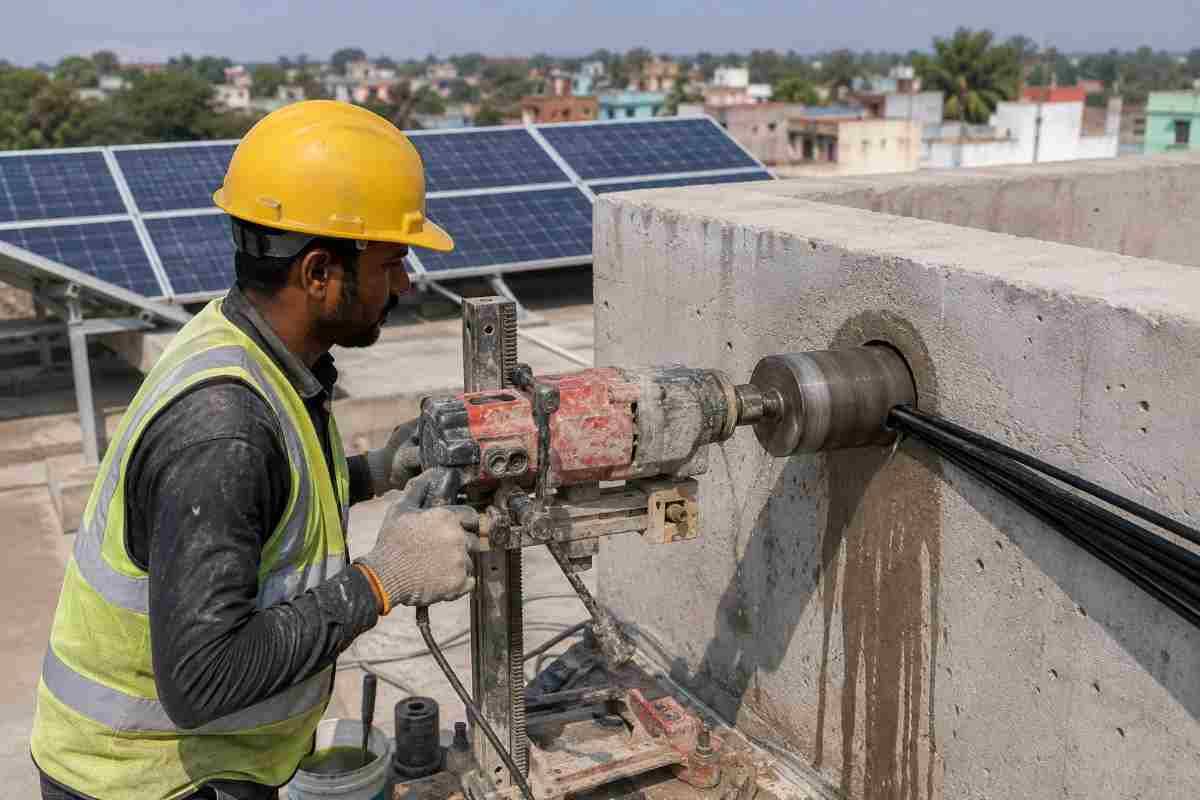
Rooftop solar is spreading quickly across Bihar. Homeowners, schools, hospitals, warehouses and small factories in and around Mokama are moving to solar to cut electricity bills and get more reliable power. A solar plant looks simple from the outside: panels on the roof, an inverter on the wall, a meter downstairs. But the cables that connect them have to pass through concrete slabs and brick or RCC walls somewhere, and how that passage is made affects the safety, appearance and life of the whole system.
This is where core cutting for solar panel cable entry holes comes in. At Core Cutting India (https://corecuttingindia.com/), we help building owners and solar installers in Mokama get clean, accurate, vibration-free holes for DC cables, AC cables, earthing conductors and conduits. Call us on +91 70096 79903 for a quick consultation.
Why Solar Installations Need Cable Entry Holes
A rooftop solar system has several electrical runs that need a path from the roof to the interior:
- DC cables from the solar panels (strings) to the inverter
- AC cables from the inverter to the distribution board or net meter
- Earthing and lightning arrestor conductors that run from the roof to ground pits
- Communication or monitoring cables, such as Wi-Fi dongles or sensor wires, in larger systems
Cables can sometimes run along the outside of a building and enter through an existing opening, but this is rarely ideal. Exposed cables suffer UV damage, rain, heat and rodent attacks. A properly planned entry hole lets you route cables through a protective sleeve or conduit directly into a service shaft, utility room or inverter room. The result is neat, safe and professional.
What Is Core Cutting?
Core cutting, also called core drilling or diamond drilling, is a method of making perfectly round, clean holes in concrete, reinforced cement concrete (RCC), brick, stone and masonry. A hollow cylindrical drill bit with industrial diamond segments on its cutting edge is mounted on a core drilling machine. As the bit rotates, the diamonds grind through the material, and water is fed to the cutting surface to cool the bit and flush out slurry. A solid cylinder of concrete, called the “core”, is left inside the bit and removed when drilling finishes.
Compared with a hammer drill, a chisel or a breaker, core cutting is much more precise. It does not shatter the surrounding concrete, which is important when you are working on a finished roof slab that must stay waterproof.
Why Core Cutting Is Better Than Traditional Methods for Solar Cable Holes
Some installers still try to make holes by chipping with a hammer and chisel or using an impact drill with a large bit. This causes real problems:
1. Cracks and micro-fractures. Impact force travels through concrete and can create hairline cracks around the opening. On a roof slab, these cracks become leak paths during the monsoon.
2. Damaged rebar cover. Rough breaking can expose or loosen steel reinforcement, leading to corrosion over time.
3. Uneven, oversized holes. Chiselled openings are irregular, and filling them properly is difficult. You end up with gaps that let in water, insects and dust.
4. Noise, vibration and dust. In occupied homes, offices and hospitals, impact drilling is disruptive. Wet core drilling is quieter and produces far less airborne dust.
5. Time and rework. A messy opening takes more time to patch and waterproof, and often needs repair work afterward.
Core cutting avoids nearly all of these issues. The hole is round, smooth-walled and exactly the size you specified, so sleeves, glands and sealants fit snugly.
Why Mokama Buildings Have Specific Requirements
Mokama, in the Patna district of Bihar, sits in the Ganga plains. That setting brings conditions that matter for solar cable penetrations:
- Heavy monsoon rainfall and high humidity. Any hole through a roof or terrace slab must be sealed carefully. Poor waterproofing will lead to seepage, damp patches and corroded fittings.
- Hot summers and strong sun. Cables and conduits on exposed roofs are subject to thermal expansion and UV exposure. Entry holes should allow protected, UV-resistant routing.
- A mix of building types. Mokama has older load-bearing masonry houses, newer RCC-framed homes, commercial shops, schools and industrial or warehouse structures. Each type needs a slightly different core cutting approach.
- Dust and general site conditions. A water-fed system keeps dust controlled, which is important when you are working near families, shops or sensitive equipment.
A local, experienced core cutting team understands these conditions and plans each hole accordingly.
Where Cable Entry Holes Are Typically Cut
Depending on the building and the system layout, we commonly cut holes in:
Roof or terrace slabs. Many installers run DC cables straight down through the slab near the panel array into a shaft or a top-floor room. This is the shortest route and keeps the cable length (and voltage drop) low.
Parapet and outer walls. If the inverter is mounted on an exterior or stairwell wall, a horizontal hole through the parapet or wall lets cables pass cleanly.
Inverter room walls. In larger commercial plants, cables move through internal walls from the inverter room to the LT panel.
Floor slabs for vertical risers. In multi-storey buildings, vertical cable routes may pass through several floor slabs.
Boundary or equipment room walls. For earthing conductors and outdoor cable runs, holes may be needed in compound walls or pump and generator rooms.
Common Hole Sizes for Solar Cable Entry
The right diameter depends on the number and thickness of cables, the type of conduit or sleeve, and any future expansion. As a general guide:
| Application | Typical Core Diameter |
|---|---|
| Single DC string pair (2 solar cables) in a small conduit | 25 mm to 40 mm |
| Multiple DC strings in one sleeve | 50 mm to 75 mm |
| AC cable from inverter to DB | 40 mm to 75 mm |
| Earthing strip or conductor passage | 25 mm to 50 mm |
| Larger commercial cable bundles or spare capacity | 100 mm to 150 mm |
These figures are indicative only. The right size depends on cable specifications and your solar installer’s design, so always confirm with the installer before drilling. A good practice is to cut slightly larger than the immediate need and fit a sleeve, leaving room for an extra cable later. It is far easier to size correctly the first time than to cut again.
The Core Cutting Process for Solar Cable Holes: Step by Step
Here is how a professional job is usually carried out:
1. Site Inspection and Marking
The team inspects the roof, wall or slab, discusses the cable route with the owner or solar installer, and marks the exact hole positions. The goal is to find a spot that is accessible, structurally safe and convenient for the cable path.
2. Scanning for Rebar and Hidden Services
Before drilling, it is good practice to check for reinforcement bars, electrical conduits, water pipes and other embedded items. Where available, rebar detectors or scanners are used. Cutting through a structural rebar or a live conduit can cause serious damage, so this step should never be skipped.
3. Machine Setup and Anchoring
The core drilling machine is fixed on a stand and anchored to the surface, either with a vacuum base or an anchor bolt, so it stays stable and the hole is perfectly straight. Where holes are drilled horizontally or at an angle, the setup is adjusted accordingly.
4. Wet Drilling
Water is supplied to the bit while drilling. This cools the diamond segments, extends bit life and controls dust. The slurry is collected and managed so it doesn’t stain walls or flow into living spaces.
5. Core Removal and Cleaning
When the bit passes through, the concrete core is removed. The hole is cleaned, slurry is wiped away and the surface is made ready for sleeving.
6. Sleeve Installation and Sealing
A PVC or HDPE sleeve or conduit is inserted, cables are pulled through, and the gap is sealed. On roof slabs, the opening is often finished with waterproof sealant, a non-shrink grout or a cable gland, plus a rain hood or an upstand where needed, so water cannot enter. In a humid, high-rainfall area like Mokama, this finishing step is as important as the cut itself.
Waterproofing: The Part You Should Never Ignore
A roof penetration is a potential leak point. Even a perfect core cut can cause seepage if the sealing is poor. Best practices include:
- Use a sleeve with a slight upstand above the roof level, so rainwater runs away from the opening rather than into it.
- Seal around the sleeve with polyurethane or other suitable waterproof sealant and non-shrink grout.
- Use cable glands or fire- and water-rated sealing compounds at the point where the cable exits the sleeve.
- Add a drip loop in the cable just before it enters the sleeve so that water follows the cable downward instead of into the hole.
- Inspect before and after the monsoon. Small gaps can open as materials age.
Your solar installer and the core cutting team should agree on the sealing method before work starts, so nothing is left to chance.
Safety and Structural Considerations
Concrete is not just a barrier. It is part of your building’s structure. A good core cutting contractor will think about the following:
Avoid cutting through structural members. Beams, columns and main load-bearing elements should not be drilled unless an engineer has approved it.
Keep a safe distance from edges and from other holes. Holes placed too close together or too close to an edge can weaken the concrete.
Protect live electrical systems. Make sure existing wiring is identified and isolated where needed before drilling.
Use proper PPE and trained operators. Wet drilling near electricity requires careful handling, such as using a residual current device (RCD) and keeping electrical connections clear of water.
Check with an engineer for large or multiple holes. For commercial and industrial buildings, particularly where several large openings are planned, a structural engineer’s input is wise.
Benefits of Professional Core Cutting for Your Solar Project
Choosing a professional service rather than improvising on site brings clear advantages:
- Clean, precise holes that match your sleeve or conduit size
- Minimal damage to surrounding concrete and finishes
- Lower noise and dust, suitable for homes, shops, schools and hospitals
- Better waterproofing outcomes, since the hole edges are smooth
- Faster completion, so the solar installation stays on schedule
- A neater, safer cable layout that looks professional and passes inspection more easily
- Longer system life, because cables are protected from sun, rain and pests
Who Needs This Service in Mokama?
Core cutting for solar cable entry is useful for:
- Homeowners installing a rooftop solar plant under a subsidy scheme or a private installation
- Solar installers and EPC contractors who want a reliable drilling partner for multiple sites
- Schools, colleges and hospitals adding solar to cut running costs
- Shops, offices and commercial buildings upgrading to renewable power
- Warehouses, cold storage and factories with larger rooftops and cable bundles
- Housing societies and apartment owners planning shared solar systems
If you are in Mokama or the nearby areas of Patna district and want solar cable holes made cleanly, a call to our team is the quickest way to get started.
Tips Before You Book a Core Cutting Service
To make the job smooth and cost-effective:
- Finalise the cable route with your solar installer first. Changing the position after marking wastes time.
- Share the number of cables and the conduit size. This helps in choosing the right bit diameter.
- Tell the team about the slab thickness and the building type. Thicker slabs and RCC need more time and a different bit selection than brick walls.
- Ensure water and power access. Wet drilling needs both. Let us know in advance if either is limited.
- Clear the work area. Move furniture, vehicles and fragile items out of the way, and cover nearby equipment.
- Plan the waterproofing materials in advance. Keep sealant, sleeves and glands ready so the hole can be finished immediately after drilling.
- Ask for a quote based on the number and size of holes. Pricing generally depends on diameter, depth and site conditions.
Frequently Asked Questions
Can core cutting damage my roof?
When done by trained operators with proper scanning and wet drilling, core cutting causes very little damage. It is far gentler than chiselling or impact drilling. The key is correct sealing afterward.
How long does it take to cut a hole?
A typical hole in a standard slab or wall takes a short time, usually minutes rather than hours, depending on the diameter, concrete strength and reinforcement. Setup and finishing add some time.
Is core cutting messy?
Wet drilling produces slurry, but it is controlled and can be cleaned. It generates much less airborne dust than dry methods.
What if the drill hits a rebar?
Diamond bits can cut through reinforcement, but it should be avoided where possible, especially in beams and columns. Scanning before drilling helps position the hole between bars. Any rebar cutting should follow engineering guidance.
Can I add more cables later?
Yes, if you choose a slightly larger sleeve at the start. Many owners plan one spare sleeve for future expansion, battery storage or monitoring cables.
Do I need permission before cutting holes in my building?
For your own home, you generally decide yourself, but for apartments, societies or commercial buildings, check with the management or structural consultant. Large or multiple holes may need professional approval.
Is core cutting suitable for old buildings in Mokama?
Yes. It is actually a better choice for older masonry or aging concrete because it creates less vibration and reduces the risk of cracking.
How do I get a quote?
Share the building type, number of holes, diameters and approximate slab or wall thickness. Call +91 70096 79903 or visit https://corecuttingindia.com/ for details.
Why Choose Core Cutting India?
Core Cutting India (https://corecuttingindia.com/) offers professional diamond core drilling and concrete cutting services for residential, commercial and industrial projects. For solar projects, we focus on what installers and owners care about: accuracy, cleanliness, speed and a finish that supports good waterproofing.
What you can expect from us:
- Precise, smooth-walled holes in RCC, brick and masonry
- A wide range of core diameters for conduits, sleeves and cable bundles
- Wet, low-dust drilling that suits occupied buildings
- Coordination with your solar installer so that holes match your design
- Clear communication on scope, timing and site requirements
Whether it is one hole for a small home system or dozens for a commercial plant, we treat each site with care.
Final Thoughts
Solar power is a long-term investment, and the details of installation decide how well that investment performs. A clean, correctly sized, well-sealed cable entry hole protects your cables, keeps rainwater out and keeps your building structurally sound. In a place like Mokama, with heavy monsoons and intense summer heat, it is worth getting this detail right the first time.
If you are planning a rooftop solar installation, talk to a core cutting specialist early, ideally while the system layout is being finalised. It will save you time, rework and avoidable leaks later.
Get in Touch
Need core cutting for solar panel cable entry holes in Mokama?
📞 Call or WhatsApp: +91 70096 79903
🌐 Website: https://corecuttingindia.com/
Share your building details, and our team will guide you on the best hole size, method and finishing for your solar project.