
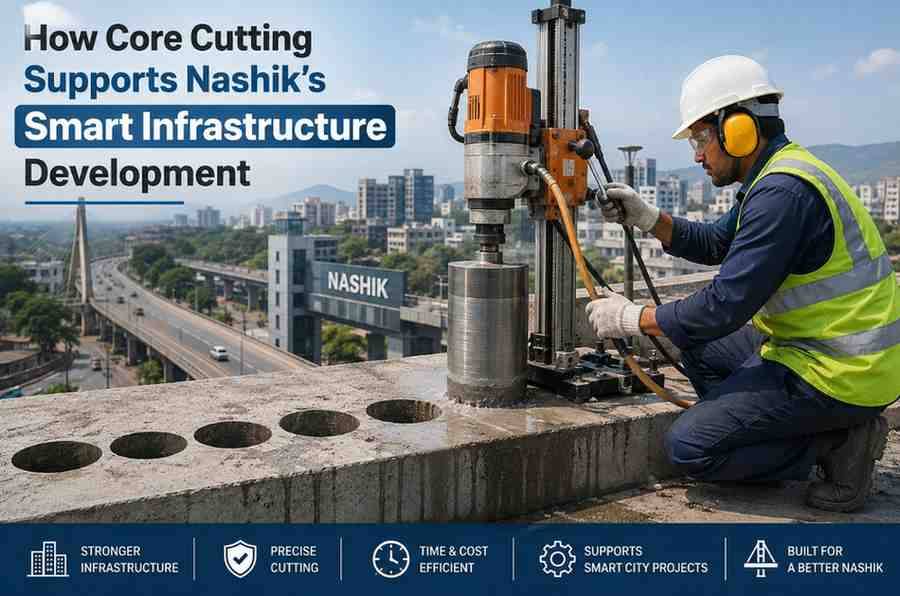
Nashik is changing fast. Once known mainly for its vineyards and temples, the city is now becoming one of Maharashtra's most active urban development hubs. Roads are widening, underground utility networks are expanding, and new residential and commercial complexes are rising across the city. Behind this visible transformation lies a quieter, more technical process that rarely gets the credit it deserves: core cutting.
At Core Cutting India ([email protected]), we've watched this shift closely. Every smart pole, every underground cable duct, every retrofitted water pipeline, and every reinforced concrete opening for HVAC or plumbing work depends on precise, controlled cutting of concrete and masonry. Without it, none of Nashik's smart infrastructure ambitions would be practically achievable. In this blog, we'll walk through what core cutting actually involves, why it has become indispensable to Nashik's development story, and where it fits into the city's ongoing Smart City Mission projects.
What Is Core Cutting, Exactly?
Core cutting is a construction technique used to create precise circular or straight openings in concrete, masonry, or reinforced structures. Using diamond-tipped blades or core bits mounted on hydraulic or electric machines, contractors can cut through walls, floors, slabs, and even roads with minimal vibration, dust, and structural disturbance.
Unlike traditional demolition methods that rely on hammering or jackhammering, core cutting is controlled and non-destructive to surrounding structures. It allows engineers to create exact openings — whether for a pipe, cable duct, ventilation shaft, or inspection chamber — without compromising the structural integrity of the building or road around it.
There are broadly two related techniques used in this line of work:
- Core drilling, which creates circular holes, typically for pipes, cables, or bolts.
- Core cutting (wall/floor sawing), which creates straight-line openings for doors, windows, expansion joints, or larger utility passages.
Both techniques are essential in modern infrastructure work, and both are widely used across Nashik's expanding urban landscape.
Why Nashik Needs This Kind of Precision Work
Nashik's growth isn't happening on empty land alone. Much of it is layered on top of existing roads, buildings, and utility networks that were laid out decades ago. <cite index="2-1">The city's smart city plan itself is built around three approaches: greenfield development, retrofitting the old city, and pan-city initiatives, with retrofitting work focused on renovating heritage structures in the older parts of town</cite>. That retrofitting work is exactly where core cutting becomes critical — you can't build new utility lines or fit modern systems into old structures by tearing them down. You need surgical precision instead.
<cite index="4-1">The Smart Cities Mission itself is built around a set of core infrastructure priorities — reliable water supply, assured electricity, sanitation and solid waste management, efficient urban mobility, robust IT connectivity, and safety systems for citizens</cite>. Nearly every one of these priorities requires some form of concrete or road cutting during implementation, whether it's laying new water pipelines, installing smart streetlight cabling, or creating underground ducting for fibre-optic networks.
<cite index="1-1">Under the Smart City Mission, Nashik's development corporation (NMSCDCL) has overseen 21 projects worth roughly Rs 10 billion, with 18 of them worth about Rs 6.50 billion already completed and the rest still in progress</cite>. Projects of this scale — spanning road redevelopment, riverfront beautification, smart lighting, and utility upgrades — all rely on contractors who can cut through existing infrastructure cleanly and reinstate it without long-term damage or disruption to public life.
Where Core Cutting Fits Into Smart City Projects
1. Underground Utility Installation
Smart cities depend on invisible infrastructure just as much as visible landmarks. Fibre-optic cables for smart surveillance systems, sensor networks for traffic management, and communication lines for public Wi-Fi all need to be routed underground or through existing structures. Core cutting allows crews to create clean access points for cable ducts and conduits without excavating entire stretches of road.
<cite index="3-1">Nashik's Smart City program has floated tenders for redevelopment of major and minor roads with infrastructure utility services, including water supply and sewerage components, in the city's Area Based Development zone</cite>. Work of this nature typically requires cutting through existing road surfaces and structures to lay or upgrade pipelines — a task where precision cutting reduces both cost and disruption compared to full-scale digging.
2. Water Supply and Sewerage Upgrades
<cite index="3-1">Nashik has also seen requests for proposals covering redevelopment of water infrastructure and de-silting work along the Godavari River as part of its smart city plan</cite>. Upgrading old pipe networks or installing new water metering systems often means cutting into existing concrete chambers, slabs, or road surfaces to access buried lines. Core cutting keeps these interventions localized, so surrounding roads and structures stay intact.
3. Smart Lighting and Electrical Infrastructure
<cite index="3-1">Among the city's smart city initiatives has been a proposal for implementing smart LED street lighting across the Area Based Development zone</cite>. Installing these systems means running new cabling through poles, footpaths, and junction boxes — work that frequently calls for precise core-drilled holes rather than broad trenching.
4. Riverfront and Heritage Zone Development
<cite index="3-1">The Godavari Riverfront Development project, which includes beautification and infrastructure components, has also been part of Nashik's smart city tendering process</cite>. Projects along heritage and riverfront zones demand extra care, since surrounding structures are often old or culturally significant. Core cutting's low-vibration, controlled nature makes it far safer for this kind of sensitive retrofitting than conventional demolition.
5. Building and Commercial Construction
Beyond public infrastructure, Nashik's private construction sector — from residential towers to commercial complexes — increasingly relies on core cutting for plumbing shafts, HVAC ducting, elevator installations, and electrical risers. As the city verticalizes, contractors need cutting methods that don't compromise a building's structural columns or load-bearing walls, and core cutting delivers exactly that.
Why Core Cutting Is Better Suited to Smart Infrastructure Than Traditional Methods
Traditional breaking methods — hammering, chiselling, or heavy demolition — tend to create larger, uneven openings, generate excess debris, and risk hairline cracks that weaken nearby structures over time. For a city trying to modernize without constantly rebuilding from scratch, that approach is neither efficient nor sustainable.
Core cutting offers several practical advantages that align directly with smart infrastructure goals:
- Minimal structural disruption: Openings are precise, so surrounding concrete and reinforcement remain undamaged.
- Reduced noise and vibration: Especially important in dense urban zones, near heritage sites, or close to operational buildings.
- Faster turnaround: Roads and public spaces can be reopened sooner, reducing disruption to daily city life.
- Lower dust and debris generation: Modern wet-cutting techniques control dust, which matters for air quality in busy urban corridors.
- Cost efficiency at scale: Localized cutting avoids the cost of large-scale excavation or demolition and rebuild.
- Compatibility with retrofitting: Since much of Nashik's smart city work involves upgrading existing infrastructure rather than building fresh, core cutting is naturally suited to this retrofit-heavy approach.
The Role of Skilled Core Cutting Contractors in Nashik's Growth
As Nashik's infrastructure projects multiply — spanning road redevelopment, utility modernization, and heritage-zone upgrades — the demand for experienced core cutting contractors has grown alongside them. This isn't just about owning the right machinery. It's about understanding structural drawings, knowing how to avoid embedded rebar and utility lines, and coordinating with civil engineers to ensure every cut supports the broader project timeline rather than delaying it.
At Core Cutting India, our teams work across residential, commercial, and public infrastructure projects in and around Nashik, offering:
- Concrete core drilling for pipes, cables, and structural inspections
- Wall and floor sawing for doors, windows, and utility openings
- Road cutting for pipeline and cable duct installation
- Precision cutting for HVAC, plumbing, and electrical risers
- Support for retrofitting and heritage-sensitive structures
Every project we take on is approached with the understanding that smart infrastructure isn't just about new technology — it's about the quality of the groundwork that makes that technology possible.
Looking Ahead: Core Cutting as a Foundation for Nashik's Smart Future
<cite index="1-1">With most of Nashik's Smart City Mission projects now complete and the remaining ones being handed over for continued management by the Nashik Municipal Corporation, the city's focus is shifting from initial rollout to long-term maintenance and expansion</cite>. That means more upgrades, more retrofitting, and more precision work in the years ahead — not less. As Nashik continues integrating IoT-based traffic systems, expanding its water and sewerage networks, and modernizing its road infrastructure, core cutting will remain one of the quiet but essential techniques making that progress physically possible.
Smart cities aren't built purely through software and sensors. They're built through the careful, physical work of adapting existing concrete, roads, and structures to carry new systems — and that work depends on precision cutting done right.
If you're planning a construction, infrastructure, or utility project in Nashik and need reliable core cutting or core drilling services, reach out to Core Cutting India at [email protected]. Our experienced teams are ready to support your project with safe, efficient, and precise cutting solutions built for the demands of modern infrastructure.
People Also Ask
What is core cutting used for in construction? Core cutting is used to create precise openings in concrete, masonry, or reinforced structures for pipes, cables, ducts, doors, windows, and utility installations without damaging the surrounding structure.
How is core cutting different from core drilling? Core drilling creates circular holes, typically for pipes or cables, while core cutting (or wall/floor sawing) creates straight-line openings for larger passages like doors, windows, or expansion joints.
Why is core cutting important for smart city projects? Smart city projects require underground utility installation, smart lighting cabling, and retrofitting of existing structures — all of which depend on precise, low-disruption cutting methods like core cutting.
Is core cutting safe for existing buildings and structures? Yes, when performed by experienced professionals following structural drawings, core cutting is a controlled, low-vibration technique that avoids damaging load-bearing elements or embedded utilities.
How much does core cutting cost in Nashik? Costs vary based on the thickness of the material, the diameter or length of the cut, site accessibility, and project scale. Contact Core Cutting India at [email protected] for a project-specific quote.