
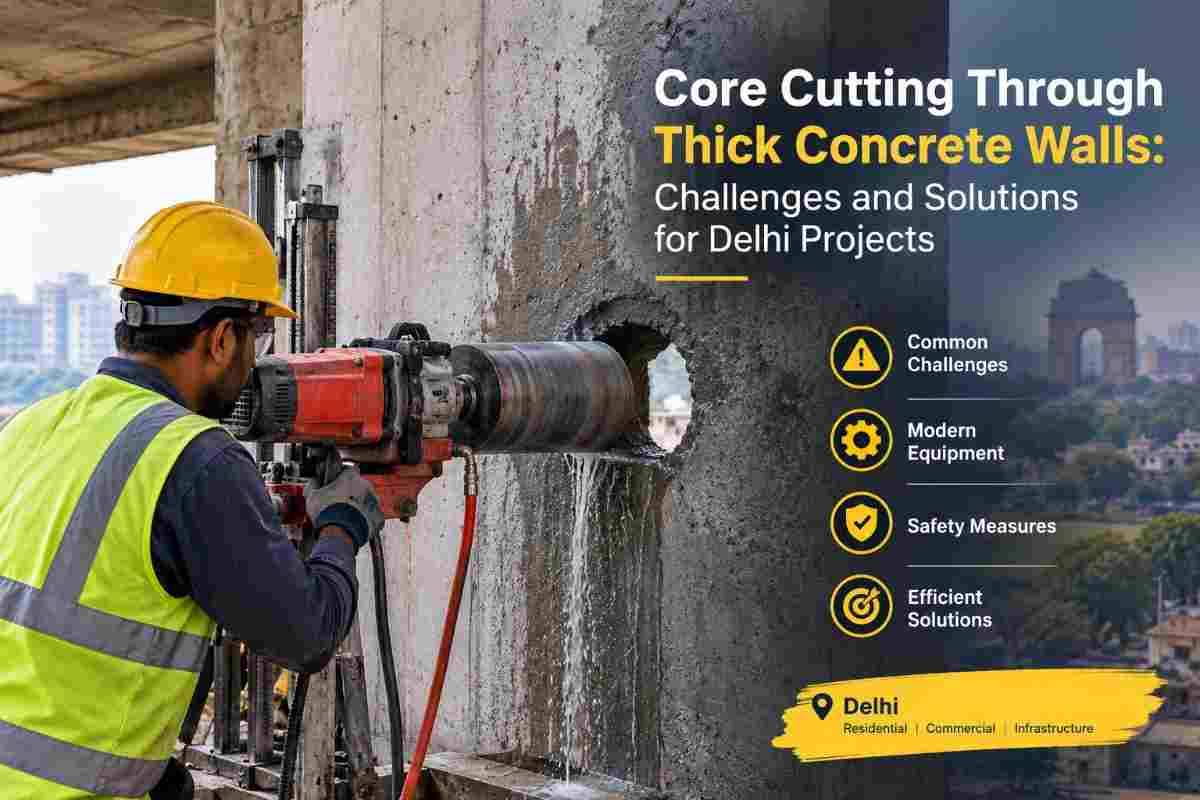
Delhi never stops building. Metro corridors extend, commercial towers rise in Connaught Place, Nehru Place and Aerocity, and residential societies across Dwarka, Rohini and Saket keep upgrading their infrastructure. Almost every one of these projects eventually runs into the same problem: a thick, reinforced concrete wall sits exactly where a pipe, duct, cable or opening needs to go.
That is where core cutting becomes essential. Done well, it produces clean, precise openings with minimal vibration and no damage to the surrounding structure. Done badly, it leads to cracked slabs, severed reinforcement, project delays and safety risks.
This guide explains why thick concrete walls are hard to cut, what makes Delhi projects especially demanding, and which solutions deliver safe, accurate results. It draws on the practices followed by professionals at Core Cutting India.
What Is Core Cutting and Why Is It Used?
Core cutting, also called core drilling, uses a hollow cylindrical drill bit with diamond segments on its cutting edge. The bit rotates at controlled speed, usually with water as coolant, and grinds through concrete, leaving a clean circular hole and a solid cylinder of material called the “core.”
Unlike hammer drilling or chiselling, core cutting does not rely on impact. This matters because impact creates vibration, which can cause micro-cracking in surrounding concrete, loosen adjacent fixtures and disturb occupants. Core cutting produces:
- Smooth, accurate hole walls with tight tolerances
- Minimal vibration and structural stress
- Lower noise than percussive methods
- The ability to cut through reinforcement steel in one pass
- Holes from about 10 mm up to 1,000 mm or more in diameter, depending on equipment
Typical applications include openings for plumbing and drainage, HVAC ducts, electrical conduits, fire-fighting lines, cable trays, anchor bolt holes, and test cores taken for strength evaluation.
Why Thick Concrete Walls Are Difficult to Cut
A 150 mm partition and a 600 mm shear wall are completely different jobs. As thickness increases, so does complexity. Here is why.
1. Heavy Reinforcement Density
Thick structural walls, especially in high-rise buildings, basements and retaining structures, are heavily reinforced with steel bars arranged in multiple layers. Cutting through concrete is one thing, but hitting dense rebar mid-drill changes everything. Bit wear accelerates, cutting speed falls, and the operator must manage heat and torque carefully.
2. Bit Wander and Alignment Drift
Over a long cutting depth, even a small angular deviation at the surface becomes a noticeable offset at the exit point. On a 500 mm wall, a one-degree error can mean the hole emerges several millimetres off target. For services that must align on both sides, this is unacceptable.
3. Heat and Slurry Management
Deep cuts generate considerable heat and abrasive slurry. If water flow is insufficient, bit segments glaze over, cutting efficiency drops, and bits can seize in the hole. Slurry also needs proper containment, especially in finished interiors.
4. Core Jamming and Extraction
A long core can bind inside the barrel, particularly when cutting through reinforced sections. Removing a heavy, stuck core from a deep hole is both a technical and a safety challenge.
5. Hidden Embedded Elements
Walls often contain items that are invisible from the surface: electrical conduits, post-tensioned cables, embedded pipes and previous repair patches. Cutting into a post-tensioned tendon, for example, can be dangerous and can compromise the structure.
6. Equipment Demands
Thick walls need higher-powered rigs, rigid stands, extension barrels and sufficient anchoring. A lightweight handheld unit is simply not appropriate for deep, large-diameter cuts.
Challenges Specific to Delhi Projects
Beyond the engineering difficulties, Delhi presents its own set of conditions that contractors must plan around.
Dense Urban Sites and Limited Access
Many Delhi projects take place in congested areas such as Old Delhi, Karol Bagh, Lajpat Nagar and Chandni Chowk, where lanes are narrow and buildings are tightly packed. Moving rigs, generators and water tanks to the work location can be as difficult as the cutting itself. In older structures, work often happens inside occupied buildings, making dust and noise control critical.
Older Buildings with Unknown Structural Details
A large share of Delhi’s building stock is decades old. Original drawings may be missing or inaccurate, and past renovations may have added undocumented reinforcement or openings. Cutting without verifying what is inside the wall is a gamble.
Strict Environmental and Pollution Regulations
Delhi’s air quality concerns mean construction activities face dust-control norms and, during certain periods, restrictions under pollution-response measures. Wet core drilling, which suppresses dust at the source, is far better suited to these conditions than dry methods. Contractors need to stay informed about current rules and plan schedules accordingly.
Noise Limits and Working Hours
Residential, hospital, office and educational zones have noise sensitivities and permitted working windows. Core cutting is quieter than breaking, but large rigs and generators still need careful management, and timing work to suit occupants often means night or weekend shifts.
Extreme Weather
Delhi summers can push temperatures past 45°C, while winters bring fog and cold. Heat stresses operators and equipment, and water availability can fluctuate. Monsoon conditions add slippery work surfaces and electrical hazards.
Utility and Water Constraints
Core cutting needs a steady supply of clean water and reliable electricity. On sites with irregular supply, contractors must bring their own water tanks and power backup to prevent stoppages that can cause bit jamming.
Metro, Basement and Infrastructure Work
Delhi’s metro expansion and deep basements in commercial buildings involve very thick diaphragm walls, raft foundations and tunnel linings. These require heavy-duty equipment and experienced crews, because errors are costly and sometimes affect public infrastructure.
Proven Solutions for Core Cutting Thick Concrete Walls
Fortunately, each of these challenges has a well-established solution. Successful projects combine careful planning, the right tools and skilled execution.
Solution 1: Scan Before You Cut
The single most important step is investigation. Ground Penetrating Radar (GPR) and rebar scanners detect reinforcement, conduits, voids and post-tension cables inside concrete. A proper scan lets the team:
- Mark safe cutting positions
- Avoid critical structural bars and tendons
- Reduce surprises, bit damage and rework
- Document findings for the engineer’s approval
For older Delhi buildings with unreliable drawings, scanning is not optional. It is the foundation of safe work.
Solution 2: Get Structural Approval
Large openings and cuts through load-bearing or shear walls should be reviewed by a qualified structural engineer. They can determine whether reinforcement can be cut, whether additional framing or strengthening is needed, and the maximum permissible opening size. Reputable contractors insist on this step rather than treating it as paperwork.
Solution 3: Choose the Right Equipment
Equipment should match the job:
- Rig-mounted core drills with a rigid column and base provide stability for deep, large-diameter cuts.
- Anchored or vacuum-mounted stands prevent movement that causes wandering and bit damage.
- High-torque, multi-speed motors allow speed adjustment for concrete versus steel.
- Extension barrels and long-reach bits handle walls much thicker than a standard bit length.
- Quality diamond bits with segments matched to the material, softer bonds for hard, abrasive concrete and harder bonds for softer material, extend life and improve speed.
Solution 4: Use Wet Core Drilling
Wet drilling is the standard for thick walls, and in Delhi it also helps meet dust-control expectations. Water cools the bit, flushes cuttings and suppresses airborne dust. A good setup includes a controlled water feed, a slurry collection ring or wet vacuum, and protection for floors and finishes. This keeps the site clean and the cut efficient.
Solution 5: Control Alignment from the Start
Accuracy begins at the first millimetre. Operators should:
- Mark the centre point and diameter precisely
- Start with a light pilot cut so the bit seats properly
- Verify verticality or horizontality with a level during the first few centimetres
- Maintain steady, moderate feed pressure rather than forcing the bit
For deep holes where entry and exit must align, some teams drill from both sides and meet in the middle, or use guide jigs for tight tolerances.
Solution 6: Manage Rebar Intersections Skilfully
When the bit meets steel, experienced operators reduce feed pressure, adjust speed and keep water flowing. This prevents glazing and protects the bit. Diamond segments built for reinforced concrete are essential. Cutting any structural bar should be pre-approved and documented.
Solution 7: Handle Core Extraction Safely
For long or large-diameter cores, plan extraction in advance. Options include breaking the core into shorter lengths by stopping and removing in stages, using core-catcher accessories, and using lifting aids for heavy cylinders. Never allow a heavy core to drop unsupported, especially on upper floors or over occupied areas.
Solution 8: Consider Alternatives for Very Large Openings
When the opening is too large for conventional core drilling, other diamond methods become appropriate:
- Wall saw cutting produces large rectangular openings such as doors and windows in thick walls.
- Wire saw cutting handles massive sections, bridge elements and structures where blade saws cannot reach.
- Combination techniques use core holes at the corners of a wall-saw opening to prevent over-cutting and ensure clean edges.
A contractor with all of these capabilities can recommend the best technique rather than forcing one method onto every job.
Solution 9: Prioritise Safety
Every thick-wall cut carries risks: electric shock, falling cores, slurry slips, noise, dust and structural instability. Good practice includes:
- Ground-fault protected power supply and well-routed cables
- Barricading below and around the cutting zone
- PPE: helmets, safety shoes, gloves, eye and ear protection, and respirators where needed
- Clear communication with building occupants
- Trained operators who understand both the equipment and the structure
Solution 10: Plan Logistics for Delhi Conditions
Smart planning offsets Delhi’s site constraints:
- Schedule noisy work during permitted hours and coordinate with building management
- Bring portable water tanks and generators for sites with unreliable utilities
- Use compact, modular rigs for tight access in older neighbourhoods
- Monitor regulatory notices on construction restrictions and adjust timelines
- Protect finished interiors with sheeting and slurry containment
Step-by-Step Process: How a Professional Team Approaches a Thick Wall
- Site survey: Understand wall thickness, access, utilities and surroundings.
- Scanning: Use GPR or rebar detection to map hidden elements.
- Engineering review: Confirm that the proposed openings are structurally acceptable.
- Marking: Mark exact centres and diameters, and confirm with the client.
- Setup: Anchor the rig, connect water and power, and set containment.
- Cutting: Start with a pilot cut, monitor alignment, and adjust feed through steel and concrete.
- Extraction: Remove cores safely and manage slurry.
- Finishing: Inspect the hole, clean up, and hand over with documentation.
Choosing the Right Core Cutting Contractor in Delhi
The contractor you choose often determines whether a project goes smoothly. When evaluating providers, look for:
- Demonstrated experience with thick, reinforced walls and large diameters
- Modern equipment including scanners, rigs and a range of bit sizes
- Trained, supervised operators rather than casual labour
- A clear safety record and process
- Transparent quotations that explain scope, diameter, depth and any extras
- Ability to handle Delhi NCR logistics, including access, timing and regulatory awareness
- Multiple techniques such as core drilling, wall sawing and wire sawing, so the method fits the job
Specialist firms like Core Cutting India focus specifically on precision concrete cutting, which is what thick-wall work demands.
Common Mistakes to Avoid
- Skipping the scan and relying on outdated drawings
- Using undersized equipment for deep or large-diameter cuts
- Insufficient water leading to overheated, glazed bits
- Rushing the start, causing misalignment that grows with depth
- Cutting structural steel without approval
- Ignoring slurry and dust control in occupied buildings
- Choosing purely on lowest price, which often leads to rework, damage and delays
Frequently Asked Questions
How thick a concrete wall can be core drilled?
With the right rig, extension barrels and bits, walls well over a metre thick can be drilled. Practical limits depend on diameter, equipment and access from both sides.
Is core cutting better than breaking concrete with a hammer?
For precision openings, yes. Core cutting produces clean, accurate holes with far less vibration and damage to the surrounding structure.
Does core cutting damage the building’s structure?
When planned properly, with scanning and engineering approval, it does not. Problems arise when cutting is done blindly, especially through reinforcement or post-tensioned elements.
What is the difference between wet and dry core drilling?
Wet drilling uses water to cool the bit and suppress dust, making it ideal for thick, reinforced concrete. Dry drilling is limited to lighter work and generates more dust.
How long does it take to core drill through a thick wall?
Time depends on thickness, diameter, reinforcement density and concrete strength. A small hole might take minutes, while a large hole through a heavily reinforced wall can take hours.
Can core cutting be done in occupied buildings?
Yes. Because it is relatively low-vibration and, with wet methods, low-dust, it suits occupied offices, hospitals and homes, provided slurry and noise are managed.
What affects the cost of core cutting in Delhi?
Hole diameter, wall thickness, reinforcement, site access, working height, working hours and the number of holes all influence pricing. A site visit is the best way to get an accurate quote.
Conclusion
Cutting through thick concrete walls is a precision task, not a brute-force one. Heavy reinforcement, alignment drift, heat, hidden embedded elements and the practical realities of Delhi’s dense, regulated, weather-extreme environment all make it demanding. Yet each of these challenges can be controlled through scanning, engineering review, the right equipment, wet drilling, disciplined technique and careful site planning.
If your upcoming project involves openings in thick RCC walls, working with experienced specialists will save time, protect your structure and keep your site safe. To discuss your requirements, visit Core Cutting India and request a site assessment.