
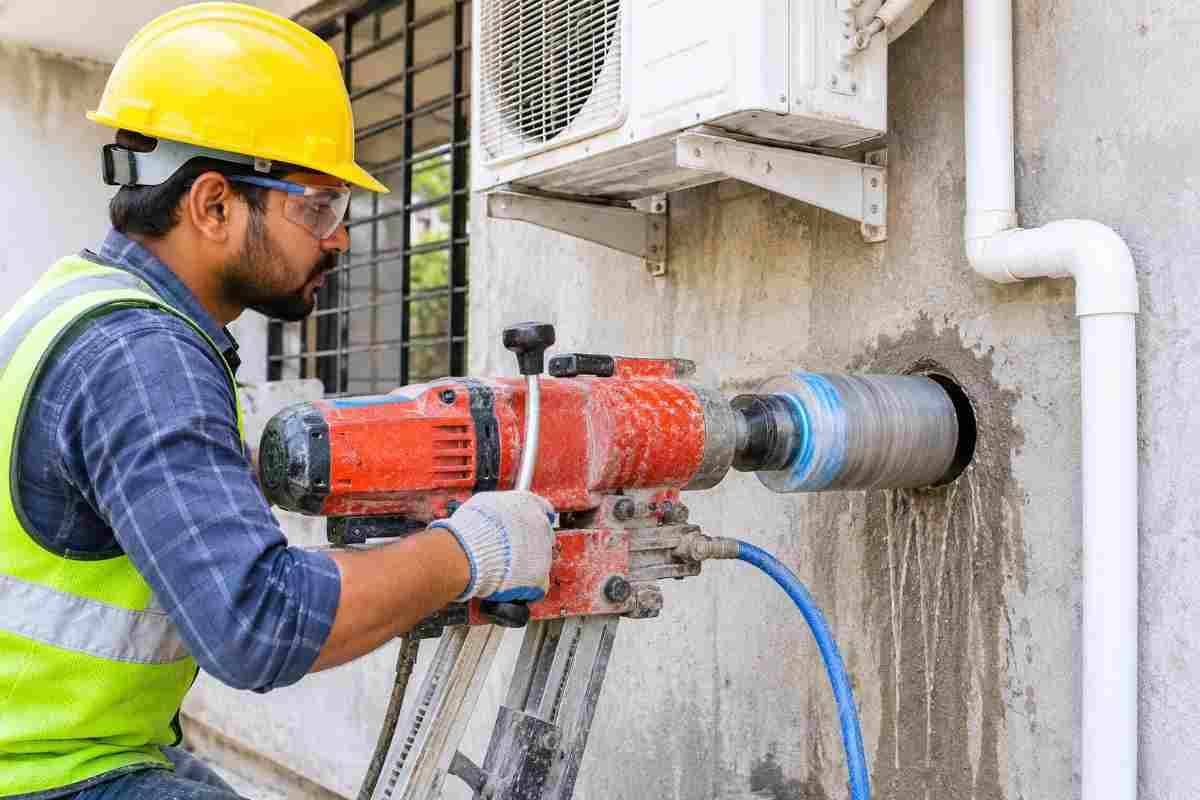
Installing an air conditioner in a reinforced cement concrete (RCC) building is not like installing one in a brick-and-plaster room. The wall is dense, steel-reinforced and unforgiving. If the AC drain pipe has to pass through it, one wrong method can leave cracks, damaged rebar, ugly broken edges and a leaking, badly sloped drain.
That is why core drilling for AC drain pipes in Hisua RCC walls has become the preferred method among homeowners, builders and interior contractors. In this guide from Core Cutting India, you will learn how the process works, how to choose the right hole size, how to maintain a proper slope, what affects the cost, and what to check before hiring a contractor.
Why AC Drain Pipes Need Proper Holes in RCC Walls
Every split or window AC removes moisture from the air as it cools. That moisture collects as condensate and must drain out of the building. In a typical installation, a drain pipe runs from the indoor unit to the outside through a hole in the wall.
In older load-bearing brick houses, a hole could be knocked through with a chisel. In RCC construction, which is common in new apartments, shops, offices, schools, clinics and hospitals in and around Hisua, the wall is made of concrete and steel. A chisel or hammer drill can do real damage here:
- Cracks spreading from the hole. Impact tools send shock through the concrete and can cause hairline cracks that widen over time.
- Weakened structure. Random chipping can expose or cut reinforcement bars.
- Rough, oversized openings. These are hard to seal and let in water, insects and dust.
- Poor drainage. A hand-made hole rarely holds a consistent slope, so water can pool or flow back.
Core drilling solves all of these problems with a clean, accurate, vibration-controlled cut.
What Is Core Drilling?
Core drilling, also called core cutting, uses a hollow cylindrical drill bit with industrial diamond segments on its cutting edge. The bit is mounted on a core drilling machine and rotates at controlled speed. As it cuts, it grinds through concrete and even steel reinforcement, leaving a perfectly round hole and a solid cylinder of concrete (the “core”) that is removed intact.
Unlike percussion drilling, which hammers material apart, diamond core drilling grinds its way through. That produces:
- A smooth, round and accurate hole
- Minimal vibration and a much lower risk of cracking
- Very little dust when wet drilling is used
- Precise control over diameter and angle
For AC drain lines, this precision is exactly what you need.
Why Hisua RCC Walls Need a Careful Approach
Hisua is seeing steady growth in residential construction, commercial buildings, shops, coaching centres and small institutions. Most of these use RCC frames with concrete or brick infill walls and slabs. In practice, an AC drain hole may pass through:
- Plain concrete or RCC shear walls, which are dense and heavily reinforced
- Beam and column zones, where cutting must be avoided or planned very carefully
- Brick walls with plaster, which are easier but still benefit from clean coring
- Parapet and boundary walls, often used to route the drain outside
Because local climate brings hot summers and a heavy monsoon, AC units run for long hours and condensate output is high. A well-made drain hole with a correct slope matters more here than in milder regions.
Benefits of Core Drilling for AC Drain Pipes
1. Clean, Accurate Holes
The hole matches the pipe diameter closely, so sealing is neat and the finished wall looks professional.
2. Structural Safety
Core drilling limits vibration and cracking. Your RCC wall retains its strength, which matters in a building you plan to own or lease for decades.
3. Dust and Noise Control
Wet core drilling uses water to cool the bit and suppress dust. That keeps your interiors, furniture and paintwork much cleaner, and noise is generally lower than breaker-based methods.
4. Faster Completion
A trained crew can often complete a standard hole in a short time, so your AC installation is not delayed.
5. Better Drainage
Because the hole can be drilled at a controlled slight downward angle, condensate flows out smoothly and does not collect inside the pipe.
6. Neat Finish
There is little to no patch-up work around the hole, which saves on masonry and repainting.
Choosing the Right Hole Size for an AC Drain Pipe
One of the most common questions is what diameter to drill. The answer depends on what will pass through the wall:
- Drain pipe only: A small-diameter hole is usually enough. Many installations use roughly 40 mm to 50 mm for a standard drain pipe, depending on the pipe’s outer diameter and any sleeve.
- Drain pipe plus refrigerant piping and wiring: Many installers bundle the copper pipes, insulation, power cable and drain hose together. In that case a larger hole, often in the range of 65 mm to 80 mm, is common.
- Cassette, ducted or VRF systems: These can require larger or multiple holes, based on the system design.
Always check the pipe’s actual outer diameter and any insulation or sleeve before deciding. A hole that is slightly larger than the pipe makes it easier to fit a PVC sleeve and seal the gap, while a hole that is too tight makes installation difficult.
Tip: Tell your contractor the exact AC model and the pipe bundle you plan to run. They can then recommend the correct bit size for your wall.
Getting the Slope Right
Condensate drains by gravity, so slope is critical. A good AC drain hole is drilled with a slight downward tilt toward the outside of the building. This prevents:
- Water pooling inside the pipe
- Back-flow into the indoor unit
- Overflow that damages false ceilings and walls
- Algae and odour buildup from stagnant water
A skilled operator sets the machine angle before drilling and maintains it through the wall thickness. Using a PVC sleeve in the hole helps hold the pipe steady and protects the concrete edge.
Step-by-Step: How Core Drilling Is Done for AC Drain Pipes
Step 1: Site Inspection and Marking
The team inspects the wall, notes its thickness and type, and marks the hole position on both sides. The position should suit the indoor unit’s drain outlet and allow a natural slope toward the outside.
Step 2: Scanning for Reinforcement and Services
In RCC walls it is wise to check for rebar, electrical conduits and plumbing lines. Marking or scanning avoids cutting something you did not intend to. If steel cannot be avoided, a diamond bit can cut through it, but this should be a deliberate decision.
Step 3: Machine Setup
The core drilling rig is anchored or fixed to the wall using a vacuum base, an anchor bolt or a stand, which keeps the cut straight and stable. A water supply is connected for wet drilling.
Step 4: Drilling
The operator starts at a low speed to create a guiding groove, then increases to working speed. Water flows continuously to cool the bit and flush slurry. The bit cuts through the wall and the concrete core is removed.
Step 5: Cleaning and Finishing
The slurry is wiped up and the hole is cleaned. Edges are checked for smoothness, and the interior is protected from water splash during the job.
Step 6: Sleeve, Pipe and Sealing
A PVC sleeve may be installed, the drain pipe is passed through, and the gap is sealed with suitable sealant or cement mortar so that water and insects cannot enter.
Wet vs. Dry Core Drilling
| Feature | Wet Core Drilling | Dry Core Drilling |
|---|---|---|
| Cooling | Water cools the bit | Air or none |
| Dust | Very low | Higher, needs extraction |
| Bit life | Longer | Shorter |
| Best for | Most RCC walls | Places where water is a problem |
| Speed | Faster and smoother | Slower in thick concrete |
For most AC drain jobs in Hisua RCC walls, wet drilling is the better choice. If the work is inside a finished room with delicate flooring, a good crew will contain the water and slurry using a catch ring or vacuum.
Common Mistakes to Avoid
- Using a hammer drill or chisel on RCC. It can crack the wall and give an uneven hole.
- Drilling without checking for rebar and conduits. Surprises inside the wall can be costly.
- Ignoring the slope. A level or upward hole almost guarantees leakage problems.
- Choosing the wrong hole size. Too small is hard to fit, and too large is hard to seal.
- Drilling through beams or columns carelessly. Structural members should not be cored without proper approval from the building’s engineer.
- Skipping sealing. An unsealed hole invites water, insects and noise.
- Hiring an untrained crew. Poor handling can break a bit, damage a wall or injure workers.
Safety and Structural Considerations
Even a small hole in an RCC wall is a modification to the structure. Keep these points in mind:
- Avoid coring in columns, beams and load-critical zones unless a structural engineer clears it.
- Keep holes away from corners, edges and each other so that the concrete retains its strength.
- If a building has post-tensioned slabs, do not drill without expert guidance.
- Use trained operators with proper protective equipment.
For apartment buildings and societies, also check whether the management or association needs to approve external drain routing.
How Much Does Core Drilling for AC Drain Pipes Cost?
Pricing varies, and a firm quote is best obtained after a site visit or at least a clear description of the job. The main factors are:
- Hole diameter: Larger bits cost more and take longer.
- Wall thickness: Thicker walls mean more cutting time.
- Material: Heavily reinforced RCC costs more than brick.
- Number of holes: Multiple holes in one visit are usually more economical per hole.
- Access and height: Upper floors, tight spaces or scaffolding needs can affect the price.
- Water and power availability: Missing utilities may require extra arrangements.
- Location and travel: Distance to the site can influence the final charge.
Rather than choosing the lowest quote, compare what each contractor includes: machine type, bit quality, slurry cleaning, sleeve, and finishing.
Residential and Commercial Applications in Hisua
Core drilling for AC drain lines is useful across many building types:
- Homes and apartments: Split AC installation in bedrooms and living rooms
- Shops and showrooms: Neat, hidden drain routing that preserves appearance
- Offices and coaching centres: Multiple units, often needing several holes
- Clinics and hospitals: Clean, low-dust work that matters in sensitive environments
- Schools and institutions: Retrofit installations in existing RCC structures
- Hotels and guest houses: Fast, tidy work with minimal disruption
The same method also serves plumbing sleeves, electrical conduits, ventilation, exhaust fan openings and sanitary lines, so a single trusted provider can handle many site requirements.
How to Choose a Core Drilling Contractor
When you look for a core cutting service in Hisua, check the following:
- Experience with RCC work. Ask about similar jobs they have handled.
- Modern machines and diamond bits. Quality equipment gives cleaner holes.
- Dust and slurry management. A professional crew protects your interiors.
- Clear pricing. You should know what is included before work starts.
- Trained operators and safety practices. This protects both people and property.
- Reliable scheduling. AC installation often depends on tight timelines.
- Willingness to advise. A good contractor tells you if a location is risky and suggests alternatives.
Aftercare: Keeping Your AC Drain Line Trouble-Free
Once the hole is drilled and the pipe is installed, simple habits keep it working well:
- Check that water flows freely after installation by pouring a small amount into the drain tray.
- Inspect the outlet end now and then for blockage from dust, insects or algae.
- Keep the outside end free so that it does not drip onto walkways or neighbours’ property.
- Re-seal any gap if you notice dampness, staining or pests near the hole.
- Service your AC regularly, since clogged drain trays are a common cause of leaks.
Frequently Asked Questions (People Also Ask)
What is core drilling for AC drain pipes?
It is a method of making a clean, round hole in a concrete or brick wall using a diamond-tipped hollow bit so that the AC drain pipe, and often the refrigerant lines, can pass through without damaging the wall.
Can you drill a hole in an RCC wall for an AC pipe?
Yes. With a diamond core drilling machine, an RCC wall can be drilled safely and accurately. The main caution is to avoid structural members like columns and beams unless an engineer approves.
What size hole is needed for an AC drain pipe?
A drain pipe alone typically needs a smaller hole, while a combined bundle with copper lines and wiring needs a larger one. Confirm the pipe’s outer diameter and any sleeve before choosing the bit.
Is core cutting better than a hammer drill for concrete?
For larger, cleaner holes in RCC, yes. Core cutting grinds rather than hammers, so it reduces vibration, cracks and uneven edges.
Does core drilling damage the wall?
When done correctly, it causes minimal damage. The hole is clean and precise, and the wall keeps its strength, provided structural elements are respected.
Is core drilling messy?
Wet drilling produces slurry, but a good crew contains it with catch rings, vacuum collection and protective sheets, keeping your room clean.
How long does it take to drill one hole?
A standard AC drain hole is usually completed in a short time, depending on the wall thickness, reinforcement and hole diameter.
How do I stop AC drain water from leaking back inside?
Make sure the hole and pipe slope slightly downward toward the outside, seal the gaps properly and keep the drain line free of blockages.
Can core drilling cut through steel rebar?
Diamond bits can cut through rebar, but you should avoid cutting reinforcement unnecessarily and consult an engineer where structural elements are involved.
How much does core drilling cost?
The cost depends on hole size, wall thickness, number of holes, access and location. Contact a provider for a quote based on your exact requirement.
Why Choose Core Cutting India for Your Hisua Project?
At Core Cutting India, the focus is on delivering clean, accurate and safe concrete cutting and drilling for homes, businesses and construction sites. For AC drain pipe holes in RCC walls, that means:
- Diamond core drilling designed for dense concrete
- Careful marking and slope planning before work begins
- Dust-controlled, low-vibration working methods
- Neat holes that make sleeve fitting and sealing simple
- Practical advice on hole size, location and layout
Whether you need a single hole for a new split AC or multiple holes for a full office or commercial fit-out, a professional approach saves time, protects your walls and avoids expensive repair work later.
Final Thoughts
Making a hole in an RCC wall for an AC drain pipe may look like a small job, but it directly affects the look, durability and performance of your cooling system. A poorly made hole can bring cracks, leaks and repeated repairs. Core drilling for AC drain pipes in Hisua RCC walls gives you a clean, accurate, slope-ready opening with minimal damage and mess.
Plan the hole size and location in advance, avoid structural members, insist on proper sealing, and work with a trained team that uses the right equipment.
Get a Free Quote Today
Ready to book core drilling for your AC installation in Hisua? Contact Core Cutting India and describe your wall type, hole size and number of holes.
📞 Call or WhatsApp: +91 70096 79903
🌐 Website: https://corecuttingindia.com/