
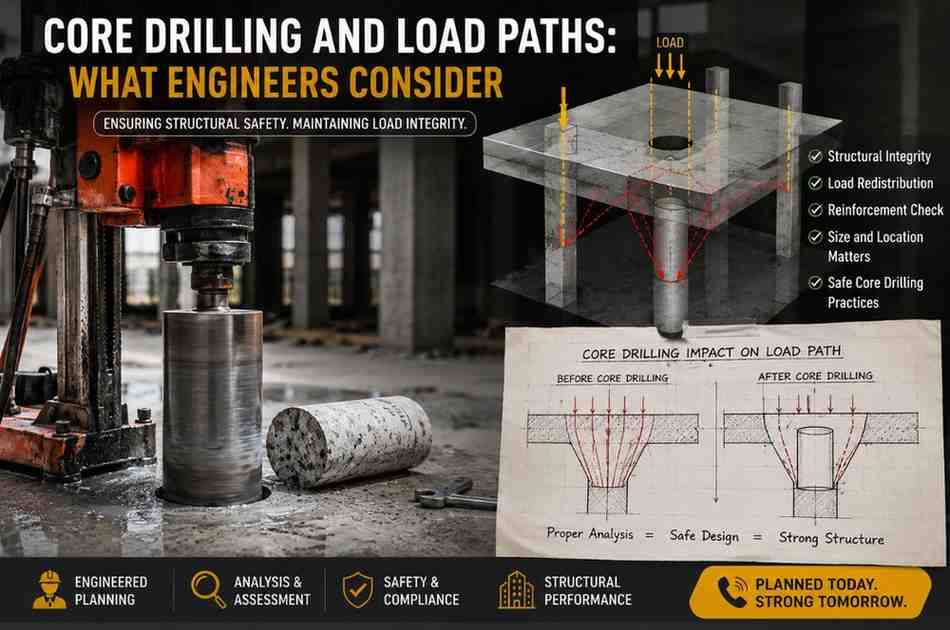
Concrete structures are built to carry loads efficiently from the roof down to the foundation, through a continuous chain known as the load path. Whenever a hole needs to be cut into a slab, beam, column, or wall — for plumbing, electrical conduits, HVAC ducts, or structural retrofits — that continuous chain is disturbed, even if only slightly. This is why core drilling is never treated as a purely mechanical task. It is, first and foremost, a structural engineering decision.
At Core Cutting India ([email protected]), every core drilling project begins with a conversation about load paths, not drill bits. This blog explains why load path analysis matters, what engineers evaluate before approving a core cut, and how professional core drilling services protect the safety and longevity of a structure.
What Is a Load Path?
A load path is the route through which forces — gravity loads, live loads, wind loads, and seismic forces — travel through a building's structural elements until they reach the ground. It typically flows like this:
Roof → Beams → Columns → Foundation → Soil
Slabs transfer loads to beams, beams transfer loads to columns, and columns transfer loads down to footings and finally into the earth. Shear walls and load-bearing walls often participate in this chain too, especially in resisting lateral forces like wind and earthquakes.
When this path is interrupted — for example, by cutting through a beam or an improperly located slab core — the structure may lose its ability to transfer forces the way it was originally designed to. This is the central concern engineers address before any core drilling begins.
Why Core Drilling Cannot Be a Random Decision
It might seem convenient to drill wherever a pipe or cable needs to pass through. However, concrete elements are rarely uniform in their structural role. A slab may look identical across its surface, but reinforcement density, moment zones, and stress concentrations vary significantly from one location to another.
Engineers consider core drilling a critical activity because:
- Concrete elements often contain post-tensioned cables or prestressing strands that carry enormous tension forces.
- Reinforcement bars (rebar) are placed strategically based on calculated bending and shear forces, not decoratively.
- Even non-load-bearing elements can be part of a lateral load-resisting system.
- A single incorrectly placed hole can trigger cracking, deflection, or in severe cases, partial structural failure.
This is why reputable core cutting agencies insist on structural drawings, scanning reports, and, where necessary, sign-off from a structural engineer before drilling.
Key Factors Engineers Evaluate Before Core Drilling
1. Location Within the Structural Grid
Engineers first identify where the proposed hole falls relative to columns, beams, and shear walls. Areas close to columns or beam-column junctions are typically avoided, as these zones experience the highest stress concentrations. A hole placed too close to a column can reduce the effective bearing area and compromise load transfer.
2. Type of Structural Element
Different elements respond differently to penetrations:
- Slabs can often tolerate small to medium openings if placed away from column strips and high-moment zones.
- Beams are far more sensitive; drilling through the tension or compression zone of a beam can seriously reduce its load-carrying capacity.
- Columns are almost always off-limits for core drilling unless a detailed structural retrofit design is prepared, since columns carry the entire building's gravity load.
- Shear walls require special caution in seismic zones, as they resist lateral forces critical to a building's stability during earthquakes.
3. Presence of Post-Tensioned or Prestressed Elements
In buildings using post-tensioned (PT) slabs, drilling into a stressed cable can be extremely dangerous, potentially causing a sudden and violent release of tension. Engineers require PT cable scanning using ground-penetrating radar (GPR) or X-ray methods before any drilling is approved in such structures.
4. Rebar Density and Cover
Excessive rebar cutting during core drilling weakens the reinforcement network that resists bending and shear. Engineers assess how much steel can be safely cut, if any, and often mandate rebar scanning to avoid unnecessary damage.
5. Size and Number of Openings
A single 100mm hole may have negligible structural impact, but multiple holes clustered together, or a large-diameter opening for HVAC or elevator shafts, can significantly change how loads redistribute through a slab or beam. Engineers calculate the cumulative effect of all penetrations, not just individual holes.
6. Load Redistribution and Alternative Load Paths
When an opening removes part of an element's cross-section, engineers evaluate whether the remaining structure can safely redistribute the load. This might involve:
- Adding supplemental reinforcement or steel plates around the opening.
- Introducing new beams or lintels to reroute loads around the penetration.
- Limiting the maximum permissible opening size based on span and loading conditions.
7. Vibration and Impact During Drilling
Core drilling, especially diamond core drilling, is chosen specifically because it minimizes vibration compared to hammer drilling or jackhammering. Engineers prefer diamond core cutting for sensitive structures because it reduces the risk of micro-cracking in adjacent concrete, which could otherwise create hidden long-term weaknesses.
8. Building Age and Existing Damage
Older structures may already have reduced capacity due to corrosion, carbonation, or prior overloading. Engineers factor in the current condition of the concrete and steel before approving any new penetration, since existing degradation reduces the safety margin available for additional openings.
The Standard Process Engineers Follow
A professional core drilling project typically follows this sequence:
- Structural drawing review – Understanding the original design intent and locating beams, columns, and reinforcement layout.
- Site survey and scanning – Using GPR or rebar scanners to detect reinforcement, conduits, and post-tensioned cables before marking the drill point.
- Load path analysis – Confirming how the proposed opening affects gravity and lateral load transfer.
- Structural approval – Sign-off from a qualified structural engineer, particularly for openings in beams, columns, or shear walls.
- Execution with diamond core drilling equipment – Precise, low-vibration cutting to the approved size and location.
- Post-drilling inspection – Checking for cracks, exposed reinforcement, or any signs the surrounding concrete has been affected.
- Reinforcement or repair, if required – Installing supplementary support where the analysis indicated a need.
Skipping any of these steps increases the risk of structural distress, which may not be visible immediately but can manifest as cracking, sagging, or reduced capacity over time.
Common Mistakes That Compromise Load Paths
Even experienced contractors sometimes make errors that engineers specifically train to avoid:
- Drilling without scanning first, assuming rebar or cables aren't present in a given spot.
- Clustering multiple holes too close together, weakening a larger effective area than any single hole would suggest.
- Ignoring column strips in flat slabs, where the highest bending moments and shear stresses are concentrated near columns.
- Ignoring seismic design requirements in shear walls, especially in earthquake-prone regions.
- Underestimating the cumulative effect of penetrations added over multiple renovation phases across a building's life.
Each of these mistakes can quietly erode a structure's safety margin, which is why load path analysis is treated as a mandatory step rather than an optional precaution.
Why Diamond Core Drilling Is the Preferred Method
Among available concrete cutting techniques, diamond core drilling is widely preferred by engineers for structurally sensitive work because it:
- Produces clean, precise, circular holes with minimal micro-cracking.
- Generates far less vibration than percussion-based tools, protecting adjacent reinforcement and structural elements.
- Allows accurate control over hole diameter and depth, which is essential when engineers have specified exact limits.
- Reduces dust and noise, making it suitable for occupied buildings and sensitive environments like hospitals or data centers.
This precision is a key reason engineers and contractors rely on specialized core cutting teams rather than general-purpose drilling equipment for structural penetrations.
The Role of Professional Core Cutting Services
Because load path considerations require both structural knowledge and drilling expertise, professional core cutting companies typically work alongside structural engineers rather than operating independently. This collaboration ensures:
- Openings are placed in locations that minimize structural impact.
- Reinforcement and post-tensioned cables are identified and protected before cutting begins.
- Drilling equipment and techniques match the sensitivity of the structural element involved.
- Any necessary reinforcement or repair work is planned in advance, not improvised after damage occurs.
At Core Cutting India, this engineering-first approach is central to how core drilling projects are executed, whether for residential renovations, commercial fit-outs, or industrial retrofits.
Conclusion
Core drilling may appear to be a simple mechanical task, but it directly intersects with a structure's ability to safely carry loads throughout its lifetime. Engineers evaluate the location, element type, reinforcement, and load redistribution implications of every proposed opening before drilling begins. This careful, methodical approach protects not just the immediate area being drilled, but the structural integrity of the entire building.
If you're planning a project that involves cutting into concrete slabs, beams, columns, or walls, it's worth working with a team that understands both the drilling process and the structural engineering behind it.
For professional, engineering-informed core drilling services, reach out to Core Cutting India at [email protected].
Target-Related Searches
- core drilling services near me
- load path analysis in concrete structures
- diamond core drilling for concrete
- structural engineering and core cutting
- core drilling in RCC slab
- concrete core cutting company India
- post-tensioned slab drilling precautions
- rebar scanning before core drilling
- core drilling for plumbing and electrical
- structural impact of concrete penetrations
People Also Ask
1. What is core drilling used for in construction? Core drilling is used to create precise, clean holes in concrete for plumbing pipes, electrical conduits, HVAC ducts, structural investigations, and utility installations without causing excessive vibration or damage to surrounding concrete.
2. Is core drilling safe for load-bearing walls? Core drilling can be done in load-bearing walls only after a structural engineer evaluates the location, size, and reinforcement layout, since improper drilling can compromise the wall's load-carrying capacity.
3. How do engineers decide where core drilling is allowed? Engineers review structural drawings, scan for reinforcement and post-tensioned cables, and analyze how the proposed opening affects load transfer before approving a specific drilling location.
4. What is a load path in a building? A load path is the route through which gravity and lateral forces travel from the roof through beams, columns, and foundations, ultimately transferring into the ground.
5. Can core drilling damage a building's structure? Yes, if done without proper planning, core drilling can cut critical reinforcement or post-tensioned cables, disrupt load paths, and lead to cracking or reduced structural capacity.
6. What is the difference between core drilling and regular drilling? Core drilling uses diamond-tipped hollow bits to cut precise, clean holes with minimal vibration, while regular drilling methods like hammer drilling are less precise and can cause more disturbance to the surrounding concrete.
7. Do I need a structural engineer for core drilling? For any drilling near beams, columns, shear walls, or post-tensioned slabs, involving a structural engineer is strongly recommended to ensure the building's load path and safety are not compromised.