
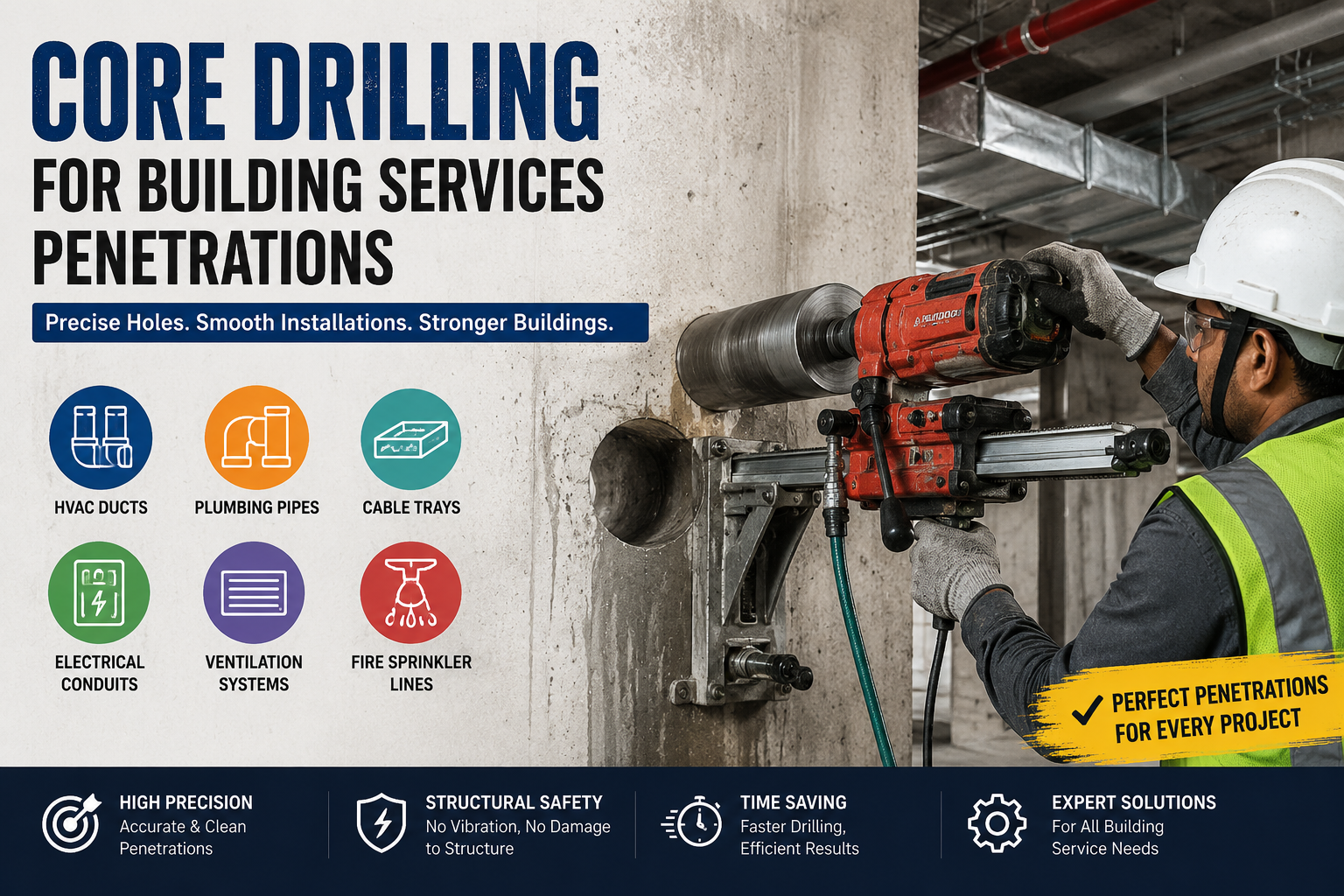
Every modern building, whether it is a residential tower in Mumbai, an IT park in Bangalore, or a hospital in Delhi, depends on an invisible network of pipes, cables, ducts, and conduits running through its walls, floors, and slabs. Getting these mechanical, electrical, and plumbing (MEP) services from one floor to another, or from one room to the next, requires clean, accurate openings in concrete. This is where core drilling becomes indispensable.
Core drilling for building services penetrations is a specialised construction technique used to cut precise, circular holes through concrete, brick, and masonry structures without damaging the surrounding structure. Unlike traditional breaking or chiselling methods, core drilling is fast, dust-controlled, and structurally safe, making it the preferred choice for contractors, MEP consultants, and builders across India.
In this blog, we explore what core drilling is, why it matters for building services, the equipment and process involved, real Indian project examples, and how to choose the right core cutting partner for your project.
What Is Core Drilling?
Core drilling is a concrete cutting method that uses a hollow, diamond-tipped cylindrical bit rotated at high speed to bore through concrete, RCC slabs, brick walls, and stone. As the bit rotates, water is typically circulated through the drill to cool the diamond segments and flush out concrete slurry, resulting in a smooth, round hole with minimal vibration and dust.
The technique is widely used to create penetrations for:
- Plumbing and drainage pipes
- HVAC ducts and AC refrigerant piping
- Electrical conduits and cable trays
- Fire-fighting sprinkler lines
- Data and telecom cabling
- Structural anchoring and bolting
Because the process is controlled and precise, it avoids the micro-cracking and structural stress that hammering or manual breaking often causes, which is particularly important in RCC (reinforced cement concrete) structures common across Indian construction.
Why Core Drilling Is Essential for Building Services Penetrations
1. Precision Without Structural Damage
Buildings today are engineered with tight tolerances. A poorly placed or oversized hole in a slab or shear wall can compromise structural integrity. Core drilling allows contractors to cut exact-diameter holes, typically ranging from 25 mm for small conduits to 300 mm or more for large HVAC ducts, without disturbing adjacent reinforcement or causing spalling.
2. Speed and Efficiency on Site
In fast-paced Indian construction environments, particularly in metro cities where project timelines are compressed, core drilling significantly reduces labour time compared to manual breaking. A single diamond core rig can complete multiple penetrations in the time it would take a labour team to chip out one opening with a hammer and chisel.
3. Dust and Noise Control
Wet core drilling, the most common method used in occupied or partially occupied buildings, minimises airborne dust. This is especially valuable in hospitals, IT offices, and residential towers where ongoing operations cannot be disrupted. Many Indian metro cities now enforce stricter construction dust norms under pollution control regulations, making dust-controlled methods like core drilling not just convenient but compliant.
4. Works Across Multiple Materials
Core drilling machines can cut through RCC, brick masonry, natural stone, and even asphalt, giving contractors flexibility across different structural elements found in Indian buildings, from older brick-and-mortar structures in cities like Pune and Kolkata to modern post-tensioned slabs in high-rise developments in Gurugram and Hyderabad.
The Core Drilling Process: Step by Step
1. Site Survey and Scanning Before any drilling begins, the exact location is marked based on approved MEP shop drawings. In RCC structures, a GPR (Ground Penetrating Radar) scan or rebar locator is used to detect embedded reinforcement bars, post-tensioned cables, and existing utilities. This step is critical in India's high-rise residential and commercial projects, where post-tensioned slabs are common and accidental cutting of a PT cable can be extremely costly and dangerous.
2. Selecting the Right Core Bit Diamond core bits come in various diameters and lengths depending on the service being routed. A 50 mm core might be used for a single electrical conduit, while a 200-300 mm core could accommodate a bathroom drainage stack or HVAC duct sleeve.
3. Mounting the Drill Rig The core drilling machine is mounted on a stand secured to the floor, wall, or ceiling using anchors or vacuum systems, ensuring stability during operation, particularly important for overhead or vertical drilling in multi-storey buildings.
4. Drilling with Water Cooling The machine drills through the concrete while water is fed to the bit to cool it and suppress dust. Slurry is collected and disposed of responsibly, in line with site environmental protocols.
5. Core Extraction and Finishing Once the hole is complete, the concrete core is removed, edges are cleaned, and the opening is inspected for accuracy before handover to MEP teams for pipe or duct installation.
6. Fire-Stopping and Sealing After services are installed through the penetration, the gap is sealed using approved fire-stopping materials or grout to restore fire rating and structural continuity, an essential requirement under India's National Building Code (NBC 2016) and local fire safety norms.
Applications in Indian Building Projects
Residential High-Rises
In cities like Mumbai, Bangalore, and Noida, residential towers increasingly use post-tensioned slabs to achieve larger column-free spans. Core drilling for bathroom plumbing, kitchen exhaust ducts, and AC copper piping must be carried out with extreme precision, often requiring PT cable scanning before every cut. Builders working on projects along the Mumbai Metropolitan Region and NCR corridors regularly depend on specialised core cutting teams to avoid costly rework.
Commercial and IT Office Spaces
Bangalore's IT corridor, including areas like Whitefield and Electronic City, has seen continuous fit-out and retrofit activity in commercial buildings. Core drilling is used extensively for routing structured cabling, HVAC risers, and fire sprinkler lines through existing RCC slabs during office interior fit-outs, often carried out on occupied floors where low-noise, low-dust methods are essential.
Hospitals and Healthcare Facilities
Hospital construction and retrofit projects in cities such as Delhi, Chennai, and Ahmedabad require penetrations for medical gas pipelines, HVAC systems, and specialised electrical services. Because hospitals often remain partially operational during renovation, wet core drilling is preferred for its minimal vibration and dust output.
Metro Rail and Infrastructure Projects
India's expanding metro rail networks, including projects in Delhi, Mumbai, Pune, and Bangalore, use large-diameter core drilling for cable routing, drainage, and utility penetrations through station structures and viaducts. These projects demand industrial-grade rigs capable of drilling thick, heavily reinforced concrete sections.
Industrial and Warehousing Projects
With India's logistics and manufacturing sector expanding rapidly around hubs like Pune, Chennai, and the Delhi-NCR region, core drilling is used for routing fire hydrant lines, electrical trunking, and process piping through thick industrial floor slabs.
Equipment Used in Professional Core Drilling
- Handheld core drilling machines: Used for smaller diameter holes up to around 150 mm, ideal for residential and light commercial work.
- Rig-mounted core drills: Used for larger diameters and precision work on vertical walls, ceilings, and thick slabs.
- Diamond core bits: Available in various sizes and bond hardness levels depending on whether the material is standard concrete, high-strength concrete, or masonry.
- GPR scanners and rebar detectors: Used before drilling to avoid cutting through reinforcement or utility lines.
- Water management systems: Vacuum slurry collectors are increasingly used on Indian sites to comply with cleanliness and environmental norms, especially on occupied or high-end finished projects.
Safety Considerations for Core Drilling in India
Core drilling, while safer than manual breaking, still requires strict safety protocols:
- Mandatory scanning of slabs before drilling in post-tensioned or heavily reinforced structures
- Use of PPE including safety goggles, gloves, and hearing protection
- Secure anchoring of drill rigs to prevent slippage, particularly for overhead or vertical drilling
- Controlled water and slurry disposal to prevent slipping hazards and environmental contamination
- Compliance with local fire and building codes when sealing completed penetrations
- Trained operators who understand structural drawings and can identify high-risk zones such as beams, columns, and post-tensioned cable paths
Given the density of Indian construction sites and the frequent presence of other trades working simultaneously, coordination and barricading around drilling zones is also a standard practice followed by experienced core cutting contractors.
Factors That Affect Core Drilling Cost in India
The cost of core drilling varies based on several factors:
- Hole diameter: Larger diameters require more time and higher-cost bits.
- Material type: RCC with heavy reinforcement costs more to drill than plain masonry.
- Location and access: Overhead, underwater, or hard-to-access locations increase labour costs.
- Depth of slab or wall: Thicker structural elements, common in high-rise and metro projects, require longer drilling time.
- Number of penetrations: Bulk core drilling packages for large MEP fit-outs are typically more cost-effective per hole.
- Site conditions: Occupied buildings requiring low-noise, low-dust methods may involve additional precautions and cost.
Builders and MEP contractors are advised to get a site assessment before finalising penetration counts, as this helps avoid change orders during execution.
Choosing the Right Core Drilling Contractor
When selecting a core cutting partner for building services penetrations, consider the following:
- Experience with RCC and post-tensioned structures: Especially important for high-rise residential and commercial buildings across Indian metros.
- Availability of scanning equipment: A contractor who scans before drilling reduces the risk of costly structural damage.
- Range of equipment: Ability to handle both small conduit penetrations and large duct openings.
- Compliance awareness: Familiarity with NBC guidelines, fire-stopping requirements, and local municipal norms.
- Track record on similar projects: Experience across residential, commercial, healthcare, or infrastructure segments relevant to your project type.
Conclusion
Core drilling has become a foundational technique in Indian construction, enabling the clean, safe, and efficient installation of MEP services across residential towers, commercial fit-outs, hospitals, and large-scale infrastructure projects. As Indian cities continue to build taller, denser, and faster, the demand for precise, code-compliant core cutting services will only grow.
Whether you are managing a residential high-rise in Mumbai, an office fit-out in Bangalore, or a hospital retrofit in Delhi, working with an experienced core drilling team ensures your building services penetrations are executed safely, accurately, and on schedule.
For professional core drilling and core cutting services across India, reach out to Core Cutting India at [email protected].
Target-Related Searches: core drilling contractors near me, core cutting services in India, diamond core drilling machine price, core drilling for plumbing pipes, wall core cutting for AC pipe, core drilling vs chiseling, core cutting for cable tray, RCC slab cutting for duct, core drilling safety precautions, cost of core drilling per hole India, core cutting company Mumbai, core cutting company Bangalore
People Also Ask:
- What is core drilling used for in construction?
- How is core drilling different from wall cutting or chiseling?
- Is core drilling safe for RCC structures?
- How much does core drilling cost in India?
- What size core drilling holes are used for MEP services?
- Can core drilling be done on load-bearing walls?
- How long does a core drilling job take?