
Introduction
Dams are among the most critical pieces of civil infrastructure in the modern world. They provide reliable water supplies, generate renewable hydroelectric power, control devastating floods, and support agricultural irrigation. However, because they hold back millions of tons of water, ageing or compromised dams pose an existential threat to downstream communities and ecosystems.
Maintaining the structural health of these massive barriers requires rigorous, ongoing evaluation. Among the suite of engineering methodologies available, core drilling stands out as an indispensable technique. By extracting intact cylindrical samples of concrete, rock, and composite materials, engineering teams gain precise insight into internal conditions that visual inspections simply cannot uncover.
At [email protected], we recognize that precision engineering is non-negotiable when dealing with high-stakes infrastructure. This comprehensive guide explores how core drilling drives effective dam inspection and maintenance, safeguarding structural integrity for decades to come.
Understanding Core Drilling in Infrastructure
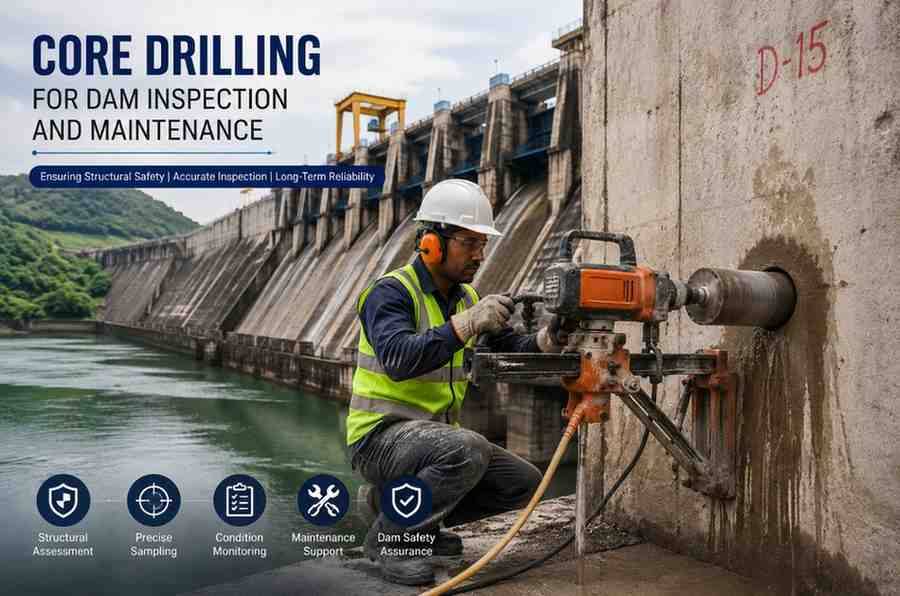
Core drilling is a specialized geotechnical and construction technique that utilizes a rotary drill equipped with a hollow, diamond-impregnated bit. Unlike conventional percussion drilling or jackhammering—which shatter material through impact and introduce micro-fractures—core drilling smoothly grinds through dense matrices.
The result is a perfectly cylindrical "core sample" extracted from the structure, alongside a clean, smooth-walled hole. In dam engineering, this technique serves a dual purpose:
-
Material Extraction & Analysis: Pulling core samples to test compressive strength, density, permeability, and chemical composition in a laboratory environment.
-
Precision Penetration: Creating engineered openings for structural tie-ins, grouting ports, anchoring cables, and drainage installations.
Why Core Drilling is Critical for Dam Inspections
Visual assessments can only reveal surface-level wear, such as minor cracking, efflorescence, or spalling. However, the true stability of a dam depends on its internal composition and foundation support. Core drilling provides the empirical data required to answer critical safety questions.
1. Assessing Concrete Strength and Aging
Over decades, mass concrete exposed to extreme water pressure, freeze-thaw cycles, and chemical leaching undergoes degradation. Core samples extracted from spillways, gravity walls, and powerhouse structures are subjected to rigorous laboratory testing. This determines:
-
Compressive Strength: Ensuring the concrete still meets original design thresholds.
-
Depth of Carbonation: Measuring how far chemical weathering has penetrated the matrix.
-
Aggregate Reactivity: Identifying internal distress caused by Alkali-Silica Reaction (ASR), which can silently fracture concrete from within.
2. Investigating Seepage and Internal Erosion
Seepage is one of the primary precursors to dam failure. When water finds preferential pathways through cracks in concrete or joints between concrete and rock abutments, it can cause internal erosion or piping. Controlled core drilling allows engineers to intersect suspected seepage zones, install piezometers for pore-pressure monitoring, and evaluate filter compatibility in transition zones.
3. Foundation and Bedrock Integrity Analysis
A dam is only as stable as the foundation upon which it rests. Core drilling is routinely extended deep into the bedrock beneath the dam structure. Geologists analyze these rock cores to map discontinuities, joint orientations, fault lines, and rock quality designation (RQD). This ensures the dam can withstand immense hydrostatic loads without sliding or settling.
Key Methods and Techniques in Dam Coring
Executing core drilling on or near a dam requires meticulous planning. Specialized methodologies are deployed to protect the surrounding infrastructure from damage.
| Drilling Method | Primary Application | Key Advantage |
| Diamond Rotary Coring | Hard reinforced concrete & igneous rock | Delivers smooth, uncompromised cylindrical samples up to deep elevations. |
| Wire-line Core Drilling | Deep foundation and bedrock investigations | Allows rapid retrieval of core barrels from deep holes without pulling the entire drill string. |
| Air/Dry Core Drilling | Water-sensitive embankment zones | Used where moisture introduction could trigger immediate internal erosion or piping. |
Navigating Embankment vs. Concrete Dams
The approach to core drilling changes drastically depending on the dam type:
-
Concrete Gravity & Arch Dams: Can typically withstand direct structural coring provided locations are chosen away from maximum stress concentration zones.
-
Embankment (Earth-Fill & Rock-Fill) Dams: Drilling directly into the clay core of an embankment dam carries severe risks of hydraulic fracturing and piping. Industry guidelines dictate that core drilling in embankments must be executed under strict parameters, often utilizing dry methods, continuous monitoring, and immediate backfilling or grouting protocols.
Maintenance Applications: Beyond Diagnostics
Core drilling isn't just an investigative tool; it is a vital enabler of active maintenance and rehabilitation strategies.
1. Pressure Grouting and Curtain Injection
To mitigate seepage beneath or around a dam, engineers create a "grout curtain." Core holes are drilled deep into the foundation rock, and cementitious or chemical grouts are injected under pressure to seal fractures, voids, and fissures. This cuts off subsurface water movement and stabilizes the foundation.
2. Post-Tensioned Anchor Installation
As seismic safety standards evolve, many older concrete dams require structural upgrades to resist modern probable maximum flood (PMF) and earthquake criteria. Contractors use heavy-duty core drilling to punch deep holes through concrete sections into the underlying rock. High-strength steel tendons are then inserted, grouted at the base, and tensioned to anchor the dam securely to the earth.
3. Retrofitting Drainage Systems
Relief wells and drainage galleries prevent dangerous uplift pressures from building up beneath concrete slabs. Core drilling enables the creation or expansion of drainage holes, ensuring that water is safely channeled away from vulnerable structural interfaces.
Best Practices and Safety Protocols
Because dam failures carry catastrophic humanitarian and economic consequences, operating on these sites leaves no room for error. Professional providers follow stringent protocols:
-
Comprehensive Subsurface Mapping: Before a single drill bit touches the surface, ground-penetrating radar (GPR) and historical design records are reviewed to locate embedded steel reinforcement, post-tensioned cables, and internal utilities.
-
Strict Fluid Control: Monitoring water pressures during wet coring prevents accidental hydraulic fracturing in earthen zones.
-
Contingency Planning: Emergency Action Plans (EAPs) and stabilization materials (such as graded sand and gravel filters) must be on standby during any intrusive work near active seepage zones.
Conclusion
Core drilling is a cornerstone of modern civil engineering, acting as the ultimate bridge between structural guesswork and absolute certainty. By unlocking deep visibility into concrete matrices and foundation rock, it empowers asset owners and engineers to execute precise inspections, catch micro-defects before they escalate, and implement robust maintenance interventions.
When dealing with critical infrastructure like dams, partnering with experienced professionals equipped with state-of-the-art diamond technology is paramount. For expert consultation, precision cutting, and specialized geotechnical core drilling solutions, reach out to the specialists at [email protected] to ensure your structures stand resilient for generations to come.