
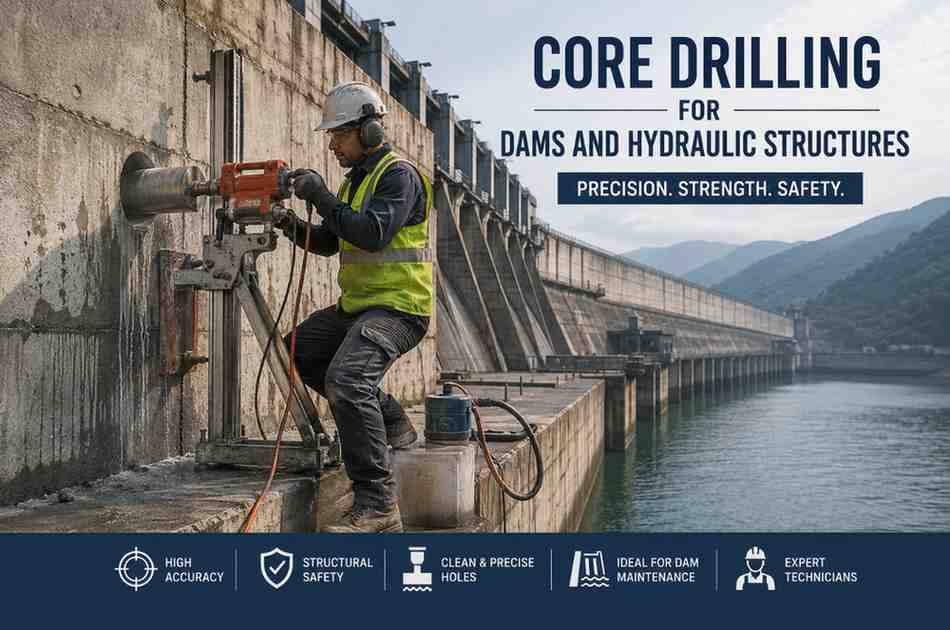
Target-Related Searches & PAA Overview
-
Target-Related Searches: Diamond core drilling for infrastructure, dam rehabilitation and drilling, geotechnical core sampling for gravity dams, pressure relief hole drilling, concrete-bedrock contact coring.
-
People Also Ask (PAA):
-
Why is core drilling necessary for dam construction and safety?
-
What types of drills are used in dam and hydraulic engineering?
-
How does core drilling help in dam seepage control and grouting?
-
What are the risks of drilling into embankment or concrete dams?
-
Dams and hydraulic structures represent some of the most complex, critical, and capital-intensive feats of civil engineering. Serving as the backbone for flood control, hydroelectric power generation, irrigation, and municipal water supplies, their structural integrity is non-negotiable. Ensuring the safety of these colossal structures requires an intimate understanding of the geology beneath them and the physical condition of the materials forming them.
This is where core drilling becomes indispensable. By extracting intact cylindrical samples of concrete, masonry, and foundation rock, core drilling offers engineers a direct, uncompromised window into the subsurface.
At [email protected], we recognize that precision engineering requires absolute data accuracy. This comprehensive guide explores the multifaceted world of core drilling for dams and hydraulic structures, covering methodologies, core applications, risk management, and long-term asset rehabilitation.
1. The Critical Role of Core Drilling in Dam Engineering
Dams endure immense hydrostatic pressures, thermal stresses, and environmental weathering over decades or even centuries. Over time, internal degradation, foundation shifting, or seepage can compromise structural safety. Core drilling serves several vital lifecycle phases of a dam:
-
Site Selection and Geotechnical Investigation: Before a single cubic meter of concrete is poured, core drilling maps the bedrock geology, detects faults, and assesses load-bearing capacities.
-
Quality Control During Construction: Verification core samples are extracted to test the compressive strength, density, and uniformity of newly placed mass concrete.
-
Condition Assessment and Health Monitoring: For aging dams, coring helps diagnose internal micro-cracking, alkali-silica reaction (ASR), and chemical leaching.
-
Remediation and Retrofitting: Drilling provides the necessary access ports for high-pressure grout injection, drainage installation, and structural anchoring.
2. Primary Applications of Core Drilling in Hydraulic Structures
Core drilling is deployed across various zones of a dam—including concrete gravity arches, masonry structures, spillways, and earthen embankment foundations. Key applications include:
A. Investigating Concrete and Masonry Integrity
Engineers frequently drill through structural mass concrete or stone masonry to extract samples for laboratory mechanical testing. These tests reveal:
-
Compressive and tensile strength parameters.
-
Modulus of elasticity.
-
Presence of internal voids, honeycombing, or cold joints.
-
Chemical degradation patterns, such as sulfate attack or ASR expansion.
B. Evaluating the Concrete-Bedrock Contact
One of the most critical zones in a dam is the interface where the artificial structure meets the natural foundation rock. Core drilling across this boundary verifies whether a tight, impermeable bond exists or if separation, weathering, or micro-fissuring has occurred, which could lead to high-pressure under-seepage.
C. Installation of Drainage and Pressure Relief Holes
Uplift pressure is a major threat to gravity dams. Water seeping beneath the base exerts an upward force that can reduce stability. Core drilling is utilized to install pressure relief wells and drainage holes downstream of the grout curtain, safely relieving hydrostatic uplift pressures.
D. Instrumentation Placement
Modern dams are heavily instrumented to track continuous movement, pore water pressure, and seepage. Core boreholes are required to install sophisticated monitoring devices, such as:
-
Vibrating wire piezometers.
-
Inclinometers for slope and foundation movement.
-
Upheaval and settlement gauges.
3. Specialized Core Drilling Techniques for Dams
Drilling into massive hydraulic structures and variable foundation geology demands specialized equipment that minimizes structural shock and maximizes sample recovery.
+------------------------------------------------------------+
|                Core Drilling Methodologies                 |
+--------------------------+---------------------------------+
| Diamond Core Drilling    | Best for pristine rock/concrete |
| Rotary Percussive        | Ideal for fast hole advancement |
| Wireline Coring          | Preferred for deep holes (>50m) |
| Air/Sonic Dry Drilling   | Critical for sensitive soils    |
+--------------------------+---------------------------------+
Diamond Core Drilling
Utilizing hollow drill bits embedded with industrial diamonds, this technique cuts a smooth, continuous cylindrical core through hard granite, basalt, or reinforced concrete. It produces minimal vibration, protecting surrounding fragile structures from micro-fracturing.
Wireline Coring Systems
For deep investigative boreholes running hundreds of feet through a dam's foundation into bedrock, wireline systems allow the inner core barrel to be retrieved via a cable winch through the drill rods without pulling the entire drill string out of the hole. This radically increases efficiency on deep exploratory projects.
Rotary-Percussive and Air/Sonic Drilling
While diamond coring is standard for solid concrete and sound rock, embankment dams (which are constructed of compacted soils, clays, and gravel shells) require alternative approaches. Excessive fluid pressure in earthen dams can trigger hydraulic fracturing or internal piping. Consequently, dry drilling methods (such as hollow-stem augers or sonic drilling) are deployed to safeguard embankment stability.
4. Mitigating Risks: The Delicate Balance of Drilling Near Water
Drilling into or immediately adjacent to a structure holding back millions of tons of water carries inherent operational risks. Improper planning or execution can result in catastrophic safety failures.
Crucial Safety Note: Uncontrolled water inflows, hydraulic fracturing of foundation rock, and the exacerbation of internal erosion paths (piping) are primary hazards during dam drilling operations.
Best Practices for Risk Mitigation:
-
Emergency Action Plan (EAP) Integration: Field crews must be fully briefed on the dam’s EAP and maintain constant communication with project operators before breaking ground.
-
Pressure-Controlled Flushing: When fluid circulation (water, polymer, or foam) is necessary, pressure-relief safety valves and continuous return-monitoring systems must be used to prevent downhole pressure spikes.
-
Controlled Feed Rates: Operators must carefully control bit advancement rates and avoid crowding the drill to prevent sudden breakthroughs into high-pressure artesian zones.
-
Immediate Post-Drilling Grouting: Exploratory boreholes must be systematically backfilled and pressure-grouted upon completion to restore the hydraulic integrity of the structure.
5. Role of Core Drilling in Dam Rehabilitation and Grouting
Many historic dams require structural remediation to meet modern safety standards and extend their operational lifespans. Core drilling acts as the precursor to advanced rehabilitation strategies:
-
Curtain Grouting: Closely spaced core holes are drilled into foundation rock, followed by the injection of specialized low-alkali cement grouts under high pressure to seal fissures and block seepage paths.
-
Body Grouting of Masonry Dams: Older stone masonry dams often suffer from mortar degradation. Crews drill intersecting paths into the dam body to inject low-viscosity repair grouts, solidifying the internal matrix.
-
Post-Tensioned Anchoring: Core drilling allows for the installation of high-strength steel tendons anchored deep into the underlying bedrock. These tendons are tensioned to clamp the dam structure firmly against sliding or overturning forces caused by extreme flood events.
Conclusion
Core drilling for dams and hydraulic structures is far more than a routine construction service—it is a critical engineering science that safeguards public safety, protects multi-million-dollar infrastructure investments, and ensures sustainable water resource management. From extracting pristine structural samples to creating pathways for life-extending grouting, the precision of core drilling dictates the future reliability of our water-retaining assets.
For expert consultations, specialized structural cutting, and professional core drilling solutions tailored to heavy civil infrastructure, reach out to industry leaders at [email protected].