
When Indian families decide to add a room, extend a balcony, or convert an open terrace into a livable space, the excitement of a bigger home often runs into a practical wall — quite literally. Every extension project eventually needs new openings for plumbing lines, electrical conduits, HVAC ducts, or structural connections between the old and new structure. This is where core drilling becomes the unsung hero of modern construction.
At Core Cutting India ([email protected]), we've worked on hundreds of extension projects across apartments, independent houses, and commercial buildings, and we've seen firsthand how the right drilling technique can make or break a renovation timeline. In this guide, we'll walk you through what core drilling is, why it matters for extension projects, and how it's practically applied in Indian construction settings.
What Is Core Drilling?
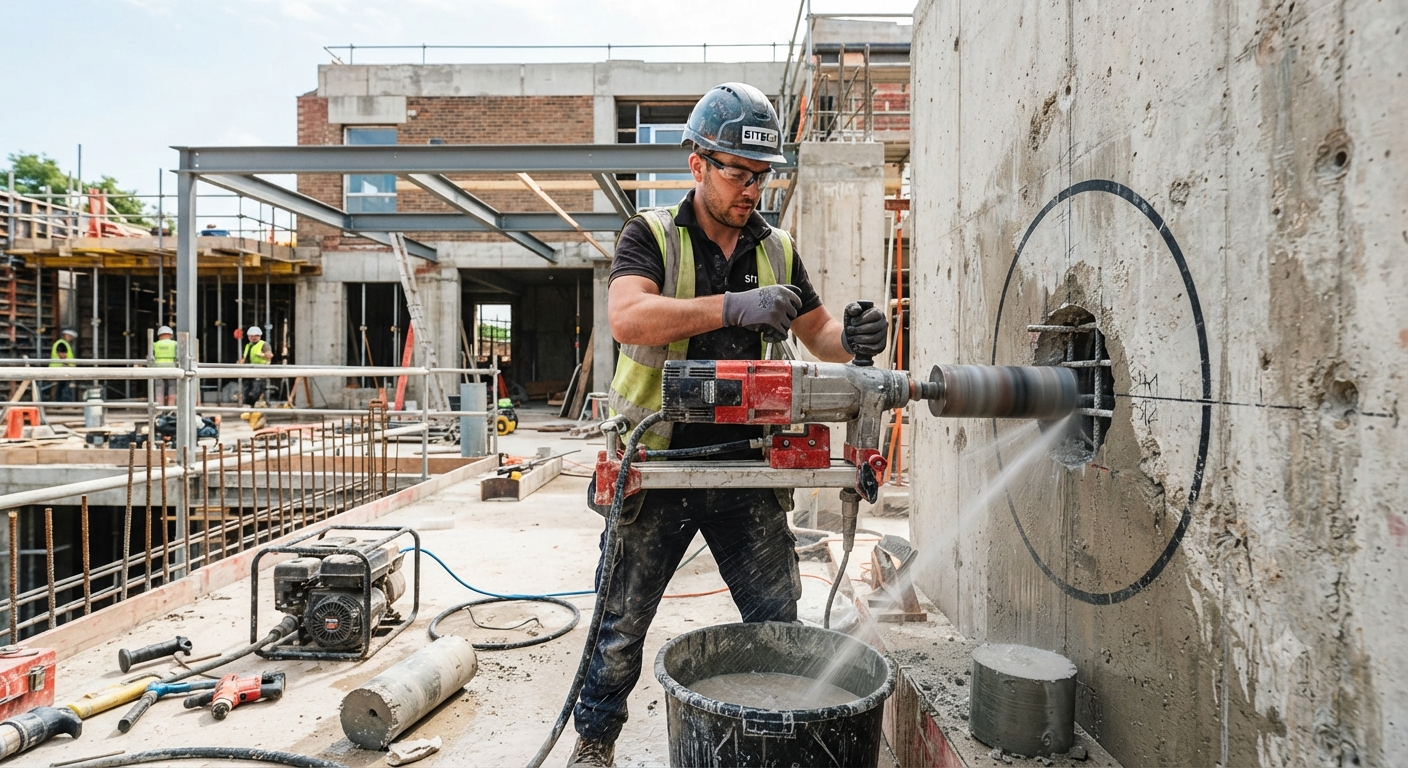
Core drilling is a precision cutting technique used to create clean, circular holes through concrete, brick, stone, or reinforced cement concrete (RCC) structures. Unlike traditional hammer drilling, which chips and breaks material away, core drilling uses a hollow, diamond-tipped cylindrical bit that rotates at high speed while water cools the blade and flushes out debris. The result is a smooth, accurately sized hole with minimal vibration, dust, or damage to the surrounding structure.
This method is especially valuable in extension projects because it allows contractors to cut through existing walls, slabs, and foundations without compromising structural integrity — something that matters enormously when you're connecting a decades-old structure to a brand-new one.
Why Core Drilling Matters for Building Extensions in India
Indian homes are built differently depending on the region, age, and construction style. Older houses in cities like Delhi, Kolkata, and Chennai often have thick brick-and-mortar walls, while newer apartment complexes in Bengaluru, Pune, and Mumbai are built with dense RCC framing. Whatever the base material, extension work almost always requires penetrations for:
- Plumbing risers and drainage pipes connecting new bathrooms or kitchens to existing sewage lines
- Electrical conduits and cable routing between the old distribution board and new rooms
- HVAC and exhaust ducting for split ACs, chimneys, or centralized cooling systems
- Structural tie-ins, such as rebar dowelling to bond a new RCC slab with an existing one
- Fire safety and sprinkler lines in commercial extensions
Traditional breaking methods using chisels or hammer drills often crack surrounding concrete, expose reinforcement bars unpredictably, and create excessive noise and dust — a serious concern in densely populated Indian residential societies where neighbours share walls and common corridors. Core drilling solves this by cutting exactly where needed, with far less collateral damage.
Indian Examples: Core Drilling in Real Extension Projects
1. Vertical Extensions in Mumbai and Pune Apartments
With land prices soaring in cities like Mumbai and Pune, many housing societies are opting for vertical extensions — adding an additional floor to existing low-rise buildings. This requires core drilling through existing RCC slabs to install new plumbing stacks and electrical risers that run seamlessly from the ground floor to the newly added level. Contractors typically use hydraulic core drilling rigs mounted on stands to ensure precision when cutting through structural slabs that are often 150–200 mm thick.
2. Independent House Extensions in Tier-2 Cities
In cities like Indore, Coimbatore, and Nagpur, it's common for growing families to extend independent houses by adding a room over the garage or converting a courtyard into an enclosed space. Here, core drilling is frequently used to cut openings in brick masonry walls for split AC pipe routing and window air conditioner drainage — jobs that used to be done with hand drills and chisels, often leaving jagged, uneven holes that let in rainwater and pests.
3. Commercial Building Extensions in Bengaluru and Hyderabad
IT parks and office spaces in Bengaluru's Outer Ring Road and Hyderabad's HITEC City frequently undergo interior extensions and floor reconfigurations. Core drilling plays a critical role in creating openings for structured cabling, fire sprinkler risers, and HVAC ducting between floors. Because these buildings house sensitive server rooms and continuous business operations, the low-vibration, low-noise nature of core drilling is essential — a jackhammer simply isn't an option when a data centre is operating one floor below.
4. Heritage and Old Structure Renovations in Kolkata and Chennai
Many older homes in Kolkata's Ballygunge or Chennai's Mylapore have thick lime-mortar or brick walls that are structurally sensitive. When these homes are extended or renovated, core drilling allows contractors to create precise openings for modern plumbing and wiring without destabilizing the surrounding masonry — something that's particularly important given the fragility of century-old construction materials.
The Core Drilling Process: Step by Step
- Site Assessment and Marking: Before any drilling begins, engineers survey the wall or slab to identify rebar locations using rebar scanners, avoiding critical structural elements.
- Selecting the Right Core Bit: Diamond core bits come in various diameters (typically 25mm to 300mm) depending on whether the hole is for a small electrical conduit or a large HVAC duct.
- Setting Up the Rig: For vertical or horizontal drilling through thick slabs, a stand-mounted rig ensures stability and precision, especially for deep cuts.
- Wet or Dry Drilling: Most professional core drilling in India uses the wet method, where water cools the diamond bit and suppresses dust — critical for compliance with pollution control norms in urban construction sites.
- Cutting and Extraction: The drill bores through the material, and the cylindrical "core" is extracted intact, leaving a clean, finished hole.
- Finishing and Sealing: Once utilities are routed through the hole, it's sealed with fire-rated or waterproof sealant depending on the application.
Benefits of Core Drilling Over Traditional Methods
Precision: Holes are cut to exact specifications, eliminating guesswork and rework.
Structural Safety: Because core drilling avoids indiscriminate breaking, it reduces the risk of weakening load-bearing walls or slabs — a major concern in Indian buildings where structural audits are increasingly mandated by municipal corporations.
Reduced Noise and Dust: This matters enormously in Indian residential complexes governed by RWA (Resident Welfare Association) rules that restrict construction noise to specific hours.
Speed: A single core drilling operation can complete in minutes what traditional breaking might take hours to achieve.
Cleaner Job Sites: Wet drilling techniques minimize airborne dust, which is especially important given India's ongoing urban air quality concerns.
Common Challenges in Indian Extension Projects
Despite its advantages, core drilling in Indian construction isn't without hurdles. Many older buildings lack accurate structural drawings, making it hard to know exactly where reinforcement bars are placed. In such cases, experienced contractors rely on scanning equipment and visual inspection to avoid cutting through critical rebar.
Water availability at the drilling site is another practical issue, particularly in high-rise buildings or water-scarce regions like parts of Rajasthan and Maharashtra during summer months. Contractors often need to arrange for portable water tanks or switch to dry-cutting methods with dust extraction attachments.
Finally, permissions matter. In many Indian cities, structural modifications — even something as seemingly minor as core drilling through a shared wall in an apartment complex — require sign-off from the housing society or a structural engineer, particularly for load-bearing elements.
Choosing the Right Core Drilling Contractor
For any building extension project, the quality of core drilling work depends heavily on the experience and equipment of the contractor. Here's what to look for:
- Proper diamond core drilling equipment rather than makeshift hammer drilling
- Experience with RCC and masonry structures specific to your region's construction style
- Rebar detection tools to avoid structural damage
- Compliance with dust and noise regulations, especially in residential societies
- Clear cost estimates based on hole diameter, wall thickness, and material type
At Core Cutting India, our teams bring specialized diamond core drilling machinery and trained technicians to every extension project, whether it's a single-room addition in a Tier-2 city or a multi-floor commercial extension in a metro. We work closely with structural engineers to ensure every cut is safe, precise, and compliant with local building codes.
Cost Factors to Keep in Mind
Core drilling costs in India vary based on several factors: the diameter of the hole, the thickness and type of material (brick, RCC, stone), the depth of the cut, and site accessibility. A small 50mm hole through a standard brick wall will cost significantly less than a 200mm hole through a 200mm-thick RCC slab on an upper floor requiring scaffolding or rig setup. It's always advisable to get a site visit and written estimate before work begins, rather than relying on rough phone quotes.
Conclusion
Building extensions are an exciting chapter in any homeowner's or business's growth story, but the technical execution behind the scenes determines whether that growth is safe and long-lasting. Core drilling has become the preferred method across Indian construction sites — from heritage homes in Kolkata to high-rise apartments in Mumbai — because it delivers precision, safety, and efficiency that traditional breaking methods simply can't match.
If you're planning an extension project and need expert core drilling services, reach out to Core Cutting India at [email protected]. Our experienced team can assess your site, recommend the right approach, and ensure your extension work proceeds smoothly, safely, and on schedule.