
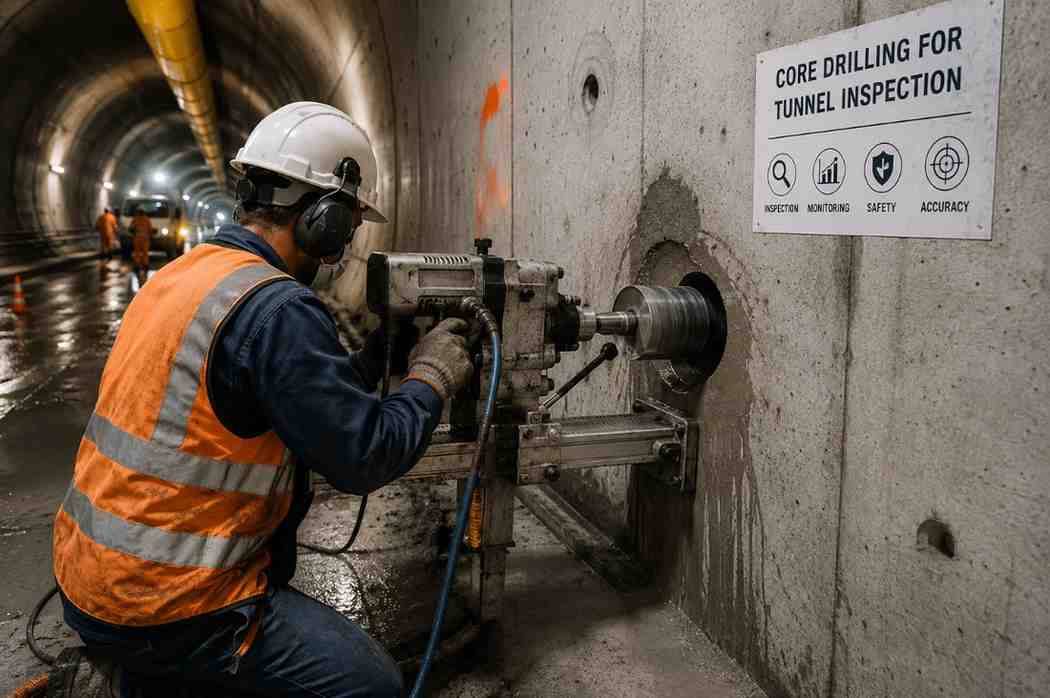
Tunnels represent some of the most critical feats of modern engineering. Serving as arteries for transportation, water supply, utility distribution, and transit, these underground structures endure immense physical pressures, environmental changes, and constant dynamic loads. However, like all civil infrastructure, tunnels degrade over time due to aging materials, ground settlement, seismic activity, and moisture infiltration.
To safeguard the millions of commuters and goods passing through them daily, rigorous structural inspections are mandatory. Among the frontline techniques used by civil engineers, core drilling for tunnel inspection stands out as the ultimate standard for gathering direct, empirical data.
Brought to you by [email protected], this comprehensive guide explores how core drilling works, its pivotal applications in tunnel health monitoring, and why it remains indispensable for infrastructure safety.
1. What is Core Drilling in the Context of Tunnel Inspection?
Core drilling is a specialized technique used to extract cylindrical samples—known as "cores"—from hard structural materials such as reinforced concrete, masonry, asphalt, or underlying rock formations.
Unlike percussive methods that fracture and break material, diamond core drilling utilizes a rotary drill rig outfitted with an industrial diamond-impregnated bit. This allows the tool to cleanly slice through composite structures without inducing micro-cracks or damaging the surrounding matrix.
When applied to tunnel engineering, core drilling serves two primary environments:
-
Tunnel Lining Inspection: Extracting cores directly from the concrete segments, shotcrete, or masonry walls of an existing tunnel to evaluate material degradation, compressive strength, and thickness.
-
Geotechnical Probing / Directional Core Drilling (DCD): Drilling ahead of the tunnel face or parallel to the tunnel trajectory to map out rock conditions, fault lines, and hydrological risks before or during excavation.
2. Why Core Drilling is Critical for Tunnel Safety
Visual inspections can only reveal surface-level symptoms such as hairline cracks, efflorescence, or minor spalling. They cannot, however, answer critical questions about what is happening inside the concrete matrix or deep within the surrounding ground.
Core drilling bridges this gap by providing tangible physical evidence. Here is why it is vital for tunnel safety:
-
Accressive Strength Verification: Laboratory crushing tests performed on extracted core samples give exact compressive strength values, ensuring the tunnel lining still meets structural design loads.
-
Thickness and Void Assessment: Cores physically confirm the actual thickness of structural walls and slabs, verifying whether construction matched engineering blueprints.
-
Corrosion and Deterioration Analysis: Cores reveal the internal state of steel reinforcement bars (rebar), showing whether carbonation, chloride attack, or rust expansion is compromising the structure from within.
3. Key Applications of Core Drilling in Tunnel Maintenance
A. Evaluating Post-Construction Distress
If a tunnel exhibits signs of excessive deformation, water leakage, or shifting ground, engineers deploy core drilling to pinpoint the root cause. By extracting cores from distressed zones, specialists can check whether the concrete mix has suffered alkali-silica reaction (ASR) or chemical leaching.
B. Sub-Surface and Geological Mapping
Before expanding or retrofitting older tunnels, directional core drilling is utilized to inspect the geological strata surrounding the tunnel bore. This helps identify hidden water-bearing fissures, cavities, or weak rock zones that could trigger catastrophic collapses if left untreated.
C. Anchor and Retrofit Verification
When upgrading tunnel safety systems—such as installing heavy ventilation fans, overhead cable trays, or structural steel strengthening arches—core drilling is used to test the depth and integrity of the base concrete before anchoring heavy loads.
4. The Core Drilling Process: Step-by-Step
Executing core drilling inside a confined, active, or dark tunnel environment requires meticulous planning and adherence to safety protocols. A standard professional workflow handled by teams like [email protected] involves:
-
Non-Destructive Scanning (GPR): Before a single drill bit touches the surface, Ground Penetrating Radar (GPR) or pachometer scans are used to map internal rebar layouts and live electrical conduits, preventing accidental strikes.
-
Rig Stabilization: In underground spaces, compact, modular core drilling rigs are anchored securely using vacuum pads, expansion jacks, or bolt-down systems to ensure absolute stability.
-
Controlled Diamond Drilling: Water-cooled diamond barrels spin smoothly through the structure, maintaining tight tolerances and suppressing dust.
-
Extraction and Logging: The cylindrical core is carefully extracted, tagged with depth and orientation markers, and preserved for laboratory testing.
-
Reinstatement ("Making Good"): Once sampling is complete, the core hole is structurally restored using high-strength, non-shrink, rapid-setting repair mortars to maintain tunnel integrity.
5. Technological Advancements in Tunnel Core Drilling
The engineering landscape has evolved far beyond basic vertical surface drilling. Modern tunnel projects leverage high-tech innovations to maximize accuracy:
-
Directional Core Drilling (DCD): Allows operators to steer boreholes along curved trajectories parallel to a planned or existing tunnel path, giving a continuous longitudinal geological profile.
-
Wireline Core Recovery Systems: Speeds up deep underground exploration by allowing inner core tubes to be retrieved through the drill string without pulling out the entire rod assembly.
-
Low-Vibration Hydraulic Rigs: Designed specifically for tight underground spaces, minimizing acoustic shock and preserving the micro-structure of fragile rock and concrete samples.
Conclusion
Tunnels are foundational lifelines of modern civilization, demanding uncompromising standards of safety and maintenance. While non-destructive testing offers a broad overview, nothing matches the definitive accuracy of physical sampling. Core drilling for tunnel inspection remains the gold standard for uncovering hidden flaws, verifying structural material strength, and mitigating long-term risks.
For expert-grade infrastructure investigations, precision cutting, and reliable structural assessments, reach out to industry professionals at [email protected] to secure the safety and longevity of your underground assets.