
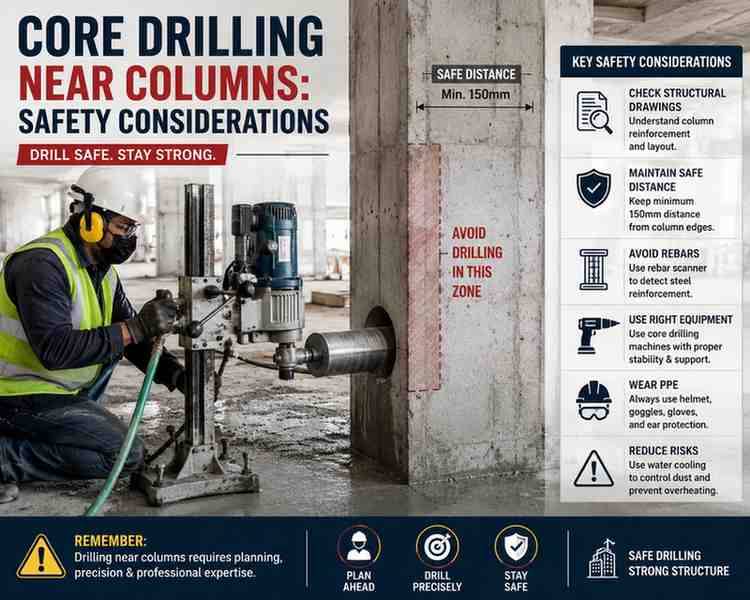
Target-Related Searches: core drilling safety guidelines, core cutting near structural columns, concrete drilling near rebar, core drilling company near me, structural core drilling services, safe drilling practices in RCC structures, core drilling for MEP services, diamond core drilling safety, core drilling permit requirements, drilling near load-bearing elements
People Also Ask:
- Is it safe to core drill near a structural column?
- How close can you drill to a column without weakening it?
- What precautions should be taken before core drilling in RCC buildings?
- Can core drilling damage the structural integrity of a building?
- Who should approve core drilling near columns — a structural engineer or contractor?
- What tools are used for detecting rebar before core drilling?
Introduction
Core drilling is one of the most widely used techniques in modern construction and renovation projects. From creating openings for plumbing, electrical conduits, and HVAC ducts to installing anchors and utility lines, core drilling offers a clean, precise, and efficient method of cutting through concrete, brick, and masonry. However, when this process takes place near structural columns, the stakes rise significantly. Columns are among the most critical load-bearing elements of any building, and even a small mistake during drilling can compromise the structural integrity of the entire structure.
At Core Cutting India ([email protected]), we specialize in precision core drilling and cutting services across residential, commercial, and industrial projects. Over the years, we have seen firsthand how improper drilling near columns can lead to costly damage, safety hazards, and even structural failure. This blog explores the essential safety considerations that every contractor, engineer, and property owner should understand before undertaking core drilling work near columns.
Why Core Drilling Near Columns Requires Special Attention
Columns are vertical structural members designed to transfer loads from beams, slabs, and upper floors down to the foundation. Unlike walls or slabs, which may have some degree of redundancy in load distribution, columns often carry concentrated loads with limited tolerance for reduction in cross-sectional area or reinforcement damage.
When drilling is performed too close to a column, or when reinforcement bars (rebar) within the column are accidentally cut, the load-carrying capacity of that column can be significantly reduced. This is why core drilling near columns is treated as a specialized task requiring careful planning, the right equipment, and adherence to strict safety protocols — not a routine drilling job.
Key Safety Considerations for Core Drilling Near Columns
1. Structural Assessment Before Drilling
Before any drilling begins, a qualified structural engineer should assess the column's design, load capacity, and reinforcement layout. This assessment determines:
- Whether drilling near the column is safe at all
- The minimum safe distance from the column edge
- The maximum permissible hole diameter and depth
- Whether temporary shoring or support is required during drilling
Skipping this step is one of the most common — and most dangerous — mistakes made on construction and renovation sites.
2. Rebar Detection and Scanning
One of the biggest risks in core drilling near columns is accidentally cutting through reinforcement steel. Columns are typically reinforced with vertical main bars and horizontal ties or stirrups, both of which are essential for the column's strength and ductility.
Professional core drilling teams use rebar detection tools such as ground-penetrating radar (GPR) or electromagnetic rebar scanners to map the exact location of reinforcement before drilling. This scanning process helps:
- Identify the position and depth of rebar
- Avoid cutting main structural bars
- Adjust the drilling location if reinforcement is found in the planned path
At Core Cutting India, rebar scanning is a standard part of our pre-drilling process for any work near structural columns.
3. Maintaining Safe Edge Distance
Every column has a "safe zone" — a minimum distance from its edge within which drilling should not occur without engineering approval. Drilling too close to the column face can weaken the concrete cover protecting the reinforcement, leading to corrosion risks and reduced structural capacity over time.
As a general safety principle, drilling near columns should always follow the specific clearance distances recommended by a structural engineer for that particular building and column design, rather than relying on generic industry assumptions.
4. Controlling Drilling Vibration and Impact
Traditional hammer drilling or impact-based methods generate vibration and shock loads that can cause micro-cracking in concrete, especially near stress-concentrated zones like columns. Diamond core drilling, which uses a rotating diamond-tipped bit with water or air cooling, is the preferred method near structural elements because it:
- Produces minimal vibration
- Reduces the risk of micro-cracks
- Provides cleaner, more precise holes
- Minimizes noise and dust compared to conventional drilling
Using low-vibration diamond core drilling equipment is one of the most effective ways to protect column integrity during the drilling process.
5. Load Redistribution and Temporary Support
In cases where drilling might temporarily affect a column's load path — for example, when installing large-diameter openings — temporary shoring or load redistribution systems may be necessary. This typically involves:
- Installing temporary props or jacks to redistribute loads to adjacent structural elements
- Sequencing drilling work during low-load periods (e.g., before additional floors are constructed)
- Coordinating with structural engineers to verify that redistributed loads do not overstress neighboring columns or beams
6. Water Management and Concrete Cooling
Diamond core drilling typically requires water for cooling the drill bit and controlling dust. Near columns, however, water management becomes critical because:
- Excess water infiltration can affect nearby electrical systems or finishes
- Water pooling at the base of columns may accelerate corrosion of exposed rebar over time
- Proper containment and vacuum extraction systems should be used to manage slurry and runoff
Wet drilling methods should always include proper containment measures, especially in occupied buildings or near sensitive structural zones.
7. Dust Control and Site Safety
Even with water-cooled drilling, some dust and debris generation is inevitable, particularly during dry-cutting phases or when preparing the drilling area. Effective dust control measures — such as vacuum extraction systems and physical barriers — help maintain visibility and air quality on site, reducing risks to workers operating near the column.
8. Worker Safety Equipment and Site Protocols
Core drilling near columns often takes place in tight spaces, at height, or within active construction zones. Personal protective equipment (PPE) such as safety goggles, hearing protection, dust masks, and gloves should be mandatory for all personnel involved. Additionally:
- Drilling rigs should be securely anchored to prevent slippage
- Work areas should be cordoned off to prevent unauthorized access
- Electrical cables and water lines should be routed safely away from walkways
9. Compliance with Local Building Codes and Permits
Many municipalities and building authorities require permits or structural sign-offs before any drilling or cutting work is performed near load-bearing elements. Compliance with local building codes not only ensures legal protection but also serves as an additional safety checkpoint, since these codes are often designed around minimum structural safety standards.
10. Post-Drilling Inspection and Documentation
After drilling is complete, it is good practice to conduct a post-drilling inspection to confirm:
- No unintended damage occurred to the column or surrounding structure
- The drilled opening matches the approved design specifications
- Any exposed rebar (if applicable) is properly treated or protected against corrosion
Documenting this process with photographs and inspection reports provides a valuable record for future reference, especially in commercial or industrial buildings where multiple contractors may work on the same structure over time.
Common Mistakes to Avoid
Even experienced teams can make errors when working near columns. Some of the most frequent mistakes include:
- Skipping rebar detection to save time, resulting in accidental cutting of structural bars
- Underestimating load paths, especially in older buildings with unknown or undocumented structural details
- Using oversized drill bits for the intended purpose, unnecessarily increasing the opening size
- Ignoring manufacturer specifications for drilling equipment, leading to overheating or bit failure
- Failing to consult a structural engineer, particularly on renovation projects where original structural drawings may not be available
Avoiding these mistakes starts with proper planning and hiring experienced core drilling professionals who understand the nuances of working near structural elements.
Why Professional Expertise Matters
Core drilling near columns is not a task suited for general contractors without specialized training or equipment. It requires a combination of structural knowledge, precision equipment, and strict adherence to safety protocols. A professional core drilling company brings:
- Access to advanced rebar scanning and detection technology
- Experience working alongside structural engineers on load-sensitive projects
- Proper diamond core drilling equipment suited for vibration-sensitive environments
- A track record of safety compliance across diverse construction environments
At Core Cutting India, our teams are trained to handle drilling projects of varying complexity, from residential renovations to large-scale commercial and industrial developments, always prioritizing structural safety alongside efficient project delivery.
Conclusion
Core drilling near columns is a task that demands careful planning, precise execution, and a strong understanding of structural engineering principles. From rebar detection and safe edge distances to vibration control and load redistribution, every step plays a role in protecting the structural integrity of the building while achieving the desired drilling outcome.
Whether you are a contractor, architect, or property owner planning renovation or MEP installation work, partnering with an experienced core drilling team can make the difference between a safe, successful project and one that risks costly structural damage.
For expert guidance and professional core drilling services near structural columns, reach out to Core Cutting India at [email protected]. Our team is ready to help you plan and execute your project safely, efficiently, and in full compliance with structural safety standards.